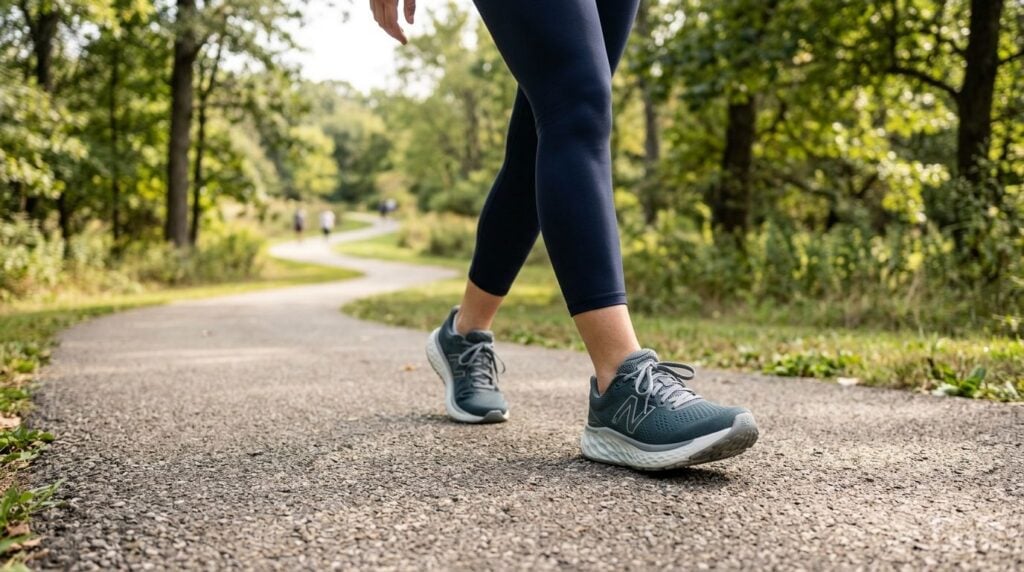
Lower back pain often starts at the feet, not the spine – the wrong shoe changes how load travels up through your knees, hips and lumbar spine with every step. Best overall: New Balance 928v3. Best for cushioning: Hoka Bondi 8. Best for built-in orthotic support: Vionic Walker. Best for overpronation control: Brooks Addiction Walker. Best wide toe box: Altra Torin. Best budget arch support: Skechers Go Walk Arch Fit.
- New Balance 928v3 is the best overall pick for arch support and stability in 2026.
- Hoka Bondi 8 suits people who walk on hard pavement and need maximum cushioning.
- Vionic Walker carries a built-in orthotic footbed, useful if you already use insoles.
- Rocker soles and firm heel counters matter more for back comfort than brand name.
- Shoe choice is one factor among several – posture, core strength and desk setup matter too.
Why this matters
Footwear absorbs a portion of the shock that would otherwise travel straight up your legs into your lower spine with each stride. A worn-out midsole, a shoe with no arch structure, or a rigid flat sole can change your gait pattern enough to load the lumbar spine unevenly over a 2026 daily step count. This isn't a claim that any shoe treats or resolves back pain – it's a mechanical fact about how weight-bearing surfaces distribute force.
People managing high heel wear and back pain already know how much footwear geometry affects posture. Walking shoes work the same way, just with lower stakes and more daily hours in them. If you're also dealing with heel or arch pain, the criteria below overlap heavily with what's covered in shoes for plantar fasciitis relief.
What makes the best shoes for lower back pain
- Arch support structure – a shoe that holds the midfoot rather than collapsing under load
- Heel cushioning depth – enough material to reduce heel-strike impact on hard surfaces
- Stability and motion control – a firm heel counter that limits excess inward or outward roll
- Toe box width – room for natural toe splay, which affects balance and stride
- Rocker sole geometry – a curved sole that reduces the effort of pushing off with each step
- Removable insole – the option to swap in a custom or orthotic insert if one is already prescribed
Best shoes for lower back pain in 2026: at a glance
| Shoe | Best for | Standout feature | Key limitation |
|---|---|---|---|
| New Balance 928v3 | Overall arch support and stability | Firm heel counter with rocker sole | Bulkier profile than running-style shoes |
| Hoka Bondi 8 | Maximum cushioning on pavement | Thick midsole stack | Less ground feel, can feel unstable on uneven terrain |
| Vionic Walker | Built-in orthotic support | Contoured footbed with arch shell | Firm footbed doesn't suit everyone's foot shape |
| Brooks Addiction Walker | Overpronation control | Dual-density support post | Heavier construction, less flexible sole |
| Altra Torin | Wide toe box and natural stride | Foot-shaped last with zero-drop platform | Zero-drop takes an adjustment period |
| Skechers Go Walk Arch Fit | Budget-friendly arch support | Arch Fit insole technology | Less structured than dedicated walking shoes |
1. New Balance 928v3: best overall for arch support and stability
The 928v3 is built as a stability walking shoe with a firm heel counter and a rocker sole designed to reduce push-off effort. It's a reasonable default when you're not sure which specific issue – arch collapse, heel impact, or motion control – is driving your discomfort.
New Balance 928v3 pros:
- Structured arch support suited to flatter or over-pronated feet
- Rocker sole reduces forefoot strain during longer walks
- Removable insole allows a custom orthotic if one has been recommended
New Balance 928v3 cons:
- Bulkier than a running-style sneaker, which some people find less versatile day to day
- Not designed for speed walking or running
New Balance 928v3 pricing: check current pricing and stock directly with the retailer, as this varies by store and season.
Best for: people who want one dependable shoe covering arch support, cushioning and stability at once. Verdict: Buy.
2. Hoka Bondi 8: best for maximum cushioning on hard pavement
The Bondi 8 carries one of the thickest midsoles in a mainstream walking shoe, built to absorb heel-strike impact on concrete and tile. If most of your daily walking happens on hard, flat surfaces – office floors, city footpaths – this is the cushioning-first option.
Hoka Bondi 8 pros:
- Deep midsole cushioning reduces the jolt of each heel strike
- Wide platform gives a stable base despite the tall stack
- Comfortable for extended periods on your feet
Hoka Bondi 8 cons:
- Reduced ground feel can feel unstable on uneven or gravel paths
- Not a motion-control shoe, so it won't correct overpronation
Hoka Bondi 8 pricing: pricing varies by retailer – confirm current cost before buying.
Best for: people walking mostly on hard, flat urban surfaces. Verdict: Buy.
3. Vionic Walker: best for built-in orthotic support
Vionic shoes are built around a contoured footbed with a molded arch shell, marketed specifically as a built-in orthotic alternative rather than a shoe that accepts a separate insert. If you've already been advised to use arch support but don't want to manage a removable insole, this covers that need directly.
Vionic Walker pros:
- Arch shell is integrated into the shoe rather than a swap-in extra
- Reasonable option if you're not using a custom orthotic
- Lace-up structure suits a range of foot widths
Vionic Walker cons:
- The built-in shell can feel too firm for people used to a soft insole
- Doesn't allow swapping in a prescribed custom orthotic as easily as a shoe with a flat removable insole
Vionic Walker pricing: check the retailer for current pricing.
Best for: people who want arch support without managing a separate insert. Verdict: Buy.
4. Brooks Addiction Walker: best for overpronation control
The Addiction Walker uses a dual-density support post under the arch, a motion-control feature aimed at people whose foot rolls inward more than average during walking. This is a narrower use case than general cushioning or arch support.
Brooks Addiction Walker pros:
- Dual-density post specifically targets excess inward roll
- Firm heel counter adds structure through the midfoot
- Durable construction for daily wear
Brooks Addiction Walker cons:
- Heavier and less flexible than most walking shoes on this list
- Overkill if you don't actually overpronate
Brooks Addiction Walker pricing: confirm current pricing with the retailer.
Best for: people with a confirmed overpronation pattern. Verdict: Buy if overpronation is confirmed, Skip otherwise.
5. Altra Torin: best for wide toe box and natural stride
Altra builds its shoes on a foot-shaped last, wider through the toe box than most walking shoes, paired with a zero-drop platform (no height difference between heel and forefoot). This suits people whose current shoes cramp their toes or who want a more natural foot position.
Altra Torin pros:
- Wide toe box allows natural toe splay for balance
- Zero-drop platform keeps the foot level rather than angled forward
- Cushioned midsole despite the flat platform
Altra Torin cons:
- Zero-drop takes an adjustment period, particularly for calf and Achilles tissue
- Less structured arch support than the New Balance or Vionic options above
Altra Torin pricing: pricing varies – check with the retailer.
Best for: people with wide feet or toe crowding in standard shoes. Verdict: Buy, with a gradual break-in period.
6. Skechers Go Walk Arch Fit: best budget-friendly option with arch support
Skechers markets its Arch Fit insole as a contoured support layer built into a lighter, more affordable shoe than the dedicated walking brands above. It's the lightest option on this list and the easiest to find in wide retail distribution.
Skechers Go Walk Arch Fit pros:
- Contoured arch support at a lower price point than specialty walking brands
- Lightweight, easy to wear for extended periods
- Widely available across Australian retailers in 2026
Skechers Go Walk Arch Fit cons:
- Less structured heel counter than the Brooks or New Balance options
- Construction tends to break down faster with heavy daily use
Skechers Go Walk Arch Fit pricing: check the retailer for current cost.
Best for: people wanting arch support without the cost of a specialty walking shoe. Verdict: Buy as an entry-level option.
How this list was ranked
Each shoe was assessed against the six criteria above – arch support structure, heel cushioning, stability, toe box width, rocker sole geometry and insole flexibility – using documented product features rather than clinical trial data. No shoe on this list is claimed to treat, cure or resolve lower back pain; the ranking reflects mechanical design features relevant to comfort and load distribution during walking.
“If your shoes are the only thing changing and your back pain doesn’t shift, the shoe isn’t the whole story.”
Which shoe should you choose?
If you're not sure where to start, the New Balance 928v3 is the safest default for 2026 – it covers arch support, cushioning and stability without requiring you to diagnose your own foot mechanics first. Move to the Hoka Bondi 8 if pavement impact is your main issue, the Vionic Walker if you want built-in orthotic support, or the Brooks Addiction Walker only if overpronation has actually been identified.
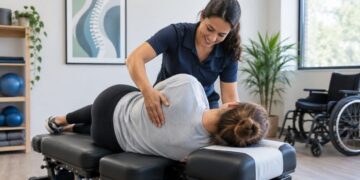
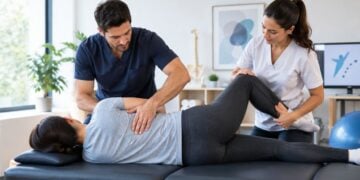
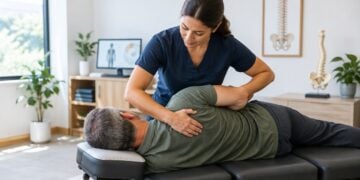
Shoes are one input into how your lower back feels day to day – posture, core strength, sitting habits and sleep position all play a role too. A chiropractor can assess how your gait, posture and spinal alignment interact and discuss whether footwear changes are a reasonable part of a broader plan following an assessment.
Discuss footwear and posture with a chiropractor
An assessment can look at gait, posture and spinal alignment together.
FAQ
What are the best shoes for lower back pain in 2026?
The New Balance 928v3, Hoka Bondi 8, Vionic Walker, Brooks Addiction Walker, Altra Torin and Skechers Go Walk Arch Fit each cover a different need – stability, cushioning, built-in orthotic support, motion control, toe box width and budget, respectively. The right one depends on which mechanical issue is affecting you.
Can the right shoes reduce lower back pain?
Footwear can influence how impact and load travel up through the legs into the lower spine, so shoe choice may be one part of managing discomfort. It isn’t a standalone solution, and a chiropractor or GP can help assess what else may be contributing.
Do walking shoes help with sciatica?
Shoe support may reduce some of the mechanical strain associated with sciatic discomfort during walking, but sciatica has multiple potential causes that need proper assessment. See a health professional if leg pain, numbness or tingling is involved.
Are cushioned shoes or firm shoes better for back pain?
It depends on the surface you walk on and your foot type – cushioned shoes like the Hoka Bondi 8 suit hard pavement, while firmer, structured shoes like the Brooks Addiction Walker suit people who overpronate. There isn’t one answer that fits everyone.
How much arch support do I need for lower back pain?
The amount of arch support that helps varies by foot shape and gait pattern, which is why shoes on this list range from lightly structured to firmly built. A podiatrist or chiropractor assessment can identify whether your arch is collapsing under load.
Should I see a chiropractor about foot and back pain together?
A chiropractor can assess how your posture, gait and spinal alignment interact, which may explain why foot and back symptoms show up together. This is general education, not a diagnosis – book an assessment for anything specific to your situation.
Are barefoot or minimalist shoes bad for lower back pain?
Minimalist shoes remove cushioning and structure, which can increase strain for people who rely on arch support or motion control. They may suit people with a different foot mechanic, but switching requires a gradual transition and, ideally, professional guidance.
How often should I replace walking shoes for back support?
Most walking shoes lose meaningful cushioning and structure well before they look worn out, so relying on visible wear alone can be misleading. If a shoe feels flatter or less supportive than when new, that’s a signal to consider replacing it.
One last thing
The shoe that ranks highest on paper isn't automatically the right one for you – a stability shoe built for overpronation can feel worse than a neutral shoe if you don't actually overpronate. Try shoes on and walk in them for more than a few steps in the store before deciding, and don't assume the most cushioned or most structured option is automatically correct for your gait in 2026.
Related guides
- Chiropractic care for high heel wearers with back pain
- How to know when back pain needs a chiropractor vs a doctor
- Best yoga poses for lower back pain relief
- Chiropractic care for plantar fasciitis and foot pain