Poor posture may contribute to headaches in some people, but posture alone cannot establish the cause of a headache. Neck discomfort, migraine and other headache patterns can overlap, so persistent, changing or unfamiliar headaches need medical assessment rather than an assumption that sitting straighter will resolve them.
- Can poor posture cause headaches? It may contribute, but posture alone cannot establish the cause.
- The International Headache Society distinguishes neck-related headache from migraine and tension-type headache; symptoms can overlap.
- Record headache timing, neck symptoms and associated symptoms before assuming your desk setup explains everything.
- Seek urgent medical help for a sudden severe headache or headache with new neurological symptoms.
Can poor posture cause headaches?
Posture is a possible contributor, not a headache diagnosis. A headache that starts during desk work deserves attention, but the timing does not prove that your sitting position caused it. Screen use, visual demands, sleep, stress and an existing headache disorder can all be relevant to the assessment.
The International Headache Society's International Classification of Headache Disorders distinguishes headaches attributed to a neck disorder from primary headaches such as migraine and tension-type headache. For this 2026 guide, that distinction matters more than whether your shoulders look rounded in a photograph.
| Pattern | Features worth reporting | What the pattern cannot establish |
|---|---|---|
| Headache during desk work | Timing, task, screen use and accompanying neck discomfort | That posture is the sole cause |
| Headache associated with neck movement | Whether particular movements reproduce familiar symptoms | A neck-related diagnosis without assessment |
| Headache with nausea or light sensitivity | Associated symptoms, severity and effect on everyday activity | That the headache is simply muscle tension |
| New or substantially changed headache | How it differs from your usual headache and when it began | That familiar neck stiffness makes it harmless |
These are discussion points, not a self-diagnosis checklist. Healthdirect Australia's headache and migraine information provides general patient guidance; the International Headache Society provides diagnostic criteria for clinicians.
Why this matters
Blaming every headache on posture can send you towards the wrong next step. You might keep replacing chairs or stretching your neck while overlooking a headache pattern that needs a GP's assessment.
Mychiro is a chiropractic clinic and wellness centre in Bondi Junction, Sydney. Information about the clinic is available from Mychiro, but this 2026 headache guide does not establish whether chiropractic care is appropriate for your symptoms.
A posture photograph cannot diagnose the cause of a headache. Your symptom history, associated symptoms and clinical assessment provide information that a photograph cannot.
What does a neck-related headache mean?
A cervicogenic headache is a headache attributed to a disorder involving the neck. The International Headache Society's criteria require evidence supporting that relationship; the presence of neck pain alone is not enough.
A clinician may ask whether neck movement brings on the familiar headache, whether movement is restricted and whether the headache changes alongside an identified neck problem. Those questions help assess a possible connection. They are not instructions to repeatedly provoke your symptoms at home.
The distinction matters because neck discomfort can also occur with migraine. Feeling pain at the base of your skull does not, by itself, tell you which headache category applies.
Avoid interpreting this as evidence that your spine is out of place or that a particular adjustment is necessary. Neither conclusion follows from the location of your pain.
Is a tension-type headache caused by tense posture?
The name tension-type headache does not mean that tense muscles or poor posture explain every episode. The International Headache Society describes a headache pattern with particular features, rather than a diagnosis made by looking at how someone sits.
People commonly describe tension-type headache as pressing or tightening. Migraine more often involves features such as nausea, sensitivity to light or sound, or worsening with usual physical activity, although individual presentations vary.
Use those descriptions to explain your experience, not to choose a diagnosis yourself. A GP can assess recurring headaches and discuss whether further investigation or a headache-specific management plan is appropriate.
Why the posture–headache relationship varies
The useful question in 2026 is not simply whether your posture looks good. It is what happens during your day, how symptoms behave and whether another explanation needs assessment.
- Task duration: Record whether symptoms appear during a sustained task and whether they also occur away from that task. Timing is useful information, not proof of causation.
- Workstation demands: Note whether you repeatedly turn towards a screen, reach for a mouse or look down at documents. Describe the task rather than labelling your whole posture as wrong.
- Headache pattern: Report whether the headache is familiar, new, becoming more frequent or changing in character. A change deserves attention even if your workstation has not changed.
- Associated symptoms: Nausea, light sensitivity, visual changes, fever or neurological symptoms can change the assessment and the urgency of medical care.
- Sleep and daily context: Record disrupted sleep, missed meals, stress and medication use alongside posture-related observations. A diary should leave room for several explanations.
A biopsychosocial approach considers physical symptoms alongside sleep, stress, activity and daily circumstances. It does not mean symptoms are imaginary, and it does not remove the need to assess medical causes.
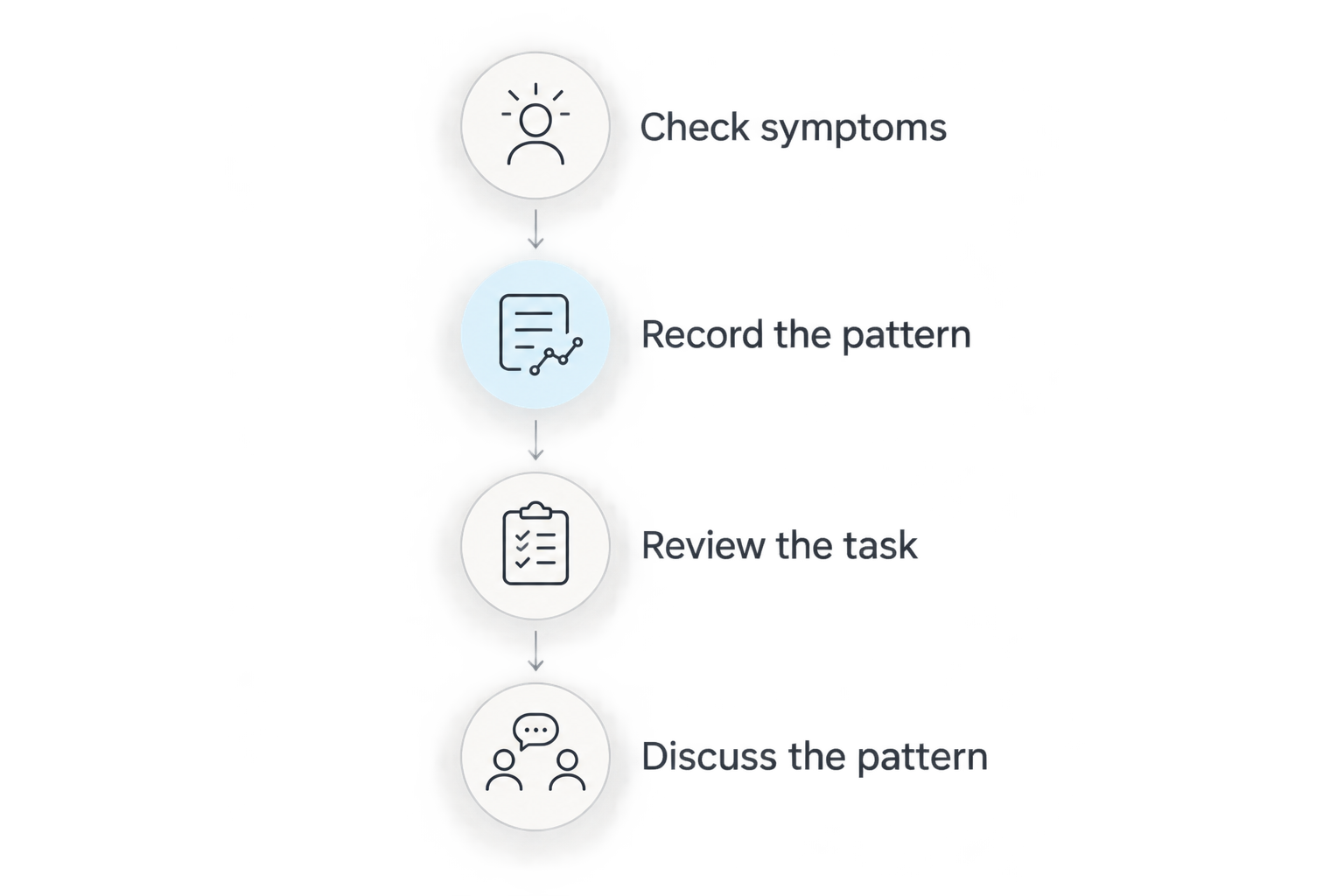
What should you do when a headache starts at your desk?
Check the symptoms before changing the furniture. A familiar mild headache during work and a sudden severe headache require different responses. Do not use an ergonomic checklist to decide whether an unfamiliar headache needs medical attention.
Check symptoms
First, notice whether the headache is sudden, unusually severe or accompanied by concerning symptoms. Follow the urgent-care guidance below if any warning signs apply.
If the headache is recurring, unfamiliar or interfering with daily activities, arrange medical advice. You do not need to prove that posture caused it before discussing it with a GP.
Record the pattern
Write down what you were doing when the headache began, where you felt it and any accompanying symptoms. Include headaches that happen away from your desk so that the record does not favour your first explanation.
You can describe intensity in words or use a 0–10 pain scale, with 0 meaning no pain and 10 meaning the worst pain imaginable. Use the same approach each time; the record supports a conversation rather than making a diagnosis.
Review the task
Check whether you can read the screen without repeatedly leaning forward, use the keyboard without reaching and support your feet comfortably. Adjust the setup to suit the task instead of forcing yourself into a rigid position.
Safe Work Australia provides general workstation guidance. That guidance addresses work setup; it does not establish the cause of an individual headache or promise that equipment changes will resolve it.
Discuss the pattern
Take your observations to a GP if headaches persist, recur or change. Ask whether the pattern needs headache-specific assessment and whether any neck symptoms warrant a separate musculoskeletal assessment.
Should you change your chair, screen or working position?
Start by identifying the problem you want an adjustment to address. Difficulty reading a low screen is a different issue from reaching for a mouse or having no comfortable place to rest your feet.
| Adjustment | Useful purpose | Limitation |
|---|---|---|
| Reposition the screen | Make the display easier to view without repeated leaning or turning | Does not diagnose or guarantee a change in headaches |
| Move frequently used items closer | Reduce unnecessary reaching during the task | Does not address every contributor to neck discomfort |
| Adjust the chair and foot support | Find a supported position suited to your desk | No chair establishes the cause of headache |
| Vary tasks and positions | Avoid making one position the requirement for the whole day | A change in symptoms does not confirm a diagnosis |
You do not need to purchase equipment before checking what your existing setup allows. Make changes you can describe clearly, and record whether they affect comfort or headache timing.
Comfort is a useful observation; it is not proof of treatment. If a headache settles after leaving your desk, tell your clinician, but do not assume that rules out migraine or another cause.
Should you stretch or crack your neck when you have a headache?
Do not force your neck into a stretch or try to produce a cracking sound to diagnose or resolve a headache. A new headache, particularly with unfamiliar neck pain or other symptoms, warrants assessment rather than repeated self-testing.
If a qualified health professional recommends movement or exercise after assessment, ask for instructions matched to your circumstances. Clarify which symptoms mean you should stop and seek advice.
There is no universal stretch sequence or repetition count for every headache. This 2026 guide therefore does not prescribe neck exercises or recommend manipulation for an undiagnosed headache.
When does a headache need urgent medical attention?
Call 000 in Australia for a sudden, extremely severe headache or headache with signs of a medical emergency. Healthdirect Australia's headache guidance identifies sudden severe headache and concerning associated symptoms as reasons for urgent assessment.
Seek emergency help for headache with new weakness, difficulty speaking, confusion, collapse or loss of consciousness. Fever with a stiff neck, sudden loss of vision, or a severe headache after a head injury also needs urgent medical attention.
Do not assume that neck stiffness or time spent at a computer explains these symptoms. A posture change, massage or chiropractic appointment is not a substitute for emergency assessment.
For recurring headaches without emergency features, speak with a GP, particularly if the pattern changes or you increasingly rely on headache medicines. A pharmacist can also advise about medicine use and when medical review is needed.
Where does chiropractic care fit into this discussion?
Mychiro offers chiropractic care and spinal adjustments. That factual description does not establish that an adjustment is appropriate for a headache or that the headache comes from your neck.
If you discuss neck discomfort with a chiropractor, explain the headache history as well as the neck symptoms. Ask about the assessment, alternatives, risks, uncertainty and circumstances requiring referral to a GP.
Choosing not to proceed with a proposed intervention is an option. Any recommendation should follow an individual assessment rather than a posture label, a photograph or a predetermined appointment schedule.
FAQ
Can poor posture cause headaches every day?
Posture alone cannot explain a daily headache pattern. Speak with a GP about frequent headaches rather than assuming your desk setup is the cause.
How do I know whether my headache comes from my neck?
You cannot reliably establish a neck-related headache from pain location or posture alone. A clinician needs to assess the headache history, associated symptoms and evidence of a neck-related cause.
Can migraine cause neck pain as well?
Neck discomfort can occur with migraine. Neck pain therefore does not rule out migraine or prove that posture caused the headache.
Will sitting up straight stop my headaches?
Sitting up straight does not guarantee that headaches will stop. Review comfort and task demands, but seek assessment for recurring, changing or unfamiliar headaches.
Should I buy a posture corrector for headaches?
A posture corrector does not establish the cause of a headache. Discuss recurring headaches with a GP before assuming a device is the appropriate response.
Should I see a chiropractor or a GP for a new headache?
A GP is an appropriate starting point for a new or unexplained headache without emergency features. Sudden severe headache or headache with new neurological symptoms requires urgent medical attention.
What should I write in a headache diary?
Record when the headache starts, its duration, intensity, associated symptoms and medicines used. Include sleep, meals, work tasks and headaches away from your desk so the record does not focus only on posture.
One last thing
For your next headache discussion in 2026, bring observations rather than a posture verdict. Mentioning that headaches also happen on days away from the computer can be just as useful as describing symptoms during work.
Ask what supports the explanation—and what would change it. That question keeps the conversation focused on assessment rather than a single assumed cause.
Related guides
- Waking up with neck pain: common contributors
- Working on the couch with a laptop
- How to prepare for your first chiropractor appointment