


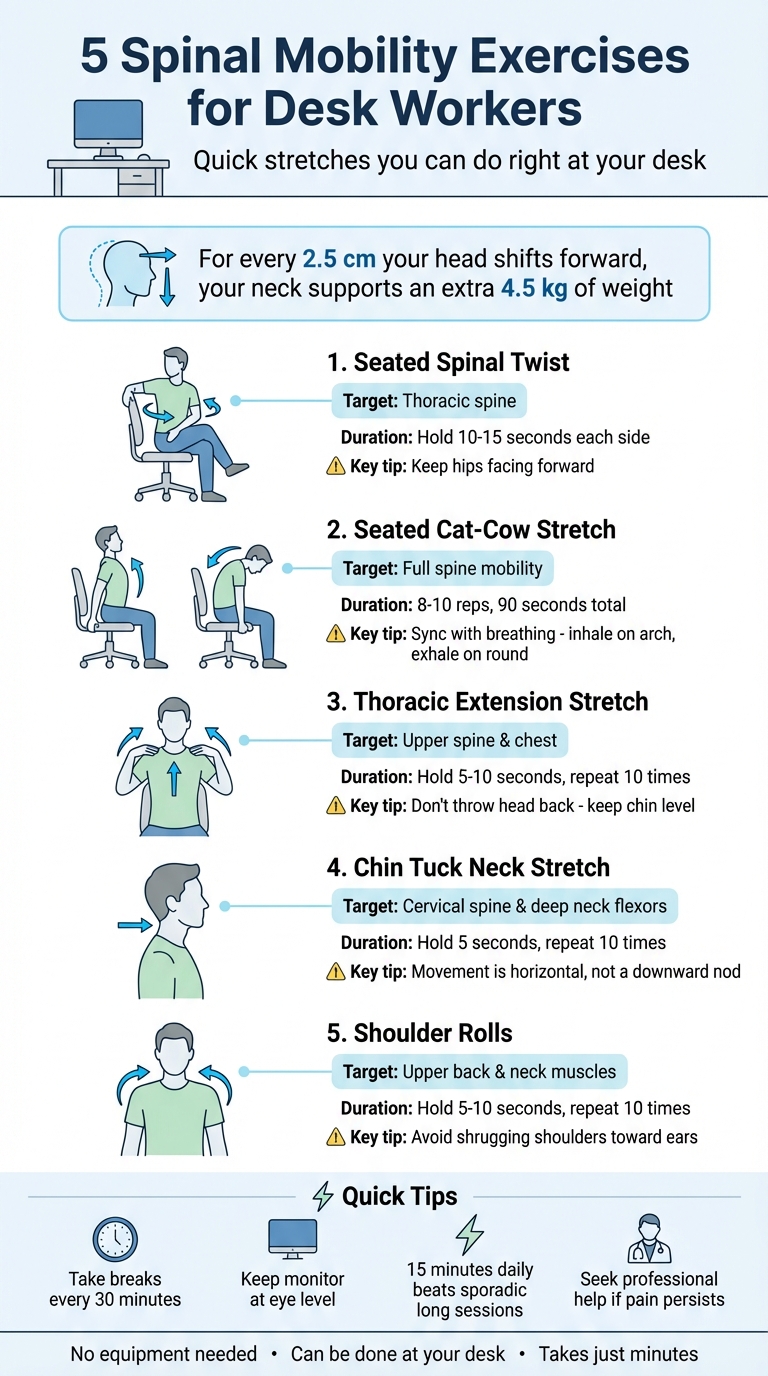
Sitting for long hours at a desk can lead to muscle imbalances, poor posture, and spinal strain. To counteract these effects, here are five simple exercises you can do right at your desk to improve spinal mobility and reduce discomfort:
- Seated Spinal Twist: Gently rotate your upper body to release tension in your thoracic spine.
- Seated Cat-Cow Stretch: Alternate between arching and rounding your back to restore movement and ease stiffness.
- Thoracic Extension Stretch: Open up your chest and loosen your upper spine to address rounded shoulders.
- Chin Tuck Neck Stretch: Relieve neck strain and strengthen deep neck muscles by pulling your chin straight back.
- Shoulder Rolls: Relax your upper back and neck muscles while improving posture.
Tip: Take breaks every 30 minutes and pair these movements with ergonomic desk adjustments, like keeping your monitor at eye level. If discomfort persists, consider seeking professional chiropractic care.
These exercises are quick, require no equipment, and can make a noticeable difference in how your body feels after hours of sitting.
5 Desk-Friendly Spinal Mobility Exercises for Better Posture
Quick 10 Minute Spine Stretch for Desk Workers! Follow Along
sbb-itb-585d67d
1. Seated Spinal Twist
The seated spinal twist is a simple way to ease tension and improve mobility in your thoracic spine, especially after long hours sitting at your desk. By gently rotating, you can help release stiffness and keep your spine more flexible.
Here’s how to do it:
- Sit upright in your office chair with your feet flat on the floor. This stable position ensures the movement stays focused on your spine, not your hips.
- Place one hand on the back of your chair and the other on your opposite thigh. Use these as leverage to guide the twist, but don’t force it.
- Slowly rotate your upper body, keeping your hips facing forward. You should feel a gentle stretch in your spine. For an added stretch, turn your head to look over your shoulder, which also engages your neck.
- Hold the position for 10–15 seconds, then return to the centre. Repeat the twist on the other side.
Doing this exercise every 30 minutes during breaks can help counteract the effects of sitting for long periods and reduce the strain on your spine.
2. Seated Cat-Cow Stretch
The seated cat-cow stretch is a simple yet effective way to get your spine moving and ease stiffness caused by sitting for too long. It’s especially helpful for anyone who spends hours hunched over a desk, as it restores movement to the spine and combats that forward-leaning posture.
Here’s how to do it: Sit on the front edge of your chair with your feet flat on the floor and your hands resting on your knees. Start with the cow position – inhale deeply as you arch your back, lifting your chest and tailbone upward. Next, move into the cat position – exhale as you round your spine, tucking your chin to your chest and pulling your pelvis inward.
"The benefit comes from slow, controlled segmental movement – not speed." – Dr. Jenny Lee, The Spinal Studio
Repeat this motion for 8–10 reps, syncing each movement with a full breath. The whole routine should take about 90 seconds. By moving slowly and deliberately, you not only wake up your spine but also improve blood flow and give your postural muscles a much-needed reset. This helps counteract the muscle imbalances that develop from sitting too long, like tightness in the front and weakness in the back.
3. Thoracic Extension Stretch
The thoracic extension stretch is designed to loosen up your upper spine, which often stiffens after long hours at a desk. This area, known as the thoracic region, can get stuck in a forward-flexed position, leading to rounded shoulders, neck pain, and even tension headaches. This stretch builds on earlier spine mobilisation techniques.
To try this stretch at your desk, sit upright with your feet flat on the ground. Good posture is essential here. Take a deep breath in, lift your chest, and pull your shoulder blades together and downward. You can place your hands on your lower back or interlace your fingers behind you to open up your chest even more. The key is to lift through your upper chest, not your lower back.
Hold the position for 5–10 seconds, then release and repeat about 10 times.
"Make sure you don’t throw your head back as this will strain your neck!" – Zion, Back to Basics Chiropractic
Keep your chin level or slightly tucked to avoid putting unnecessary strain on your neck. Also, resist the temptation to shrug your shoulders; instead, actively pull your shoulder blades downward and together to properly engage your upper back muscles.
This stretch can help ease stiffness by addressing shoulder internal rotation and chest tightness. Plus, it encourages better ribcage movement, which may support deeper, easier breathing.
4. Chin Tuck Neck Stretch
The chin tuck focuses on your cervical spine – the seven neck vertebrae – and can help engage the deep neck flexors while easing tension in the suboccipital muscles located at the base of your skull. This stretch is particularly useful for relieving the neck stiffness that often comes from long hours at the computer.
Studies show that for every 2.5 centimetres your head shifts forward from its neutral position, the strain on your cervical spine increases by about 4.5 kilograms. If your head is 5 to 7.5 centimetres forward – as is common in desk jobs – your neck muscles might be supporting an extra 9 to 13.5 kilograms. This added pressure can lead to discomfort and even musculoskeletal problems over time.
To try the chin tuck while at your desk, sit upright with your feet flat on the floor. Let your arms rest naturally and gently pull your chin straight back. Be careful not to tilt your head; the movement should be horizontal, not a downward nod. Keep your shoulders relaxed and avoid shrugging them upwards.
Hold the position for 5 seconds, then release. Repeat this 10 times. A common mistake is pushing your chin forward or upward instead of pulling it straight back – try to avoid this. For added benefit, you can combine the chin tuck with a thoracic extension stretch by squeezing your shoulder blades together while tucking your chin. This combination can help ease both neck and upper back tension, making it a great addition to your mobility routine.
5. Shoulder Rolls
Shoulder rolls are a simple yet effective way to ease tension in your upper back and neck, especially if you spend long hours at a desk. These movements focus on your thoracic spine (upper back) and the muscles that support your shoulder blades, helping to counteract the hunched posture and inward shoulder rotation that often come with extended keyboard and mouse use.
When you sit for hours, the muscles at the front of your body – like your chest and front shoulders – tend to tighten, while the muscles at the back weaken, making it harder to maintain good posture. Shoulder rolls work to release tension in the upper trapezius and levator scapulae, two muscles that often bear the brunt of stress from a forward head posture.
To try shoulder rolls at your desk:
- Sit upright with your feet flat on the floor and your chin slightly tucked.
- Relax your arms and gently pull your shoulder blades back, as if you’re squeezing a pencil between them.
- Avoid shrugging your shoulders toward your ears.
- Hold this position for 5 to 10 seconds, then relax.
- Repeat 10 times, keeping your breathing slow and steady.
For the best results, take these shoulder breaks every 30 minutes. You can also combine shoulder rolls with other movements. For example, after finishing your rolls, tilt your neck gently toward one shoulder to stretch the upper trapezius further. These small, regular breaks can help ease the pressure that builds up in your spine from sitting for extended periods.
Tips for Adding These Exercises to Your Day
The hardest part about spinal mobility exercises isn’t figuring out which ones to do – it’s remembering to actually do them in the middle of a busy day. The trick? Tie these movements to habits you already have, so they don’t feel like extra tasks requiring extra effort.
One effective method is habit stacking. For example, you could do a seated spinal twist right after your morning coffee or a chin tuck stretch just before opening your laptop. These small, natural triggers make it easier to stay consistent without overloading your mental to-do list. Technology can be a great ally here too. The Australian Chiropractors Association offers the free "Straighten Up Australia" app, which provides guided exercises and reminders to keep you on track. Pairing these quick postural exercises with minor desk adjustments can further improve your spinal mobility throughout the day.
Speaking of desk adjustments, regular postural breaks every 30 minutes can make a big difference. Here’s why: for every 2.5 centimetres your head moves forward from a neutral position, the strain on your cervical spine increases by about 4.5 kilograms. Considering that most desk setups leave your head 5 to 7.5 centimetres forward, your neck muscles are often dealing with far more weight than they should. That’s why frequent, short breaks are more effective than one long stretching session.
To maximise the benefits of these exercises, consider tweaking your workspace. Keep your monitor at eye level and an arm’s length away. If you can, use a sit-stand desk to alternate between sitting and standing. When standing, simple movements like heel raises or gentle hip hinges can help keep your spine active. Even small changes, like parking further away or taking the stairs, can add valuable movement to your routine.
If you’re still experiencing discomfort after incorporating these strategies, it might be time to seek professional advice. Persistent sharp or radiating pain, or morning stiffness lasting over 45 minutes, could indicate deeper musculoskeletal issues. A professional assessment can help identify and address these problems. Chiropractic care can play a role in improving posture, easing tech-neck strain, and managing the compensatory patterns that desk work often creates. For those in Bondi Junction, Dr Steve offers evidence-based chiropractic care with easy online booking, making it simple to fit spinal health into even the busiest schedules.
Conclusion
Sitting at a desk for hours doesn’t have to come with the side effects of stiffness, tension, and discomfort. The five exercises discussed in this article can help address the muscle imbalances that often result from prolonged sitting. Adding regular movement breaks into your day can improve spinal mobility, ease the strain on your neck, and even help maintain your energy levels throughout the day.
Consistency is key. Short, daily sessions – just 15 minutes – can often be more effective for managing posture and discomfort than sporadic, longer workouts.
If you’ve been consistent with these exercises but still find no relief, it may be time to seek professional guidance. Persistent symptoms, such as sharp pain, radiating discomfort, or ongoing stiffness, warrant further evaluation. For those dealing with prolonged discomfort or specific concerns like tech-neck strain, chiropractic care could be an option to explore. Bondi Junction residents can book with Dr Steve, who offers evidence-based care tailored to busy schedules.
These exercises work best when paired with regular posture breaks, ergonomic adjustments, and professional input when needed – because staying active is crucial for managing the physical challenges of desk work.
This content is for informational purposes only and does not replace professional medical advice.
Chiropractic care focuses on musculoskeletal health, and outcomes vary for each individual.
Always consult a qualified healthcare professional before making decisions about your health.
FAQs
How often should I do these desk exercises?
It’s a good idea to include desk exercises in your daily routine to help keep your spine mobile and ease stiffness. Simple movements like neck rotations or stretches can be done in sets of 5 repetitions on each side, or you could dedicate 15 minutes a day to a full routine.
The trick is to be consistent – try to fit these exercises in at least once every hour or several times a day. Pay attention to how your body feels, and don’t hesitate to check in with a healthcare professional if you’re unsure about anything.
What if an exercise causes pain or dizziness?
If you feel pain or dizziness during an exercise, stop right away. This could mean the movement isn’t right for your condition or might be performed incorrectly. Don’t push through it – reach out to a healthcare professional, like a chiropractor, for tailored advice. If the discomfort continues, it’s important to get help to figure out what’s causing it and find safer options to maintain your musculoskeletal health.
Can these exercises help if I already have back or neck pain?
These exercises might help with mobility and ease stiffness, potentially offering relief for those dealing with back or neck pain. However, it’s important to perform them cautiously and consult a healthcare professional to confirm they’re suitable for your specific situation.