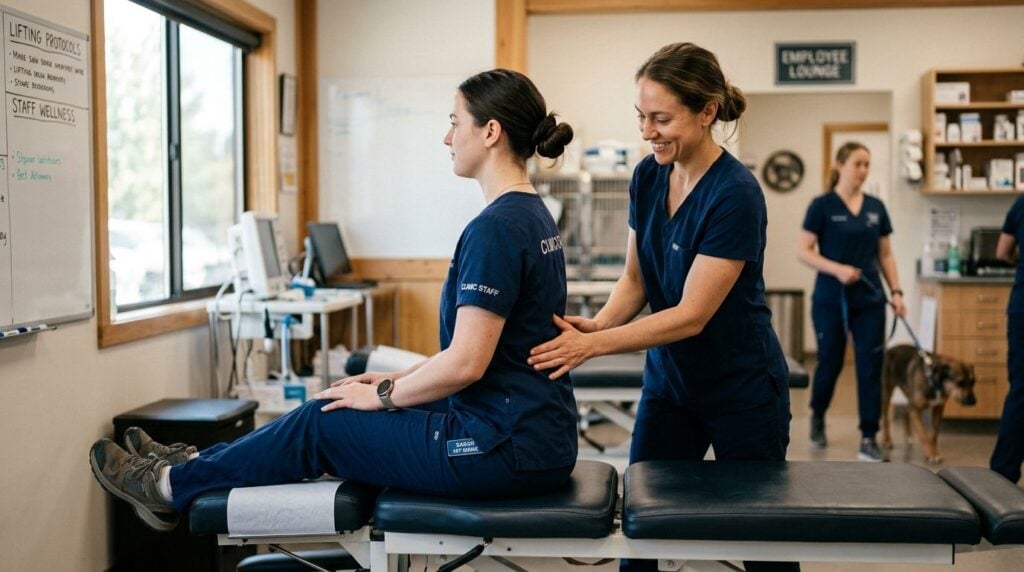
Vet nurses and veterinary support staff lift patients that do not hold still, do not weigh the same twice in a row, and often need restraining mid-lift — which puts a different kind of load through the spine than a standard patient transfer. A chiropractor for vet nurses back pain focuses on assessing how repeated animal lifting, awkward table heights and unpredictable movement patterns affect the neck, mid-back and lower back over a working week, then discussing options for managing that strain with a registered chiropractor.
- Vet nursing involves unpredictable, moving loads that differ from standard patient-handling tasks in general nursing.
- A chiropractor for vet nurses back pain can assess recurring stiffness after lifting and discuss options following assessment.
- Rotating high-load tasks and reviewing lifting technique are free first steps before booking any appointment.
- MyChiro in Bondi Junction offers chiropractic assessments for musculoskeletal strain in Bondi Junction, Sydney.
Why chiropractic care matters for vet nursing staff
General nursing and hospital patient handling usually involve predictable weight, cooperative or sedated patients, and hoists built for human anatomy. Veterinary lifting is different on almost every count. A struggling 25kg dog, a fractious cat that lunges mid-restraint, or a large patient that shifts weight onto a handler during a procedure all create sudden, asymmetric loading through the lower back and shoulders.
Vet nurses also spend long stretches bent over consult tables that are rarely the right height for every patient, then move straight into a lift with no reset in posture. That combination — sustained flexion followed by an unplanned load — is a common pattern behind recurring lower back and neck complaints in veterinary clinics through 2026, and it is different enough from other lifting-heavy jobs that generic manual handling training does not always cover it.
Chiropractic care for nurses and other healthcare workers covers some of the same shift-pattern and repetitive-strain territory. Vet nursing adds the unpredictability of a patient who cannot be instructed to hold still.
Steps for managing lifting-related back strain in vet nursing
Review your lifting mechanics for moving patients
Object-lifting technique — bend the knees, keep the load close — only partially applies when the load is trying to get away from you. Vet nursing staff benefit from technique review that accounts for sudden shifts in weight, not just static mass.
- Reposition your feet before a struggling animal changes direction, rather than twisting through the spine
- Keep the patient as close to your body as the procedure allows
- Use a second handler for any animal over roughly 15-20kg or showing active resistance
- Avoid lifting straight out of a deep squat when a patient lunges; reset your stance first
- Start from the core principles in lifting heavy objects safely and adapt them for movement, not just weight
Set up consult and treatment areas to reduce awkward reaches
A table set at the wrong height forces sustained forward flexion before the lift even starts. Fixing the setup removes load you would otherwise absorb through the lower back all day.
- Adjust table height between patients where the equipment allows it
- Position frequently used equipment within arm's reach to cut unnecessary twisting
- Keep non-slip mats near lifting zones so footing is not a second variable during a struggle
- Flag consistently awkward setups — low tables, tight corridors, blocked walkways — to clinic management as an ergonomics issue rather than a personal one
Build a rotation system for high-load tasks
Clinics that let the same one or two staff members handle every large-animal lift concentrate the strain in the same bodies week after week.
- Rotate large-patient handling across the team within a shift, not just across a week
- Pair less experienced staff with a second handler on unpredictable patients
- Track who has done consecutive high-load lifts and adjust rostering where possible
- Build short recovery gaps into surgery days with heavier patient volume
Strengthen the muscle groups that support spinal load
General strength does not replace lifting technique, but it changes how much a single awkward lift transfers to the spine.
- Work on core and glute strength that supports the lower back during unplanned loading
- Add thoracic mobility work to reduce compensation through the lower back
- Keep shoulder and upper-back strength in the mix, since restraining animals loads this area heavily
- Spread strength sessions across 2-3 days a week rather than one long session
Get a chiropractic assessment when stiffness becomes a pattern
Occasional soreness after a heavy shift is common in physical work. Stiffness that returns most weeks, or is now present at the start of a shift rather than the end, is a different signal worth discussing with a qualified health professional.
- Book an assessment if lower back or neck stiffness now shows up before your shift starts
- Describe specific lifting scenarios — large dogs, resistant patients, low tables — so the assessment reflects your actual workload
- Ask what a chiropractic adjustment may involve following assessment, and what alternatives exist if adjustment is not appropriate for your presentation
- Discuss a plan that combines assessment with the technique and rostering changes above, rather than one in isolation
Know when to escalate beyond musculoskeletal management
Some symptoms sit outside what chiropractic assessment is designed to manage and need medical review instead.
- Numbness, tingling or weakness down an arm or leg
- Loss of bladder or bowel control
- Pain following a specific traumatic incident, such as being knocked or kicked by a large patient
- Fever or unexplained weight loss alongside back pain
- Pain that keeps worsening despite rest and workload changes
If any of these apply, medical assessment comes first. A chiropractor can help you work out when back pain needs a chiropractor vs a doctor as part of that initial conversation.
Comparing options for lifting-related back strain
| Option | Best for | Key limitation |
|---|---|---|
| Lifting technique review | Reducing strain before it accumulates | Needs consistent practice across the whole team; not an answer for existing pain |
| Rostering and team-lift rotation | Clinics where the same staff handle most large-patient lifts | Requires manager buy-in and enough staff to rotate |
| Strength and mobility work | Staff wanting to reduce how much one awkward lift affects them | Takes weeks to build; not an immediate change |
| Chiropractic assessment | Vet nursing staff with recurring stiffness or restriction after lifting | Adjustment is considered following assessment, not a substitute for medical review when red flags are present |
| Mechanical lifting aids | Clinics regularly handling larger or non-ambulatory patients | Not available in every practice; needs space and setup time |
For vet nursing staff whose back or neck stiffness now follows a weekly pattern rather than a one-off, a chiropractic assessment paired with technique and rostering changes is a reasonable next step to discuss with a registered chiropractor.
“If you have to twist through your lower back to keep hold of a moving patient, reset your footing first. The lift can wait a second longer than the twist can.”
Discuss recurring lifting strain
Book a chiropractic assessment at MyChiro in Bondi Junction, Sydney.
Common mistakes vet nursing staff make with lifting strain
- Treating every patient as the same weight class. A 4kg cat that bolts mid-restraint can load the spine as awkwardly as a much heavier, calmer dog.
- Twisting instead of resetting footing. Rotating through the lower back to hold a moving patient is one of the more common patterns behind recurring strain in 2026 clinic workloads.
- Calling for a second handler only on obviously large patients. Mid-sized resistant animals produce plenty of awkward single-handler lifts that never get reported.
- Pushing through stiffness because it comes with the job. Stiffness appearing before a shift, not just after, is worth acting on rather than normalising.
- Skipping recovery after high-volume surgery days. Consecutive heavy-lift days with no gap concentrate strain instead of spreading it.
FAQ
What causes back pain in vet nurses and veterinary staff?
Back pain in vet nursing commonly comes from repeated lifting of moving, unpredictable patients combined with sustained forward flexion over consult and treatment tables. Sudden shifts in weight during restraint add asymmetric load that standard object-lifting technique does not fully account for.
Can chiropractic care help with lifting-related back pain?
A chiropractic assessment can examine joint restriction, movement and posture patterns connected to repeated lifting, and any adjustment is considered following that assessment. It sits alongside technique changes and workload management rather than replacing them.
How many chiropractic appointments do vet nurses usually need?
That depends on how long the stiffness has been present and what the assessment finds, so it is discussed case by case with the treating chiropractor. There is no fixed number that applies to everyone.
Is a chiropractic assessment suitable for vet nursing staff with recurring strain?
A chiropractor can assess whether an adjustment may be appropriate for a given presentation and will refer for medical review where red-flag symptoms are present. Suitability is determined at assessment, not assumed in advance.
What is the difference between physiotherapy and chiropractic care for lifting strain?
Physiotherapy typically centres on rehabilitation exercise programs, while chiropractic care centres on assessment of joint function and adjustment following that assessment. Many people use one, the other, or both depending on what an assessment identifies.
When should a vet nurse see a doctor instead of a chiropractor?
Numbness or tingling down a limb, loss of bladder or bowel control, pain after a direct injury such as a kick, or fever alongside back pain all warrant medical review first. A chiropractor can help identify these signs during an initial conversation.
How can vet nurses reduce back strain from lifting animals?
Rotating high-load lifts across the team, adjusting table heights where possible, and reviewing footing and repositioning technique for moving patients are practical first steps. Strength and mobility work adds a longer-term layer on top of that.
Does private health insurance cover chiropractic visits in Sydney in 2026?
Cover varies by fund and policy level, so checking directly with your insurer is the most reliable way to confirm what applies to your policy in 2026.
One last thing
The detail most vet nursing staff miss is timing, not technique. Stiffness that shows up at the start of a shift, rather than only at the end of a heavy day, is a different signal from ordinary end-of-day fatigue and is worth raising sooner. Waiting for one dramatic lift to cause an injury misses the pattern: most recurring strain in vet nursing builds from a string of ordinary, mid-sized, unpredictable lifts across 2026's busier clinic weeks.
Related guides
- Chiropractic care for tradies and manual labourers
- Chiropractic care for shift workers with back pain
- How to strengthen your core without straining your lower back