
A chiropractor should not be assumed to help numb feet simply because the numbness starts after standing all day. Persistent, recurring or unexplained numbness needs medical assessment; chiropractic care may be appropriate only after assessment identifies a relevant musculoskeletal concern. This 2026 guide explains what to record, when to seek urgent help and what to ask before considering adjustments.
- Can a chiropractor help numb feet from standing all day? Assessment comes before any decision about chiropractic care.
- Mychiro provides chiropractic care in Bondi Junction; unexplained foot numbness needs medical assessment, not an assumed spinal explanation.
- Seek emergency help for numbness with sudden weakness, stroke symptoms, or new bladder or bowel changes.
- Record where numbness occurs, when it starts and whether it changes after you stop standing.
Can a chiropractor help numb feet from standing all day?
The answer depends on the cause, not the number of hours you spend standing. Numbness alone does not establish that a spinal adjustment is appropriate, and a long shift does not establish a diagnosis.
A chiropractor can discuss whether a musculoskeletal assessment falls within their scope. However, that discussion must not replace medical assessment of persistent or unexplained altered sensation. You can read about Mychiro's chiropractic services without treating the service description as a recommendation for your symptoms.
Use this sequence before deciding on care:
- Check for urgent changes. Sudden weakness, stroke symptoms or new bladder or bowel changes require urgent medical attention.
- Arrange medical assessment for unexplained numbness. Tell your GP whether symptoms persist, recur or are spreading.
- Discuss the findings. Ask what explanations need consideration and whether further examination or referral is appropriate.
- Consider care only after assessment. Any proposed chiropractic care should have a clear reason, limitations, risks and a review point.
These steps are a decision framework, not a diagnosis or an instruction to book chiropractic appointments.
Why this matters
Foot numbness is different from ordinary tiredness after work. Describing both as “sore feet” can leave out the detail a health professional needs: whether you have reduced feeling, tingling, burning, pain or weakness.
Healthdirect Australia's information on numbness and tingling describes several possible causes and advises medical assessment where symptoms are unexplained or accompanied by concerning changes. NHS information on peripheral neuropathy also distinguishes altered sensation from weakness and balance difficulties. Neither source supports assuming that standing-related numbness requires spinal manipulation.
For decisions about care in 2026, keep the distinction clear: a symptom appearing during work is an observation, not proof that work posture or spinal alignment caused it. You do not need to identify the cause yourself before asking for assessment.
When does foot numbness need urgent medical attention?
Seek emergency assistance if numbness appears with sudden facial drooping, arm weakness or difficulty speaking. In Australia, call 000 for a medical emergency rather than arranging a routine chiropractic appointment.
New numbness around the groin or saddle area, particularly with new difficulty passing urine, loss of bladder or bowel control, or leg weakness, also needs emergency medical assessment. A suddenly cold, pale and painful foot warrants emergency assessment rather than massage or manipulation.
Other changes need prompt medical advice, including:
- Numbness that is worsening or spreading.
- New weakness, foot dragging or difficulty walking.
- Reduced sensation with a foot wound, particularly if you have diabetes.
- Symptoms following an injury.
- Numbness that continues after you change position or stop the activity.
This is not an exhaustive checklist. If you are unsure how urgently you need care, contact a medical service for triage. Do not use the absence of pain as reassurance that reduced sensation needs no attention.
Who should you speak to first?
A GP is an appropriate starting point for recurring or unexplained foot numbness. Different practitioners have different roles; choosing one does not establish the diagnosis or rule out the need for another.
| Assessment option | Appropriate starting context | What to discuss | Important limitation |
|---|---|---|---|
| Emergency department | Sudden or serious warning signs | Onset, associated weakness and other urgent changes | Not a substitute for planned follow-up after an emergency assessment |
| GP | Persistent, recurring or unexplained numbness | Medical history, medicines, examination and possible investigations | Further appointments or referral may be needed |
| Podiatrist | Questions about footwear, local foot pressure or foot health | Shoe fit, skin condition and foot function | Footwear assessment does not rule out broader medical causes |
| Chiropractor | A musculoskeletal concern considered appropriate following assessment | Examination findings, proposed care, alternatives and referral needs | Chiropractic care is not a general treatment for unexplained numbness |
Mychiro is a chiropractic clinic in Bondi Junction for people seeking chiropractic assessment; unexplained foot numbness requires medical assessment first. Its location or service offering does not establish whether chiropractic care is appropriate for an individual symptom.
Why numb feet after standing varies
The description “numb feet after work” covers different experiences. The following details help a clinician understand your presentation, but none can diagnose the cause on its own.
- Location: Specify whether the change affects your toes, sole, heel, the top of your foot or a wider area.
- Distribution: Explain whether it affects one foot or both, and whether the pattern is similar on each side.
- Timing: Record whether it starts during standing, during walking, after work or at rest.
- Persistence: Describe whether normal sensation returns completely, partly or not at all after changing position.
- Associated changes: Mention back pain, leg pain, weakness, balance changes, swelling, skin changes or wounds.
- Health and work context: Include relevant medical conditions, medicines, footwear and tasks performed before symptoms begin.
Avoid using these observations to label yourself with a trapped nerve, sciatica or poor circulation. Those explanations require clinical assessment; an online checklist cannot distinguish them reliably.
Does numbness mean there is nerve pressure in my back?
Numbness does not prove there is nerve pressure in your back. A clinician needs to consider the symptom pattern, your history and examination findings before discussing a possible explanation.
Back pain occurring at the same time is relevant information, not confirmation of a spinal cause. Likewise, having no back pain does not remove the need to assess persistent altered sensation.
Is it less concerning if numbness goes away when I sit down?
Numbness that changes when you sit down still deserves assessment if it recurs. The change is useful information to report, but it does not establish why the symptom happens.
Tell the clinician whether sensation returns fully and whether the pattern is changing. Do not deliberately stand until your foot becomes numb to reproduce the symptom for an appointment.
Should I book adjustments before seeing my GP?
Recurring or unexplained numbness should be medically assessed before you assume adjustments are appropriate. If you are already receiving chiropractic care, report the numbness and ask whether medical assessment or referral is needed before continuing.
You can decline a procedure or request more explanation. An assessment is not an obligation to proceed with a course of care.
Prepare your symptom notes in 2026
A short written account is easier to use than trying to remember every detail during an appointment. Record what you notice during your usual routine without provoking symptoms or delaying medical advice to collect more information.
Symptom location
Mark the affected area on a simple drawing of your feet. Describe reduced feeling separately from pins and needles, burning or pain, because those words communicate different experiences.
If you notice a change in both feet, record each side separately. Avoid testing sensation with pins, sharp objects or hot surfaces.
Work pattern
Write down the task you were doing when symptoms began: standing at a counter, walking between stations or remaining in one position. Include the footwear you wore and whether anything pressed against your feet or legs.
You do not need a minute-by-minute diary. A clear account of the usual pattern is the aim, not an experiment to find your maximum standing tolerance.
Associated changes
Note any weakness, stumbling, back or leg pain, swelling, wounds or changes in skin appearance. Bring a medicine list and relevant medical history to the appointment rather than deciding which details are connected yourself.
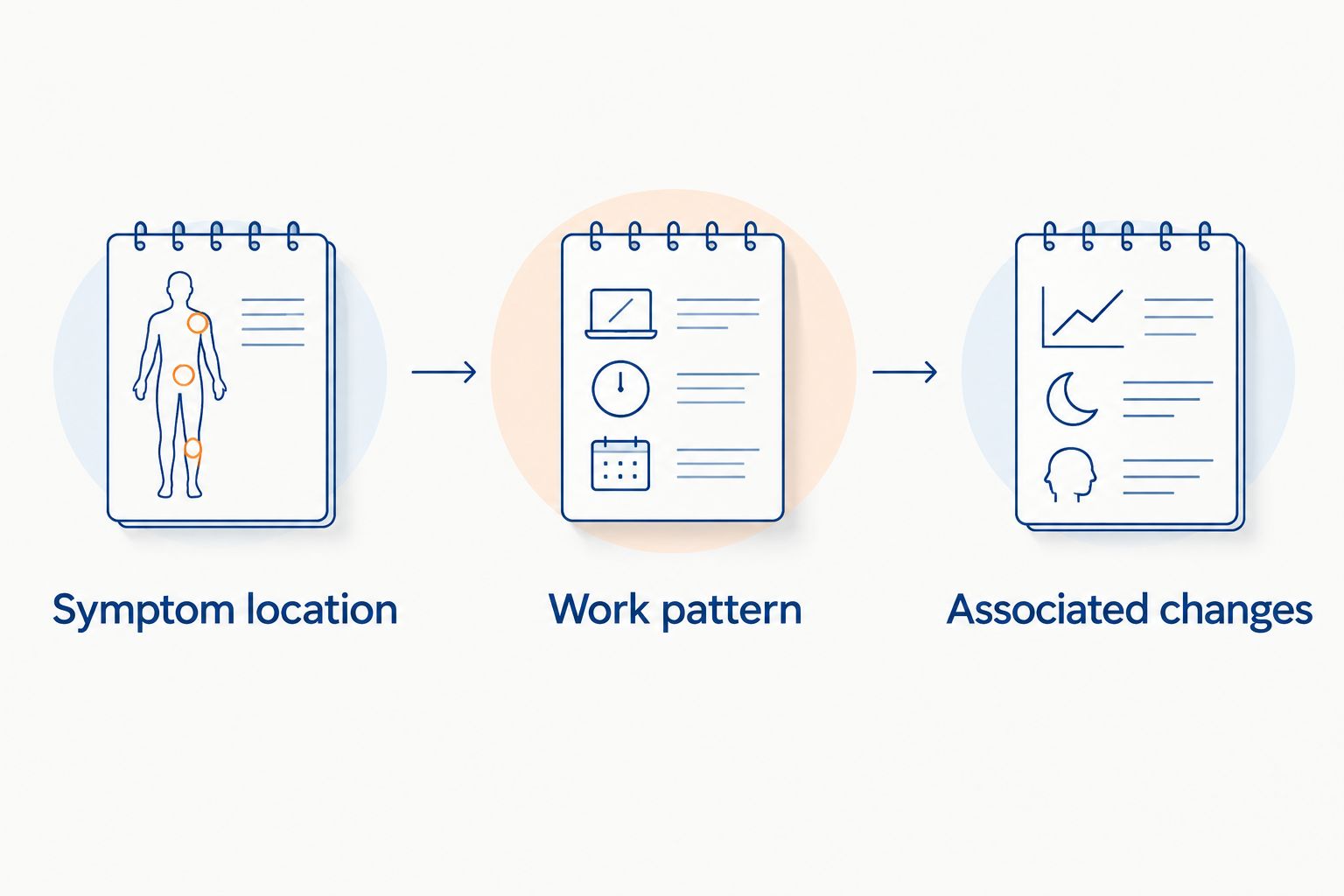
These notes support a conversation; they cannot confirm that you need imaging, adjustments, exercises or another intervention. Leave those decisions until the relevant assessment has taken place.
What should you ask before considering chiropractic care?
If chiropractic care is discussed after assessment, ask for the reason in plain language. “Your feet go numb because you stand all day” is not enough detail to explain a proposed procedure.
Useful questions include:
- What findings support the proposed musculoskeletal explanation?
- What other explanations need medical assessment?
- What is the purpose of the proposed care?
- What are the material risks, limitations and alternatives?
- What change would prompt referral or stopping care?
- When will the plan be reviewed?
Information about spinal decompression for herniated discs concerns a specific proposed intervention and diagnostic context; it does not establish that standing-related foot numbness comes from a herniated disc or that decompression is appropriate for you. Ask the assessing clinician to explain that distinction before discussing any procedure.
Do not commit to a predetermined course of adjustments solely because your feet become numb at work. A proposed plan needs an individual clinical reason and a way to reconsider it if symptoms change or the explanation remains uncertain.
What can you discuss about your work setup in 2026?
Workplace changes belong alongside assessment, not in place of it. You can describe prolonged standing, limited opportunities to change tasks and footwear requirements to your clinician and workplace supervisor.
Ask whether your duties allow changes between sitting, standing and walking. If protective footwear is mandatory, discuss fit concerns through the appropriate workplace process rather than replacing it with unsuitable shoes.
Do not assume an anti-fatigue mat, insole, compression sock or massage device addresses the cause of numbness. Products advertised for comfort are not diagnostic tools, and a change in symptoms after using one does not confirm an explanation.
Avoid aggressive stretching, forceful self-manipulation or deep pressure over a numb area while the cause remains unclear. Ask a qualified health professional what activity is appropriate for your circumstances, particularly if sensation, balance or walking has changed.
How should you review the next step in 2026?
Before leaving an appointment, make sure you understand the next action. That might be medical follow-up, further assessment, referral or a discussion about care for an identified musculoskeletal concern.
Ask what you should do if the numbness returns or worsens. A plan should distinguish routine review from symptoms that require prompt or emergency medical attention.
If different practitioners are involved, tell each one about the others and any proposed procedures. Mychiro's chiropractic services should not be presented as a substitute for medical investigation of unexplained altered sensation.
FAQ
Can a chiropractor help numb feet from standing all day?
Chiropractic care should not be assumed appropriate for numb feet after standing. Persistent, recurring or unexplained numbness needs medical assessment before considering whether a musculoskeletal approach has a role.
Should I see a GP or a chiropractor for numb feet?
A GP is an appropriate starting point for recurring or unexplained foot numbness. Emergency warning signs require urgent medical attention rather than a routine appointment with either practitioner.
Can standing all day prove that my numb feet are caused by posture?
Standing all day does not prove that posture caused your numb feet. The timing is useful information for an assessment, but it does not identify the cause.
Do numb feet mean I have a slipped disc?
Numb feet do not establish that you have a disc problem. A clinician needs to consider your history, symptom pattern and examination findings before discussing that explanation.
Should I stretch my feet when they feel numb?
Do not use forceful stretching as a substitute for assessment of unexplained numbness. Ask a qualified health professional which activities are appropriate, especially if you also have weakness or balance changes.
When should I call an ambulance for numbness?
Call 000 for numbness accompanied by stroke symptoms such as sudden facial drooping, arm weakness or difficulty speaking. New saddle-area numbness with bladder or bowel changes also requires emergency medical assessment.
Do I need an X-ray before discussing foot numbness?
You should not assume an X-ray is needed before assessment. A clinician should explain whether any investigation is indicated and what question it would address.
One last thing
Tell the clinician that your foot feels numb, even if it does not hurt. Asking only about aching feet can leave reduced sensation out of the conversation.
The practical recommendation for 2026 is to bring a clear symptom description and seek an explanation before choosing a procedure. This article provides general education, not an individual diagnosis or recommendation for chiropractic care.
Related guides
- How to prepare for your first chiropractor appointment
- What qualifications should a Sydney chiropractor have?
- How chiropractors coordinate with GPs on imaging referrals