

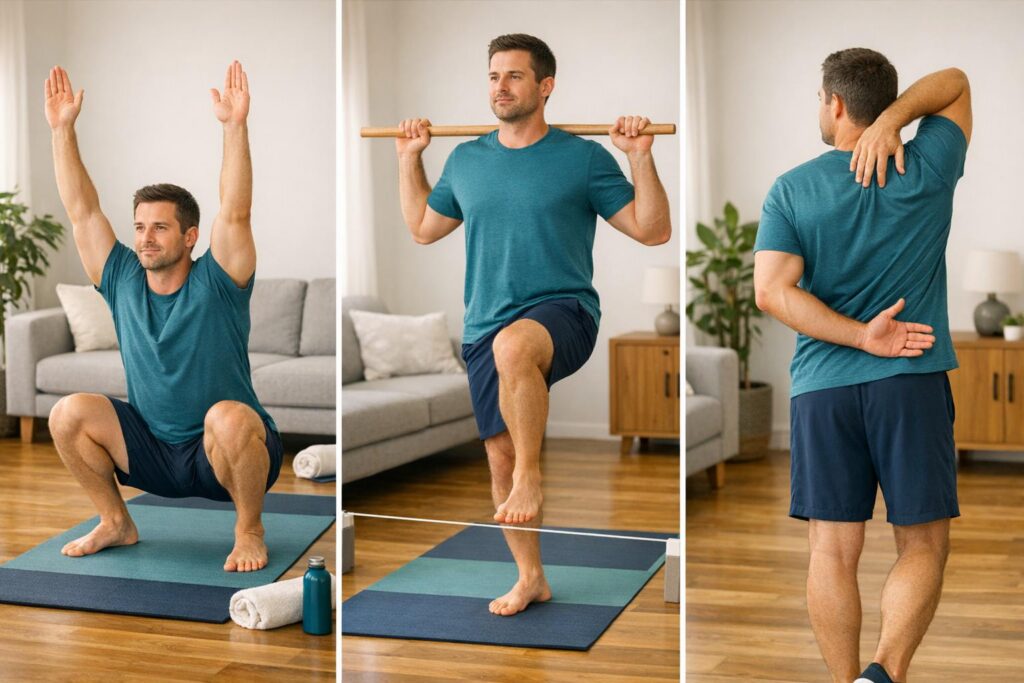
Everyday aches like back pain or stiff joints are often linked to how you move. Functional movement tests help identify issues like poor mobility or muscle imbalances before they lead to chronic pain. These tests focus on basic patterns – squatting, bending, or reaching – to spot weaknesses and compensations in your body.
Here are three key tests you can try:
- Deep Squat Test: Checks ankle flexibility, hip mobility, and core stability. Difficulty maintaining balance or alignment may indicate restrictions.
- Hurdle Step Test: Assesses single-leg stability and coordination. Misalignments here could point to knee or hip pain risks.
- Shoulder Mobility Test: Highlights shoulder and thoracic restrictions that often cause neck or upper back tension.
If these tests reveal limitations, targeted exercises can help improve movement quality and reduce pain. For more persistent issues or sharp pain, consider a professional assessment – usually around $200 for a 60-minute session. Addressing movement problems early is key to staying pain-free and active.
Functional Movement Screen (FMS) with Dr. Johnny

Main Functional Movement Tests for Everyday Aches

Three Essential Functional Movement Tests for Identifying Pain Causes
Functional movement tests are a great way to pinpoint areas where your mobility or stability might need some work. By identifying these limitations, you can target specific movement patterns with corrective exercises to help ease aches and prevent compensatory pain. Let’s look at three key tests that assess different aspects of movement.
Deep Squat Test
The Deep Squat Test is all about evaluating how well your body moves during a basic squat. It checks your ankle flexibility, hip mobility, and core stability, while also looking at how aligned your knees and thoracic spine are. Squat mechanics are crucial for everyday actions like lifting objects or simply getting up from a chair.
Here’s how to do it: Stand with your feet shoulder-width apart, then lower yourself into a full squat. Keep your heels flat on the ground and your torso upright. Struggling to maintain this position? If your heels lift, your knees collapse inward, or your torso tilts forward too much, you might have restrictions in your ankles, hips, or thoracic spine. These issues can often lead to lower back discomfort, especially during lifting tasks.
Once you’ve tackled the squat, move on to the Hurdle Step Test, which takes a closer look at single-leg stability and coordination.
Hurdle Step Test
The Hurdle Step Test is designed to assess how well your hips move, how stable your legs are, and how coordinated your lower limbs are. This is a key movement for daily activities like climbing stairs, stepping over obstacles, or walking on uneven ground. Research even shows that people who score below 14 on the Functional Movement Screen (which includes this test) are almost three times more likely to get injured.
To try a simplified version at home, stretch a piece of tape across a door frame at knee height. Stand with your toes under the tape, holding a broomstick across your shoulders. Lift one leg over the tape, tap your heel on the ground, and return. A successful attempt means your hip, knee, and ankle stay aligned, your spine remains stable, and the pole doesn’t wobble. If you notice imbalances, they could be contributing to knee or hip pain.
After this, you can shift your focus to your upper body with the Shoulder Mobility Test.
Shoulder Mobility Test
The Shoulder Mobility Test highlights any restrictions in your shoulders and thoracic spine. These limitations often show up as neck tension, upper back pain, or even headaches – issues that are especially common for people with desk jobs or rounded shoulders.
"If an individual is unable to move a joint freely through its full range of motion, they are unbalanced, unable to reach their full physiology, as well as putting themselves at risk to various health complications as they age as well as pain." – Australian Chiropractors Association (ACA)
To perform this test, stand with your feet hip-width apart and raise both arms straight overhead. Pay attention to any tightness, discomfort, or difficulty fully extending your arms. If you notice restrictions, exercises that improve thoracic rotation – like kneeling rotations where you twist your elbow through your body and back – can help. Working on these areas can improve posture and ease strain on your neck and upper back.
Using Functional Movement Test Results
Functional movement tests aren’t just about identifying where things hurt – they’re about uncovering why your body is compensating in the first place. By focusing on correcting these underlying issues, you can address the root causes of movement dysfunction, rather than just managing the symptoms.
Addressing Root Causes, Not Symptoms
These tests are designed to pinpoint compensatory patterns that can lead to joint stress and discomfort. For example, knee pain often stems from problems higher up the chain, like limited hip mobility or weak hip stability. If your hips aren’t functioning properly, your knees may take on extra stress to compensate, eventually causing pain. Tests like the deep squat, hurdle step, and shoulder mobility assessments are great tools for identifying these hidden imbalances.
Another key insight from these tests is spotting asymmetries between the left and right sides of your body. Such imbalances can create uneven joint wear and heighten the risk of injury. They also help distinguish whether your issue is due to restricted mobility (tightness) or poor stability (weakness). This distinction is crucial – it determines whether stretching or strengthening exercises will be more effective. By addressing these limitations early, you can reduce the risk of chronic pain or sudden injuries.
These findings lay the groundwork for corrective exercises tailored to your specific needs.
Tailored Corrective Exercises
Once you’ve identified your movement limitations, it’s time to work on them using specific exercises. For example, if the active straight leg raise test highlights tight hamstrings, a simple yet effective exercise is lying on your back with one knee bent at 90 degrees while slowly extending the opposite leg 10–15 times. If the hurdle step test is challenging, start with single-leg stance exercises using light support, gradually progressing to unassisted balance work as your hip stability improves.
For issues like thoracic spine stiffness revealed by the shoulder mobility test, kneeling thoracic rotations can be a game-changer. Begin on all fours, thread one elbow under your body, then rotate upward. Aim for 10–15 repetitions on each side, focusing on controlled, precise movements to enhance mid-back mobility. Remember, it’s not about doing more – it’s about doing it right. Five perfect repetitions will benefit your body far more than twenty rushed ones.
"The key is moving well, not just moving more." – Dr. Scott McEvoy, Chiropractor, Five Dock Osteopathic & Chiropractic Centre
If you’re unsure where to start or want expert advice, consider a functional movement screening consultation. Typically priced around $200 for a 60-minute session, these evaluations include a personalised program that combines manual therapy with targeted rehabilitation exercises tailored to your activity level and goals.
sbb-itb-585d67d
When to Seek Professional Help
If your self-assessment and corrective exercises aren’t giving you much relief, it might be time to consult a professional. Experiencing sudden or sharp pain during a movement test – or even during everyday activities like bending, lifting, or reaching – is a clear sign to stop and seek a professional assessment. Pain is your body’s way of telling you that something might not be moving as it should.
Who Can Benefit from Functional Movement Tests
Professional movement screenings go beyond what you can do on your own, helping to uncover movement issues that might otherwise go unnoticed. For example:
- Office workers dealing with repetitive strain or posture-related problems, such as tension headaches or stiffness that doesn’t ease with basic stretches, could gain a lot from these screenings.
- Active individuals, whether you’re chasing kids around or sticking to a regular fitness routine, can use these tests to spot compensation patterns from past injuries or subtle imbalances that might lead to bigger problems down the track.
Research shows that about 68% of adults aged 30 to 60 experience movement limitations that affect their daily lives. Additionally, around 10% of Australians report chronic pain that interferes with their daily activities. If you’re not seeing improvement after a week of self-directed corrections, seeking professional help could make a big difference. Including a movement screening in your healthcare routine once or twice a year can help you stay ahead of potential issues.
What to Expect from a Professional Assessment
A professional assessment builds on the results of your self-tests and any corrective exercises you’ve tried. Typically lasting around 60 minutes and costing about $200 at clinics like Invigor Health, the session will involve a practitioner guiding you through a series of basic movement patterns. These tests evaluate your flexibility, strength, coordination, and neuromuscular control. They’ll also look for any imbalances between your left and right sides, assess whether your issues are due to limited mobility or poor stability, and identify compensation patterns that could be causing pain elsewhere in your body.
The outcome? A personalised plan tailored to your specific needs. This isn’t about generic exercises – it’s about targeted strategies that suit your activity level and goals. Your plan might include manual therapy along with rehab exercises designed just for you. If you’re near Bondi Junction and need gentle care focused on nervous-system health, movement dysfunction, and posture, a chiropractic assessment could support your mobility and overall musculoskeletal health.
Conclusion
Functional movement tests are a helpful way to uncover the root causes of those everyday aches and pains before they escalate into more serious problems. Rather than just addressing symptoms, these tests pinpoint imbalances and restrictions that could be causing discomfort. Studies consistently highlight how early detection can play a key role in preventing injuries.
"Prevention trumps cure, every time." – Invigor Health
You can perform many of these tests at home for a quick baseline check. But if you’re feeling pain during movement, not seeing improvement after a week of corrective exercises, or noticing your movement patterns getting worse, it’s worth seeking a professional assessment. A tailored approach can help address specific issues and potentially stop a chain reaction of problems down the line. This makes regular screenings and targeted interventions an important part of staying healthy.
Incorporating these assessments into your routine can improve your day-to-day comfort and help you maintain mobility. Whether you’re dealing with tension from long hours at a desk, trying to stay active, or aiming to move pain-free as you age, understanding your body’s movement is a crucial first step. Scheduling regular checks – once or twice a year – can help you catch potential problems early and keep you moving confidently through life.
This content is for general informational purposes and doesn’t replace professional medical advice. Chiropractic care focuses on musculoskeletal health, and results may vary. Always consult a qualified healthcare professional before making health decisions.
FAQs
How often should I repeat these movement tests?
The frequency of movement tests varies based on personal goals and requirements. Typically, self-assessments – like mobility or movement pattern tests – can be performed on a monthly basis or according to the guidance of a qualified healthcare professional. These regular evaluations are a useful way to track progress and spot any shifts in mobility or functional ability over time.
How can I tell if it’s a mobility issue or a stability issue?
Mobility challenges occur when movement becomes restricted, such as struggling to move a joint through its full range – think of limited neck flexion or reduced hip rotation. On the other hand, stability issues are about maintaining control and alignment during movement, often noticeable in balance or coordination difficulties. Performing specific movement tests can help pinpoint whether the problem lies with mobility or stability. If you’re uncertain, seeking advice from a healthcare professional, like a physiotherapist or chiropractor, can offer valuable guidance.
When should I stop testing and see a chiropractor?
If your pain doesn’t ease, gets worse, or if movement tests reveal patterns that hint at potential dysfunction, it might be time to consult a chiropractor. These functional movement tests can uncover hidden issues, but when symptoms persist or mobility is restricted, a professional assessment could be necessary to aid recovery and help restore proper movement.