
Stress can affect sleep, concentration and muscle tension. If back or neck discomfort is adding to the pressure, an assessment can help you understand your options. Research does not establish chiropractic adjustments as a treatment for psychological stress or a way to reset the autonomic nervous system. Here is how to interpret the evidence and choose useful support.
Key takeaways:
- Stress can be accompanied by muscle tension, but posture or tightness alone does not identify its cause.
- Changes in cortisol or heart rate variability do not, by themselves, prove a stress-management benefit.
- Chiropractic care may be considered for selected muscle or joint complaints after assessment.
- Care for persistent stress may involve your GP or a qualified mental health professional.
Start with what is affecting daily life: discomfort, poor sleep, worry or a combination. A suitable plan should address those concerns and include a way to review progress.
How Stress Impacts the Nervous System and Physical Health
The Nervous System’s Response to Stress
The stress response involves changes in the nervous and hormonal systems. It can help us respond to a challenge, but ongoing stress may affect wellbeing. Symptoms alone cannot establish that the autonomic nervous system is out of balance or that spinal treatment is needed.
Stress can be accompanied by neck, shoulder or back tension. That tension does not establish vertebral subluxations, disrupted brain-body communication or a need for regular adjustments. Persistent, new or worsening symptoms deserve an appropriate assessment.
Physical Symptoms That Can Accompany Stress
You may notice a change in how you sit or move when you feel tense. A postural change is not a diagnostic test for stress or spinal damage. Comfortable support, position changes and manageable activity may be useful, depending on your symptoms.
Discomfort can have several contributors. Its location or timing cannot confirm that stress has restricted circulation, and a general article cannot distinguish stress-related symptoms from another condition.
When discomfort and stress occur together, consider practical factors such as movement demands, sleep and daily habits, and emotional pressures. These can inform an assessment without assuming that each factor causes spinal misalignment.
sbb-itb-585d67d
Current Research on Chiropractic Care and Stress
What Autonomic Research Can Tell Us
When considering chiropractic care in Bondi Junction, distinguish care for a muscle or joint complaint from a claim to regulate stress. Research into autonomic responses does not establish that adjustments repair nerve communication or treat psychological stress.
A systematic review published in 2024 included 14 trials with 618 participants. Overall, it found low-quality evidence that spinal manipulation did not change autonomic measures compared with control or sham procedures. An isolated finding for one heart-rate-variability measure after cervical manipulation requires caution.
A trial published online in 2024 recruited 95 healthy young adults and compared seated cervical manipulation with a sham procedure. Measures of heart rate variability (HRV) and norepinephrine did not demonstrate a short-term autonomic effect from manipulation compared with sham. This does not establish a treatment for ongoing stress.
Why a Measured Change Is Not a Treatment Benefit
A research measurement and a meaningful improvement in daily life are different outcomes. A study needs to show that any change is reliable, relevant to patients and attributable to the treatment being tested.
A change in cortisol levels cannot by itself show that a treatment helps someone manage stress. Cortisol has normal daily variation, and research methods and comparison groups matter. These measurements should not be presented as proof that adjustments reduce stress hormones.
Claims that adjustments balance serotonin or dopamine, improve blood flow to the brain, increase mental clarity or build stress resilience go beyond established clinical evidence. Benefits for a selected musculoskeletal complaint should be discussed separately.
Two examples illustrate why the evidence needs careful interpretation:
| Evidence | What Was Examined | What It Means |
|---|---|---|
| 2024 systematic review | 14 trials; autonomic measures | No overall effect versus control or sham; low-quality evidence and an isolated HRV finding require caution. |
| Trial published online in 2024 | Seated cervical manipulation versus sham | No demonstrated short-term autonomic effect in the measured HRV and norepinephrine outcomes. |
| Clinical interpretation | Stress and everyday wellbeing | These findings do not establish adjustments as a treatment for psychological stress. |
Small samples, variable methods and short follow-up limit interpretation. A promising mechanism is not enough to recommend treatment: evidence should show a meaningful benefit for the relevant condition, alongside risks and alternatives.
Video: Chiropractic Research Discussion
Choosing Support for Discomfort and Stress
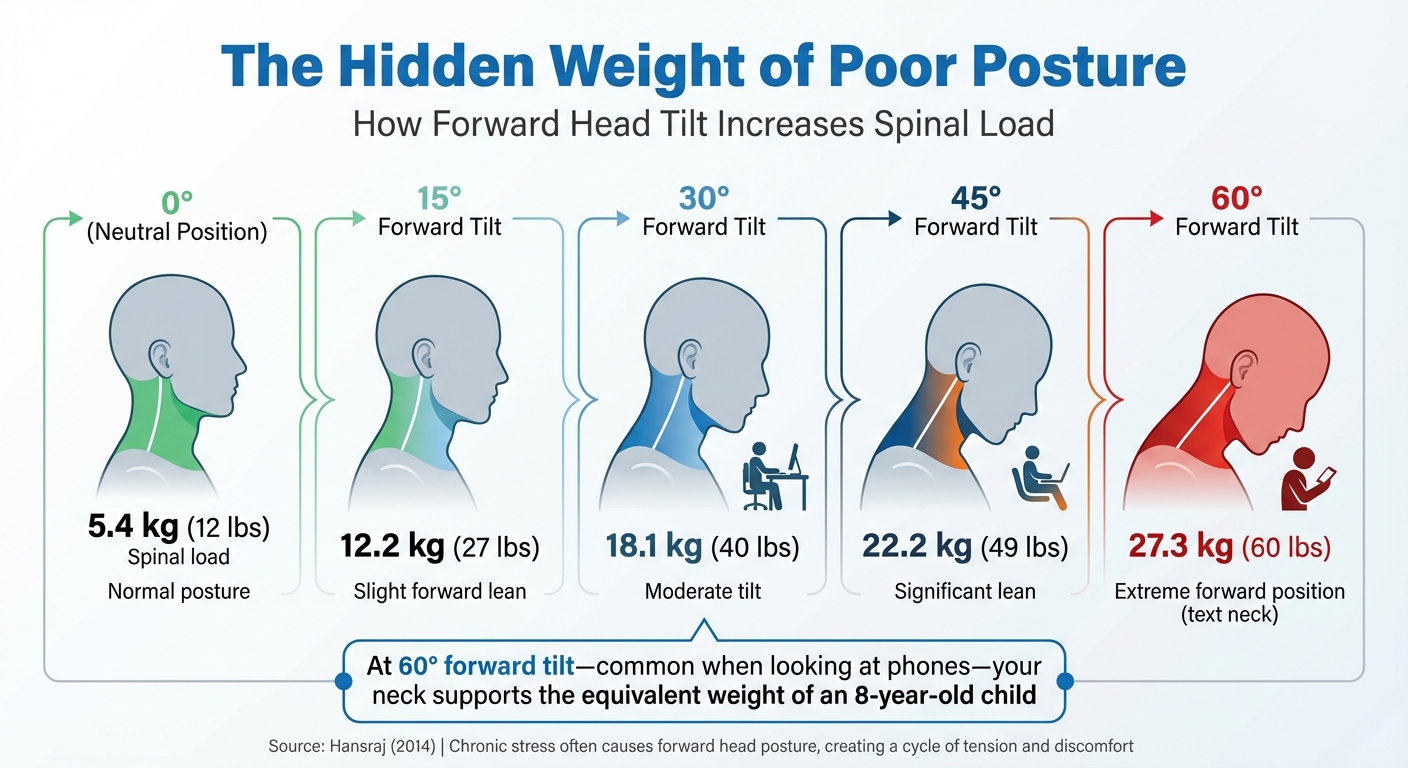
Posture illustrations cannot diagnose stress or predict pain; comfortable positions and individual assessment matter.
Addressing Posture and Muscle Tension
If desk work feels uncomfortable, consider the task, your setup and opportunities to move. Stress may be one contributor to tension, but rounded shoulders or a forward head position do not prove that the spine is damaged or out of place.
Mechanical estimates of neck loading at different angles are not a personal pain or injury prediction. There is no single ideal posture for every activity. Aim for comfortable variation and seek advice when symptoms persist or limit daily life.
For selected back or neck complaints, an assessment may lead to advice, suitable exercise, manual therapy or referral. The choice should reflect your symptoms and goals, rather than a promise that spinal realignment will break a stress cycle.
Support for Persistent Stress
For stress that is affecting sleep, work or relationships, speak with your GP or a qualified mental health professional. Chiropractic adjustments have not been established as a way to switch the body from fight-or-flight into rest-and-digest mode.
Manageable activity, a regular sleep routine and relaxation practices can be useful parts of stress support. They can be considered alongside care for a separate muscle or joint complaint. Manual treatment is optional and is not required for these habits to help.
Research Limitations and Areas for Further Study
Research varies in the participants, techniques, comparison procedures and outcomes used. Short follow-up and small samples can make results uncertain, especially when applying a finding to people with different symptoms.
People’s reports of stress and function are meaningful outcomes. Physiological measures can add information, but they do not automatically make a study more clinically useful. Appropriate comparison groups and reliable methods help distinguish treatment effects from other influences.
A study involving healthy young adults or a particular occupational group may not apply to everyone. Before using a finding to guide care, consider the participants, condition and intervention. A useful question is:
Does this research address my concern and the treatment being proposed?
Further research should measure outcomes that matter to patients, use suitable comparison groups and assess benefits and harms over time. Another question to ask is:
What improvement are we aiming for, and when will we review whether the plan is helping?
Until stronger evidence establishes a benefit, adjustments should not be promoted as a treatment for psychological stress or autonomic dysfunction.
Conclusion
Stress and musculoskeletal discomfort can occur together. Care should address the individual concerns without assuming that spinal alignment explains stress or that a laboratory change predicts relief.
Research on autonomic measures does not establish a clinical stress-management benefit from chiropractic adjustments. For practical decisions, focus on your symptoms, goals and available options:
Choose support that fits the problem you want to address, and review its usefulness over time.
For ongoing stress, that support may include your GP or a mental health professional. For back or neck discomfort, an appropriate assessment can help identify suitable musculoskeletal care or the need for referral.
At MyChiro in Bondi Junction, chiropractor Dr Steve can discuss back pain, neck pain or headaches. New patients can book a free initial consultation. Same-day treatment is optional, costs $125 and is offered only if clinically appropriate, with no obligation to proceed.
Before starting treatment, discuss the expected benefits, risks, alternatives and costs. Agree a review point rather than assuming that ongoing adjustments are needed to maintain stress resilience.
This information is general and not a substitute for professional medical advice.
Chiropractic care focuses on musculoskeletal health, and results can vary from person to person.
Always consult a qualified healthcare professional before making decisions about your health.
FAQs
Can chiropractic care reduce stress?
Research does not establish chiropractic adjustments as a treatment for psychological stress. A chiropractor may assess a separate muscle or joint complaint. For persistent stress affecting daily life, seek support from your GP or a qualified mental health professional.
What is HRV and why is it important for stress?
HRV describes variation in the intervals between heartbeats. It is influenced by many factors and is not a standalone diagnosis of stress or a direct measure of how well a treatment is working. Research findings about HRV do not establish a stress-management benefit from adjustments.
How is the need for treatment decided?
There is no established course of chiropractic sessions for treating psychological stress. If you seek care for a muscle or joint complaint, discuss an individual plan, expected outcomes and a review point. More sessions are not automatically better.