

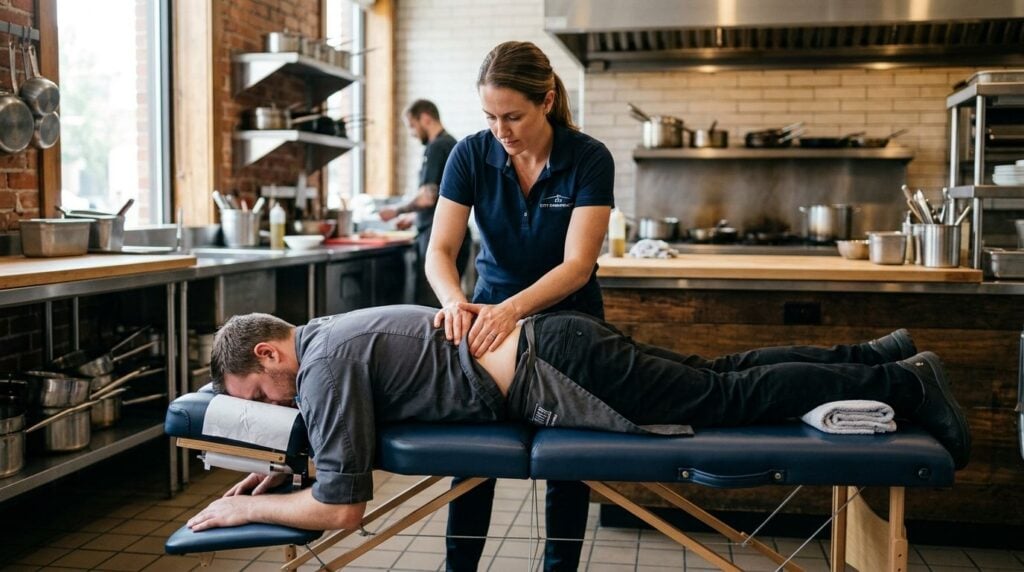
Chiropractic care for chefs and kitchen staff with back strain looks at how a chiropractor can support the specific load pattern of commercial kitchen work: long standing shifts on hard tile, repeated bending over prep benches, and lifting stockpots that get heavy fast during a dinner service. This guide breaks down what to try first, when a musculoskeletal assessment may be appropriate, and where kitchen work differs from the average office back-pain case.
- Chiropractor for chefs back pain queries usually trace to prolonged standing, forward-bent prep posture and repetitive lifting during service.
- Anti-fatigue mats, stance changes and better lifting mechanics are the no-cost first steps before booking an assessment.
- A chiropractic assessment at MyChiro in Bondi Junction may be appropriate once self-management stalls or symptoms recur weekly.
- Numbness, tingling or pain radiating down a leg needs GP or urgent assessment, not a wait-and-see approach in 2026.
Why chiropractic care matters for chefs and kitchen staff
Kitchen work stacks several load types that don't overlap neatly with generic desk-worker advice. Chefs stand through 8 to 12 hour shifts across prep and service, reach into low ovens and high dry-store shelves, lift stockpots and delivery crates, and spend the whole shift on tiled or rubber-matted floors that don't flex the way carpet does.
Twisting to plate at the pass while holding a hot pan loads the lower back and shoulders at the same time. That mix of static standing, occasional heavy lifting and repeated rotation looks a lot closer to what shift workers with back pain report than what a desk-based office worker describes.
The hot line environment also limits what you can do about it mid-shift. Breaks are short, stretching space is tight, and footwear choices matter more here than in most jobs because you're on your feet for the entire service, not walking between meetings.
How to manage back strain from kitchen work
Map where your shift loads your spine
Before changing anything, work out which parts of your shift actually strain your back. Most kitchen back pain traces to two or three repeated movements, not the whole job.
- Prep bench height relative to your hip height
- Walk-in fridge and freezer reach patterns (low crouches, high shelf reaches)
- Dish pit forward bend over the sink or rack
- Pass and expediting posture (twisting while carrying plates)
- Stockpot and crate lifts during delivery and breakdown
Change your stance and station setup first
This is the free, no-appointment-needed step, and it's where most chefs see the biggest shift in day-to-day discomfort.
- Put an anti-fatigue mat at the station you stand at longest
- Add a block or riser under a bench that sits too low for your height
- Alternate your standing leg and foot position every 20 to 30 minutes
- Move the heaviest, most-used walk-in items to waist height
- Take short unloading breaks between tickets when service pace allows
Rethink how you lift and carry kitchen loads
Stockpots, oil drums and delivery crates are where a single bad lift undoes weeks of good posture. The mechanics matter more than the weight itself.
- Bend at your hips and knees, not your waist, when lifting a stockpot
- Brace your core before lifting a loaded tray, pan or crate
- Use a trolley or a two-person lift for heavier stock deliveries
- Keep loads close to your body rather than reaching at arm's length
- Ask a colleague to spot a heavy lift during a rush instead of rushing it solo
A full breakdown of technique sits in the lift heavy objects safely guide, worth reading before your next big delivery day.
Build the core and hip capacity the line demands
Kitchen strain is rarely a straight-line movement, so straight-line core work only gets you partway there.
- Rotational core exercises rather than just sit-ups or planks
- Hip hinge practice with light load before adding weight
- Calf and ankle mobility work to support standing tolerance
- Short daily mobility rather than saving it all for days off
Get a musculoskeletal assessment when self-management plateaus
If station changes, better lifting mechanics and a few weeks of core and mobility work haven't reduced how often your back tightens up, a chiropractic assessment can look at joint restriction, movement patterns and nerve-type symptoms specific to kitchen work. Any adjustments or a management plan would be discussed with you following that assessment, not applied beforehand.
- Assessment covers movement screening and a history of your shift pattern
- Adjustments and mobility work may be discussed as part of a plan following assessment
- Red-flag screening for numbness, weakness or bowel/bladder changes
- Referral to a GP when symptoms sit outside a musculoskeletal presentation
Book a back strain assessment
Bondi Junction clinic, discuss your shift pattern with a chiropractor.
Support recovery on days off
What you do between shifts shapes how your back copes with the next double.
- Prioritise sleep after back-to-back doubles
- Rotate footwear rather than wearing one worn-out pair every shift
- Use rest days for gentle movement, not full inactivity
- Note which stations or services worsen symptoms so you can raise it at your next assessment
Comparing your options for kitchen back strain
| Option | Best for | Key limitation |
|---|---|---|
| Station and stance changes | Chefs whose pain ties to one repeated posture or bench | Doesn't address stiffness that's already set in |
| Supportive shoes for standing all day plus mats | Line cooks on their feet 8+ hours a shift | Won't resolve an underlying joint restriction on its own |
| Chiropractic assessment | Chefs with recurring stiffness or nerve-type symptoms once red flags are ruled out | Requires an in-person visit, not a same-shift fix |
| Structured core and mobility program | Chefs wanting longer-term capacity for lifting and standing | Takes consistent weeks of practice before change shows |
Common mistakes chefs and kitchen staff make
- Powering through pain during service instead of adjusting the station setup that's causing it
- Lifting stockpots by bending at the waist rather than hinging at the hips and knees
- Wearing worn-out or non-supportive shoes on tile for 10+ hour shifts, service after service
- Stacking doubles with no rest day between them, leaving no recovery window for tight muscles
- Ignoring numbness or tingling down a leg and putting it down to normal chef fatigue rather than getting it checked
FAQ
What causes back pain in chefs and kitchen staff?
Back pain in chefs usually comes from a combination of prolonged standing on hard floors, forward-bent prep posture and repetitive lifting of stockpots or crates. Twisting to plate at the pass while carrying hot pans adds rotational load that desk-based jobs don’t involve.
Is a chiropractor for chefs back pain a good first step?
Station and stance changes plus better lifting mechanics are the sensible first step for most chefs. A chiropractic assessment may be appropriate once those changes have been tried for a few weeks without improvement.
How many chiropractic sessions do kitchen staff typically need?
There’s no set number, since this depends on what an assessment finds and how your symptoms respond over time. A chiropractor can discuss a realistic plan once your history and movement screening are complete.
Can standing all day on a hard kitchen floor cause lower back pain?
Yes, prolonged standing on tile or hard rubber matting without support can contribute to lower back and hip stiffness over a shift. Anti-fatigue mats and supportive footwear reduce some of that load.
What should a chef do about numbness or tingling down the leg?
Numbness or tingling that radiates down a leg is a red flag and should be assessed by a GP or chiropractor promptly rather than managed at home. It can indicate nerve-related irritation that needs proper screening.
Are ergonomic changes enough to manage kitchen back strain?
Ergonomic changes resolve strain tied to a single repeated posture or bench height for many kitchen workers. They’re less likely to address stiffness or restriction that’s already built up over months or years on the line.
How can chefs protect their back when lifting stockpots?
Bend at the hips and knees rather than the waist, brace your core before lifting, and keep the pot close to your body instead of holding it at arm’s length. Use a trolley or a second person for the heaviest deliveries.
One last thing
The walk-in fridge is the most overlooked load point in most kitchens. Reaching to shoulder height on a high shelf while twisting to grab a container behind you combines two of the worst positions for the lower back at once, and it happens dozens of times a shift without anyone noticing. Rearranging the heaviest, most-used items to waist height in 2026 costs nothing and removes one of the more repetitive strain patterns on the line.
Related guides
- Strengthen your core without straining your lower back
- Chiropractic care for tradies and manual labourers