

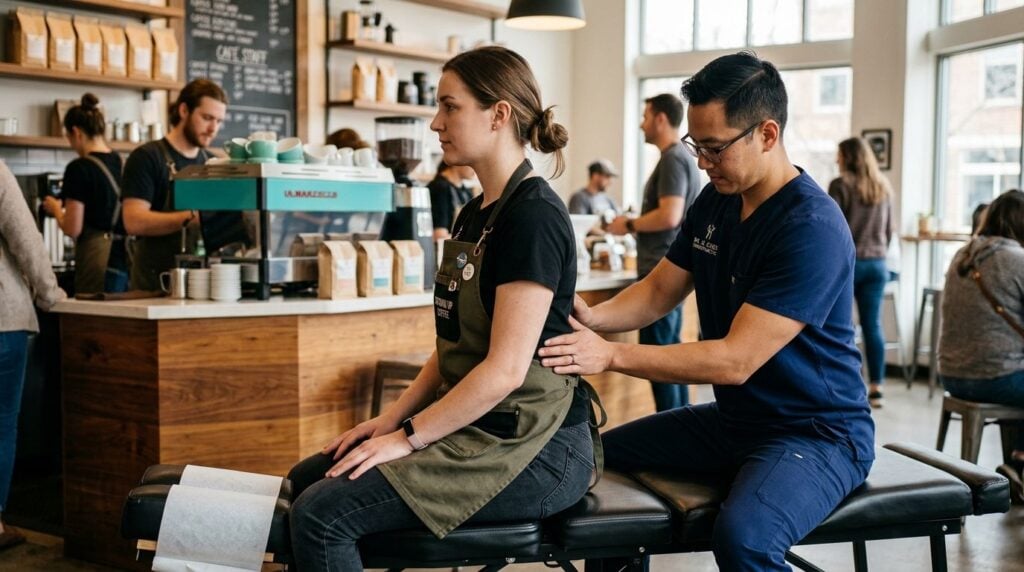
Baristas and cafe staff standing all day put repetitive load through the lower back, feet and shoulders from hours at the espresso machine, and the strain pattern is different from a typical desk-based back complaint. Twisting toward the group head, reaching overhead for cups, and standing on hard tile for six to ten hours a shift each load the spine and joints in a specific, repeatable way, which is why a generic "sit up straight" tip rarely helps someone working a cafe bar.
- Chiropractor for baristas back pain queries usually trace back to standing on hard floors, twisting toward the machine and reaching overhead for six-plus hours a shift.
- Footwear, bar layout and micro-breaks address a large share of shift-related stiffness before any clinical assessment is needed.
- A chiropractic assessment in 2026 may be appropriate when pain persists past two weeks of self-care or worsens across consecutive shifts.
- Chiropractic care for baristas at MyChiro in Bondi Junction focuses on the specific loading pattern of standing, reaching and twisting behind a bar.
Why this matters for baristas and cafe staff
Prolonged standing on hard commercial flooring is a well-documented occupational risk factor for lower back and foot discomfort across hospitality and retail work, and cafe bars add a layer most standing jobs don't have: a fixed espresso machine height that forces the same reach and twist motion hundreds of times a shift. Shorter staff round their shoulders to reach the group head; taller staff bend at the waist to reach a low milk fridge. Neither position is adjustable mid-rush.
MyChiro in Bondi Junction sees this pattern regularly among hospitality workers in the area, and the assessment approach for a barista differs from the approach for someone with a desk job, because the joints and muscles under repeated strain are not the same. Chiropractic care for baristas starts with identifying which specific movement in the shift is driving the pain, not a general spine check.
Update your footwear and standing surface first
Footwear and flooring are the cheapest variable to change and the first thing worth auditing before anything else.
- Swap flat-soled fashion sneakers for shoes with arch support and a firm heel counter
- Add an anti-fatigue mat at the espresso station and the till if the floor is tile or concrete
- Replace insoles every six to twelve months once cushioning visibly compresses
- Rotate two pairs of shoes across the week rather than wearing one pair to compression
- Check that shoes aren't more than 12-18 months old if worn on shift five or more days a week
A closer look at supportive footwear for people on their feet all day covers what to look for in a shoe built for a full standing shift rather than casual wear.
Adjust your bar station to cut reach and twist
Most bar layouts are set once and never revisited, even after staff turnover changes who's actually working the station.
- Move the milk fridge and jug rack within arm's reach without a full-body twist
- Set the POS screen at a height that doesn't force a forward head tilt
- Store frequently used cups and lids at waist height, not overhead or floor level
- Position the grinder and portafilter dock so the dominant-hand reach is a step, not a stretch
- Flag any station element that requires bending below knee height more than a few times an hour
Break up long standing blocks with short resets
Static standing for hours straight is harder on the spine than standing that includes small position changes.
- Shift weight between feet every few minutes rather than locking both knees
- Do 10-15 calf raises during a lull to pump circulation through the lower legs
- Rotate onto a seated task (till reconciliation, stock counts) for five minutes each hour if rostering allows
- Step away from the machine to restock rather than reaching across the body repeatedly
- Use rest breaks to sit fully, not to stand and scroll a phone
Stretch the muscles the espresso machine overworks
The reaching and twisting behind a bar shortens specific muscle groups, and stretching those groups at the start or end of a shift can ease the tightness that builds across the day.
- Doorway chest stretch to counter the rounded-shoulder reach position
- Standing hip flexor stretch to release tightness from hours of upright standing
- Seated or standing calf stretch against a wall or step
- Thoracic spine rotation, arms crossed, rotating gently side to side
- Forearm and wrist stretch to offset repetitive tamping and steaming motions
Strengthen your core, glutes and feet off-shift
Standing all day without any strength work off the clock tends to make the same joints do all the stabilising work, shift after shift.
- Glute bridges, 2-3 sets of 12-15, to support the lower back during standing
- Front plank holds, building toward 30-45 seconds, for core endurance
- Single-leg balance drills to build ankle and hip stability
- Towel scrunches with the toes to strengthen the small muscles of the foot
- Bird-dog holds to train the lower back and glutes to work together
Get a professional assessment when pain persists past two weeks
If footwear changes, station adjustments and stretching haven't eased the pain within two weeks, or if pain is getting worse across shifts rather than better, a chiropractic assessment may be appropriate to identify what's driving it. Chiropractic care for baristas at MyChiro involves assessing posture, joint movement and muscle tension specific to standing and reaching work, and discussing findings before recommending next steps.
A chiropractor for baristas back pain cases typically checks the lower back, hips, shoulders and neck as a linked system, not the lower back in isolation, because the reaching motion at the machine loads all four together.
“A barista twisting toward the group head for six hours a shift loads the lower back in a similar repetitive pattern to someone bent over a workbench all day.”
Discuss a barista-specific assessment
MyChiro in Bondi Junction assesses standing and reaching strain specific to cafe work.
Track your symptoms across a working week
A simple log makes it easier to spot patterns and gives useful detail if you do see a health professional.
- Note which shifts (opening, closing, weekend rush) trigger the worst stiffness
- Record which side of the body feels tighter, since bar layout often loads one side more
- Track whether pain eases on days off or persists regardless of rest
- Log footwear changes alongside symptom changes to see what actually helps
- Flag any numbness, tingling or pain radiating down a leg or arm for a health professional
Comparison of options for barista-specific back pain
| Option | Best for | Key limitation |
|---|---|---|
| Supportive footwear and anti-fatigue mats | Early shift-related aching in the feet and lower back | Doesn't address an existing joint restriction or muscle imbalance |
| Bar station ergonomic changes | Reducing repetitive reach and twist load | Needs manager buy-in and physical relayout of the station |
| Self-directed stretching and strengthening | Mild, early stiffness that clears with rest | Needs daily consistency and doesn't identify the underlying cause |
| Chiropractic assessment and care | Recurring or worsening pain after two weeks of self-care | Requires an in-person assessment; outcomes vary by individual and aren't guaranteed |
Common mistakes baristas make with back pain
- Wearing fashion sneakers behind the bar because they look fine with the uniform, with no arch support for a six-hour standing shift
- Twisting from the waist to reach the group head instead of stepping, which repeats the same spinal rotation hundreds of times a shift
- Skipping breaks during a rush and going four or more hours without shifting weight or sitting down
- Carrying milk crates on one hip rather than centring the load, which builds a lopsided strain pattern over months
- Ignoring forearm and wrist tightness from tamping, assuming it's unrelated to the back pain that shows up later in the shift
FAQ
What causes back pain in baristas and cafe staff?
Barista back pain usually comes from a combination of standing on hard floors for long shifts, repeated twisting toward the espresso machine, and overhead reaching for cups. The repetitive nature of the motion is what separates it from general standing fatigue.
Can a chiropractor for baristas back pain actually help?
A chiropractic assessment can identify which joints and muscles are under the most strain from standing and reaching work and discuss options based on those findings. Any recommendation depends on an individual assessment, so results aren’t the same for everyone.
How many hours of standing is too much for cafe staff?
There’s no fixed cutoff, but shifts longer than four to six hours without a seated break or position change are when most staff start reporting stiffness. Breaking up standing time with small position changes matters more than the total hours worked.
What shoes help with barista back pain?
Shoes with arch support, a firm heel counter and cushioned soles reduce the load transferred up through the ankles, knees and lower back during a standing shift. Fashion sneakers without structured support tend to make shift-related stiffness worse over 2026’s longer trading hours in busy cafes.
Should baristas stretch before or after a shift?
Light dynamic stretching before a shift can prepare the muscles for repetitive reaching, while static stretching after a shift helps release tightness that built up across the day. Both have a place, and consistency matters more than timing.
When should a barista see a chiropractor for back pain?
A chiropractic assessment may be worth discussing if pain persists beyond two weeks of footwear and ergonomic changes, or if it worsens across consecutive shifts rather than easing on days off. Numbness, tingling or pain radiating down a leg or arm warrants prompt assessment by a health professional.
Is standing all day worse than sitting all day for back pain?
Both extremes carry risk, but for different reasons: prolonged sitting reduces movement and can stiffen the hips, while prolonged static standing loads the lower back and feet continuously. The healthiest pattern for either job type is regular position changes throughout the shift.
Can cafe owners reduce staff back and foot injuries?
Providing anti-fatigue mats, reviewing bar station height for different staff heights, and building short seated breaks into rosters are practical, low-cost changes. These adjustments reduce the repetitive load that builds into chronic complaints over a working year.
One last thing
Most cafe bars are built to one height, set for whoever installed the equipment, and never adjusted for the range of staff who actually work it. A barista who's noticeably shorter or taller than that original setup is doing extra reaching or bending on every single drink, all shift, every day, in 2026 and every year the layout stays unchanged. Checking bar height against your own height and adjusting shelf and fridge placement accordingly is a five-minute audit most cafes have never done.
Related guides
- Chiropractic care for retail workers on their feet
- Chiropractic care for shift workers with back pain
- When back pain needs a chiropractor vs a doctor