
A chiropractor may be appropriate following assessment of knee pain that is not related to sport, but the absence of a sports injury does not establish which care you need. Start with an assessment of the symptoms and their possible cause; do not assume that a spinal adjustment is indicated.
- Can a chiropractor help with knee pain not from sport? Assessment comes before deciding whether chiropractic care is appropriate.
- Mychiro is a chiropractic clinic in Bondi Junction; its service description does not establish suitability for your knee symptoms.
- Discuss unexplained knee pain, swelling or reduced movement with a qualified health professional before choosing a procedure.
- A proposed care plan should explain its purpose, alternatives, risks and review criteria without promising an outcome.
Why this matters
You do not need to play sport to have a concern about your knee. However, describing pain as “not from sport” tells a clinician what did not happen, rather than explaining what did.
Choose an assessment before choosing a procedure. For readers considering care in 2026, the useful questions concern the clinician’s scope, the reason for the proposed care and when medical assessment is needed. Mychiro provides chiropractic care and spinal adjustments in Bondi Junction, Sydney; that description alone does not establish whether the clinic’s services are appropriate for a particular knee complaint.
Can a chiropractor help with non-sport knee pain?
A chiropractor can discuss musculoskeletal concerns and consider whether assessment falls within their scope. Whether chiropractic care is appropriate for your knee symptoms depends on the findings, the evidence for the proposed approach and whether referral is needed.
There is no single answer for every person with knee pain. A recommendation should relate to an identified clinical problem, not simply to the fact that you have not injured yourself playing sport.
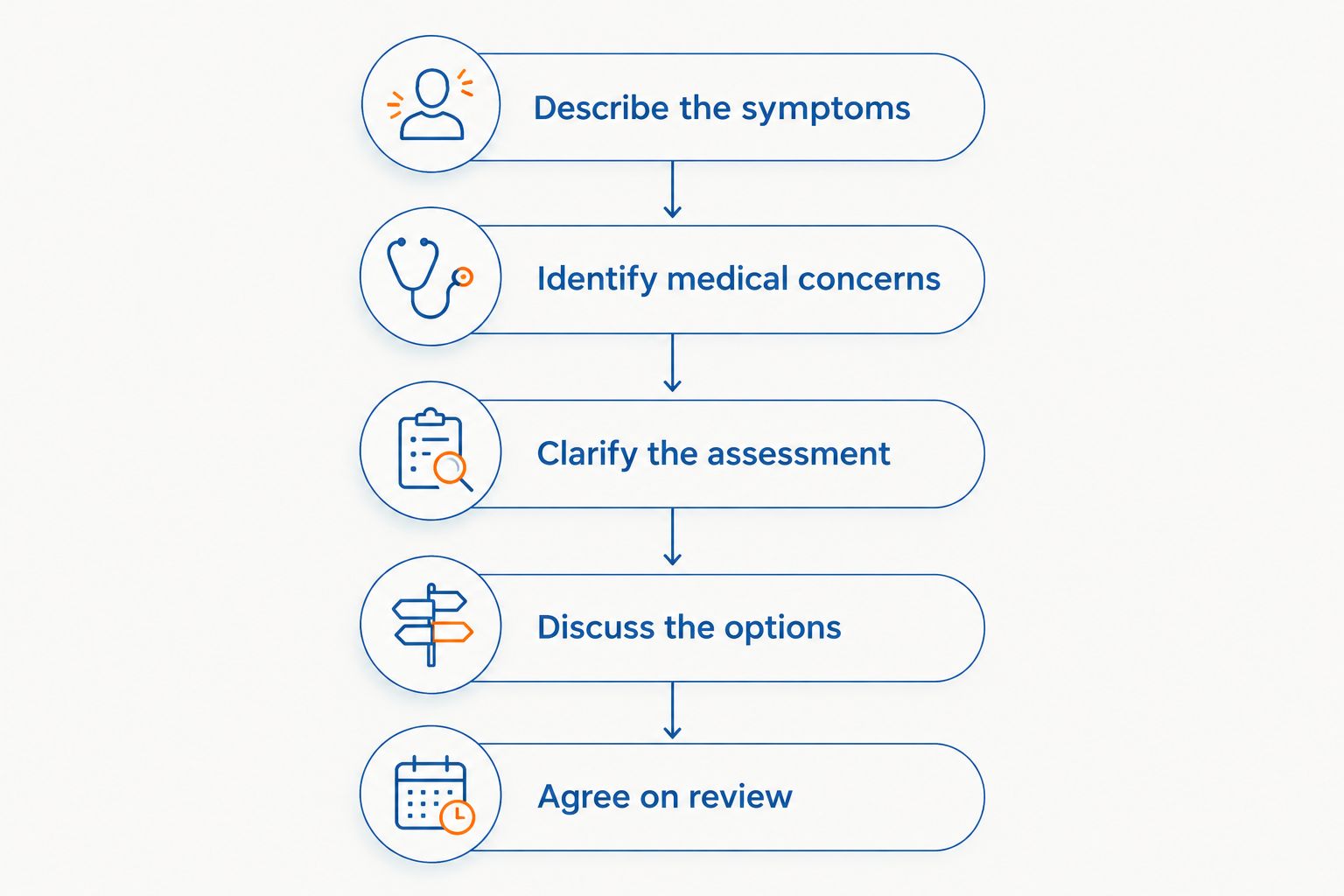
Use the following sequence when deciding what to do:
- Describe the symptoms. Explain where you feel discomfort, when it began and which everyday activities are affected.
- Identify medical concerns. Report swelling, changes in general health, difficulty bearing weight or any recent injury.
- Clarify the assessment. Ask what the clinician is considering and what remains uncertain.
- Discuss the options. Ask about alternatives, including medical assessment or physiotherapy where appropriate.
- Agree on review criteria. Establish what will prompt reassessment, a change of plan or referral.
These steps organise a discussion. They are not a self-diagnosis tool or a reason to begin adjustments without an explanation.
Which health professional should I speak to first?
If you are unsure why your knee hurts, a GP is a reasonable starting point. A medical assessment is particularly relevant when symptoms are unexplained, accompanied by swelling or associated with changes in your general health.
The table compares the purpose and limits of different assessment routes. It does not rank practitioners or imply that everyone needs appointments with multiple providers.
| Assessment route | Reason to consider it | Limit or question to clarify |
|---|---|---|
| GP | Discuss unexplained symptoms, medical history and whether investigations or referral are indicated | Ask what follow-up is needed if the initial explanation remains uncertain |
| Physiotherapist | Discuss movement, everyday function and whether an exercise-based approach is appropriate | Ask whether medical assessment is needed before progressing a plan |
| Chiropractor | Discuss whether a musculoskeletal assessment is appropriate within the practitioner’s scope | Do not assume that knee pain requires spinal adjustments |
| Urgent medical service | Obtain assessment when concerning symptoms are present | This is not a substitute for routine follow-up after an urgent issue is assessed |
You can ask any practitioner to explain the boundaries of their role. A clear referral recommendation is a useful part of care, not a failure to provide a service.
If more than one clinician becomes involved, ask who will coordinate the plan. Bring relevant correspondence so that each practitioner understands what has already been assessed.
What should you tell the clinician about your knee?
Prepare a short account in your own words. You do not need to arrive with a diagnosis, a theory about alignment or a list of procedures you want performed.
The following details give the conversation a practical starting point:
- Location: point to the area rather than describing the whole leg as painful.
- Onset: explain whether you noticed a particular beginning or a gradual change.
- Daily activities: describe difficulties with walking, stairs, sitting down or getting up.
- Associated changes: mention swelling, locking, giving way or reduced movement.
- Health background: bring relevant diagnoses, medicines and previous investigation reports.
- Your priorities: explain which ordinary activity you want assessed and discussed.
Report observations without deciding what they mean. For example, saying that stairs are uncomfortable is more useful than assuming a particular structure is damaged.
Also explain what you have already tried and what happened afterwards. Include advice from other health professionals so that recommendations are not considered in isolation.
Why recommendations for non-sport knee pain vary
“Non-sport knee pain” is a description, not a diagnosis. Recommendations differ because the assessment must account for your symptoms, health history and circumstances rather than fit everyone into the same appointment schedule.
These are relevant discussion factors:
- Symptom history: what changed, when it changed and whether the pattern is continuing.
- Everyday function: which tasks are limited and how that affects your routine.
- Examination findings: what the practitioner identifies and how those findings support the explanation.
- Medical context: existing conditions, medicines and information from previous assessments.
- Uncertainty: whether further assessment or another professional’s opinion is needed.
- Your preferences: what you understand, what you are comfortable with and which alternatives you want explained.
None of these factors establishes that an adjustment is necessary. Ask the practitioner to connect each proposed intervention to a specific assessment finding and a stated purpose.
A personalised explanation should also acknowledge uncertainty. You should be able to distinguish what the clinician has observed from what still needs investigation.
Does knee pain mean you need a spinal adjustment?
Knee pain alone does not establish a need for spinal adjustments. Ask why a spinal procedure is being proposed for a knee complaint and what evidence supports that specific recommendation.
Do not accept “alignment” or “nerve pressure” as a complete explanation without clarification. Ask what those terms mean in your case, how the conclusion was reached and whether another assessment is required.
For a person with an established diagnosis of osteoarthritis, NICE guideline NG226 discusses manual therapy only alongside therapeutic exercise, rather than as a stand-alone approach. That condition-specific guidance is not evidence that spinal manipulation is appropriate for every unexplained knee symptom.
When discussing a plan in 2026, ask the practitioner to identify guidance relevant to the actual diagnosis. A general statement about chiropractic care is not a substitute for evidence addressing the proposed intervention and clinical problem.
What should an explained care plan include?
Before agreeing to care, you should understand what is being proposed and why. The discussion should cover reasonable alternatives, relevant risks, consent and what happens if the working explanation changes.
Ask these questions in plain language:
- What are you assessing or proposing to address?
- Which findings support that explanation?
- Why is this particular intervention being suggested?
- What are the alternatives, including no procedure while further assessment occurs?
- What risks and limitations should I understand?
- When will we review the decision, and what would trigger referral?
You can request time to consider the answers. Consent to an assessment does not mean you must agree to every procedure subsequently suggested.
Avoid committing to a fixed course solely because a package is presented. If appointments are proposed, ask how their purpose and frequency relate to the assessment. The guide to how often to see a chiropractor provides related questions to raise, but an article cannot determine an individual schedule.
When should knee pain have urgent medical assessment?
Seek urgent medical assessment for a hot, red or markedly swollen knee, particularly if you also feel unwell or have a fever. Inability to bear weight or move the knee also warrants prompt medical advice rather than an appointment for manipulation.
Healthdirect Australia’s knee-pain guidance describes circumstances requiring medical attention. This 2026 educational guide does not replace individual triage, and a short list cannot cover every concerning presentation.
If symptoms are severe, rapidly worsening or difficult to interpret, contact an appropriate medical service for advice. Do not wait for a routine chiropractic visit to clarify an urgent concern.
For a life-threatening emergency in Australia, call 000. Otherwise, a GP, urgent care service or Healthdirect can advise on the appropriate assessment pathway.
What can you organise before your appointment?
Bring relevant reports, a current medicine list and a short description of the activities affected. Existing information helps you explain the situation without trying to reproduce a previous clinician’s conclusions from memory.
Choose an ordinary activity to discuss, such as getting out of a chair or using stairs. You do not need to repeatedly provoke symptoms to demonstrate that a problem exists.
Avoid forceful self-manipulation or copying an adjustment from a video. If you want advice about activity, exercise or medicines while waiting, ask a qualified health professional who can account for your circumstances.
In 2026, online information can help you prepare questions, but it cannot establish the cause of your knee pain. Keep a distinction between educational material and advice given after your own assessment.
How many chiropractic appointments would I need?
There is no universal appointment count for knee pain that is not related to sport. Whether chiropractic appointments are appropriate at all should be considered before discussing frequency.
If a clinician proposes ongoing care, ask for a stated purpose and review point. Continuing an unchanged plan without reassessment is not an explanation of why further appointments are needed.
Would I need an X-ray or MRI before discussing care?
You do not need to arrange imaging yourself before seeking an assessment. A qualified clinician can discuss whether an investigation is indicated and what decision its result would inform.
Bring previous imaging reports if you have them. Do not assume that another scan is necessary simply because you are consulting a different practitioner.
FAQ
Can a chiropractor help with knee pain not from sport?
Chiropractic care may be appropriate following assessment, but not playing sport does not establish suitability. Ask what the assessment indicates, whether referral is needed and what evidence supports any proposed intervention.
Should I see a GP or a chiropractor for unexplained knee pain?
A GP is a reasonable starting point when the cause of knee pain is unclear. Mention swelling, changes in general health and difficulty bearing weight so that the appropriate assessment pathway can be considered.
Does knee pain mean my spine is out of alignment?
Knee pain alone does not establish a spinal alignment problem. Ask the practitioner to explain the findings and why any proposed spinal procedure is relevant to your knee complaint.
Do I need an adjustment at my first appointment?
You do not have to agree to an adjustment because you have attended an assessment. Ask about the purpose, alternatives, risks and limitations before deciding whether to consent.
When should I get urgent help for knee pain?
Seek urgent medical assessment for a hot, red or markedly swollen knee, particularly with fever or feeling unwell. Inability to bear weight or move the knee also warrants prompt medical advice.
Can I decide how many appointments I need from an online article?
An online article cannot determine an appropriate appointment schedule for your knee symptoms. First establish whether the proposed care is appropriate, then discuss its purpose and review criteria.
Does Mychiro’s service description confirm that it manages knee pain?
Mychiro’s supplied service description identifies chiropractic care and spinal adjustments, not a knee-specific service. Confirm whether assessment of your particular concern falls within the practitioner’s scope before arranging care.
One last thing
The most useful question is not simply whether a chiropractor can see you. Ask what the assessment would change about your next decision. An answer should explain whether you need advice, a proposed care plan, further investigation or referral.
For your 2026 care decisions, keep the distinction between an available service and a clinically appropriate recommendation. Mychiro’s chiropractic service information describes the clinic; your symptoms still require their own assessment and explanation.
Related guides
- How to prepare for your first chiropractor appointment
- What qualifications should a Sydney chiropractor have?
- How chiropractors coordinate with GPs on imaging referrals