

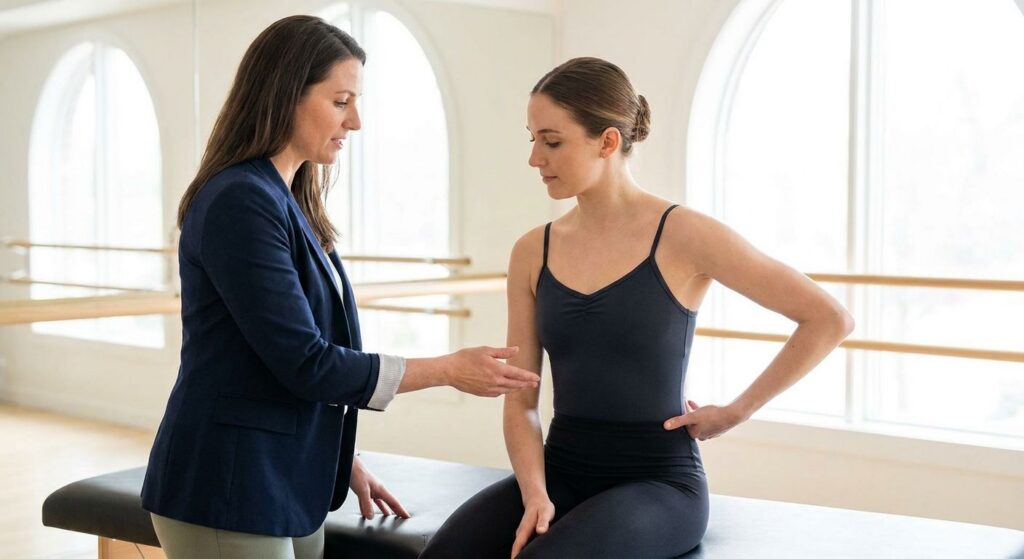
Dancer-focused chiropractic care is a spinal, pelvic and hip assessment built around the repetitive turnout, extension and impact loading of ballet, contemporary and competitive dance, with the aim of supporting movement capacity and recovery between rehearsals. A dancer's training pattern looks nothing like a desk worker's — hours of turned-out positions, high-impact landings and asymmetric loading create strain patterns that a generic posture check won't pick up.
- Chiropractor for dancers care starts with assessing hip, pelvis and lower back mechanics behind turnout and jump strain.
- Tight hip flexors and one-sided turnout are common patterns worth discussing with a chiropractor or physiotherapist.
- Core control without extra lower back loading supports landing and pelvic stability during rehearsal blocks.
- Self-directed stretching, physiotherapy and chiropractic assessment each suit different stages of a dancer’s training.
- MyChiro in Bondi Junction offers assessment appointments dancers can book directly in 2026.
Why chiropractic care matters for dancers
Dance training loads the hips and lower back differently to most sports. Turnout asks the hip joint to rotate externally far beyond a resting range, and when a dancer can't get the full rotation from the hip itself, the shortfall gets absorbed somewhere else — usually the knees, ankles or lumbar spine.
Jumps and landings add repetitive impact on top of that rotation demand. Extensions and arches load the lower back in end-range positions, often for hours across a single rehearsal day. None of this is a single injury event — it's cumulative strain building across weeks and seasons.
Dance culture also tends to normalise working through discomfort rather than stopping to check what's causing it. That's part of why hip and lower back complaints in dancers often get managed later than they could be, once a pattern has already set in rather than at the first sign of tightness.
MyChiro in Bondi Junction works with dancers looking to understand what's driving hip or back strain before it limits training capacity, using assessment findings — not assumptions — to guide next steps.
Track your training load and pain patterns
Before anything else, get a clear picture of when and where strain shows up. This is the free, do-it-yourself step every dancer can start today.
- Log rehearsal hours per week alongside performance and class time
- Note which specific movements provoke symptoms — grand plié, arabesque, grand jeté
- Rate discomfort on a simple 0-10 scale daily, not just after a bad class
- Flag whether strain is one-sided or symmetric across both hips
- Track rest days actually taken versus scheduled
A pattern that repeats across two or three weeks is worth raising with a qualified health professional rather than waiting for it to settle on its own.
Loosen tight hip flexors and turnout muscles
Hip flexor and turnout-muscle tightness shows up constantly in dancers because these muscle groups work in end-range positions for hours at a time. A tight hip flexor stretching routine is the standard starting point most dancers can manage themselves between sessions.
- Hold a static psoas and iliacus stretch for 30-60 seconds post-rehearsal, not before
- Foam roll the TFL and quads to reduce tension around the front of the hip
- Pair hip flexor stretching with external rotator strengthening, not stretching alone
- Avoid pushing a stretch into sharp or radiating pain — that's a different signal
- Repeat consistently across the week rather than only after a hard session
Build core control without loading the lower back
Core strength is often misunderstood in dance training as more crunches. What actually supports landing control and pelvic stability is deep core engagement that doesn't compress the spine. A core strengthening approach that avoids straining the lower back matters more for dancers than volume of ab work.
- Start with dead bug and bird-dog patterns before adding load
- Practise engaging the transverse abdominis before jumps, not just during floor work
- Limit high-rep sit-ups and crunches under fatigue
- Add anti-rotation planks to build pelvic control through turns
- Progress core loading gradually across a training block, not in a single week
Check for pelvic or hip asymmetry
Many dancers carry a slight pelvic tilt or one-sided hip pattern without realising it, often from favouring a stronger side during turns or extensions. This is a mechanical pattern worth having assessed rather than guessing at from symptoms alone, since asymmetry that goes unaddressed tends to compound across a season of training.
Warm up properly before rehearsal and performance
A cold hip joint going straight into full turnout is a common setup for strain. A structured warm-up changes how the joint and surrounding muscles respond to load.
- Spend 10-15 minutes on dynamic movement before technical work
- Include hip circles and controlled pliés to build range gradually
- Increase range of motion in stages rather than reaching full extension immediately
- Save static stretching for after training, not before
- Add light cardio to raise tissue temperature before high-impact work
Build recovery habits between sessions
Recovery is where a lot of dancers under-invest relative to training hours, and it compounds over a season.
- Prioritise consistent sleep across training weeks
- Alternate heavier and lighter training days where the schedule allows
- Use heat or ice as appropriate for how the area feels, not on a fixed schedule
- Stay on top of hydration and general nutrition across long rehearsal days
- Schedule deload weeks into the season rather than only after an injury forces one
Know when to book a professional assessment
If hip or lower back strain persists beyond two to three weeks despite adjusting training load, stretching and recovery, a professional assessment is a sensible next step rather than pushing through another rehearsal block. Chiropractic care for dancers, following assessment, can be discussed alongside strength coaching or physiotherapy depending on what the findings show.
Some symptoms need medical review before anything else — numbness or tingling down the leg, loss of bladder or bowel control, or pain following a specific traumatic fall. These warrant a GP or emergency assessment, not a training modification.
Book a dancer hip and back assessment
Discuss turnout, jump load and lower back strain patterns with MyChiro in Bondi Junction.
Comparing options for hip and back strain in 2026
| Option | Best for | Key limitation |
|---|---|---|
| Self-directed stretching and mobility work | Mild, occasional tightness after training | Doesn't address underlying joint mechanics or asymmetry |
| Physiotherapy-led rehab | Dancers recovering from a diagnosed injury | Often needs a referral and multiple sessions across weeks |
| Chiropractic assessment (e.g. MyChiro) | Dancers wanting a spine, pelvis and hip mechanics review | Works best alongside training adjustments, not as a stand-alone fix |
| Dance-specific strength and conditioning coaching | Building long-term load tolerance across a season | Results depend on consistency, not a single session |
Common mistakes dancers make with hip and back strain
- Stretching tight hip flexors without addressing an anterior pelvic tilt underneath
- Treating one-sided hip tightness as normal instead of checking for turnout compensation
- Skipping deload weeks across a full performance season
- Increasing rehearsal hours while ignoring a twinge that keeps returning
- Relying on stretching alone without building core or glute strength alongside it
FAQ
What does a chiropractor for dancers actually assess?
A chiropractor for dancers typically assesses hip, pelvis and lower back mechanics linked to turnout, jumps and extension work. Findings guide whether adjustments, strength work or a referral to another professional may be appropriate.
Can chiropractic care help with hip flexor tightness from dance training?
Chiropractic assessment can identify whether hip flexor tightness relates to pelvic positioning or joint mechanics, which then informs a stretching and strengthening plan. It’s typically discussed alongside a physiotherapist or coach rather than in isolation.
Is chiropractic care appropriate for dancers with lower back strain?
Chiropractic care may be appropriate for dancers with lower back strain following a proper assessment of the spine, pelvis and surrounding muscles. Whether it suits a specific case depends on findings and history, which is why assessment comes before any plan.
How is a dancer’s assessment different from a general back pain check?
A dancer’s assessment factors in turnout range, jump impact and rehearsal hours, not just a static posture check. This picks up asymmetric loading patterns that a general assessment might miss.
How often should dancers get their hips and back checked?
There’s no fixed schedule — it depends on training intensity and whether symptoms are recurring. A dancer training through a full season with persistent tightness has more reason to book an assessment than one with occasional, mild soreness.
Can chiropractic care help with turnout-related hip pain?
Turnout-related hip pain often stems from the hip joint being pushed beyond its available rotation, with the lower back or knees compensating. Assessment can clarify whether the pain pattern relates to hip mechanics, pelvic position or a combination of both.
When should a dancer see a doctor instead of a chiropractor?
Numbness, tingling down the leg, loss of bladder or bowel control, or pain following a specific fall or trauma need medical review first. These aren’t training-load issues and shouldn’t wait for a training-based approach.
Does MyChiro see dancers in Bondi Junction in 2026?
MyChiro in Bondi Junction offers assessment appointments for patients dealing with hip, pelvis and lower back strain, including dancers managing training-related tightness. Appointment availability can be checked directly on the MyChiro site.
One last thing
Most dancers can't reach full stage turnout from hip rotation alone — the gap commonly gets absorbed through the knees, ankles and lower back, which is one reason lower back strain shows up more often in turnout-heavy styles like ballet than in styles with less rotation demand. Checking passive hip rotation range early in training, rather than assuming flexibility work alone will close the gap, is a more useful starting point than another round of static stretching in 2026.
Related guides
- Chiropractic care for leg length discrepancy and posture imbalance
- How to prepare for your first chiropractor appointment