

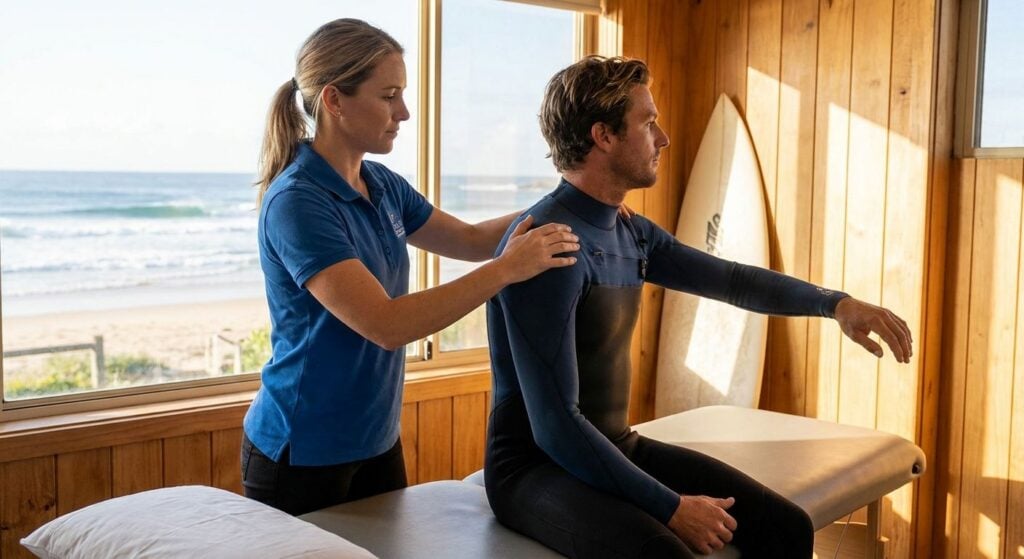
Surfers who paddle, pop up and duck-dive several times a week often develop shoulder and lower back pain patterns that differ from land-based athletes, and addressing them usually means looking at paddling mechanics, thoracic spine mobility and load management together rather than treating the shoulder in isolation. Surfing puts repetitive overhead and rotational strain through the shoulder girdle and lower back that most single-sport guides don't account for.
- Surfers shoulder pain often traces back to paddling volume, thoracic stiffness and weak scapular stabilisers, not just the joint itself.
- A surfers shoulder pain chiropractor assessment in 2026 typically checks paddling posture, spinal rotation and shoulder mechanics before any hands-on care is discussed.
- Rotator cuff and scapular strengthening, plus thoracic mobility work, are the self-managed starting points most surfers try first.
- MyChiro in Bondi Junction offers assessment-based chiropractic care that can be discussed alongside strength and mobility work for surfers.
- Persistent pain past 2-3 weeks, numbness, or pain that changes with neck position warrants a professional assessment rather than more paddling.
Why chiropractic care matters for surfers
Surfing asks the shoulder to work in a range most other sports don't touch — repeated overhead paddling strokes, sudden pop-up loading through the lats and rotator cuff, and rotational torque through the lower back on turns. Local surfers around Bondi and the Eastern Suburbs often search for shoulder and back pain solutions after a run of consecutive dawn sessions, not after a single acute injury.
The pattern that shows up most in surfers is a stiff thoracic spine paired with an overworked shoulder — when the mid-back can't rotate, the shoulder joint takes on rotation it isn't built for. This is why a generic shoulder stretch routine sometimes doesn't shift the pain: the driver may sit higher up the kinetic chain. A chiropractic assessment can help map where the restriction actually is before deciding what to work on.
Lower back pain in surfers frequently connects to prolonged lumbar extension while paddling and lying prone on the board. Addressing this may involve looking at core strength work that doesn't load the lower back rather than jumping straight to spinal adjustments.
Update your paddling posture
Paddling posture sets up most of the shoulder and back strain surfers deal with, and it's usually the first thing worth checking before assuming the joint itself is the problem.
- Keep the chest lifted rather than sagging into the board, which reduces excessive lumbar extension
- Rotate through the thoracic spine on each stroke instead of pulling purely through the shoulder
- Avoid holding the neck in extension for long paddle-outs — reset position every 10-15 strokes
- Check board positioning; paddling too far back overloads the lower back, too far forward overloads the shoulders
- Film a session occasionally to spot asymmetries between left and right-side paddling
Warm up your shoulders and thoracic spine before paddling out
Cold shoulders and a stiff thoracic spine going into a session is one of the more avoidable contributors to surfers shoulder pain.
- Arm circles and band pull-aparts for 60-90 seconds before entering the water
- Thoracic rotations on hands and knees, 8-10 reps each side
- Cat-cow through the full spine to prime the lower back for prone positioning
- Scapular wall slides to activate the muscles that stabilise the shoulder blade
- Light resistance-band external rotation, 2 sets of 12-15
Strengthen your rotator cuff and scapular stabilisers
A rotator cuff that hasn't been trained to handle repetitive overhead load is a common finding behind ongoing shoulder pain in surfers, and this is one of the more evidence-supported areas to address with a structured program.
- Prone Y-T-W raises with light dumbbells, 2-3 sets of 10-12
- Side-lying external rotation, 2 sets of 12 per side
- Face pulls with a resistance band, 3 sets of 15
- Scapular push-ups to build serratus anterior control
- Progress load gradually over 2026's training blocks rather than adding volume all at once
Stretch your chest, lats and hip flexors after sessions
Tight anterior chest and lat muscles pull the shoulder into a rounded position that adds strain during the next paddle-out, and tight hip flexors from lying prone contribute to lower back irritation.
- Doorway pec stretch held for 30 seconds, 2-3 rounds
- Lat stretch against a wall or rack, 30 seconds per side
- Kneeling hip flexor stretch, 30 seconds per side after every session
- Foam rolling through the thoracic spine — see foam roller options for lower back tension for specific movements
- Gentle spinal twists lying on the back to close out the cool-down
Address thoracic spine mobility for pop-up mechanics
The pop-up motion demands quick thoracic rotation and extension, and a stiff mid-back often shows up as compensatory strain through the shoulders or lower back during this exact movement.
- Open-book stretches lying on your side, 8-10 reps each direction
- Thread-the-needle rotations on hands and knees
- Extension over a foam roller placed under the mid-back
- Banded shoulder dislocates to build rotational range
- Practising slow, controlled pop-ups on land before paddling out
Manage load and session frequency
Most overuse shoulder and back pain in surfers builds from stacking high-volume sessions without recovery, not from a single wipeout.
- Track weekly paddling volume, not just number of sessions
- Build in at least one lower-intensity or rest day between consecutive heavy sessions
- Reduce duration rather than skipping sessions entirely when early soreness appears
- Pay attention to pain that lingers more than 24-48 hours after a session
- Adjust training load around swell forecasts rather than paddling out regardless of conditions
Get an assessment when pain persists
When shoulder or back pain in surfers doesn't settle with the steps above over 2-3 weeks, or starts limiting paddling range, an assessment from a chiropractor or another qualified health professional can help identify what's driving it. A chiropractic assessment at a clinic such as MyChiro in Bondi Junction typically looks at thoracic and lumbar spine mobility, shoulder mechanics and posture patterns before any care plan is discussed. Chiropractic adjustments, mobility work and exercise guidance may be appropriate following that assessment, depending on findings.
Book a surfers pain assessment
Same-week appointments available at the Bondi Junction clinic.
Comparing your options for surfers shoulder and back pain
| Option | Best for | Key limitation |
|---|---|---|
| Self-managed stretching and strengthening | Mild, early-stage stiffness or soreness | Requires consistency; won't identify an underlying joint or spinal restriction |
| Physiotherapy | Structured rehab after a known injury | Often needs multiple sessions; access can be limited around peak surf season |
| Chiropractic assessment and care | Ongoing stiffness, recurring pain, or unclear cause | Outcomes vary by individual; care plans depend on assessment findings, not guaranteed timelines |
| Sports massage | Muscular tightness and short-term relief | Doesn't address biomechanical drivers like thoracic restriction |
A chiropractic assessment is the option best suited to surfers whose shoulder or back pain keeps returning despite stretching and strengthening, because it looks at the whole kinetic chain rather than the sore spot alone.
Common mistakes surfers make
- Stretching only the sore shoulder — ignoring thoracic spine stiffness that's often the real driver of restricted paddling range
- Paddling through pain that changes week to week — inconsistent pain location or intensity is worth having assessed rather than pushed through
- Skipping the warm-up on dawn patrol — cold tissue going straight into repetitive paddling raises strain on the shoulder and lower back
- Overloading rotator cuff work without addressing posture — strengthening a joint that's still working from a poor paddling position limits results
- Waiting until pain affects daily life — surfers often keep paddling through gradually building pain and only seek assessment once it starts affecting sleep or work
Surfers dealing with shoulder tightness that overlaps with swimming-style overhead strain may also find the stretches for swimmer's shoulder pain useful as a cross-check, since the overhead loading pattern is similar.
FAQ
What causes surfers shoulder pain?
Surfers shoulder pain is usually linked to repetitive overhead paddling strokes, thoracic spine stiffness and weak scapular stabilisers rather than a single injury. Poor paddling posture and high training volume without recovery days are common contributing factors.
Can a chiropractor help with surfers shoulder pain?
A chiropractor can assess paddling-related shoulder and back pain and discuss options such as spinal mobility work, adjustments or exercise guidance following that assessment. Whether chiropractic care is appropriate depends on individual findings, not a fixed protocol.
How long does surfers shoulder pain take to settle?
Mild paddling-related shoulder pain often eases within 1-3 weeks with reduced volume, warm-ups and targeted strengthening. Pain that persists beyond that window or worsens with continued paddling is worth having professionally assessed.
Is lower back pain common in surfers?
Yes, lower back pain is common among surfers due to prolonged lumbar extension while paddling and lying prone on the board. Core strengthening that avoids extra lumbar load is often the first self-managed step.
Should surfers stretch before or after paddling?
Both matter, but dynamic warm-ups such as arm circles and thoracic rotations before paddling reduce strain during the session, while static stretching after paddling helps address tightness that builds up in the chest, lats and hip flexors.
When should a surfer see a chiropractor instead of stretching more?
A professional assessment is worth booking when shoulder or back pain persists past 2-3 weeks, changes with neck or arm position, or starts limiting paddling range despite consistent stretching and strengthening.
Does thoracic spine stiffness cause shoulder pain in surfers?
Restricted thoracic rotation can force the shoulder joint to compensate during paddling strokes and pop-ups, which may contribute to ongoing shoulder strain. Addressing thoracic mobility alongside shoulder strengthening is a common approach.
What should a first chiropractic appointment for surfers involve?
A first appointment typically covers a history of surfing frequency and symptoms, an assessment of shoulder and spinal mobility, and a discussion of findings before any care plan is proposed. Details on what to expect are covered in the guide on preparing for a first chiropractor appointment.
One last thing
Most surfers assume shoulder pain means a shoulder problem, but the pattern that shows up most often in assessments is a stiff thoracic spine forcing the shoulder to compensate during every single paddling stroke — which is why stretching the shoulder alone rarely resolves it in 2026's high-volume surf seasons. Checking thoracic rotation before adding more rotator cuff exercises can save weeks of frustration.
Related guides
- Best stretches for swimmer's shoulder pain
- Chiropractic care for frozen shoulder recovery
- How to strengthen your core without straining your lower back
- How to prepare for your first chiropractor appointment