


DIY home renovators’ chiropractic care is musculoskeletal assessment and, where appropriate, chiropractic adjustments, with the aim of informing decisions about symptoms and renovation activities. This 2026 guide explains practical task planning, questions to ask before care, and when medical assessment takes priority; Mychiro is a chiropractic clinic and wellness centre in Bondi Junction, Sydney.
- Chiropractic care for DIY home renovators starts with assessment, not an automatic adjustment or a promised renovation outcome.
- Mychiro provides chiropractic care in Bondi Junction; suitability for an individual renovator requires assessment.
- Plan manual handling and overhead work before starting; appointments do not replace task changes.
- Seek medical assessment for concerning symptoms or injury rather than assuming renovation-related pain needs an adjustment.
Why chiropractic care matters for DIY home renovators
For DIY home renovators, the relevant question is whether chiropractic assessment is appropriate—not whether every renovation project requires care. Carrying materials, working overhead and fitting flooring involve different tasks, so a useful consultation needs more detail than simply saying your back hurts.
Unlike a fixed workstation, your renovation setup changes as the job progresses. A bench disappears, access narrows, and materials arrive before you have somewhere convenient to store them. Start by examining the task, not by assuming your spine needs correcting.
Chiropractic care is one option to discuss with a qualified health professional. It does not establish that you can lift a particular load, resume ladder work or continue through symptoms. Those decisions depend on the task, your circumstances and any assessment findings.
Mychiro provides chiropractic care for local adults in Bondi Junction; whether it is appropriate for a DIY renovator depends on assessment. You do not need an appointment simply because you are renovating, and adjustments should not be presented as compulsory maintenance for a demanding weekend.
Plan your renovation and care in 6 steps
1. Map the work before picking up tools
Start with a written task list. Separate carrying, cutting, overhead work, floor-level work and clean-up rather than treating the entire renovation as one activity.
For your 2026 renovation plan, note where each task happens and what equipment it requires. A job described as painting a room might also include shifting furniture, moving paint containers, preparing ceilings and repeatedly relocating access equipment. Those details matter when you decide what to do yourself.
Check tool and access-equipment instructions before use. For ladder tasks, Australian workplace guidance uses 3 points of contact as a practical principle; do not improvise a working position that conflicts with the ladder’s instructions. Electrical, structural and other regulated work also needs the appropriate professional involvement.
Your task list is a planning document, not a physical clearance test. If you cannot describe how you will move an item or reach a surface, resolve that question before starting.
- List each task and its working position.
- Identify awkward items, stairs and restricted access.
- Check tool, ladder and platform instructions.
- Separate DIY work from work requiring qualified trades.
- Arrange assistance before materials need moving.
2. Change the handling task before changing your posture
First look for ways to avoid an awkward carry: reposition supplies, use suitable handling equipment or arrange assistance. Do not assume that remembering a lifting cue makes every load manageable.
Safe Work Australia’s hazardous manual task guidance considers more than weight. Force, repetition, sustained positions and the working environment also matter. A large panel presents a different handling problem from a compact toolbox, even without a quoted weight limit.
The guide to lifting heavy objects offers a related reading topic, but no article can determine whether a particular lift is appropriate for you. Check the actual item, route and available equipment.
If symptoms interfere with carrying, balance or gripping, stop the task and consider professional advice. An assessment can be discussed; it is not permission to return immediately to the same setup. There is no universal kilogram limit in this guide because load shape, access and individual circumstances differ.
- Clear the route before moving materials.
- Store supplies near their point of use where practical.
- Use suitable trolleys or other handling equipment.
- Arrange coordinated help for awkward items.
- Reconsider tasks that involve uncontrolled reaching or twisting.
3. Prepare a useful symptom and task history
Write down what happened before arranging care. Include the activity, the location of symptoms, any change over time and what you have stopped doing because of them.
For example, describing difficulty reaching overhead while installing cabinetry gives a clinician more useful context than saying your posture is bad. Do not diagnose a trapped nerve, slipped disc or misalignment from the sensation alone. Those labels are not substitutes for assessment.
Mychiro offers chiropractic care and spinal adjustments. Whether an adjustment is appropriate, whether another approach should be discussed, or whether referral is needed depends on assessment—not the fact that you have a renovation deadline.
Bring relevant medical information and describe previous injuries or existing health conditions. You can also explain your preferences, including whether you want to discuss options without proceeding to an adjustment. Preparing this information does not commit you to treatment.
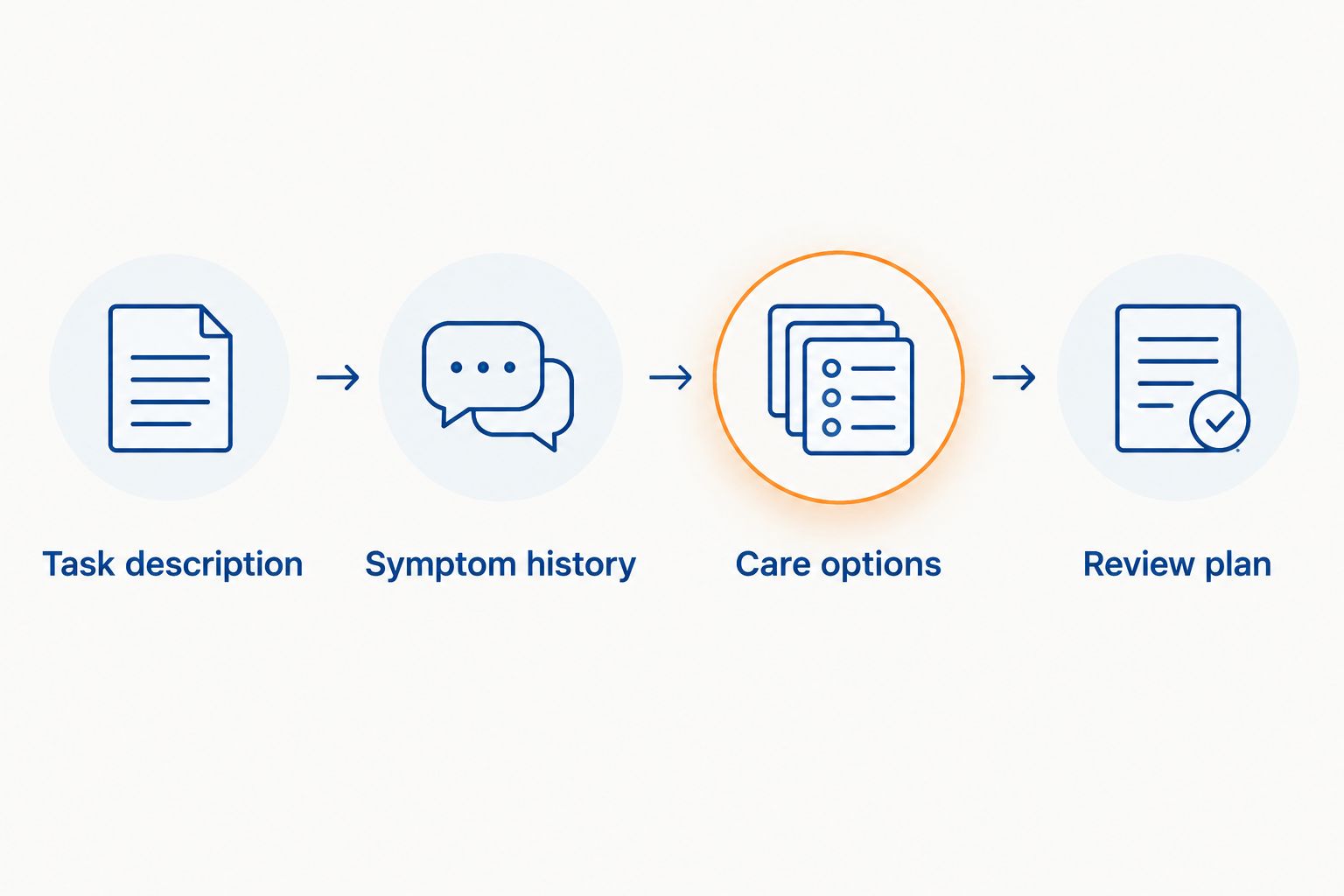
- Task description: explain the movement and working setup.
- Symptom history: note onset, changes and affected activities.
- Care options: ask what alternatives can be discussed.
- Review plan: agree how any proposed care will be reconsidered.
These four prompts organise the conversation without assuming a diagnosis or a particular clinical outcome.
4. Ask about suitability, risks and alternatives
Start with questions rather than a request for a particular technique. You do not need to arrive knowing whether you want adjustments, decompression or an exercise programme.
Ask what the clinician has identified, what remains uncertain and why a proposed approach is being considered. A description of nerve pressure or spinal alignment needs explanation; it should not become an automatic reason for repeated appointments.
For any proposed chiropractic adjustment, discuss the relevant risks, alternatives and the option of not proceeding. Ask whether your medical history changes the recommendation. A decision about care should be separate from pressure to finish demolition, painting or flooring by a particular date.
Use these 4 questions for a 2026 consultation. They are a discussion checklist, not a test that can establish clinical suitability by itself. You can request clarification and take time to consider the information before consenting.
- What findings make this option appropriate to discuss?
- What risks or precautions apply to my circumstances?
- What alternatives, including no adjustment, should I consider?
- What would prompt review, a change of approach or referral?
5. Revise the work plan instead of testing yourself
Review the practical plan before returning to a task that you stopped because of symptoms. Identify what will be different: assistance, equipment, access, working position or whether someone else should complete it.
Avoid using a demanding renovation task as a test of whether you are ready. Carrying plasterboard upstairs or sanding overhead involves more than a simple movement check. Ask a qualified health professional about activities you are unsure about rather than interpreting an appointment as general clearance.
Your 2026 project plan should allow tasks to be reassigned or postponed. Moving from flooring to ceiling work is not necessarily a meaningful change if both tasks remain uncomfortable or difficult.
Record practical changes rather than promising yourself a recovery deadline. A clinician can discuss individual activity advice; a general article cannot prescribe your workload, exercise dose or return-to-work schedule.
- Identify what needs to change before restarting.
- Reassign tasks that remain difficult or uncertain.
- Avoid treating heavy work as a readiness test.
- Discuss activity restrictions or modifications when relevant.
- Keep any agreed review separate from the project deadline.
6. Recognise when medical assessment takes priority
Do not assume symptoms are ordinary renovation soreness simply because they began during a project. Healthdirect’s back pain guidance identifies circumstances that require urgent assessment, including new bladder or bowel difficulties and loss of sensation around the groin or saddle area.
Seek prompt medical assessment for symptoms after a significant fall or other injury, new weakness, or back pain accompanied by fever or feeling seriously unwell. This is referral guidance, not a suggestion that chiropractic care manages these situations.
Stop renovation work while arranging appropriate help. If there is a medical emergency, call 000 in Australia. Do not delay emergency assessment to finish a task or attend a routine chiropractic appointment.
This list is not exhaustive. If you are uncertain about the urgency of symptoms, contact a medical service for advice. Changes in symptoms deserve reassessment rather than an assumption that a previous explanation still applies.
- Stop the task when concerning symptoms develop.
- Seek urgent help for bladder, bowel or saddle-sensation changes.
- Arrange medical assessment after significant injury.
- Report new weakness, fever or feeling seriously unwell.
- Call 000 for a medical emergency.
Compare your options before choosing care
These options address different needs. Choose according to the problem that needs assessment, not a promise to get you back to renovating faster. No option below guarantees an outcome or replaces appropriate referral.
| Option | Suited to | Practical advantage | Key limitation |
|---|---|---|---|
| DIY task and setup changes | Planning work when there is no need for clinical assessment | Lets you change access, handling and task allocation yourself | Cannot diagnose symptoms or establish fitness for demanding work |
| GP or medical service | Symptoms needing medical assessment, injury review or consideration of wider health factors | Provides a medical assessment pathway | A consultation does not itself resolve the renovation setup |
| Physiotherapy assessment | Discussing movement, function and individual exercise or activity advice | Provides a setting to assess functional concerns | Advice requires individual assessment; an online routine is not equivalent |
| Chiropractic assessment | Discussing musculoskeletal concerns and whether chiropractic care is appropriate | Provides an opportunity to consider findings, adjustments and alternatives | Adjustments are not automatically appropriate and do not replace medical assessment when indicated |
For Mychiro chiropractic care, the factual service description is a Bondi Junction clinic offering chiropractic care and spinal adjustments. That description does not establish suitability for a particular symptom, technique or renovation activity.
You can ask a provider to explain the proposed assessment before deciding whether to proceed. Registration, informed consent, relevant risks and referral arrangements matter more than promotional descriptions or another person’s experience.
Common mistakes DIY home renovators make
Treating the weekend deadline as a clinical deadline
A booked tradesperson or approaching inspection does not determine what your body can tolerate. Keep project logistics separate from decisions about symptoms, assessment and activity.
Asking for an adjustment without describing the job
A clinician needs context, not only a preferred technique. Explain whether the difficulty involves overhead drilling, floor preparation, carrying materials or working in a confined space.
Changing posture while leaving the task unchanged
A reminder to stand differently does not remove an awkward panel, obstructed route or unsuitable access setup. Reconsider the handling method and environment instead of expecting a posture cue to solve the whole task.
Using someone else’s experience as evidence of suitability
Another renovator’s appointment or exercise routine cannot establish what is appropriate for you. Discuss your own history, symptoms and preferences without expecting the same recommendation or result.
Interpreting discomfort as proof of spinal misalignment
Symptoms alone do not establish a structural explanation. In 2026, keep your description factual: where symptoms occur, when they began and which activities are affected. Leave diagnosis to an appropriate assessment.
FAQ
Do DIY home renovators need chiropractic care before starting a project?
Renovating does not automatically create a need for chiropractic care. Start with task planning, equipment instructions and appropriate assistance; discuss assessment with a qualified health professional if symptoms or health concerns warrant it.
Can a chiropractic adjustment tell me whether I can lift building materials?
A chiropractic adjustment does not establish clearance to lift building materials. The task, load, access, symptoms and individual assessment all need consideration.
Should I see a chiropractor or a GP after hurting my back renovating?
The appropriate pathway depends on the symptoms and circumstances, with medical assessment taking priority after significant injury or when concerning symptoms are present. New bladder or bowel difficulties, saddle-area numbness or new weakness require urgent medical advice.
What should I tell a chiropractor about my renovation work?
Describe the exact task, working position, symptom history and activities you have stopped or changed. Include relevant medical conditions, medicines and previous injuries so these can be considered during assessment.
Are chiropractic adjustments always part of an appointment?
An adjustment is not automatically appropriate or required. Ask about assessment findings, relevant risks, alternatives and the option of not proceeding before giving consent.
Does Mychiro offer chiropractic care in Bondi Junction?
Mychiro is a chiropractic clinic and wellness centre in Bondi Junction, Sydney, offering chiropractic care and spinal adjustments. Whether chiropractic care is appropriate for a DIY renovator depends on individual assessment.
What should I do if renovation work causes concerning symptoms?
Stop the task and seek appropriate medical advice rather than pushing through or assuming an adjustment is needed. Call 000 for a medical emergency in Australia.
One last thing
Change the job description before choosing a care option. Write down what you are actually asking your body to do, including access, tools and handling—not simply the room you want finished.
For this 2026 guide, the general education and referral framework draws on Safe Work Australia’s hazardous manual task guidance, Healthdirect Australia’s back pain information, and the Australian Commission on Safety and Quality in Health Care’s Low Back Pain Clinical Care Standard. These sources support task-risk assessment and appropriate clinical assessment; they are not evidence that chiropractic care produces a particular result for renovators.
General information cannot diagnose your symptoms or determine whether an adjustment is appropriate. Discuss individual concerns with a qualified health professional.
Related guides
- Preparing for your first chiropractor appointment
- What to expect from spinal manipulation
- Qualifications to check when choosing a Sydney chiropractor