


Instead of calling clinics to ask whether Medicare covers chiropractic appointments, start with your GP: a Medicare chiropractor referral requires an eligible care plan and a clinically appropriate referral, not just a Medicare card. This 2026 guide explains how to prepare for that discussion, check your paperwork and confirm the claiming requirements before an appointment.
- A Medicare chiropractor referral depends on GP assessment, an eligible care plan and a valid referral.
- In 2026, the standard allocation is five individual allied health services per calendar year, shared across eligible professions.
- MyChiro provides chiropractic care in Bondi Junction; ask separately about Medicare referral and claiming arrangements.
- Confirm remaining services and referral validity before attending; a Medicare card alone does not establish eligibility.
Why this matters
Medicare does not subsidise every chiropractic appointment. The chronic condition management pathway connects eligible allied health services to a GP's assessment and care plan. A referral is therefore a clinical decision, not an administrative form you automatically receive on request.
MyChiro provides chiropractic care for local patients in Bondi Junction; your GP assesses whether a Medicare referral is appropriate. You can find the clinic's general information at MyChiro, but confirm its Medicare arrangements directly rather than assuming that any appointment is claimable.
For 2026, the relevant current pathway is the GP chronic condition management plan. Services Australia describes eligibility as involving a chronic condition that has been, or is likely to be, present for at least 6 months, or a terminal condition. Your GP must also assess whether you would benefit from structured management.
The administrative rules below draw on Services Australia's chronic condition management guidance and the Medicare Benefits Schedule requirements for individual allied health services, including chiropractic item 10964, applicable to the 2026 pathway. These rules describe subsidy eligibility, not evidence that chiropractic care is appropriate for a particular condition.
Before you start
- Gather your information. Have your Medicare details, medication list, relevant reports and a short account of your symptoms, their duration and their effect on daily activities. Bring any existing care plan or allied health referral.
- Choose the appropriate GP appointment. Tell reception you want to discuss chronic condition management and whether an allied health referral is appropriate. Ask what appointment type the practice uses; a routine appointment does not automatically include care-plan preparation.
- Check the shared allocation. The standard allowance is 5 individual allied health services per calendar year, shared across eligible professions—not five chiropractic appointments plus separate allowances for each other profession. Previous allied health claims can affect what remains.
Do not delay medical assessment while organising referral paperwork if you have new, severe or rapidly worsening symptoms. This guide concerns Medicare administration, not symptom assessment or a recommendation to undergo an adjustment.
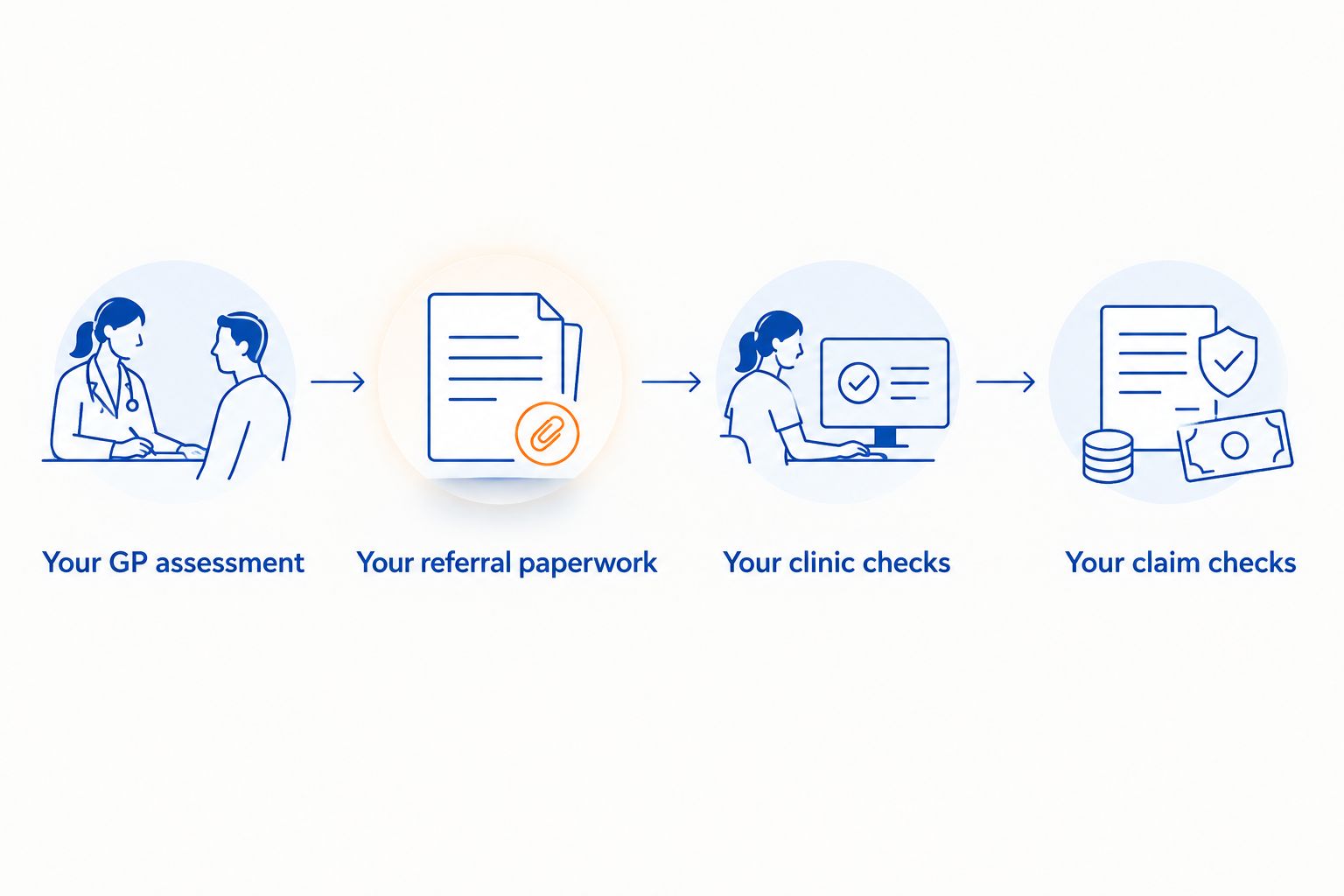
Your GP assessment
Prepare your symptom summary
- Write down when the problem started and whether it is continuous, intermittent or changing. Describe what happens rather than choosing a diagnosis yourself.
- List the activities affected, such as sitting, walking, sleeping or working. Include what you have already discussed with health professionals and any relevant investigations.
- Note previous allied health appointments in the current calendar year. Include other professions, because their eligible claims can use the same allocation.
- Take this information to your GP and ask whether a GP chronic condition management plan is appropriate. Ask about the referral pathway without requesting a predetermined clinical decision.
Your notes do not need to be polished. A clear account of the problem and your existing care gives the GP information to assess rather than a conclusion to endorse.
Expected result: your GP has enough information to discuss eligibility, identify any further assessment needed and explain the next administrative step.
Discuss the care plan
- Ask your GP to assess the condition and explain whether it meets the chronic condition management requirements. Duration alone does not establish eligibility.
- Discuss your goals and the health professionals who should be involved. Chiropractic care may be appropriate following assessment; another referral or further medical investigation may be recommended instead.
- If your GP prepares a plan, ask for a copy and an explanation of the agreed actions. Check that you understand who is responsible for each action.
- Ask how the plan will be reviewed and how information from any allied health provider will return to the GP. Keep the practice's instructions with your paperwork.
In 2026, access to these allied health services generally requires an eligible plan prepared or reviewed within the previous 18 months. The GP practice should check the applicable requirement against your records, particularly if you already have older paperwork.
A care plan does not establish that every service you request is clinically indicated. It also does not require you to undertake every possible allied health service.
Expected result: you understand whether a plan is appropriate, what it covers and whether a chiropractic referral forms part of it.
Your referral paperwork
Confirm the referral
- Ask whether the GP is referring you for chiropractic services under the chronic condition management pathway. A general recommendation to see a chiropractor is not the same as a Medicare-eligible referral.
- Obtain the referral or confirm how the GP practice will send it. Keep your own copy so you can check the information and provide it if transmission fails.
- Check your identifying details, the referring practitioner's details, the referral date and any stated duration. Ask the practice to correct errors before your appointment.
- Ask the receiving clinic to confirm that it has the referral and can check it against the relevant Medicare requirements. Do not assume that sending the care plan alone completes this step.
Under the current referral rules, a referral generally remains valid for 18 months from the first service provided under it, unless the referrer specifies another duration. Ask the GP practice and receiving provider to confirm the applicable dates for your document.
The care plan and referral serve different purposes. The plan records the broader management arrangements; the referral supports access to the particular allied health service. Keep both where you can retrieve them.
Expected result: the receiving provider has readable referral paperwork, and you understand its applicable duration.
Your clinic and claim checks
Verify the appointment requirements
- Contact the clinic before attending and say that you have a GP referral under the chronic condition management pathway. Ask whether the practitioner and proposed service meet the Medicare claiming requirements.
- Ask the clinic to check the referral paperwork and explain its billing and claiming process. Confirm whether you need to submit a claim yourself or whether the clinic handles submission.
- Check how many eligible allied health services you have already used this calendar year. Services Australia and the relevant providers can help clarify your claims record; your own appointment list is useful supporting information.
- Bring your Medicare details and any documents the clinic requests. Ask what happens if the referral or eligibility check identifies a problem before the service proceeds.
For a Medicare chiropractor referral at MyChiro, confirm the clinic's current arrangements directly. This guide does not establish that a particular practitioner, appointment type or service at the clinic is Medicare-claimable.
Medicare Benefits Schedule item 10964 describes an eligible individual chiropractic service lasting at least 20 minutes, alongside other item requirements. Appointment duration alone does not make a service eligible, and you do not select the item yourself: the provider must determine whether the requirements are met.
Expected result: you understand the paperwork, remaining allocation and claiming arrangements before attending, rather than discovering an administrative problem afterwards.
Keep a claim record
- Keep the service date, provider details and any receipt or claim confirmation after each appointment.
- Record other eligible allied health services used during the same year. Track the combined allocation, not chiropractic appointments alone.
- Check any rejected claim with the provider and Services Australia rather than submitting altered paperwork yourself.
- Tell your GP about relevant changes in your circumstances and follow the agreed review arrangements.
A simple record helps you distinguish appointments attended from Medicare services actually claimed. That distinction matters when a provider needs to investigate a remaining-allocation question or a rejected claim.
Expected result: you have a usable record for future eligibility checks and care-plan discussions.
When you already have a plan or referral
You do not necessarily need to begin with a new care plan. If you already have paperwork, start by asking your GP practice and the receiving provider to check what remains valid and whether the planned service is covered.
| Starting point | Suitable for | Advantage | Limitation | Next action |
|---|---|---|---|---|
| No existing care plan | People seeking an initial eligibility assessment | Starts with the GP's assessment of current needs | A plan or chiropractic referral is not automatic | Discuss chronic condition management with your GP |
| Current plan and referral | People checking access under existing arrangements | Existing documents can be checked before repeating paperwork | Referral validity and remaining services still need confirmation | Send the documents to the receiving provider |
| Existing plan with changed needs | People whose circumstances or care goals have changed | Allows the GP to reconsider the management arrangements | Previous referral decisions do not establish current suitability | Ask the GP whether review or a different referral is appropriate |
For existing paperwork used in 2026, check both the document rules and the annual allocation. A referral can remain valid across calendar years, while the service allowance is counted by calendar year; these are separate checks.
Do not assume that the start of a new year means you need a new referral. Equally, do not assume an old referral remains usable simply because you have services left. The receiving provider should check the document that actually applies to you.
Troubleshooting
You have a plan but no referral
Ask your GP practice whether a referral was issued and how it was sent. A care-plan copy is not a substitute for the required referral. If chiropractic care was not included, discuss that decision with your GP rather than asking the clinic to create referral paperwork.
The clinic cannot find your paperwork
Confirm which clinic or practitioner received the document and ask the GP practice to resend it through its usual process. Provide your own copy if requested. Check receipt before attending; do not assume an email or transmission was successfully received.
You have already used the annual allocation
Confirm the claims record, including services from other allied health professions. The standard 2026 allocation is five individual services across eligible professions. Discuss any further care on its own clinical merits; do not interpret the allocation as a recommendation to attend five times.
Your referral dates are unclear
Ask the receiving provider to check the referral's stated duration and the first service date where relevant. Also ask the GP practice to check the care-plan preparation or review date. Referral validity and plan recency are different requirements, so checking only one can leave a problem unresolved.
A Medicare claim is rejected
Ask the provider for the rejection reason and contact Services Australia where necessary. Possible administrative issues include referral requirements, provider eligibility or the annual service limit. Identify the actual reason before arranging another appointment or requesting replacement documents.
Customise your workflow
Keep your care plan, referral and service record together, whether on paper or in a secure digital folder. Use the same record when speaking with your GP, chiropractor or another allied health provider. Avoid sharing health documents through public or unsecured channels.
If chiropractic care forms part of the agreed plan, prepare for your first chiropractor appointment and bring the information the clinic requests. Ask about the proposed assessment, consent process, alternatives and any questions specific to your circumstances.
For chiropractic care at MyChiro, the practical next step is to clarify the referral and administrative requirements—not to assume that an adjustment will be recommended. Any proposed care should follow assessment and an informed discussion.
FAQ
How do I get a Medicare chiropractor referral from my GP?
Ask your GP whether you are eligible for a GP chronic condition management plan and whether chiropractic services are appropriate within it. If the GP issues a referral, have the receiving provider check the paperwork and remaining Medicare allocation before attending.
Does having back pain automatically qualify me for a Medicare referral?
No, back pain alone does not automatically establish eligibility. Your GP assesses the condition, the chronic condition management requirements and whether an allied health referral is appropriate.
How many chiropractic appointments does Medicare subsidise in 2026?
The standard chronic condition management allocation is five individual allied health services per calendar year, shared across eligible professions. It is not a separate allowance of five services for every profession, and each claimed service must meet the relevant requirements.
Can I use a Medicare card without a GP referral?
A Medicare card alone is not enough for a chiropractic claim under this pathway. You need an eligible care plan, a valid referral and a service that meets the Medicare item requirements.
How long does a Medicare allied health referral last?
Under the current rules, a referral generally lasts 18 months from the first service provided under it unless the referrer specifies a different duration. Ask the receiving provider to confirm the dates and rules applicable to your paperwork.
Do I need a new referral at the start of each year?
Not automatically: referral validity and the calendar-year service allocation are separate requirements. Have your existing referral, care-plan dates and remaining services checked before using it in a new year.
Can I share my Medicare services between a chiropractor and another provider?
Yes, the standard allocation can be shared across eligible allied health professions when the services are supported by the appropriate plan and referrals. Your GP should discuss the referral arrangements according to your assessed needs.
Does MyChiro accept my Medicare referral?
Ask MyChiro directly to confirm its current Medicare referral and claiming arrangements. Provide your referral details so the clinic can explain the administrative checks required before an appointment.
One last thing
Five eligible services is a subsidy limit, not a care target. Having unused services does not mean you should arrange appointments to use them up. Your GP and allied health provider should discuss care according to your assessed needs, not the number left on a calendar-year allocation.
Before your GP appointment, write down one question: what assessment and management are appropriate for my circumstances? That keeps the referral discussion focused on your care rather than on obtaining a particular document.
Related guides
- What qualifications should a Sydney chiropractor have?
- What to expect from spinal manipulation
- How to choose the right chiropractor for your condition