

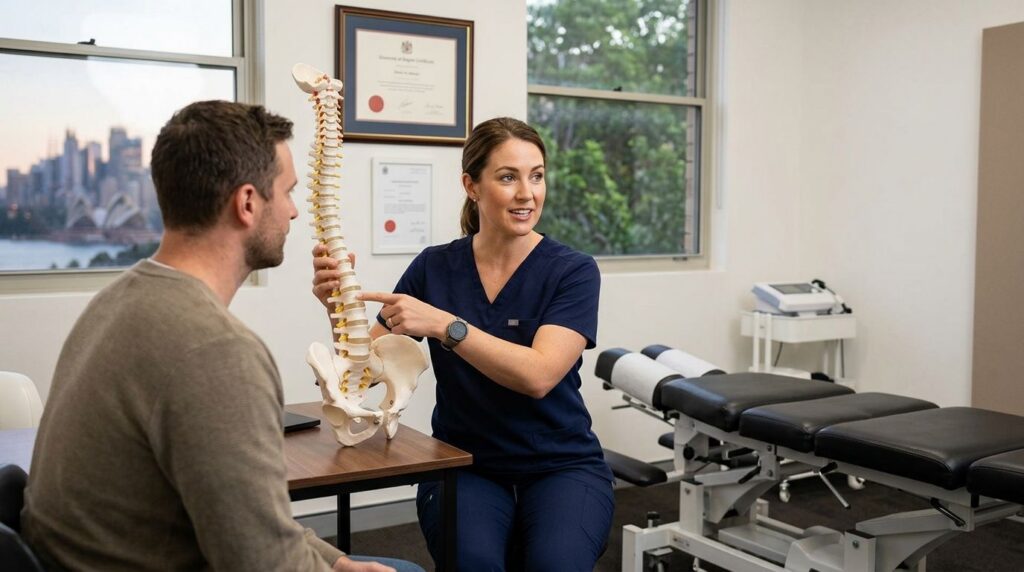
Checking a chiropractor's qualifications in Sydney comes down to one non-negotiable and a handful of strong signals. Non-negotiable: current AHPRA registration with the Chiropractic Board of Australia. Strong signal: an accredited chiropractic degree recognised under the National Law. Extra confidence: current CPD hours, professional indemnity insurance and postgraduate technique-specific training on top of the base qualification.
- Checking chiropractor qualifications in Sydney starts with AHPRA registration on the Chiropractic Board of Australia’s public register.
- An accredited chiropractic degree confirms the five-year training standard set for the profession nationally.
- Current CPD hours and professional indemnity insurance show a practice, such as MyChiro in Bondi Junction, keeps its compliance current in 2026.
- Postgraduate technique-specific training adds confidence but never substitutes for the base registration check.
Why this matters
Anyone can print a brochure that lists letters after a name. Not everyone practising under a chiropractic-sounding title in Australia has met the same regulatory bar, and the gap between "registered" and "unregistered" is the single biggest variable in chiropractor qualifications sydney searches this year.
The Chiropractic Board of Australia, under the Health Practitioner Regulation National Law, sets the floor: a recognised degree, ongoing CPD, and a live entry on the AHPRA public register. Everything past that floor — technique certificates, scope transparency, insurance currency — is where practices differentiate on substance rather than marketing copy. MyChiro operates in Bondi Junction under this same regulatory structure, and the checklist below applies whether you're assessing MyChiro or any other Sydney clinic.
What makes a qualified chiropractor
Before looking at the table, here's what to check and why each item matters on its own:
- Registration status — current, unrestricted AHPRA registration under the Chiropractic Board of Australia
- Degree accreditation — a program recognised by the Councils on Chiropractic Education Australasia (CCEA)
- CPD compliance — logged continuing professional development hours for the current cycle
- Insurance currency — active professional indemnity cover, mandatory under the National Law
- Scope transparency — clarity about what's within scope of practice and when referral to a GP or specialist is appropriate
- Technique-specific training — documented postgraduate certificates for any named technique offered
Chiropractor qualifications in Sydney: at a glance
| Qualification | What it confirms | How to verify | Limitation |
|---|---|---|---|
| AHPRA registration | Legal right to practise under the National Law | AHPRA public register, search by name | Confirms legal status, not communication style |
| Accredited degree | Completion of a CCEA-recognised chiropractic program | Ask the practice or check AHPRA's register entry | Doesn't reflect ongoing skill maintenance |
| Current CPD hours | Ongoing professional development in the current cycle | Not publicly listed — ask the practitioner directly | Self-reported unless audited by the Board |
| Professional indemnity insurance | Financial protection is in place for patients and practitioner | Ask the clinic; most disclose on request | Doesn't indicate clinical approach |
| Technique-specific training | Extra postgraduate study in a named method | Certificates, ask the practitioner what training backs a technique | Not all techniques have separate accredited certification |
| Scope-of-practice transparency | Clarity on referral pathways for conditions outside scope | Ask directly during a consultation | Depends on individual practitioner disclosure |
1. AHPRA registration: what it confirms about legal standing
AHPRA registration under the Chiropractic Board of Australia is the line between a legally practising chiropractor and someone who isn't. The public register shows the practitioner's name, registration number, and whether any conditions or restrictions apply.
AHPRA registration pros:
- Free and instant to check on the public register
- Shows any current conditions, undertakings or restrictions
- Updated by the regulator, not the clinic itself
AHPRA registration cons:
- Doesn't show years of experience or caseload
- Doesn't reflect communication style or how a consultation is run
- A clean register entry doesn't guarantee a good fit for every patient
Most relevant for: confirming a practitioner can legally use the title "chiropractor" in Sydney. Verdict: non-negotiable.
“If a chiropractor’s name doesn’t appear on the AHPRA public register, that detail matters more than anything else in the brochure.”
2. Accredited chiropractic degree: what it confirms about base training
In Australia, chiropractic degrees are accredited through the Councils on Chiropractic Education Australasia and typically run as a five-year full-time program combining a bachelor's and master's qualification. This is the academic pathway AHPRA registration is built on.
Accredited degree pros:
- Standardised curriculum across accredited providers
- Includes supervised clinical placement hours before graduation
- Recognised nationally, not state by state
Accredited degree cons:
- A degree from 2010 says nothing about training completed since
- Doesn't confirm which techniques a graduate later specialised in
- Overseas qualifications require separate assessment before AHPRA registration is granted
Most relevant for: confirming the base academic standard behind the title. Verdict: strong signal.
3. Current CPD hours: what they confirm about ongoing competence
The Chiropractic Board of Australia's continuing professional development standard requires registered chiropractors to log a minimum number of CPD hours every year — 20 hours under the current standard. This is the mechanism that keeps a 2010 graduate's knowledge current in 2026.
CPD compliance pros:
- Requires demonstrated learning activity, not just time served
- Can be audited by the Board
- Covers clinical, ethical and professional development areas
CPD compliance cons:
- Not published publicly per practitioner
- Relies on self-declaration unless audited
- Meeting the minimum doesn't indicate depth of learning
Most relevant for: confirming a practitioner isn't relying solely on training from years ago. Verdict: good sign.
4. Professional indemnity insurance: what it confirms about accountability
Professional indemnity insurance is a mandatory registration requirement under the National Law, not an optional extra a clinic chooses to carry.
Professional indemnity insurance pros:
- Mandatory, so absence is a genuine red flag
- Protects patients if something goes wrong with treatment
- Standard across the profession, easy to ask about
Professional indemnity insurance cons:
- Coverage details and limits aren't usually itemised for patients
- Having insurance says nothing about clinical outcomes
- Confirms compliance, not quality of care
Most relevant for: confirming baseline accountability is in place. Verdict: non-negotiable.
5. Technique-specific postgraduate training: what it confirms about a named method
Some chiropractors complete additional postgraduate certification in a specific technique — for example, a particular adjustment method or a decompression protocol. This sits on top of the base degree and isn't required for registration.
Technique-specific training pros:
- Shows continued interest in a particular clinical area
- Often includes hands-on supervised practice
- Useful when a patient wants a specific approach discussed at assessment
Technique-specific training cons:
- Not all named techniques have a formal accredited certificate behind them
- Marketing language sometimes overstates what a short course actually covered
- Doesn't replace an individualised assessment for each patient
Most relevant for: patients wanting to ask specifically what training backs a named technique. Verdict: extra confidence.
6. Scope-of-practice transparency: what it confirms about referral pathways
A chiropractor who's clear about what sits inside their scope — and what needs referral to a GP, physiotherapist or specialist — is demonstrating a working understanding of the profession's limits, not just its qualifications on paper.
Scope transparency pros:
- Reduces the chance of delayed diagnosis for conditions outside chiropractic scope
- Shows the practitioner works within a broader healthcare network
- Easy to test directly: ask what would prompt a referral
Scope transparency cons:
- Hard to verify before a first consultation
- Depends entirely on individual practitioner disclosure
- No public register tracks this the way it tracks formal qualifications
Most relevant for: patients with symptoms that might need medical assessment alongside chiropractic care. Verdict: good sign.
How this checklist is ordered
Registration and insurance sit at the top because they're legal requirements, not preferences — a practice can't legally operate without them. Degree accreditation and CPD sit next because they describe the training pipeline behind the registration. Technique-specific training and scope transparency sit last because they're genuine differentiators between compliant practices, not compliance thresholds themselves.
Which qualification matters most when choosing a Sydney chiropractor?
Start with the AHPRA public register, every time, before anything else. If that check clears, the accredited degree and current CPD hours are the next two things worth confirming directly with the clinic. Everything else — technique certificates, scope transparency, how a consultation is structured — is worth discussing at an initial visit, where a chiropractor can explain what's appropriate to discuss following an assessment of your particular symptoms.
MyChiro in Bondi Junction operates under this same registration and CPD structure, and patients are welcome to ask about any of the six items above before booking.
Have questions before you book?
Ask about registration, training or scope of practice before your first visit.
FAQ
What qualifications does a chiropractor need in Sydney?
A chiropractor practising in Sydney needs current AHPRA registration with the Chiropractic Board of Australia and a CCEA-accredited chiropractic degree. Ongoing CPD hours and professional indemnity insurance are also mandatory requirements, not optional extras.
How do I check if a Sydney chiropractor is registered?
Search the practitioner’s name on the AHPRA public register, which is free and updated by the regulator directly. The listing shows registration status and any current conditions or restrictions.
How many CPD hours does a chiropractor need each year in Australia?
The Chiropractic Board of Australia’s current standard requires a minimum of 20 CPD hours per year. These hours must cover recognised learning activities, not just time logged.
Do chiropractors need professional indemnity insurance in NSW?
Yes, professional indemnity insurance is a mandatory registration requirement under the Health Practitioner Regulation National Law. A registered chiropractor cannot legally practise without current cover.
Can a chiropractor use the title ‘Dr’ in Sydney?
Some registered chiropractors use the title ‘Dr’ where permitted under the National Law, provided they clearly identify as a chiropractor alongside the title. This naming requirement exists so patients aren’t confused about which profession is treating them.
Is a chiropractic degree in Australia the same length as other allied health degrees?
Chiropractic degree programs accredited by CCEA typically run five years full-time, combining bachelor and master-level study. Program length can vary slightly between providers, so it’s worth confirming with the individual practitioner.
Should I ask my chiropractor about postgraduate training?
Yes — asking what postgraduate certification backs a named technique is a reasonable question before booking. A chiropractor can explain what training they’ve completed and whether a particular approach may be appropriate following an assessment of your symptoms.
What’s the difference between AHPRA registration and CPD compliance?
AHPRA registration confirms legal standing to practise as a chiropractor in Australia, checked once and maintained annually. CPD compliance confirms ongoing learning activity within each year’s cycle, which the registration alone doesn’t capture.
One last thing
The AHPRA public register updates in real time, which means a five-minute check before booking tells you more than most clinic websites will. In 2026, that register is still the fastest way to separate a properly qualified chiropractor from a title used loosely — check it first, ask about CPD and technique training second, and leave scope-of-practice questions for the actual consultation.
Related guides
- How to choose the right chiropractor for your condition
- How to prepare for your first chiropractor appointment
- Private health funds that cover chiropractic in Sydney
- Chiropractors covering workers compensation claims in Sydney


