

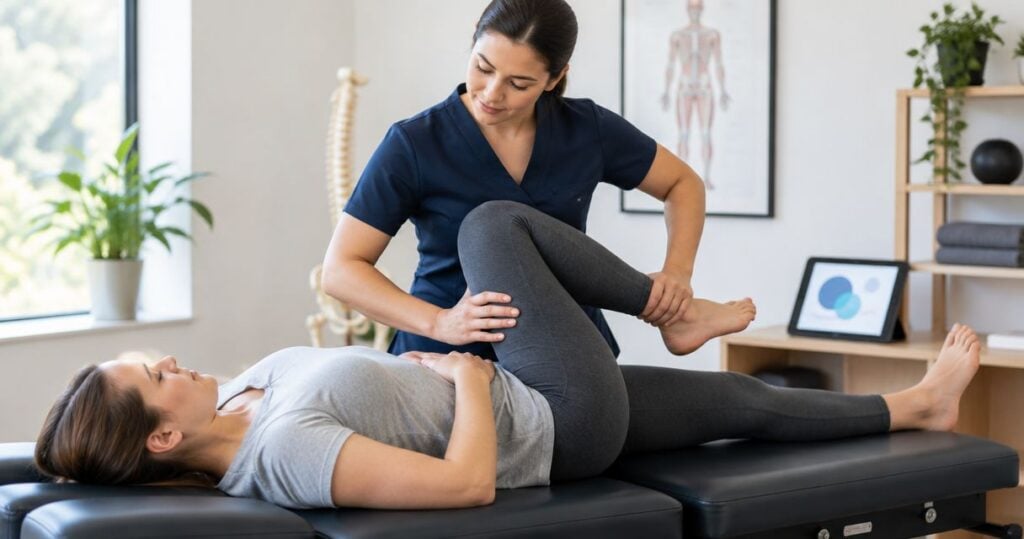
Chiropractic care for hypermobility and joint instability starts with a joint-by-joint assessment, not a standard adjustment plan lifted from a typical back pain case. Joints that already move beyond a typical range respond differently to manual therapy than stiff, restricted joints, so the approach shifts toward stability and control rather than restoring lost motion.
- Chiropractic care for hypermobility starts with a joint-by-joint assessment, not a generic adjustment plan.
- A Beighton score of 4 or more out of 9 in adults signals generalised joint hypermobility worth assessing.
- Registered chiropractors modify technique and force for lax joints instead of defaulting to high-velocity thrusts.
- Strengthening and proprioception work matters more than stretching once a joint already moves too far.
- Swelling, fainting or unexplained bruising alongside joint symptoms need GP review, not a chiropractic booking.
Why chiropractic care matters for hypermobility
A joint that dislocates or slips out of position doesn't need more range of motion, it needs a better system for controlling the range it already has. That's the practical difference between hypermobility care and the stiff-neck-and-tight-hip cases most back pain content is written for.
The chiropractic clinic at MyChiro in Bondi Junction builds care plans around this distinction: assessment first, then a stability-focused plan discussed with the patient, adjusted case by case. Joint hypermobility is commonly screened using the Beighton scale, a 9-point system covering the fingers, thumbs, elbows, knees and spine. Adults typically need a score of 4 or more out of 9, and adolescents 6 or more, before the pattern is considered clinically significant rather than one flexible joint on its own.
Because hypermobility can sit alongside connective tissue conditions, sensible care in 2026 treats chiropractic input as one part of a bigger picture that may include a GP, a physiotherapist, or a rheumatologist, not the only stop.
The 7-step approach below
Each step below moves from free, self-directed action toward the point where a registered chiropractor's assessment adds something a home routine can't.
Get an assessment before starting any program
Self-diagnosing hypermobility from being able to touch your thumb to your forearm is a party trick, not a clinical pattern. A proper assessment separates the two.
- Beighton score testing across the standard 9 points
- A joint-by-joint history of dislocations, subluxations or "giving way" episodes
- Family history check, since hypermobility patterns often run in families
- Screening for red-flag symptoms that need GP referral rather than joint work
- Baseline notes or range-of-motion records so progress can be tracked over time
Build joint stability with targeted strengthening
Flexibility without stability is just a joint waiting to slip. Strengthening work for hypermobile joints looks different from a general mobility routine because the goal is control, not more range.
- Closed-chain exercises like wall sits and step-ups that load joints in controlled positions
- Isometric holds before progressing to dynamic movement
- Proprioception drills such as single-leg balance or wobble-cushion work
- Avoiding end-range stretching, which many hypermobile people default to because it "feels good"
- Slow, staged load progression week to week rather than chasing extra flexibility

“Flexibility without stability is just a joint waiting to slip.”
Discuss chiropractic care options with a registered chiropractor
Once the self-directed basics are in place, an assessment-led conversation with a registered chiropractor can shape a more individual plan.
- Ask how technique is modified for lax joints, including whether lower-force mobilisation is used instead of a high-velocity thrust
- Request a written plan tied to your specific assessment findings
- Confirm the practice will coordinate with your GP or a rheumatologist if broader symptoms are present
- Ask about home exercise support between visits
- Clarify how progress will be measured beyond symptom relief, such as stability or control markers
Adjust daily movement and ergonomics
Small daily habits either protect a lax joint or keep loading it into positions it can't control.
- Swap deep static stretches during warm-ups for active mobility instead
- Choose supportive footwear over minimalist shoes for standing-heavy days
- Set up desks and workstations to avoid locking knees or elbows into hyperextension
- Use bracing or taping for the specific joint most prone to giving way
- Pace repetitive tasks with scheduled breaks rather than pushing through a full shift
Track flare patterns and your baseline
A symptom log turns "my joints feel off" into information a chiropractor or GP can actually use.
- Note which joints slip or ache after specific activities
- Log sleep quality and fatigue alongside pain, since the two frequently overlap in hypermobility
- Rate stability, not just pain, week to week
- Bring the log to follow-up assessments
- Watch for patterns tied to overtraining one joint or under-supporting another
Know the red flags that need medical referral
Some symptoms sit outside routine joint instability management and need a GP, not a chiropractic booking.
- Joint swelling with heat or redness
- Chest pain, palpitations or fainting episodes
- Unexplained bruising or unusually fragile skin
- Numbness or weakness spreading beyond one limb
- Persistent symptoms in a child or teenager that don't settle with rest
Review footwear, bracing and support options
Support tools have a place, but they work best alongside strengthening, not instead of it.
- Supportive shoes for standing or walking-heavy days
- Joint-specific braces for ankles or knees prone to giving way
- Kinesiology taping for short-term support during a specific event
- Avoiding long-term reliance on bracing, which can let stabiliser muscles weaken further
- Revisiting support choices every few months as strength improves
Comparing care options for hypermobility and joint instability
| Care option | Best for | Key limitation |
|---|---|---|
| Self-directed strengthening program | People with mild, occasional joint slips wanting a starting point | Without assessment, exercises can target the wrong joint or load it incorrectly |
| Chiropractic assessment and care plan | People wanting an individual movement and stability plan alongside manual therapy | Not a stand-alone solution for systemic connective tissue conditions |
| Physiotherapy referral | People needing structured rehab protocols and progressive loading | Public pathway wait times can be longer than private options |
| GP or rheumatology referral | People with suspected connective tissue disorders or multi-joint involvement | Requires a GP referral and availability varies by region |
Book a joint stability assessment
Start with an assessment before any adjustment or exercise plan is discussed.
Common mistakes with hypermobility and joint instability
- Chasing extra stretch because it feels good, when the joint already exceeds a typical range and stretching adds instability
- Skipping assessment and self-diagnosing based on being "double-jointed" rather than checking for a clinical pattern
- Loading heavy weights into an unstable joint position, such as locked-out elbows or hyperextended knees, during gym sessions
- Dismissing fatigue as unrelated to joint symptoms, when the two frequently overlap in hypermobility
- Relying on bracing indefinitely instead of building the stabiliser strength the brace is meant to support
Joint instability that includes ankle sprains or repeated "giving way" episodes often benefits from the same stability-first logic covered in ankle sprains and instability, which walks through proprioception work for a single joint in more depth.
FAQ
What is joint hypermobility?
Joint hypermobility means a joint moves beyond the range typically seen in the general population, often screened using the Beighton scale, a 9-point system covering the fingers, elbows, knees and spine. A single flexible joint isn’t unusual; the pattern becomes clinically relevant when several joints score positive alongside symptoms like pain or a history of sprains.
Can a chiropractor help with hypermobility?
A registered chiropractor can assess joint stability, discuss a movement and strengthening plan following that assessment, and coordinate with your GP when broader connective tissue concerns are suspected. Chiropractic care is one part of managing joint instability, not a stand-alone solution for systemic conditions.
Are high-velocity adjustments appropriate for hypermobile joints?
Whether a high-velocity adjustment is appropriate depends on the individual joint and the assessment findings, since lax joints often respond better to lower-force mobilisation and stability-focused technique. This decision follows assessment rather than being applied by default to every patient.
What is the Beighton score used for?
The Beighton score is a 9-point clinical screening tool used to flag generalised joint hypermobility across the fingers, thumbs, elbows, knees and spine. Adults typically need a score of 4 or more, and adolescents 6 or more, before the pattern is considered clinically significant.
How is hypermobility care different from typical back pain care?
Hypermobility care shifts the focus from restoring lost range of motion, which is common in stiff-joint back pain cases, toward building stability and control in joints that already move too far. Exercise selection, adjustment force and home advice are adjusted accordingly.
Can exercise make hypermobility worse?
The wrong exercise, particularly deep stretching or heavy loading in an unstable joint position, can aggravate hypermobile joints, while controlled strengthening and proprioception work generally supports stability. A chiropractor or physiotherapist can help sequence a program around the joints most affected.
When should someone with joint instability see a doctor instead of a chiropractor?
Joint swelling with heat or redness, fainting or palpitations, unexplained bruising, or spreading numbness and weakness need GP review rather than a chiropractic booking. These signs sit outside routine joint instability management and need broader medical assessment.
One last thing
Most fitness assessments measure how far you can stretch, which is exactly the wrong test for a hypermobile joint in 2026 or any other year. Ask for a stability or proprioception test instead, such as a timed single-leg balance comparison between sides, so you know where a joint actually loses control rather than how far it can bend.
Related guides
- Resistance bands for at-home back rehab exercises
- Choosing the right chiropractor for your condition
- When back pain needs a doctor instead of a chiropractor


