

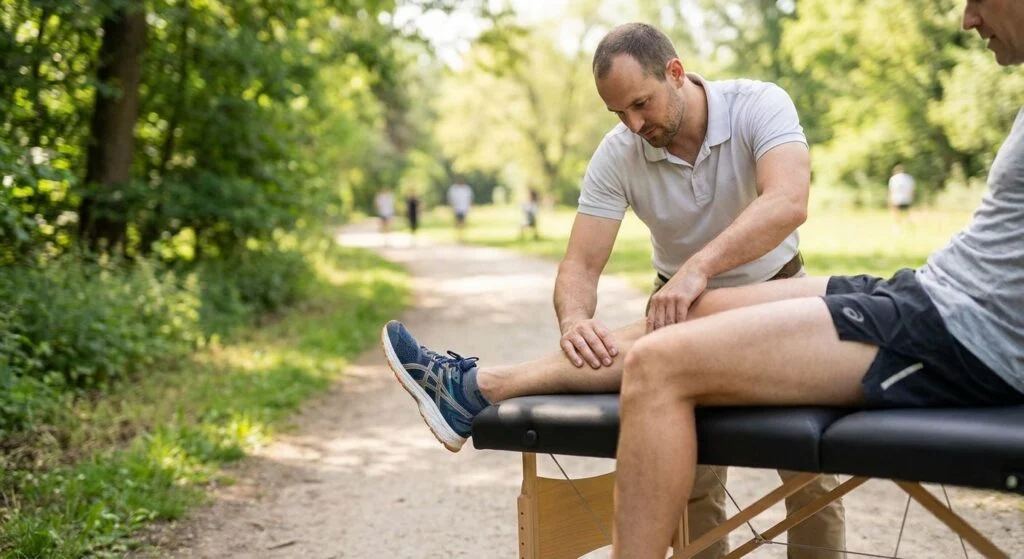
Iliotibial (IT) band syndrome is a common cause of lateral knee pain in runners, usually linked to how the hip, pelvis and lower limb move together rather than a problem with the knee joint itself. Runners chasing higher weekly mileage or a spring 2026 race goal are the group most likely to search for a chiropractor for IT band syndrome once rest and stretching stop settling the ache.
- IT band syndrome causes lateral knee pain in runners and is usually linked to hip and pelvic mechanics, not just the knee.
- A chiropractor for IT band syndrome typically starts with a gait, hip and pelvic assessment before any hands-on care is discussed.
- Reducing weekly mileage and building hip abductor strength are common first steps before a clinic visit is needed.
- MyChiro in Bondi Junction offers assessment-based chiropractic care for runners, with any adjustments following a full movement review.
Why chiropractic care matters for runners with IT band syndrome
Runners are repetitive-load athletes. The same hip drop, pelvic tilt or leg-length pattern that goes unnoticed at 20km a week can start causing friction over the lateral femoral condyle once volume climbs toward a marathon block in 2026. That's why lateral knee pain in runners so often traces back to the hip, not the knee.
A chiropractor for runners dealing with knee and hip pain typically looks at the whole kinetic chain: foot strike, hip control, pelvic alignment and spinal mechanics, because IT band tension is often a symptom of how those parts move together during a stride cycle, not an isolated soft-tissue fault.
This matters for training decisions too. A runner who keeps stretching the IT band directly but never addresses hip abductor weakness or a mileage jump tends to see the same pain return every time training load increases. Understanding the actual driver changes what you do about it.
The mechanical pattern behind most cases
Most IT band irritation in runners shows up alongside one or more of these:
- A rapid increase in weekly mileage, commonly more than 10% week-on-week
- Hip abductor and glute medius weakness on the affected side
- A pelvic drop visible on video during single-leg stance
- Worn or uneven-wearing running shoes
- Repeated downhill running or one-sided road camber
None of these guarantee IT band syndrome will develop, and identifying one doesn't mean it's the only factor at play. It does give you a starting point for the steps below.
Step-by-step: managing IT band syndrome as a runner in 2026
Step 1: Track when the pain actually shows up
Before changing anything, note the pattern. Pain that starts at a predictable distance, gets worse on downhills, or eases with rest but returns the next long run tells you far more than a single sore session.
- Log distance, pace and surface for each run this week
- Note the exact point in the run when pain starts
- Rate pain 0-10 immediately after, not the next morning
- Flag whether pain affects your stride or gait
- Record any recent change in shoes, terrain or training plan
Step 2: Adjust training load before anything else
The first-line, no-cost step for most runners is reducing load, not adding treatment. A short block of reduced mileage or cross-training often lets irritated tissue settle before you reassess.
- Cut weekly mileage back toward your pre-flare baseline
- Swap one hard session for cycling, swimming or the elliptical
- Avoid downhill repeats and heavily cambered footpaths for now
- Keep easy runs genuinely easy rather than pushing through discomfort
- Reassess pain levels after 7-10 days of reduced load
Step 3: Have your hip, pelvis and gait assessed
If pain keeps returning as soon as mileage climbs back up, a broader assessment of hip, pelvic and lower-limb mechanics can be discussed with a qualified health professional. This is the point where a chiropractic assessment may be appropriate, alongside or instead of physiotherapy, depending on your history and findings.
- Ask for a gait or running-form review, not just a knee check
- Have hip and pelvic alignment assessed, not only the sore leg
- Discuss any leg-length or pelvic asymmetry findings
- Get a clear explanation of what the assessment found before agreeing to a care plan
- Confirm what red flags would mean referral to a GP or sports physician
Step 4: Build hip abductor and core strength
Weak hip abductors and a poorly controlled core are consistently linked to the hip drop pattern seen in runners with lateral knee pain. Strength work is slower than stretching but tends to address more of the underlying pattern. Guidance on building core strength without straining your lower back is useful here, since core control and hip stability work together during a running stride.
- Side-lying hip abduction, 2-3 sessions per week
- Single-leg glute bridges
- Clamshells with a light resistance band
- Step-downs to check for hip drop under control
- Planks and dead bugs for anti-rotation core control
Step 5: Stretch and mobilise the surrounding tissue
Direct IT band stretching has limited evidence behind it, but mobility work for the hip flexors, glutes and quads around it can support the strength work above. Static stretches are commonly held for around 30 seconds per side.
- Kneeling hip flexor stretch
- Figure-four glute stretch, lying or seated
- Standing quad stretch against a wall
- Foam rolling the outer thigh and glutes, avoiding direct pressure on painful spots
- Dynamic hip openers as part of your warm-up
Step 6: Review footwear and running surfaces
Worn shoes and one-sided terrain compound an existing mechanical pattern. A shoe review is a low-cost check worth doing alongside the steps above, not a substitute for them.
- Replace running shoes showing uneven outsole wear
- Rotate running direction on cambered roads or tracks where possible
- Consider a gait analysis at a specialty running store
- Avoid switching to a very different shoe type mid-training block
- Reintroduce hills gradually rather than all at once
Step 7: Know when to bring in a health professional
If pain doesn't ease with load management and strength work over several weeks, or if you notice swelling, locking, or pain that changes character, it's worth discussing next steps with a health professional rather than continuing to self-manage. Guidance on choosing the right chiropractor for your condition covers what to ask before booking, including how a clinic approaches assessment before recommending care.
“Symptoms that return every time weekly mileage climbs usually point to a mechanical pattern, not bad luck.”
Comparing your options for IT band syndrome relief
| Option | Best for | Key limitation |
|---|---|---|
| Self-myofascial release (foam rolling) | Mild, intermittent outer-thigh tightness | Doesn't address the hip or gait pattern driving the friction |
| Home strength program (hips, glutes, core) | Runners willing to commit to consistent training | Takes weeks of consistent work to shift movement patterns |
| Physiotherapy | Runners wanting a structured, exercise-led rehab plan | May involve several visits depending on findings |
| Chiropractic assessment and care | Runners whose symptoms return despite load changes and who want hip/pelvis mechanics reviewed | Not a first step without ruling out other causes of lateral knee pain |
| GP or sports medicine referral | Persistent swelling, locking, or pain unrelated to training load | Usually only needed when red-flag symptoms appear |
Have your running mechanics assessed
Book an assessment to review hip, pelvic and lower-limb mechanics before your next training block.
Common mistakes runners make with IT band syndrome
- Ramping mileage back up too fast after a break. A week off followed by a return to full volume is a common trigger for a repeat flare in 2026 training blocks.
- Stretching the IT band directly and ignoring hip weakness. The band itself has limited flexibility to gain; the muscles controlling the hip usually need the work.
- Running through pain until forced to stop entirely. Early load adjustments are far easier to make than managing a full stoppage later.
- Changing shoes or adding orthotics without addressing the movement pattern. New footwear can help, but it doesn't replace a hip and gait assessment.
- Skipping the warm-up on hill or interval days. Cold hip and glute muscles are less able to control pelvic movement under load.
FAQ
What is IT band syndrome in runners?
IT band syndrome is lateral knee or thigh pain caused by friction and irritation where the iliotibial band crosses the outside of the knee, common in runners increasing mileage. It’s usually linked to hip and pelvic control rather than a fault in the band itself.
Can a chiropractor help with IT band syndrome?
A chiropractor can assess hip, pelvic and lower-limb mechanics that may be contributing to IT band symptoms, and any care plan follows that assessment. Whether chiropractic care is appropriate depends on individual findings and should be discussed with a qualified health professional.
How long does IT band syndrome take to settle?
Recovery time varies depending on training history, load and how early adjustments are made, so there’s no fixed timeline. It’s best discussed with a health professional once your specific pattern has been assessed.
Should I stop running with IT band syndrome?
Most runners reduce volume and adjust training rather than stop completely, but the right amount of rest depends on pain severity and how it responds to load changes. A health professional can help set a return-to-run plan.
What’s the difference between a chiropractor and a physiotherapist for IT band syndrome?
Chiropractors typically focus on assessing spinal, pelvic and joint mechanics, while physiotherapists often lead with structured exercise rehab programs. Many runners use one or both depending on assessment findings.
What exercises help IT band syndrome?
Hip abductor strengthening, glute activation work and core control exercises are commonly recommended alongside gradual mobility work for the hip flexors and quads. A tailored program depends on individual assessment.
When should I see a doctor instead of a chiropractor for IT band syndrome?
See a GP or sports physician if you notice swelling, locking, numbness, or pain that doesn’t follow the usual running-related pattern. These signs warrant medical assessment before continuing self-management.
Does foam rolling help IT band syndrome?
Foam rolling the outer thigh and surrounding muscles is a common self-management step, though it doesn’t address hip weakness or gait patterns on its own. It’s usually paired with strength work rather than used alone.
One last thing
The outer thigh isn't where the problem usually starts. Runners who address hip control and training load together in 2026, rather than treating the IT band in isolation, tend to have a clearer picture of why the pain kept coming back in the first place.
Related guides
- How to choose the right chiropractor for your condition
- How to warm up before a workout to prevent back injury