

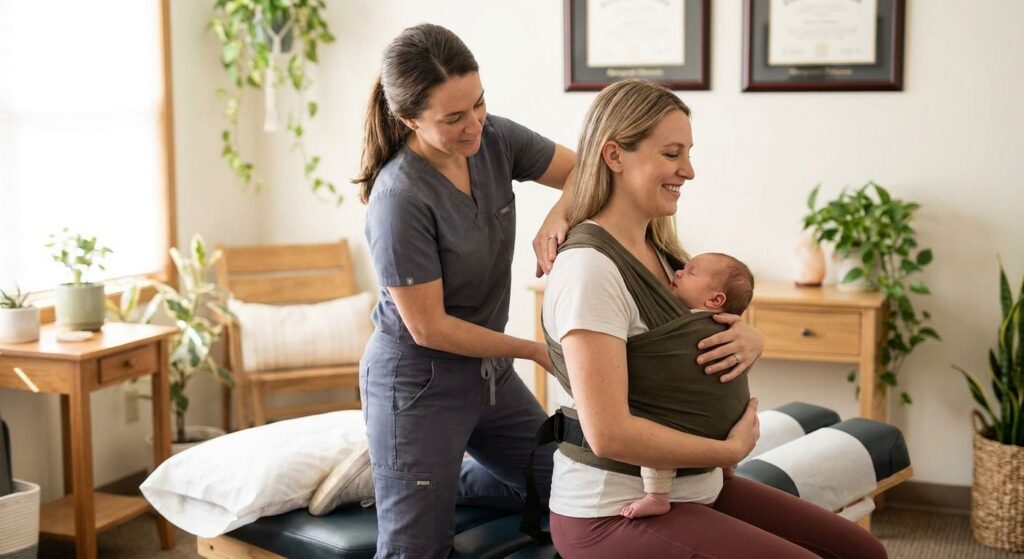
Postpartum chiropractic care addresses the back pain, pelvic instability and nursing-related neck strain that show up weeks or months after delivery, and this guide breaks down what actually helps versus what wastes your recovery window.
- Start postpartum chiropractic care around the 6-8 week mark once your GP or obstetrician clears you.
- SI joint and pelvic assessment matters more than generic spinal adjustments in the first three months.
- C-section recovery needs gentler mobilisation, not high-velocity thrusts, until scar tissue has settled.
- A home exercise plan for feeding and carrying posture multiplies the benefit of in-clinic visits.
Why this matters
Pregnancy and birth reshape your spine, pelvis and posture faster than almost any other physical event your body goes through, and most of that reshaping doesn't reverse on its own by 2026 standards of postpartum care. Relaxin loosens ligaments for months after delivery, feeding posture rounds the upper back and neck for hours a day, and carrying a baby on one hip shifts load through the SI joints unevenly.
The clinics doing this well, including Mychiro in Bondi Junction, treat postpartum recovery as a distinct phase from general back pain care, not an extension of it. That distinction is the whole reason this guide exists.
Who this is for
This is for mums between roughly 6 days and 12 months postpartum dealing with lower back pain, SI joint or pubic symphysis discomfort, sciatica-type leg pain, upper back and neck tightness from nursing, or tension headaches from broken sleep and forward head posture. It's not a substitute for pelvic floor physiotherapy, and it's not the right starting point if you haven't had medical clearance after a complicated delivery.
What to look for in postpartum chiropractic care
Experience with pregnancy-specific biomechanics
A practitioner who treats postpartum bodies daily will check SI joint alignment, pubic symphysis tenderness and diastasis recti before touching your spine. Generic back-pain protocols miss the ligament laxity that relaxin leaves behind, and that laxity can persist for 4 to 6 months after birth.
Techniques matched to your healing stage
High-velocity, low-amplitude thrusts aren't automatically off the table, but a clinician who adjusts technique for C-section scar tissue, tearing, or general fatigue is doing it right. Low-force methods and soft tissue work are usually the safer starting point in the first 6-8 weeks.
Fast access when pain is fresh
Pain that sits untreated for months tends to compensate itself into a second problem, usually in the opposite hip or the neck. Same-day or next-day availability matters more here than in almost any other chiropractic scenario, because the postpartum window is short and busy.
A whole-body, not just spine, approach
Sleep deprivation, feeding position, stress and posture all feed into postpartum pain, which is why biopsychosocial care outperforms spine-only adjustments in outcome studies on manual therapy. Ask whether the clinic addresses sleep and posture habits, not just the joint that hurts.
Clear home exercise guidance
A 10-minute in-clinic adjustment does little if you spend six hours a day hunched over a feeding pillow. The practitioners worth paying for hand you 2-3 specific exercises tied to your actual daily movements, not a generic sheet.
Willingness to coordinate with your GP or obstetrician
After a C-section or an assisted delivery, chiropractic care should work alongside your medical follow-up, not around it. A clinic that asks about your birth history and defers to medical clearance when needed is the one to trust.
Recommended care approaches, ranked
1. Initial postural and SI joint assessment – the starting point. This is the single most useful first appointment, typically booked around the 6-week mark, and it flags pelvic misalignment before it becomes chronic. Skipping straight to symptom-only treatment means missing the root cause. Buy.
2. Nerve-focused adjustment for lingering leg pain – for the sciatica holdovers. If pregnancy-related nerve pressure didn't resolve by week 8, targeted adjustment and decompression work address the mechanical pressure directly rather than masking it with rest alone. Buy.
3. Soft tissue work for nursing-related upper back and neck tension – the desk-job-you-never-signed-up-for pick. Feeding sessions can add up to 3-4 hours a day in a flexed neck position during the newborn stage, and targeted soft tissue release plus posture cueing addresses that load directly. Buy.
4. Home exercise programming – the low-cost multiplier. A short daily routine, usually 5-10 minutes, reinforces every adjustment between visits and shortens the number of sessions you'll need overall. Consider, and treat it as mandatory rather than optional if your clinic offers it.
5. Gentle mobilisation after C-section – the cautious pick. Scar tissue and abdominal wall healing take longer than most people expect, often 6-12 weeks before full mobility work is appropriate. Anything more aggressive before that window closes is a Skip.
What to avoid
- Generic "back pain" protocols with no pregnancy history intake. If nobody asks about your delivery type, tearing, or C-section, that's a sign you're getting treated like any other back pain patient, not a postpartum one.
- High-velocity adjustments booked before medical clearance. This looks like efficient, no-nonsense care but skips the step that actually protects healing tissue.
- One-size posture advice that ignores diastasis recti. Standard core-bracing cues can worsen abdominal separation if nobody's checked for it first.
Book a postpartum assessment
Get your SI joint, posture and nerve pressure checked before pain becomes chronic.
Verdict comparison
| Care approach | Best for | Typical timing | Verdict |
|---|---|---|---|
| SI joint and posture assessment | Everyone starting postpartum care | 6 weeks postpartum | Buy |
| Nerve-focused adjustment | Lingering sciatica-type pain | 8+ weeks postpartum | Buy |
| Soft tissue work for neck/upper back | Frequent nursing or bottle-feeding | Ongoing | Buy |
| Home exercise program | Extending in-clinic results | Daily, 5-10 min | Consider |
| Gentle C-section mobilisation | Post-surgical recovery | 6-12 weeks postpartum | Consider |
“If you’re still guarding your lower back at six weeks postpartum, that’s not normal, it’s fixable.”
If you want the fuller picture of how spinal changes during pregnancy set up these postpartum issues, the chiropractic care during pregnancy guide covers what shifts trimester by trimester and why so much of it doesn't reverse on its own.
FAQ
When should you start postpartum chiropractic care?
Most clinics recommend starting around 6-8 weeks postpartum, once you’ve had medical clearance from your GP or obstetrician. Earlier gentle care is sometimes appropriate for specific pain, but full adjustment work usually waits for that clearance.
Is postpartum chiropractic care safe while breastfeeding?
Yes, chiropractic adjustments don’t interfere with breastfeeding or milk supply. Sessions are often timed around feeding schedules purely for comfort and convenience, not medical necessity.
How much does postpartum chiropractic care cost in 2026?
Pricing varies by clinic and by whether it’s an initial assessment or a follow-up adjustment. Check current rates directly with the clinic since 2026 pricing differs between initial and standard visits.
Can chiropractic care help with postpartum pelvic pain?
Chiropractic adjustment targeting the SI joint and pubic symphysis can reduce postpartum pelvic pain caused by ligament laxity from pregnancy. It works best combined with pelvic floor physiotherapy rather than as a standalone fix.
Is chiropractic care different after a C-section versus a vaginal birth?
Yes, C-section recovery calls for gentler mobilisation around the abdominal wall and scar tissue for the first 6-12 weeks. Vaginal birth recovery focuses more on pelvic floor and SI joint alignment from the start.
How many postpartum chiropractic visits do most mums need?
It depends on how long symptoms have been present and how consistent the home exercise routine is, so visit counts vary between patients. A clear treatment plan should be laid out after the initial assessment, not left open-ended.
Does postpartum chiropractic care help with headaches?
Adjustment focused on the upper back and neck can reduce tension headaches linked to nursing posture and disrupted sleep. It works alongside sleep and posture changes, not as a substitute for them.
One last thing
The upper back and neck tension from feeding posture often outlasts the SI joint pain by months, because nobody treats it as a separate problem worth its own plan. Ask specifically about neck and thoracic work at your first postpartum visit, not just pelvic alignment, since 2026 clinic data on manual therapy outcomes keeps pointing to combined spine-and-soft-tissue plans over single-region adjustment.
Related guides