


Pet groomers’ chiropractic care is assessment and care provided by a chiropractor, with the aim of informing decisions about musculoskeletal concerns that affect grooming work. This 2026 guide explains how to review your workstation, animal-handling tasks and care options without assuming that adjustments are appropriate for every symptom.
- Chiropractic care for pet groomers starts with assessment, not an automatic adjustment plan.
- MyChiro provides chiropractic care in Bondi Junction; suitability for an individual pet groomer requires assessment.
- Review grooming ergonomics, animal transfers and tool placement alongside any discussion of care.
- Discuss alternatives, risks and review points before agreeing to chiropractic adjustments.
Why chiropractic care matters for pet groomers
Pet grooming involves more than standing at a table. Your work can include bathing, clipping, drying, reaching around an animal and moving equipment between stations. A useful assessment needs to account for those tasks rather than treating every concern as a posture problem.
Animals also move. A workstation arrangement that suits a cooperative small dog does not necessarily suit another animal, so handling arrangements belong in the discussion alongside your symptoms.
The practical question is whether chiropractic care is appropriate following assessment—not whether pet groomers need routine adjustments. Workplace changes and medical assessment remain separate decisions; one does not replace the other.
For your 2026 workplace review, Safe Work Australia’s Hazardous Manual Tasks model Code of Practice provides a framework for considering force, repetition, sustained positions and task design. The related guide on handling and lifting heavy objects offers another starting point, although moving a live animal requires its own handling assessment.
Build a task-specific plan before choosing care
Record the grooming tasks you want to discuss
Start with a written description of your work. You do not need a tracking app: a notebook can capture which task you were doing, what you noticed and whether you changed or stopped the task.
Choose 3 tasks to describe in detail, such as bathing, clipping and transferring animals. This is a manageable starting list, not a clinical monitoring schedule. Record concerns without diagnosing yourself; a note about discomfort during drying is more useful than assuming that a particular joint or nerve is responsible.
Include work outside the grooming table. Cleaning tubs, carrying supplies and driving a mobile grooming vehicle can otherwise disappear from the conversation.
- Name the task and equipment involved.
- Note the animal’s movement and your handling position.
- Describe symptoms in your own words.
- Record whether symptoms occur away from work.
- Bring relevant previous assessment information.
Review one workstation before changing everything
Inspect 1 workstation first, using your existing equipment. Walk through the task without an animal present and notice where you reach, bend, turn or hold equipment. This is a layout review, not a test of your spine.
Look at the whole sequence. Moving clippers closer achieves little if you still have to reach across the table for every attachment. Likewise, a table adjustment must account for animal access, restraint arrangements and the equipment manufacturer’s instructions.
Your 2026 workstation checklist should describe what can actually change in the available space. Avoid buying equipment solely because it is advertised as ergonomic; compare its adjustment range, cleaning requirements and suitability for your workflow.
- Place frequently used tools within practical reach.
- Check that cables do not obstruct movement.
- Review table and tub adjustment instructions.
- Keep access routes clear of stored supplies.
- Identify tasks that require awkward access.
Plan animal transfers instead of relying on lifting technique
Map how an animal reaches the bath, grooming table and collection area. Begin with the handling resources already available: an appropriate access arrangement, a colleague’s assistance or a different task sequence. Follow workplace procedures and animal-handling training.
Do not use a general lifting tip as permission to lift an animal you cannot control. An animal’s behaviour and the surrounding space matter, not just its weight. If the transfer cannot be performed within your workplace’s handling arrangements, stop and organise another approach.
If physical symptoms are affecting transfers, assessment can be discussed with a qualified health professional. MyChiro provides chiropractic care and spinal adjustments in Bondi Junction; those services do not replace a workplace animal-handling plan.
- Review access to baths and tables.
- Identify transfers that need assistance.
- Follow restraint and handling procedures.
- Avoid lifting while holding grooming tools.
- Report equipment or space limitations to the manager.
Build task variation into the grooming schedule
Review the booking sheet and identify where the same task repeats without a change in position or activity. Start with scheduling adjustments that your workplace can accommodate, rather than assuming that a particular break interval suits every groomer.
Task variation does not mean rushing an animal’s care or leaving it unattended. Discuss changes with colleagues and retain the handling and supervision arrangements required for each animal. A different task is only a useful alternative if you can perform it appropriately.
For a 2026 roster review, distinguish between changes you control and changes that need manager approval. A solo mobile groomer has different options from a salon with several staff members.
- Separate demanding transfers where scheduling allows.
- Alternate compatible grooming and administrative tasks.
- Plan pauses when the animal is appropriately supervised.
- Allow time to reposition equipment between appointments.
- Raise recurring scheduling constraints with the manager.
Ask what an assessment will involve
Prepare a short work summary before contacting a health professional. Explain the concern, its history and the tasks it affects. Ask whether that practitioner’s scope is appropriate and whether medical assessment or another referral should come first.
Chiropractic assessment does not automatically mean receiving an adjustment. If an intervention is proposed, ask why it is being considered, what alternatives exist and what risks apply to your circumstances. The guide on what to expect from spinal manipulation provides background for that conversation, not confirmation that manipulation suits you.
MyChiro provides chiropractic care for local adults, including pet groomers considering an assessment in Bondi Junction. That describes the service and audience; it does not predict an individual outcome.
- Explain the grooming tasks affected.
- Disclose relevant conditions, medicines and previous injuries.
- Ask about proposed examination procedures.
- Request an explanation of alternatives and risks.
- Ask when referral to another practitioner is appropriate.
Agree on a plan you understand
If care is proposed, connect the discussion to a specific concern rather than accepting a vague promise about alignment. You should understand what the practitioner proposes, why it is relevant and how the decision will be reviewed.
Write down 2 questions before the discussion: what would justify continuing, and what would justify changing or stopping the plan? These are decision questions, not a prescribed appointment schedule. You can also ask what happens if you choose not to proceed.
At MyChiro or another clinic, discuss any proposed adjustments in the context of your assessment. Do not assume that a named technique, equipment item or repeated appointment schedule demonstrates suitability.
- Identify the concern the plan addresses.
- Ask what information supports the recommendation.
- Discuss alternatives, including no intervention.
- Agree on when the plan will be reviewed.
- Ask how new symptoms should be reported.
Review work changes separately from clinical care
Keep a simple record of workplace changes alongside any care you choose. Describe what changed and whether the task became easier or harder to perform. Avoid treating a good shift or a difficult shift as proof that one intervention caused the difference.
Your 2026 review can include practical observations: whether assistance was available, whether a tool remained accessible and whether the table setting suited the task. Those observations help identify operational problems without turning your notes into a diagnosis.
If concerns persist, change or interfere with work, discuss them with an appropriate health professional. Do not keep repeating an activity merely to test whether an adjustment has changed it.
- Record equipment and scheduling changes.
- Note whether agreed handling assistance was available.
- Bring relevant observations to a planned review.
- Discuss concerns about proposed care promptly.
- Reassess tasks when the workplace or equipment changes.
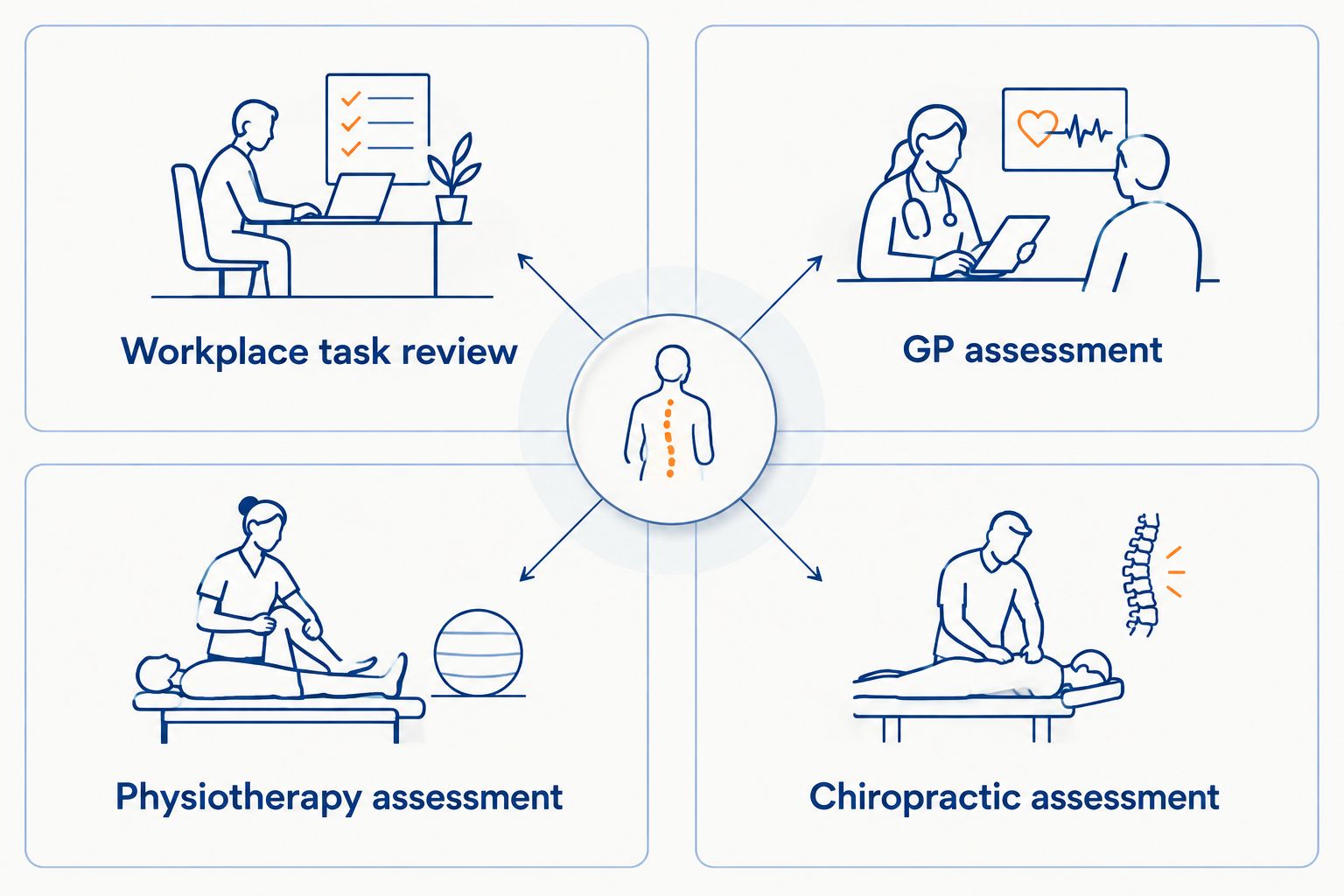
Compare workplace support and healthcare options
Different options answer different questions. A workplace review considers how grooming tasks are organised; a healthcare assessment considers your symptoms and circumstances. Neither automatically determines what the other should recommend.
Use this comparison to organise your questions, not to diagnose yourself or select care from a symptom label. For a 2026 decision, confirm the practitioner’s scope and the proposed service directly.
| Option | Who it suits | What it contributes | Key limitation |
|---|---|---|---|
| Workplace task review | Groomers identifying handling, layout or scheduling problems | Documents the work process and opportunities for change | Does not provide a medical diagnosis |
| GP assessment | Groomers with unexplained, changing or broader health concerns | Medical assessment and discussion of investigations or referrals when indicated | Does not replace an on-site grooming workflow review |
| Physiotherapy assessment | Groomers discussing movement, function and rehabilitation questions | Assessment and discussion of an individual management plan | Suitability and the proposed approach require assessment |
| Chiropractic assessment at MyChiro | Local groomers considering chiropractic care in Bondi Junction | Discussion of musculoskeletal concerns and whether chiropractic care is appropriate | Adjustments are not appropriate for every person or concern |
The options are not necessarily exclusive. If more than one practitioner is involved, tell each about the other care you receive so that recommendations can be considered together.
Common mistakes pet groomers make
Treating every symptom as a posture problem
A photograph of your stance does not establish why you have symptoms. Describe the task, your health history and what has changed before accepting an explanation based only on how you stand.
Improving the table but ignoring the bath
Reviewing clipping height leaves other tasks untouched. Include washing, drying, transfers and cleaning in the workplace discussion; the task that needs attention is not necessarily the one you perform most often.
Assuming a colleague’s care plan suits you
A coworker’s choice of practitioner or adjustment schedule is not an assessment of your circumstances. Ask for the reasoning behind your own proposed plan rather than copying someone else’s appointments.
Using care as permission to repeat an unmanageable transfer
An appointment does not make an uncontrolled animal transfer appropriate. Keep assistance, equipment and handling procedures in place regardless of whether you receive chiropractic care.
Buying equipment before defining the problem
A new mat, stool or table needs to suit the actual task and workplace. Write down the requirement first, then check equipment instructions and practical constraints rather than relying on health-related advertising claims.
Know when medical assessment comes first
Do not assume that a new or unusual symptom is a routine grooming-related concern. Healthdirect’s back pain guidance identifies symptoms that warrant urgent medical attention, including changes in bladder or bowel control and numbness around the genital or buttock area.
Seek urgent medical assessment for those symptoms rather than arranging a routine chiropractic appointment. Symptoms following significant trauma, or back pain accompanied by fever or feeling seriously unwell, also need medical assessment. Contact emergency services when immediate emergency assistance is required.
This guide provides general workplace and appointment-planning information. It does not diagnose a condition or establish whether chiropractic adjustments are appropriate for you.
FAQ
Is chiropractic care appropriate for pet groomers?
Chiropractic care may be appropriate following an individual assessment. Your symptoms, health history and grooming tasks should inform the discussion; being a pet groomer alone is not a reason to receive adjustments.
Do pet groomers need regular chiropractic adjustments?
Pet grooming work alone does not establish a need for regular adjustments. Ask why any proposed appointment schedule is relevant to your assessment and when it will be reviewed.
Should I change my grooming workstation before booking an appointment?
You can review your workstation without waiting for an appointment, but workplace changes do not replace assessment of concerning symptoms. Start by checking tool access, equipment instructions and animal-transfer arrangements.
Should I see a GP, physiotherapist or chiropractor?
Choose the assessment that matches the question you need answered. A GP can assess medical concerns, while physiotherapy or chiropractic assessment can be discussed for relevant musculoskeletal questions; urgent symptoms require medical assessment.
What should I tell a chiropractor about my grooming work?
Describe the tasks affected, the symptoms you notice and any relevant health history. Include bathing, drying, clipping, transfers and cleaning rather than discussing standing posture alone.
Can chiropractic adjustments replace changes to animal handling?
Chiropractic adjustments do not replace workplace animal-handling arrangements. Assistance, appropriate equipment and workplace procedures remain separate requirements.
Does MyChiro provide chiropractic care near Bondi Junction?
MyChiro is a chiropractic clinic and wellness centre in Bondi Junction, Sydney. Pet groomers considering chiropractic care can discuss whether an assessment is appropriate; the clinic’s location and services do not establish individual suitability.
One last thing
Before your next workplace discussion, write down the animal’s route from arrival to collection. Include every transfer and equipment change, not just time at the grooming table. Reviewing the full route gives you a more specific question than asking whether your posture is wrong.
Related guides
- Prepare for your first chiropractor appointment
- Qualifications to check when considering a Sydney chiropractor