


Physiotherapists’ chiropractic care is an individually assessed healthcare option, with the aim of discussing their own musculoskeletal concerns and care choices. This 2026 guide to chiropractic care for physiotherapists focuses on you as a patient—not on patient referrals—and separates workplace planning from decisions about chiropractic adjustments.
- Chiropractic care for physiotherapists starts with individual assessment, not an assumption that hands-on work requires adjustments.
- MyChiro provides chiropractic care in Bondi Junction; suitability for an individual physiotherapist requires assessment.
- Review treatment-room ergonomics and workload before assuming a particular movement explains your symptoms.
- Discuss consent, alternatives, risks and review criteria before agreeing to chiropractic adjustments.
Why chiropractic care matters for physiotherapists
Physiotherapy work can include hands-on care, exercise demonstrations, patient assistance and computer-based documentation. Your assessment needs to distinguish these tasks rather than treating your job title as an explanation for symptoms. A clinician also needs to understand what happens outside work.
Your professional knowledge does not replace an independent assessment of your own concerns. You might recognise a familiar symptom pattern, but recognition alone does not establish its cause or identify an appropriate care option.
MyChiro is a chiropractic clinic and wellness centre in Bondi Junction, Sydney. For physiotherapists considering chiropractic care in 2026, the relevant question is whether the proposed approach is appropriate following assessment—not whether another clinician uses a familiar technique.
This guide offers a practical decision process, not a diagnosis or a recommendation that every physiotherapist needs appointments. Workplace adjustments, another healthcare assessment or no additional chiropractic care are all possible decisions.
How to assess your options in 2026
Review your working day before choosing care
Start with a written task map using your existing diary or a sheet of paper. Describe what your work involves and when you notice difficulties, without assigning a diagnosis to each activity. Separate hands-on appointments, patient assistance, demonstrations, driving and documentation.
Write observations in ordinary language. For example, record that you find a particular reaching task uncomfortable rather than concluding that it has displaced a joint. Include whether the same concern appears away from work, and whether it changes your ability to complete usual activities.
This record gives an assessing clinician useful context. It does not establish that work caused the problem, and it should not become a reason to postpone assessment when symptoms are concerning or worsening.
Keep the task map brief enough to maintain. A clear description of a difficult activity is more useful than a lengthy list of anatomical theories that have not been assessed.
- List the tasks you actually perform, including administrative work.
- Describe the activity, timing and practical difficulty without self-diagnosing.
- Note changes in workload, equipment or responsibilities.
- Include relevant activities outside the clinic.
- Identify what you want an assessment to help you decide.
Adjust your workspace without chasing perfect posture
Review the equipment you already have before buying accessories. Check whether the treatment plinth, stool, computer and frequently used supplies allow you to organise tasks without unnecessary reaching. Discuss shared-room constraints with your manager rather than making changes that interfere with someone else’s work.
A workspace review is not a promise of symptom relief. Its purpose is to identify practical task demands and opportunities for change. Avoid turning an ergonomic suggestion into a rule that everyone must hold the same posture throughout the day.
Safe Work Australia’s Hazardous manual tasks model Code of Practice provides an authoritative framework for examining force, repetition, duration and posture. For patient assistance, use your workplace’s handling procedures, available equipment and escalation process; generic lifting tips do not replace those arrangements.
For your 2026 workplace review, involve the person responsible for occupational health and safety where a task needs organisational changes. An individual healthcare appointment cannot substitute for fixing an unsuitable work process.
- Check plinth and seating adjustments before each different task.
- Keep frequently used supplies within a practical working area.
- Review documentation equipment separately from hands-on equipment.
- Use workplace procedures for patient handling and assistance.
- Raise staffing, equipment or scheduling constraints with your manager.
Arrange an independent assessment when appropriate
Begin by deciding what you need assessed, not which technique you want delivered. You can discuss the concern with a qualified health professional and ask whether chiropractic assessment, physiotherapy assessment, medical assessment or another pathway is appropriate.
If you consider MyChiro for chiropractic care, bring your task map and relevant health information. The clinic provides chiropractic care and spinal adjustments; those service descriptions do not establish that an adjustment is appropriate for your presentation.
Ask the assessing clinician to explain the working assessment, any uncertainty and the reasons for the proposed next step. Relevant medical history, medicines, previous procedures and changes in symptoms belong in that discussion. Do not assume a colleague already knows these details because you work in healthcare.
Medical assessment takes priority when concerning features are present. Healthdirect’s back-pain guidance identifies warning signs such as new bladder or bowel problems, numbness around the groin, or leg weakness. Seek urgent medical assessment for these features rather than proceeding with routine manual care.
- Explain your symptoms and relevant health history without shorthand.
- Ask what the assessment establishes and what remains uncertain.
- Discuss whether another healthcare professional should be involved.
- Tell the clinician about new or changing symptoms.
- Follow medical referral advice rather than requesting a particular adjustment.
Discuss consent and alternatives before any adjustment
Use a written question list to prepare for the conversation. Ask what the proposed procedure involves, why it is being considered, what risks are relevant to you and what alternatives exist. Include the option of declining the procedure or taking time to decide.
Knowing how a technique is performed is not the same as consenting to receive it. Your familiarity with manual therapy does not remove the need for an explanation tailored to your assessment and preferences. Ask for plain language if professional terminology obscures the decision.
The guide to what to expect from spinal manipulation provides a related topic to discuss with the assessing clinician. General reading does not replace an individual conversation about suitability, risks and alternatives.
For decisions in 2026, avoid selecting care through claims about superior results, permanent correction or a required number of visits. Request a rationale specific to your circumstances, including how the plan will be reviewed and what would prompt a change.
- Ask for the procedure to be explained before consenting.
- Discuss relevant risks and reasonable alternatives.
- Clarify whether assessment can proceed without an adjustment.
- State your preferences and any concerns about manual techniques.
- Ask how to pause, decline or withdraw consent.
Coordinate care around a shared purpose
Start coordination yourself with a short summary of your current care, medicines and agreed activities. Where more than one clinician is involved, explain each person’s role and ask whether communication would help. Share information only through an appropriate process and with your consent.
Coordination is a way to clarify responsibilities, not evidence that combining professions produces a particular outcome. A second provider should have an identifiable purpose rather than duplicate an existing plan. Ask who is responsible for reviewing changes and handling concerns between appointments.
If biopsychosocial care is discussed, ask how physical factors, your work setting and your own concerns relate to the plan. The term should explain the assessment rather than become a label attached to you. Stress or workplace pressures should not be used to dismiss symptoms.
Keep workplace arrangements separate from clinical recommendations. A provider can discuss your presentation, while your employer remains responsible for workplace processes within its role.
- Bring an accurate summary of current care and medicines.
- Explain the purpose of involving another clinician.
- Agree on what information can be shared and with whom.
- Resolve conflicting instructions before following both plans.
- Identify who will review concerns or arrange referral.
Review function and agree when to reassess
Choose practical activities to discuss at review, such as completing documentation, demonstrating an exercise or carrying out a usual household task. Record what you can do and what remains difficult. Avoid using a single change in sensation as proof that a structural problem has been corrected.
Agree with the clinician on the review process and the circumstances that would change the plan. These include lack of progress against agreed goals, new concerns, unwanted effects or a change in your preferences. Do not continue appointments simply because they were entered into a calendar.
Your 2026 care plan should explain its purpose in language you can repeat outside the consultation. If you cannot explain what is being assessed or why the next appointment is proposed, ask for clarification before committing.
The decision process is straightforward: record tasks, review the workspace, seek assessment, discuss consent and review the plan. These are decision checkpoints, not a compulsory course of care.
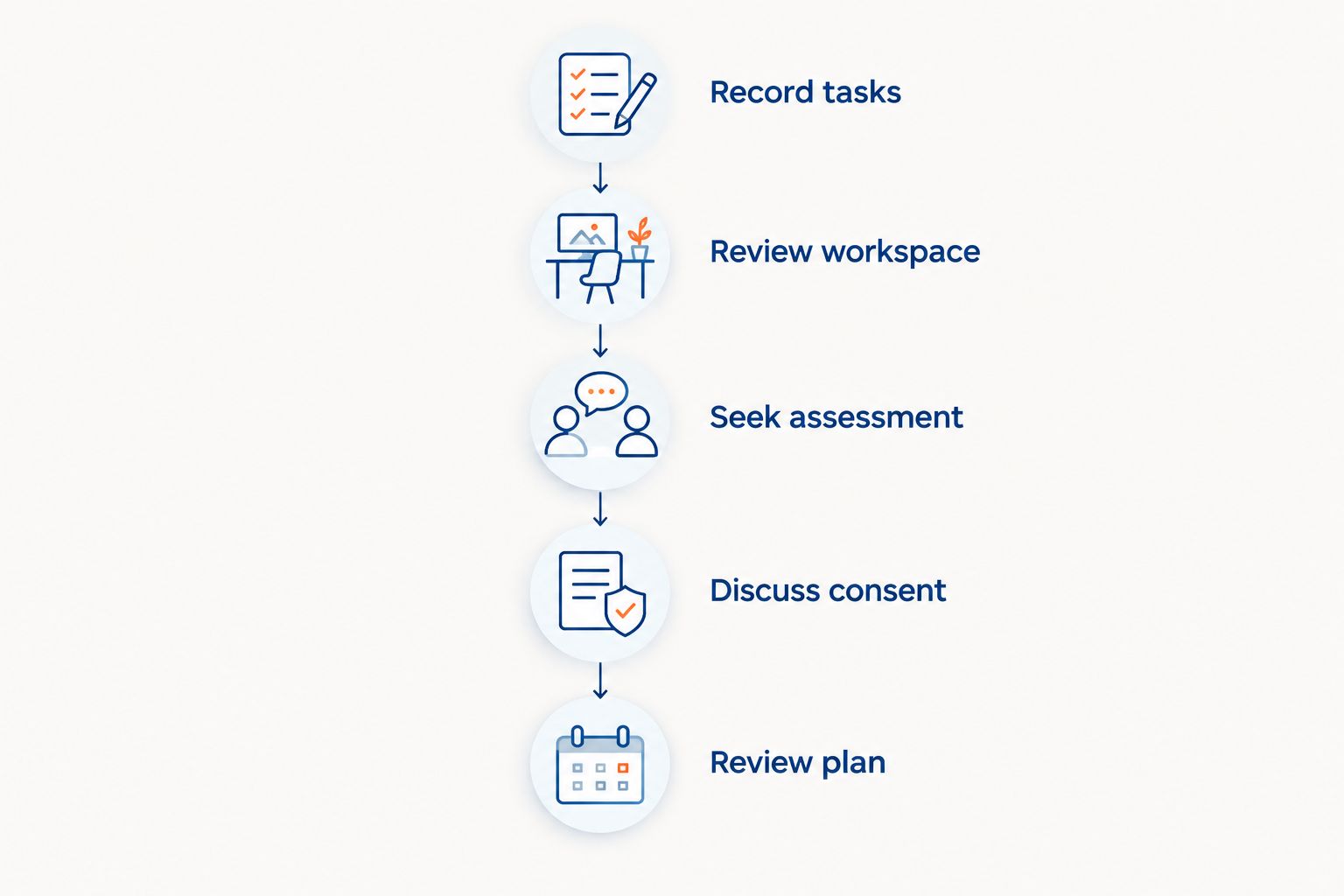
- Record tasks that matter to your work and daily life.
- Review workspace changes separately from clinical care.
- Seek assessment when concerns need individual evaluation.
- Discuss consent before agreeing to a procedure.
- Review plan purpose, progress and reasons to change direction.
Compare options by purpose, not professional title
Choose the pathway that addresses the assessment question. This table compares practical purposes and limitations; it does not rank professions or claim that one service produces better outcomes. More than one pathway can be relevant, but additional care needs a clear reason.
| Option | Appropriate context | Practical advantage | Key limitation |
|---|---|---|---|
| Self-directed task and workspace review | Identifying work activities and questions to raise | Uses your existing diary, equipment and observations | Does not diagnose symptoms or replace healthcare assessment |
| Workplace occupational health and safety review | Equipment, patient-handling or scheduling concerns | Addresses the work process rather than only the individual | Does not replace assessment of your health concerns |
| Independent physiotherapy assessment | Discussing movement, activity and rehabilitation questions | Creates an opportunity to review your own presentation independently | Familiarity with your profession does not establish the diagnosis |
| MyChiro chiropractic care | Considering chiropractic assessment in Bondi Junction | Provides a local setting to discuss chiropractic care and adjustments | Individual suitability must be assessed; adjustments are not a prerequisite |
| GP or urgent medical assessment | Diagnostic uncertainty or concerning symptoms | Provides a pathway for medical assessment and referral | The next step depends on the presentation, not a preferred manual technique |
Before selecting a pathway, clarify its purpose, the information needed and the alternatives. Ask about fees directly rather than assuming a particular funding arrangement. A profession’s name alone does not tell you whether a proposed plan is appropriate.
Common mistakes physiotherapists make when considering care
Treating professional familiarity as a diagnosis
Recognising a movement pattern can encourage you to settle on an explanation before assessment. Describe what happens first. Keep diagnostic conclusions open until an independent clinician has considered the relevant history and findings.
Booking a technique rather than an assessment
Requesting a particular adjustment can put the procedure ahead of the decision. Ask whether it is appropriate, what alternatives exist and whether there is a reason not to proceed. You do not need to accept manual care to demonstrate professional openness.
Making individual care carry a workplace problem
An appointment cannot change an inaccessible plinth, unavailable handling equipment or a scheduling rule. Raise those matters through workplace channels. Keep your healthcare decisions and your employer’s work-design responsibilities distinct.
Collecting overlapping plans without a shared purpose
Multiple providers can leave you with conflicting instructions or unclear review responsibilities. Explain the role of each provider and request clarification where advice differs. Do not assume that adding another appointment adds value.
Continuing without a review question
A recurring booking is not a clinical reason for ongoing care. Ask what the next appointment is intended to assess and what would justify stopping or changing the plan. Reassessment should allow a decision, not merely repeat the previous visit.
FAQ
What is chiropractic care for physiotherapists?
Chiropractic care for physiotherapists means considering chiropractic assessment for their own health concerns as patients. It does not imply that physiotherapists need adjustments because of their occupation or that they should refer their patients for chiropractic care.
Do physiotherapists need regular chiropractic adjustments?
Being a physiotherapist does not establish a need for regular chiropractic adjustments. Any proposed procedure or ongoing care needs an individual assessment, informed consent and a clear review rationale.
Is chiropractic care better than physiotherapy for a physiotherapist?
A professional title alone does not establish which care option is appropriate for an individual physiotherapist. Discuss the assessment findings, proposed approach, risks and alternatives rather than choosing through a general comparison of professions.
Can I have an assessment without agreeing to an adjustment?
You can state that you want to discuss assessment before deciding about an adjustment. Ask the clinic to explain its consultation process, and make consent to any proposed procedure a separate decision.
What should I bring to an appointment at MyChiro?
Bring relevant health information, your current medicines and a brief description of the work or daily activities you find difficult. MyChiro provides chiropractic care in Bondi Junction; ask about the consultation process rather than assuming a particular procedure will occur.
When should I seek medical assessment instead of a routine chiropractic appointment?
New bladder or bowel problems, numbness around the groin, or leg weakness require urgent medical assessment rather than routine chiropractic care. Healthdirect’s back-pain guidance describes these warning signs; this guide cannot assess your symptoms.
How should I check whether ongoing care is appropriate?
Ask what the next appointment is intended to assess and how the plan will be reviewed. Discuss agreed functional goals, any unwanted effects, alternatives and circumstances that would prompt stopping, changing care or referral.
One last thing
Bring one difficult task, not a self-diagnosis. A precise account of what you are trying to do gives the consultation a practical focus without prescribing its conclusion. You can understand manual therapy professionally and still take time to decide whether you want it personally.
For further reading, Safe Work Australia’s Hazardous manual tasks model Code of Practice addresses workplace task assessment, the Australian Commission on Safety and Quality in Health Care’s Low Back Pain Clinical Care Standard addresses assessment and care planning, and Healthdirect’s back-pain information explains when medical attention is needed.
Related guides
- Prepare for your first chiropractor appointment
- Check a Sydney chiropractor’s qualifications
- Chiropractic care for nurses and healthcare workers