

Rowers’ chiropractic care is assessment and discussion of musculoskeletal concerns with a chiropractor, with the aim of informing an individual care plan rather than promising pain relief or performance gains. This 2026 guide to chiropractic care for rowers explains how to document training, prepare for assessment and compare care options; rowing-specific questions include repeated strokes, ergometer sessions, boat handling and race schedules.
- Chiropractic care for rowers starts with assessment, not an automatic adjustment or a promised return-to-rowing date.
- MyChiro provides chiropractic care in Bondi Junction; rowing-specific expertise and performance outcomes are not established here.
- Record rowing load, symptoms and equipment changes before discussing back pain with a qualified health professional.
- Choose coaching for technique questions and medical assessment for concerning symptoms; these roles are not interchangeable.
Why chiropractic care matters for rowers
The useful question is whether chiropractic care is appropriate for your circumstances—not whether every rower needs adjustments. A training diary and a clear account of symptoms give a health professional something more specific to assess than the statement that rowing hurts your back.
MyChiro is a chiropractic clinic and wellness centre in Bondi Junction, Sydney. MyChiro provides chiropractic care for local patients seeking discussion of musculoskeletal concerns, rather than a stated rowing-performance service.
Rowers need to distinguish on-water training from ergometer work, gym sessions and carrying equipment. Those activities involve different tasks, so record them separately rather than attributing every symptom to the rowing stroke. Your coach can discuss technique and training structure; a qualified health professional assesses health concerns.
This distinction matters when you are preparing for a regatta. A race date is useful context, but it does not establish that an adjustment is appropriate or that you can continue training unchanged. Assessment should determine the next step, not the competition calendar.
Build a practical assessment plan
The following steps organise information and decisions. They are not an exercise prescription, a diagnosis or a schedule of chiropractic appointments.
Record your rowing and symptoms separately
Start with a notebook or a spreadsheet. Describe what you did, what you noticed and when you noticed it, without deciding that a joint is out of place or a nerve is compressed.
A useful 2026 training record distinguishes an ergometer session from an outing in a boat. Include gym work and equipment handling as separate entries. Record duration in minutes, distance in metres and stroke rate in strokes per minute when those details are already available; there is no need to invent missing measurements.
Bring 3 recent training entries as an organisational starting point, not as a diagnostic threshold. Include an ordinary session as well as sessions associated with symptoms so the discussion is not limited to your hardest workout.
- Identify the activity: on-water rowing, ergometer, gym or boat handling.
- Record available session duration, distance and stroke rate.
- Describe the location and timing of symptoms in plain language.
- Note any recent change in equipment, workload or routine.
- Record what you stopped or changed because of symptoms.
Review the stroke with your coach
Use coaching input for a technique question before purchasing equipment or following a generic posture programme. Rowing is commonly described through 4 stroke phases: catch, drive, finish and recovery. Those labels help you explain when you notice a problem without claiming to identify its medical cause.
If symptoms occur around the catch, for example, tell your coach and health professional that timing. Do not conclude from a video that you have a disc injury or that a particular adjustment is needed. A technique recording is context, not a clinical examination.
Keep the 2 training settings—water and ergometer—distinct in your notes. Ask your coach to explain any proposed setup change and record it, rather than changing several variables without a clear reason.
- Ask your coach to review the stroke phase you have identified.
- Record the ergometer settings used during the session.
- Note boat-position or equipment changes where relevant.
- Avoid diagnosing an injury from rowing footage.
- Keep a record of coaching changes to discuss at assessment.
Prepare for a chiropractic assessment
You can prepare without buying a device or committing to a course of appointments. Bring your training notes, relevant medical information and questions about what an assessment involves.
If you are considering MyChiro chiropractic care, explain that you row and describe your concerns rather than requesting an adjustment in advance. The clinic’s stated services include chiropractic care and spinal adjustments; that does not establish that manipulation is appropriate for your presentation.
An assessment discussion should cover your history, the proposed examination and whether referral is needed. The guide to what to expect from spinal manipulation provides another topic to discuss with the practitioner, not a reason to assume you need the procedure.
For your 2026 appointment notes, prioritise information that changes the clinical conversation: previous injuries, existing diagnoses, medicines and what you currently cannot do comfortably.
- Bring your training diary and relevant previous reports.
- List medicines and existing health conditions accurately.
- Explain previous injuries and any current medical care.
- Describe limitations in rowing and everyday activities.
- Ask whether medical assessment or another referral is indicated.
Ask about the proposed care before consenting
Assessment and consent come before an adjustment. Ask what the practitioner proposes, why it is being considered and what alternatives are available. You can decline a procedure or request more explanation.
Do not accept a promise that an adjustment will correct your rowing technique, prevent future injury or produce a particular race result. Those are separate claims requiring evidence specific to the claim and circumstances. A general description of chiropractic care does not establish them.
Use 3 consent questions to structure the conversation: What is proposed? What are the potential risks and limitations? What are the alternatives? Ask how your medical history affects that discussion and what happens if you choose not to proceed.
- Request a plain-language explanation of the proposed procedure.
- Ask about potential risks, limitations and expected uncertainty.
- Discuss alternatives, including referral where appropriate.
- Explain any procedure you do not wish to receive.
- Ask what information you should receive before making a decision.
Agree on an individual training discussion
Do not copy another rower’s rehabilitation plan or use a generic online exercise list as clearance to train. Take your current programme to the health professional assessing you and ask which activities need individual discussion.
Separate the tasks you want to return to: easy ergometer rowing, on-water sessions, lifting a boat, strength training and racing. Being able to complete one task does not answer every question about the others. Your coach needs usable guidance, not a vague instruction to improve posture.
Where exercise or training changes are proposed, ask for clear instructions and a review process. This guide does not prescribe sets, repetitions or loading because those decisions require information about your presentation.
Keep the discussion centred on what you can do and what needs reassessment, rather than a promised recovery date.
- Bring your current rowing and gym programme.
- Identify the tasks you want to discuss individually.
- Ask what changes, if any, are appropriate following assessment.
- Request clear instructions for any prescribed exercise.
- Share agreed information with your coach with your consent.
Check who is coordinating your care
A rower can receive coaching advice while also seeing a health professional, but the roles should remain clear. Your coach manages sport instruction; clinical concerns require an appropriately qualified practitioner.
If you already have a GP, physiotherapist or another clinician involved, tell the chiropractor. Explain what has been assessed and what advice you have received. Avoid presenting separate plans as though each practitioner knows about the others.
For a 2026 care plan, identify who will discuss training-related health questions and how information will be shared. Ask permission before sending clinical documents to a coach, club or other third party.
Coordinated communication is a practical objective, not a claim that a particular combination of services produces a better outcome.
- List the practitioners currently involved in your care.
- Bring existing advice rather than relying on memory.
- Ask who will address questions outside each practitioner’s role.
- Decide what information you consent to share.
- Clarify who to contact if your symptoms change.
Set a review point and referral boundaries
Before agreeing to further care, ask how the plan will be reviewed. Set 1 explicit review point as an administrative decision; its timing should be discussed with the practitioner rather than prescribed by this article.
Review the activities that matter to you, including everyday tasks as well as rowing. Report changes accurately, including no change or worsening symptoms. Appointment attendance alone does not show that a plan remains appropriate.
Healthdirect’s public guidance on back pain identifies symptoms requiring urgent medical attention, including bladder or bowel changes, numbness around the genital or anal area, and leg weakness. Seek urgent medical assessment for those symptoms rather than arranging a routine adjustment. Serious injury, fever with back pain or other concerning changes also require medical advice.
- Agree when and how the care plan will be reviewed.
- Record changes in symptoms and activity limitations.
- Ask what should prompt earlier medical assessment.
- Report new symptoms rather than attributing them to training.
- Reconsider the plan if the assessment findings or circumstances change.
Compare care options for rowers
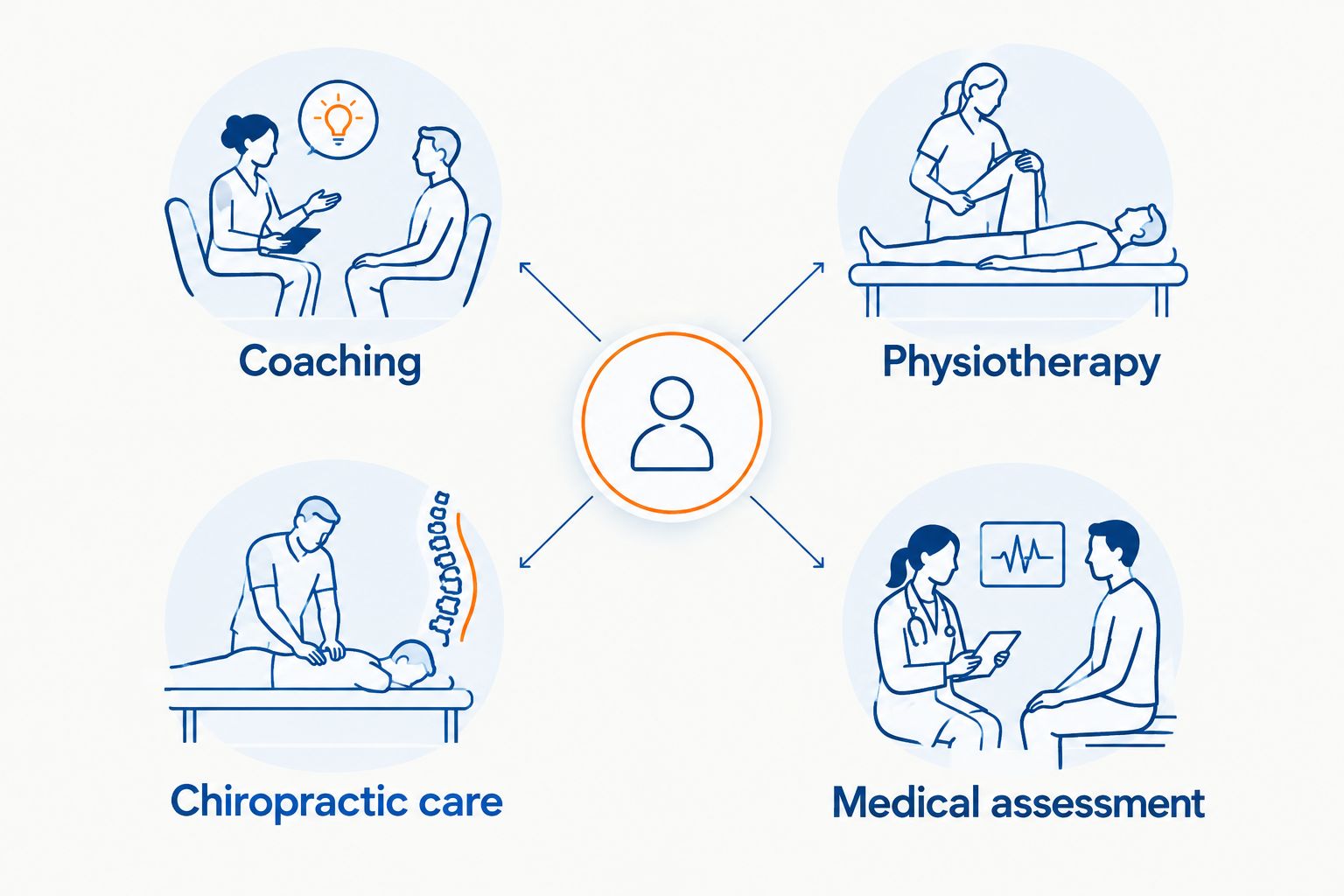
Choose an option by the question you need answered, not by a claim that one profession suits every rowing problem. This 2026 comparison describes roles and limitations; it does not rank clinical outcomes.
| Option | Suited to | Practical advantage | Key limitation |
|---|---|---|---|
| Coaching | Stroke technique, boat setup and training organisation | Uses direct knowledge of your rowing programme | Does not replace clinical assessment or diagnose a medical condition |
| Physiotherapy | Discussion of movement, function and an individual rehabilitation plan | Provides a setting for assessment and exercise planning | Assessment is still needed; a generic programme is not individual clearance |
| Chiropractic care | Discussion of musculoskeletal concerns with a chiropractor | Provides a setting for assessment and discussion of chiropractic services | Adjustments are not automatic, and no rowing-performance outcome is established here |
| Medical assessment | Uncertain symptoms, broader health questions and concerning changes | Provides medical evaluation and referral where indicated | Does not replace sport-specific coaching |
These options are not mutually exclusive. The important boundary is that technique advice does not substitute for health assessment, and a clinical consultation does not substitute for coaching.
Common mistakes rowers make
Treating a race deadline as clinical clearance
A regatta gives your practitioner useful context, but it does not decide whether a procedure or training session is appropriate. Tell the practitioner about the event and ask for an individual assessment rather than a promise to get you to the start line.
Calling every symptom a technique problem
Noticing symptoms during rowing does not establish their cause. Record the pattern and discuss it with a qualified health professional; use your coach’s observations as supporting context, not a diagnosis.
Booking adjustments without a defined question
Regular appointments should not be an automatic requirement of participation in rowing. Explain the concern you want assessed, ask why a service is proposed and agree on how the plan will be reviewed.
Changing several variables without recording them
New ergometer settings, a different gym programme and a changed rowing schedule create separate discussion points. Document each change so your coach and clinician can understand what happened, rather than relying on a general impression that training became harder.
Assuming no pain means unrestricted readiness
Your return-to-rowing discussion should address the actual tasks ahead, not just a symptom description. Ask about on-water work, ergometer sessions, boat handling and competition separately where those questions are relevant to your assessment.
Evidence and scope
This is an educational planning guide, not evidence that chiropractic care improves rowing performance or prevents injury. It makes no claim that spinal adjustments resolve a rower’s back pain.
Relevant public references for this 2026 guide include Healthdirect’s Back pain guidance for medical-assessment advice, NICE guideline NG59 for the scope of low back pain and sciatica care in adults, and Ahpra’s advertising guidance for regulated health services. General guidance does not establish a specific clinical benefit for rowers or for an individual clinic.
FAQ
Is chiropractic care appropriate for every rower?
No; chiropractic care is not a routine requirement for rowing. Whether it is appropriate for a particular concern depends on assessment, your history and the options discussed with a qualified health professional.
Can chiropractic adjustments improve my rowing performance?
This guide does not establish that chiropractic adjustments improve rowing performance. Discuss technique and training with your coach, and seek an individual assessment for health concerns without assuming a performance benefit.
What should I bring to a chiropractor appointment as a rower?
Bring training notes, relevant medical information and a clear description of your concerns. Separate on-water rowing, ergometer work, gym sessions and equipment handling in your account.
Should I see a chiropractor, a physiotherapist or a doctor?
The appropriate professional depends on the question and your symptoms. Coaching addresses technique, health professionals assess clinical concerns, and concerning or uncertain symptoms require medical advice.
Do I need a spinal adjustment at my first appointment?
An appointment does not automatically require a spinal adjustment. Ask what is proposed, why it is being considered, what the potential risks and limitations are, and what alternatives you have.
When does back pain need urgent medical attention?
Seek urgent medical assessment for back pain with bladder or bowel changes, numbness around the genital or anal area, or leg weakness. Healthdirect identifies these as warning signs; do not substitute a routine chiropractic appointment for urgent assessment.
Does MyChiro provide rowing-specific performance care?
MyChiro is described as a chiropractic clinic and wellness centre providing chiropractic care and spinal adjustments in Bondi Junction. Rowing-specific expertise or performance services are not established by that description; ask directly about your assessment needs.
One last thing
Bring an ordinary training session to the conversation, not just the session that hurt. A diary containing only difficult days leaves out part of the account your practitioner needs to hear.
For your next assessment discussion, place an ordinary session beside one associated with symptoms. Describe what differed without deciding which difference caused the problem. That gives your coach and health professional concrete questions to consider while keeping diagnosis and care decisions where they belong.
Related guides
- What qualifications should a Sydney chiropractor have?
- How to prepare for your first chiropractor appointment
- Lower back pain when sitting: causes and practical steps