

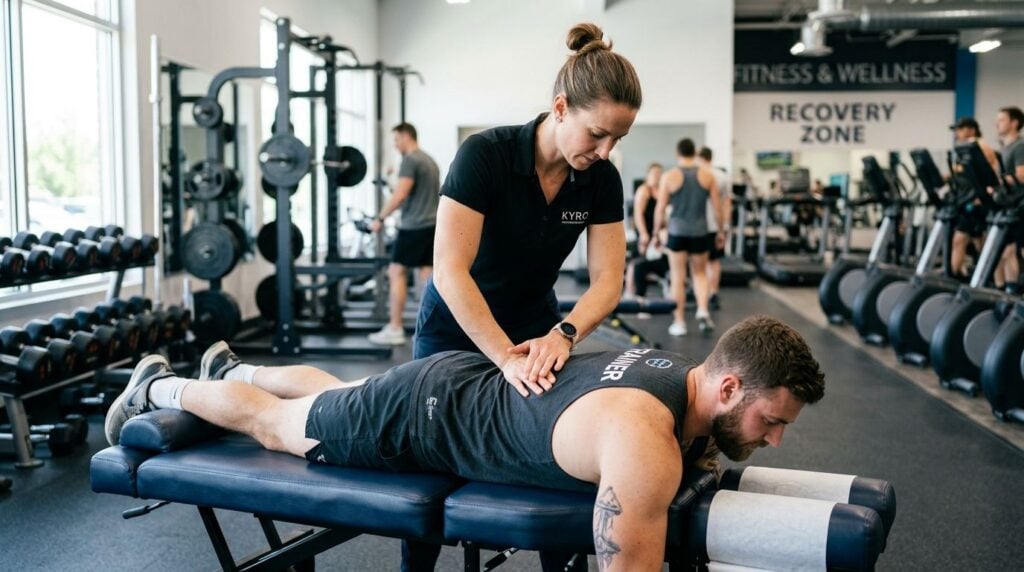
A chiropractor for personal trainers is chiropractic assessment and care aimed at the repetitive strain that builds up from spotting, demonstrating and coaching clients for a living, rather than one sudden injury. Personal trainers and fitness instructors carry a different strain pattern to most office-based clients: hours on their feet, the same lift demonstrated dozens of times a day, and back-to-back 2026 session bookings that leave little time for their own recovery.
- A chiropractor for personal trainers focuses on repetitive, asymmetric strain from spotting and demonstrating, not a single injury event.
- Running 6-8 client sessions a day with almost no recovery gap is a common pattern behind ongoing shoulder and lower back tightness.
- Rotating which side you spot from and scheduling short mobility breaks can reduce cumulative load between assessments.
- A professional assessment is worth discussing when self-managed stretching and load changes stop easing symptoms.
Why chiropractic care matters for personal trainers
A personal trainer's day doesn't look like a desk worker's day, and the strain doesn't build the same way. Where a desk job wears down the spine through stillness, a personal trainer's body wears down through repetition: the same squat cue demonstrated at the same angle, the same side used to spot every deadlift, six to eight 30-to-60-minute sessions run back to back with barely a break in between.
A chiropractic clinic in Bondi Junction such as MyChiro looks at that cumulative movement history rather than just the day something started to hurt. That distinction matters because most personal trainers don't present with a single traumatic injury — they present with a pattern that's been quietly building for months while they kept working through it.
Self-employed instructors also tend to push through discomfort longer than most, because a cancelled session is lost income. That delay is exactly what turns a small movement compensation into a longer-running issue by the time it's raised with a health professional.
Managing strain as a personal trainer: where to start
1. Track your daily movement load
Before anything else, get a clear picture of what your body is actually doing across a working week. Most trainers underestimate how repetitive their own movement really is.
- Log how many sessions you run per day and how many involve heavy demonstration lifts
- Note whether you consistently spot or hand off equipment from one side
- Track hours spent standing or in a semi-squat coaching position
- Review which shoes you're wearing for your own gait, not just the gym floor
- Flag any movement you avoid or modify without really thinking about why
2. Build recovery habits between sessions
Recovery for a personal trainer usually has to happen in the gaps between clients, not after a full shift ends.
- Take a 10-minute mobility break between back-to-back bookings when possible
- Stretch the muscle group you just used to demonstrate, not just the next one
- Hydrate consistently across a full day of coaching, not just during your own training
- Foam roll high-use areas — lats, glutes, hip flexors — at the end of a shift
- Rotate which side you use to spot or demonstrate, session by session
3. Get an assessment when self-management plateaus
If stretching, load changes and recovery breaks stop making a difference, that's the point to bring in a professional opinion rather than keep guessing. A chiropractor for personal trainers can assess how your specific coaching movements — spotting angle, demonstration reps, standing posture — are loading your spine and joints, and discuss what may be appropriate following that assessment.
- Postural and movement pattern review specific to coaching and demonstrating
- Joint mobility checks through the spine, shoulders and hips
- Discussion of your session load and how it's distributed across the week
- Referral for imaging if any findings suggest it's warranted
- Individualised guidance on movement adjustments, discussed alongside your own training goals
4. Strengthen your structural weak points
Trainers often program excellent client sessions and skip their own structural work entirely. A short, targeted routine covering the areas most exposed by coaching demands is worth prioritising over another full workout.
- Core stability work that supports repeated bending and lifting demonstrations — see this guide on how to strengthen your core without straining your lower back
- Glute activation drills before heavy spotting sessions
- Thoracic spine mobility work to offset hours of forward-leaning coaching posture
- Unilateral strength work to correct the imbalance from always spotting on one side
- Breathing mechanics drills to reduce compensatory bracing through the lower back
5. Warm up before you demonstrate anything heavy
Coaching a 7am client straight into a heavy demonstration lift with no warm-up is one of the most common patterns behind recurring shoulder and lower back tightness in trainers. A proper warm-up before a workout to prevent back injury applies just as much to the person coaching as the person being coached.
- Run a dynamic warm-up before your first session of the day, every day
- Rehearse a heavy demonstration at a lighter load first
- Warm up shoulders separately before overhead lift demonstrations
- Avoid jumping straight into a max-effort cue rep from cold
- Build joint-specific mobility prep into your own pre-shift routine, not just your clients'
6. Adjust your training environment
Small environmental changes reduce repetitive strain without changing how you coach.
- Position mirrors so you're not twisting your neck to check client form
- Rotate which platform or rack you use for demonstrations across the week
- Keep a mat handy for kneeling demonstrations instead of the bare floor
- Review your spotting technique periodically, not just when something feels off
- Vary your footwear between sessions rather than wearing one pair all day
7. Know when to scale back before returning to full sessions
If you've had a flare-up, a graded return to full coaching load matters more than pushing straight back into a full roster. Trainers who go straight back to eight sessions a day after a flare tend to see it return faster than those who scale up over one to two weeks.
- Reduce demonstration reps and hand off heavier lifts to equipment or verbal cueing initially
- Track what specifically triggers a flare-up, not just when it happens
- Get clearance before resuming full spotting duties on heavy lifts
- Communicate modified sessions to clients rather than working through discomfort silently
- Reintroduce your own training volume gradually alongside your coaching load
Options for personal trainers managing training-related strain
| Option | Best for | Key limitation |
|---|---|---|
| Chiropractic assessment | Recurring strain from repetitive demonstration and spotting | Requires an in-person consult to map the specific movement pattern |
| Remedial massage | Short-term muscle tightness after heavy training blocks | Doesn't address the underlying joint or movement mechanics |
| Physiotherapy | Structured rehab programming after an acute injury | Progress is often slower to notice in day-to-day coaching movement |
| Self-managed mobility work | Day-to-day maintenance between professional check-ins | Limited effect once symptoms are already restricting coaching |
Discuss your training-related strain
An assessment can focus on movement patterns specific to coaching and demonstrating.
Common mistakes personal trainers make with their own bodies
- Demonstrating every exercise at full working weight instead of using a lighter cue rep, session after session across a 2026 roster
- Always spotting or handing off equipment from the same side, which loads one hip and shoulder far more than the other over a working year
- Treating six to eight sessions a day as normal without ever programming their own recovery around it
- Ignoring shoulder or lower back tightness because clients come first, letting a small niggle turn into a longer pattern
- Wearing whatever shoes are comfortable for the gym floor rather than choosing footwear suited to their own gait
If you always spot from the same side, your body eventually carries the cost of that asymmetry.
FAQ
What is a chiropractor for personal trainers?
A chiropractor for personal trainers is a chiropractor who assesses movement and strain patterns typical to coaching, spotting and demonstrating exercise for clients. The focus is on repetitive, asymmetric load rather than a single injury event.
Can chiropractic care help with shoulder pain from demonstrating overhead lifts?
Shoulder strain from repeated overhead demonstrations can be assessed by a chiropractor, who may discuss adjustments, mobility work or referral depending on findings from that assessment. Persistent or worsening shoulder pain is worth raising with a qualified health professional.
How often should personal trainers get a musculoskeletal check-up?
There’s no fixed schedule for this, but many trainers find it useful to check in whenever a movement pattern feels persistently different to six months earlier. A change in coaching technique to avoid discomfort is also a reasonable trigger to seek an assessment.
Is chiropractic care suitable for someone who trains clients every day?
Chiropractic assessment can be discussed by anyone coaching clients daily, with the focus on how repetitive load and asymmetry are affecting the spine and joints over time. What’s appropriate depends on individual findings from an assessment.
What causes lower back pain in personal trainers?
Lower back pain in personal trainers is often linked to repeated bending and lifting demonstrations, long standing hours and inconsistent core engagement across a full day of sessions. Asymmetric spotting habits can compound the pattern over time.
Should a personal trainer keep coaching through back pain?
Whether to keep coaching through back pain depends on the type and severity of the symptoms. Persistent or worsening pain is worth discussing with a qualified health professional before continuing high-load sessions.
How is chiropractic care for personal trainers different from care for other occupations?
The focus for personal trainers is repetitive, asymmetric loading from spotting and demonstrating, compared with a desk worker’s strain from prolonged sitting or a tradie’s strain from heavy manual lifting. The assessment approach centres on coaching-specific movement patterns.
One last thing
The single habit that changes the most for the least effort is rotating which side you spot from — not adding another stretch routine, not buying new shoes. Most trainers default to one side without ever noticing, and by 2026 standards of coaching load, that one-sided pattern is doing more of the damage than any single heavy demonstration lift.
Related guides