

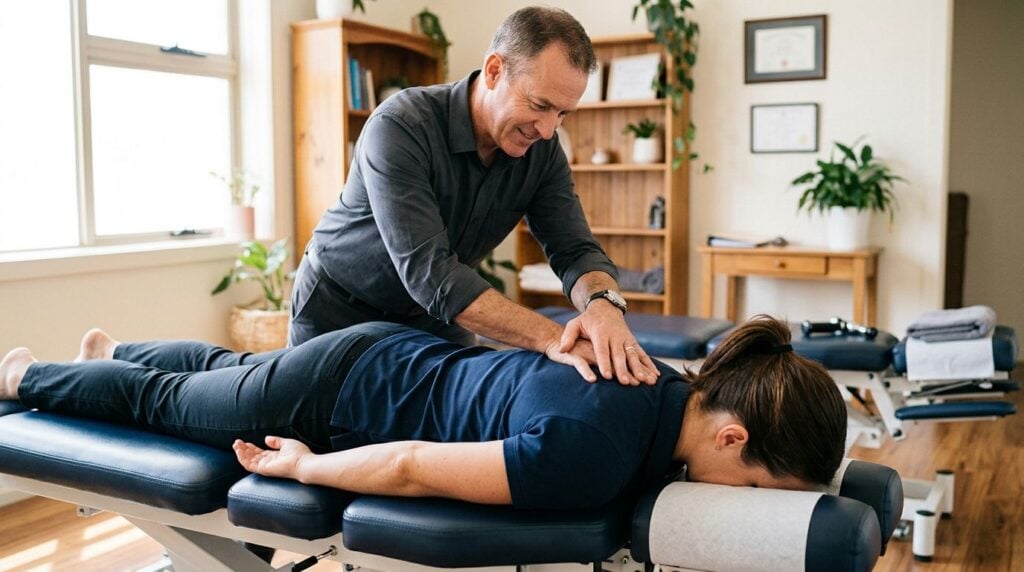
Massage therapists chiropractic care focuses on the forearm, wrist, thumb, shoulder and lower back strain that builds from delivering multiple table treatments in a single shift, with assessment-led adjustments and mobility work considered alongside self-care and ergonomic changes. Unlike desk-based repetitive strain, a massage therapist's load runs through the thumbs, forearms and shoulders while the lower back holds a static forward lean through each 30, 60 or 90-minute session.
- Chiropractor for massage therapists care usually centres on thumb, wrist, shoulder and lower back strain from repeated table work.
- Assessment-led adjustments and mobility exercises are options many massage therapists discuss with a chiropractor in 2026.
- Self-myofascial release, table height changes and forearm strengthening are the first free steps before any clinical visit.
- A chiropractor can assess spinal and joint load and refer onward when red-flag symptoms are present.
Why this matters for massage therapists in 2026
Massage therapy loads the same small joints of the hand and forearm session after session, with little natural variation in hand position. A practitioner delivering back-to-back appointments through a working day builds cumulative mechanical load through the thumb's carpometacarpal joint, the wrist flexors and the thoracic spine faster than most desk-based occupations see.
Repetitive strain in this line of work rarely arrives as one dramatic injury. It shows up as a dull ache after a heavy day, then a grip that feels weaker by Friday, then a shoulder that clicks on overhead reaches. The mechanism overlaps with the elbow-loading patterns covered in repetitive strain injuries like tennis elbow, where sustained gripping and pressure through the forearm are the common thread.
Chiropractic care for massage therapists in 2026 is generally framed around catching that build-up early, through assessment of spinal and joint mechanics, rather than waiting until a practitioner can no longer work a full column of bookings.
Step-by-step: managing repetitive strain as a massage therapist
Track your strain patterns before you self-diagnose
A simple weekly log tells you more than guessing after a bad day. Note which body part flares, which technique triggered it, and how many bookings preceded the symptom.
- Record pain location and a 0-10 scale after each shift
- Note which techniques (deep tissue thumb work, cupping, trigger point) precede symptoms fastest
- Track whether discomfort is one-sided or bilateral
- Log client volume per day and gaps between bookings
Change your table setup and body mechanics
Most repetitive strain in this trade starts with table height and reach, not the technique itself. Small mechanical changes reduce the load before any hands-on care becomes relevant.
- Set table height so your forearms angle down, not up, during firm pressure work
- Reposition the client rather than reaching across the table
- Alternate lean side to side instead of locking into one stance
- Avoid locked knees during standing work to reduce lower back load
Rebuild forearm, wrist and thumb range with daily mobility work
Mobility work between clients, not just at the end of the day, keeps the small joints of the hand moving through their full range. This matters most for practitioners noticing early symptoms consistent with carpal tunnel syndrome, where wrist flexor tightness is a common contributor.
- Wrist flexor and extensor stretches between appointments
- Thumb CMC joint circles, 10-15 reps each direction
- Forearm release with a massage ball or foam roller
- Grip strengthening with a stress ball, 2-3 sets a few times a week
Build recovery days into your booking schedule
Scheduling decisions carry as much weight as any exercise. A column of five deep tissue bookings back to back compounds load in a way a mixed-modality day does not.
- Cap consecutive deep tissue or firm-pressure bookings per day
- Alternate a lighter-technique day after a high-volume day
- Build a short break between clients rather than running straight through
- Rotate technique focus across the week rather than repeating the same grip pattern daily
Get a chiropractic assessment for joint and spinal load
Once self-care and ergonomic changes are in place, a chiropractor can assess spinal and shoulder mechanics, review posture under sustained load, and discuss whether adjustments or a home exercise plan may be appropriate following assessment. This is a step to raise with a qualified health professional rather than something to self-manage indefinitely.
- Ask about assessment of thoracic and cervical spine mechanics, not just the symptomatic joint
- Request a home exercise plan targeting wrist, forearm and thoracic mobility
- Discuss whether your work pattern is contributing to any asymmetry found on assessment
- Bring your strain log so patterns are visible from the first visit
Strengthen the postural muscles that support your working position
Strain often follows weak supporting muscles rather than the joint doing the obvious work. Building strength around the shoulder blades and thoracic spine changes how load distributes through a full day.
- Thoracic extension exercises to counter the forward lean
- Scapular retraction work, 2-3 times a week
- Rotator cuff strengthening for overhead and lateral reach
- Core and hip hinge work to support the standing forward-lean posture
Watch for red flags that need referral beyond chiropractic
Some symptoms sit outside what chiropractic assessment alone should address, and these warrant medical review before continuing manual work.
- Numbness or tingling spreading past the wrist into the fingers
- Night pain that doesn't settle with rest
- Swelling that doesn't reduce within a few days
- Noticeable loss of grip strength
Comparing your options for repetitive strain management
| Option | Best for | Key limitation |
|---|---|---|
| Self-myofascial release and stretching | Daily maintenance between clients | Doesn't address joint alignment or referred nerve symptoms |
| Ergonomic table and technique changes | Reducing new strain at the source | Requires retraining muscle memory, slow to change habits |
| Remedial massage exchange with a colleague | Softening tight forearms and shoulders | Doesn't assess spinal or joint mechanics |
| Chiropractic assessment and adjustment | Reviewing spinal and joint load following assessment | Requires booking and ongoing follow-through to see change |
| Physiotherapy referral | Structured rehab for a diagnosed injury | Typically needs a longer program and a separate referral |
Book a chiropractic assessment
Discuss thumb, wrist, shoulder and back strain with a chiropractor at Bondi Junction.
Common mistakes massage therapists make with repetitive strain
- Working through pain because the book is full. A fully booked column of appointments doesn't change what the joint is telling you; delaying assessment tends to extend recovery time, not shorten it.
- Defaulting to thumbs for every deep tissue technique. The CMC joint carries a disproportionate share of mechanical load relative to its size when forearms or elbows could do the same work.
- Skipping mobility work between clients. A tight schedule is the reason most practitioners give for dropping the two-minute stretch, and it's the same reason symptoms build unnoticed.
- Treating a one-sided grip change as normal wear. Asymmetry that persists week to week, rather than settling after a day off, is worth raising with a chiropractor or GP.
- Not adjusting table height per client. The same fixed height forces reach and rotation on taller or shorter clients, adding load that has nothing to do with the technique itself.
This pattern of fixed posture and repeated close-contact work also shows up in hairdressers and beauty therapists, who report similar shoulder and wrist strain from repeated close-range service work.
FAQ
What is chiropractic care for massage therapists?
It’s assessment of the spinal and joint mechanics affected by repeated table work, focused on the thumb, wrist, forearm, shoulder and lower back. Adjustments and mobility exercises are discussed as part of a broader plan, not a standalone fix.
Can a chiropractor help with thumb and wrist strain from massage work?
A chiropractor can assess joint and spinal mechanics contributing to thumb and wrist strain and discuss options following that assessment. Symptoms spreading into the fingers or affecting grip strength warrant a broader medical check first.
How often should a massage therapist see a chiropractor?
Frequency depends on assessment findings and work volume, and is best set with a chiropractor after the first visit. Practitioners doing high-volume weeks may discuss more frequent check-ins than those with a lighter book.
Is chiropractic care better than physiotherapy for repetitive strain?
Neither is universally better; chiropractic care tends to focus on spinal and joint assessment while physiotherapy often runs structured rehab programs for a diagnosed injury. Many practitioners use one or both depending on what assessment finds.
What exercises help forearm and wrist strain from massage therapy?
Wrist flexor and extensor stretches, thumb CMC joint circles and forearm release with a ball or roller are common starting points. A chiropractor or physiotherapist can tailor a plan once the specific strain pattern is assessed.
How do I know if my strain needs a doctor instead of a chiropractor?
Numbness spreading past the wrist, night pain, unresolved swelling or noticeable loss of grip strength are reasons to see a GP first. A chiropractor can flag these red flags during assessment and refer on where appropriate.
Can ergonomic table changes reduce repetitive strain risk?
Table height and stance changes reduce awkward reach and rotation, which are common contributors to cumulative strain. They work best alongside mobility exercises and scheduled recovery days, not as a substitute for either.
Does chiropractic care address lower back pain from standing at a table all day?
Assessment can look at spinal mechanics affected by a static forward-lean posture held through long sessions. What’s appropriate from there depends on individual findings and is discussed with a chiropractor directly.
One last thing
The thumb's carpometacarpal joint is small relative to the shoulder or spine, yet it often reports symptoms first in massage therapists because it carries concentrated pressure through techniques the forearm or elbow could share. Practitioners who deliberately rotate technique through the forearm and elbow, rather than defaulting to the thumb, tend to see that specific joint settle faster once the load is redistributed. It's a mechanical fix worth testing in 2026 before assuming the answer has to involve a clinic visit.
Related guides