


No—chiropractic care is generally a private medical expense, not a personal income tax deduction in Australia in 2026, even when you attend because of discomfort associated with work. Private health insurance benefits, eligible Medicare benefits and approved compensation payments are separate arrangements; an unpaid gap does not automatically become tax-deductible.
- Can you claim chiropractic care on tax in Australia? Generally no: personal chiropractic expenses are private medical costs.
- The Australian Taxation Office distinguishes private medical expenses from deductible work expenses, even where work contributes to symptoms.
- Private health insurance and Medicare benefits are not income tax deductions; separate eligibility rules apply.
- Mychiro provides chiropractic care in Bondi Junction; ask a registered tax agent about your individual tax position.
Can you claim chiropractic care on tax in Australia?
For an individual paying for personal chiropractic appointments, the general answer is no. The Australian Taxation Office's guidance on medical expenses and work-related deductions treats private medical costs as private expenditure, rather than an expense you can ordinarily deduct against employment income.
That distinction applies whether you attend Mychiro or another chiropractic clinic. The provider's location, your occupation and the fact that you paid yourself do not determine whether an expense is deductible.
The table separates an income tax deduction from other ways an eligible person might receive financial assistance. It describes general arrangements, not confirmation that a particular appointment qualifies.
| Payment or claim pathway | What it means | Main limitation |
|---|---|---|
| Personal income tax deduction | An eligible expense reduces taxable income | Personal chiropractic expenses are generally private and not deductible |
| Private health extras | An insurer pays a benefit for an eligible service | Cover, waiting periods, limits and provider recognition depend on the policy |
| Medicare | A government benefit applies to an eligible service | Referral, patient and service requirements apply |
| Workers compensation | An insurer funds or reimburses approved expenses under a claim | Acceptance, approval and scheme rules determine payment |
| Employer payment | An employer pays or reimburses an expense | Employer tax and fringe benefits rules are separate from your personal deduction |
A receipt proves you paid for an appointment; it does not prove the appointment is tax-deductible.
Why this matters
The word claim causes confusion because insurers, Medicare and the tax system use it differently. A health fund claim can be valid while a tax deduction for the same type of appointment is not.
For your 2026 tax return, classify the payment before entering anything in a work-related expenses category. Start by identifying whether you are asking about a deduction, an insurance benefit, a government benefit or reimbursement.
This article provides general information, not personal tax advice. The tax discussion draws on Australian Taxation Office guidance covering private medical expenses, work-related deductions, record keeping and the private health insurance rebate; your registered tax agent can apply those rules to your circumstances.
Personal appointments: generally not deductible
An appointment you arrange and pay for personally is generally a private medical expense. That remains the starting point when you believe attending helps you remain comfortable at work or continue your usual duties.
The income tax test is not simply whether an expense benefits your working life. Ordinary personal expenses can support your capacity to earn income without becoming deductible work expenses.
Consider someone who spends their working day at a computer and pays for a chiropractic appointment. The connection they draw between desk work and discomfort does not, by itself, change the private nature of the appointment expense.
Do not enter the payment under another description to make it look work-related. Calling an appointment workplace maintenance, professional wellbeing or business support does not change what the payment was actually for.
Work-related discomfort: not an automatic tax exception
A physically demanding job does not automatically make personal chiropractic expenses deductible. Nor does a letter explaining that your work involves lifting, standing or prolonged sitting establish a deduction by itself.
Keep these questions separate:
- Did your work contribute to the reason you sought care?
- Does the expense satisfy the tax law's deduction requirements?
- Is there an accepted compensation claim that can fund an approved service?
The answers concern different rules. Evidence relevant to a workers compensation application is not automatically evidence that a personal tax deduction is available.
Do not assume that a work connection overrides the private-expense rule. If you believe your circumstances fall outside the ordinary position, give a registered tax agent the full facts before claiming.
Sole traders: paying through a business does not change the expense
Being self-employed does not automatically turn your own healthcare into a business deduction. A sole trader still needs to distinguish business expenditure from private expenditure.
Paying an appointment invoice with a business card is not enough. Neither is explaining that you need to remain physically able to operate your business.
If your business account pays a personal medical bill, ask your bookkeeper or accountant how to record the private payment correctly. Do not assume an accounting software category determines its tax treatment.
For a company paying a director's or employee's expense, additional employer and fringe benefits considerations can arise. That situation needs separate advice rather than the assumption that the individual's appointment has become deductible.
Private health extras: a benefit, not a deduction
Private health extras can provide a benefit towards an eligible chiropractic service where your policy includes that cover. Your insurer determines eligibility under the policy, including applicable waiting periods, annual limits and provider recognition requirements.
That benefit is not a deduction for the appointment on your income tax return. Any amount you pay after the insurer's contribution generally remains a private medical expense.
Check your policy rather than assuming the words extras cover guarantee a chiropractic benefit. Ask the insurer what applies to your particular membership and the service you are considering.
The guide to private health fund extras for chiropractic care explains the insurance pathway separately from tax. Confirm current entitlements directly with your fund before relying on reimbursement.
What about the private health insurance rebate?
The Australian Government private health insurance rebate concerns eligible insurance premiums. It is not a deduction for individual chiropractic appointments.
Your private health insurance information can therefore matter when preparing a tax return even though your personal appointment invoices are not deductible. Do not confuse the insurance rebate with a medical-expense deduction.
Medicare and compensation: separate eligibility rules
Medicare benefits for eligible allied health services depend on the relevant patient, referral and service requirements. Having a Medicare card alone does not establish that a chiropractic appointment attracts a benefit.
A GP can discuss whether an applicable referral pathway is appropriate. Confirm the referral requirements and billing arrangements before assuming a benefit applies; a referral does not make a remaining personal expense tax-deductible.
Workers compensation operates under its own scheme rules. If you have a work injury claim, ask the insurer or case manager whether the proposed service requires approval and what documentation is needed.
Do not assume approval for one appointment authorises every later appointment. Equally, an insurer declining payment does not turn the expense into an allowable personal tax deduction.
Why chiropractic claim eligibility varies
The ordinary tax position is consistent: personal chiropractic expenses are generally private. What varies is whether another payment pathway applies and who is responsible for the bill.
- Claim type: An income tax deduction, extras benefit and compensation reimbursement have different requirements.
- Insurance policy: Chiropractic cover depends on your membership terms, limits and waiting periods.
- Referral eligibility: Medicare benefits require the relevant eligibility and referral conditions to be met.
- Compensation approval: Payment depends on the applicable scheme, accepted claim and authorisation requirements.
- Who pays: Personal payment, employer reimbursement and insurer payment create different administrative and tax questions.
None of these factors means a receipt should automatically go into the deductions section of your 2026 return. Identify the arrangement first, then check its rules with the organisation responsible.
How do I check before lodging my tax return?
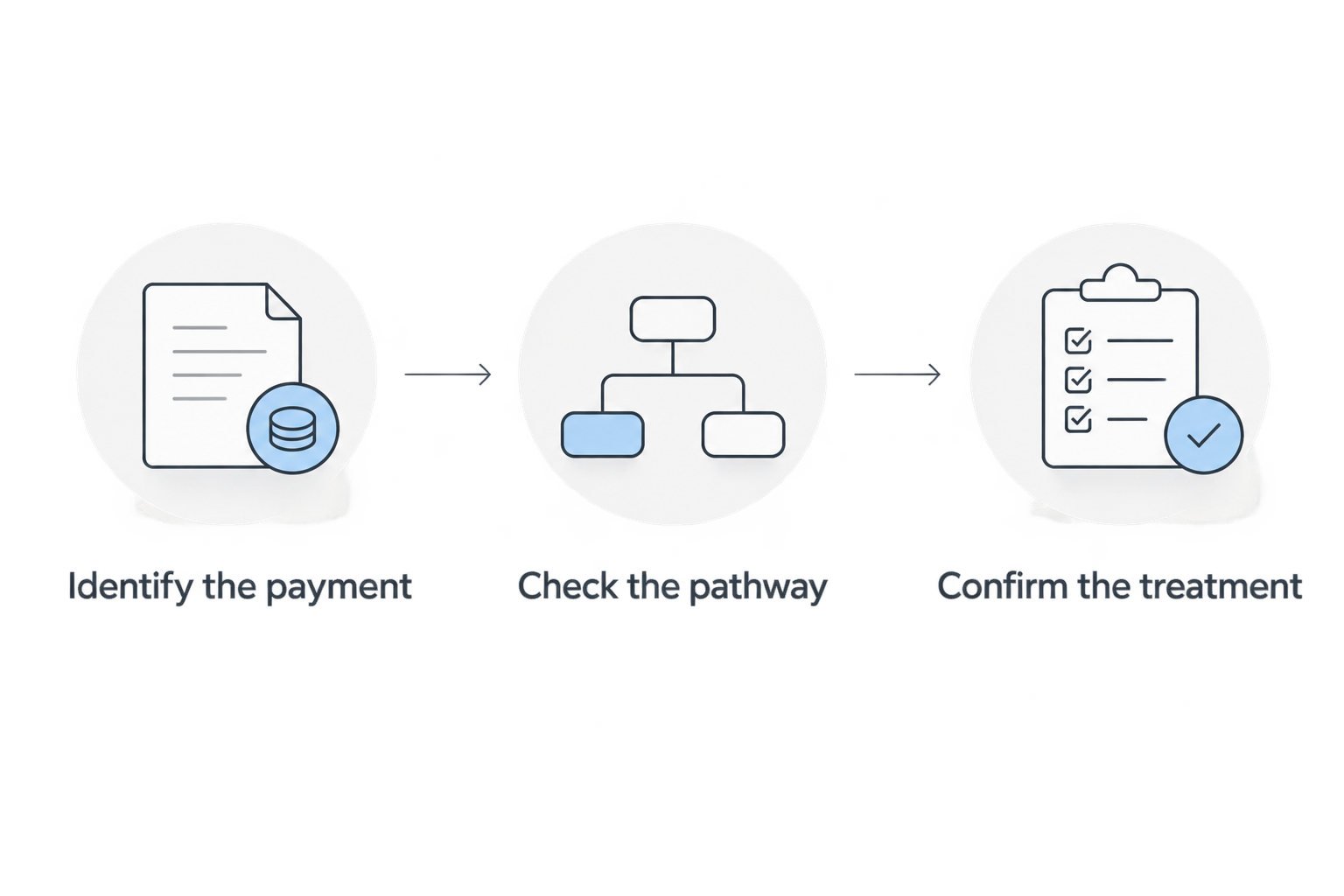
Use this sequence before claiming an appointment expense. It keeps questions about payment separate from questions about deductibility.
- Identify the payment. Record what the invoice covers, who received the service and who paid it. Keep any related insurer benefit statement or reimbursement advice.
- Check the pathway. Establish whether you are considering personal tax, private health insurance, Medicare, compensation or an employer arrangement.
- Confirm the treatment. Ask your insurer about benefits, your case manager about compensation, and your registered tax agent about the income tax position.
Give your adviser the actual documents rather than only describing an expense as work-related. Include any reimbursement already received or pending so the payment is not assessed in isolation.
Which records should I keep?
Keep the itemised invoice, receipt, proof of payment and any benefit or reimbursement statement together. These documents help distinguish the amount billed from the amount you ultimately paid yourself.
The ATO generally requires records supporting tax return claims to be retained for 5 years from the date you lodge, although exceptions apply. That record-keeping rule does not make an otherwise private medical expense deductible.
Keep insurance and compensation paperwork according to the relevant organisation's requirements as well. A health fund's evidence requirements serve a different purpose from the ATO's substantiation rules.
Can I claim the gap after my health fund pays?
The remaining gap is generally not tax-deductible because your personal chiropractic appointment remains a private medical expense. Paying part of the bill yourself does not create a deduction that was unavailable for the original expense.
Keep the benefit statement with the receipt so your records show both payments. If another organisation is also involved, disclose the existing benefit rather than assuming every pathway can reimburse the same amount.
Does a GP referral make chiropractic care tax-deductible?
A GP referral does not, by itself, make personal chiropractic expenses tax-deductible. A referral can relate to access or eligibility under a particular healthcare arrangement, not permission to claim a private expense against taxable income.
Ask the referring practice about the referral's purpose. Direct questions about tax deductibility to a registered tax agent, not the practitioner issuing the referral.
Should I book before the end of the financial year for tax reasons?
Booking before 30 June 2026 does not make a private chiropractic expense deductible. Bringing a payment forward cannot change its underlying character.
Make healthcare decisions according to your needs and an appropriate assessment, not an assumed tax benefit. From 1 July 2026, the same distinction between an appointment expense and a separate benefit or reimbursement still matters.
FAQ
Can I claim chiropractic care on my Australian tax return in 2026?
Personal chiropractic expenses are generally not deductible on an Australian income tax return in 2026 because they are private medical expenses. A registered tax agent can assess any circumstances you believe fall outside that general position.
Can I deduct chiropractic appointments if my job causes discomfort?
A connection between your work and discomfort does not automatically make personal chiropractic appointments deductible. Workers compensation eligibility is a separate question for the relevant insurer or scheme.
Can a sole trader put chiropractic appointments through the business?
A sole trader’s personal chiropractic appointments are generally private expenses, even when paid from a business account. Ask an accountant how to record any private payment made using business funds.
Can I claim my chiropractic gap payment on tax?
A personal chiropractic gap payment is generally not tax-deductible. An insurer paying part of the bill does not change the private nature of the remaining expense.
Is a private health insurance claim the same as a tax claim?
No, a private health insurance claim requests a benefit under your insurance policy, while a tax deduction reduces taxable income. Each has different eligibility rules.
Can Medicare cover a chiropractic appointment?
Medicare benefits can apply to eligible chiropractic services when the relevant patient, referral and service requirements are met. Ask your GP about eligibility and confirm billing arrangements before relying on a benefit.
What should I ask Mychiro about chiropractic appointment paperwork?
Ask Mychiro what appointment documentation can be provided for your records. Your insurer determines insurance benefits, and a registered tax agent advises on personal income tax treatment.
One last thing
The useful question is not just whether you can claim—it is who you are claiming from. An insurer, Medicare, a compensation scheme and the ATO each assess a different entitlement.
Mychiro is a chiropractic clinic in Bondi Junction, Sydney, not a substitute for personal tax advice. Keep the clinical decision separate from the funding decision, and confirm the relevant rules before budgeting for reimbursement or entering a deduction.
Related guides
- Getting a Medicare-subsidised chiropractic referral from your GP
- Getting workers compensation approval for chiropractic care
- Claiming chiropractic visits through HICAPS