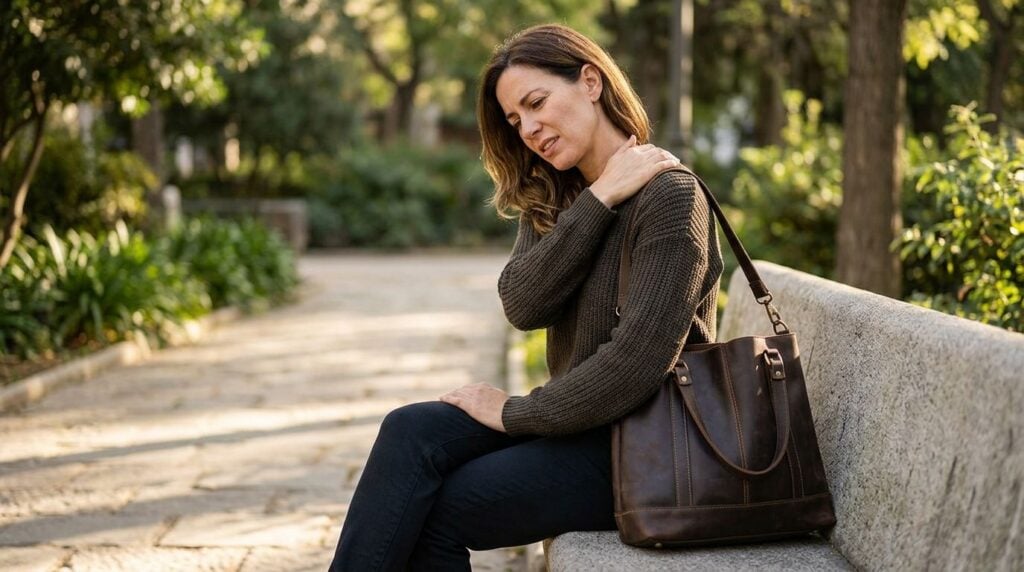
A handbag that hangs off one shoulder for hours every day changes how your shoulder blades, neck and upper spine share load, and that uneven pull is a common trigger people bring up with a chiropractor in 2026. Easing the strain usually comes down to how you carry the bag, not a single stretch or gadget.
- Switching shoulders, shortening the strap and cutting bag weight below 10% of body weight are the main ways to ease upper back pain from a heavy handbag.
- A crossbody or two-strap bag distributes load across both sides of the back instead of loading one trapezius muscle.
- Stretching the chest and strengthening the muscles between the shoulder blades addresses the postural pattern a heavy bag builds over weeks.
- Pain lasting more than one to two weeks, or spreading down the arm with tingling, is worth having assessed by a health professional.
Why this matters
Upper back pain from bag-carrying is usually a load and repetition problem rather than a structural one. Carry the same 4-6kg bag on the same shoulder five days a week for months, and the upper trapezius and levator scapulae on that side end up doing constant low-level work they weren't built to sustain. Over time that shows up as a dull ache between the shoulder blades, a tight neck, or a shoulder that sits noticeably higher than the other. MyChiro sees this pattern often enough in Bondi Junction commuters that it's worth breaking down properly rather than guessing at fixes.
The good news is that most of this is behavioural. Bag weight, strap design and which shoulder you default to are things you control every morning, and small changes compound the same way the strain did.
How to relieve upper back pain from carrying a heavy handbag
The steps below target the load itself first, then the muscles that compensate for it.
- Audit and reduce the bag's contents. Empty it out weekly and remove anything not used that day — water bottles, extra chargers and old receipts add up fast.
- Alternate shoulders deliberately. Don't wait until one side aches; switch at set points in your day (leaving home, arriving at work, lunch).
- Shorten the strap so the bag sits at hip height or higher, close to your centre of gravity, rather than swinging at the knee.
- Switch styles for heavier days. A crossbody bag or a two-strap backpack spreads load across the torso instead of concentrating it on one trapezius.
- Stretch the chest and front of the shoulder a few times a day to counter the forward pull a heavy bag creates.
- Strengthen the mid-back — rows, band pull-aparts and scapular squeezes build the muscles that resist the bag's downward drag.
| Carry style | Load distribution | Best for |
|---|---|---|
| One-shoulder handbag | Uneven — concentrated on one trapezius and neck | Short trips with a light load |
| Crossbody bag | Diagonal — spreads across the torso | Daily commuting, moderate loads |
| Two-strap backpack | Even across both shoulders | Heavier loads or long carry days |
| Top-handle tote (hand-carried) | Uneven — pulls on the wrist, forearm and shoulder | Occasional, light use |
Handbags under 10% of body weight: lower strain risk
Occupational health guidance developed for backpacks generally recommends keeping total carried weight under 10% of body weight, and the same principle applies to one-shoulder bags because the same stabilising muscles are doing the work. For a 65kg adult, that's roughly 6.5kg — lighter than most people assume once a laptop, water bottle and makeup bag are all in there together.
Handbags between 10-15% of body weight: strain builds by midday
Once a bag creeps past 10% of body weight, the shoulder and neck muscles on the carrying side start working harder to keep the shoulder level, and that fatigue tends to show up as an ache by mid-afternoon rather than first thing in the morning. This range is common for anyone carrying a laptop bag doubling as a handbag, or a commuter also packing gym gear.
Handbags over 15% of body weight: highest load on the upper back
Above 15% of body weight, the load is heavy enough that switching shoulders alone doesn't fully offset the strain — the bag itself needs to come down in weight or move to a two-strap style. Regularly carrying a bag in this range, especially on the same side, is one of the more consistent patterns behind persistent upper back and neck tightness.
Why upper back pain from handbags varies from person to person
- Strap width and material — narrow, hard straps concentrate pressure into a smaller area of the shoulder than wide, padded ones.
- Total bag weight relative to body size — the same 5kg bag loads a smaller frame more than a larger one.
- Carry-side habit — always defaulting to the same shoulder means the same muscles absorb the load every single day.
- Existing posture pattern — rounded shoulders or a forward head posture from desk work compounds the effect of an asymmetric bag.
- Combined daily load — a handbag plus a laptop bag or gym bag on the same side multiplies the strain.
- Hours carried per day — an hour-long commute each way adds up to meaningfully more load time than a short walk to the car.
Students dealing with a similar asymmetric-load problem from heavy backpack strain face the same underlying mechanics, just with two straps instead of one.
Should you see someone about it?
If the ache is mild, comes on after long carry days, and eases with rest, the steps above are a reasonable starting point to try for a couple of weeks. If pain persists beyond one to two weeks, worsens, or comes with numbness, tingling or weakness down the arm, that combination is worth having assessed by a health professional rather than managed on your own — those symptoms can point to nerve involvement that stretching alone won't address.
A chiropractic assessment can look at how your spine, shoulder girdle and posture are responding to the load and discuss options with you from there, including whether the pattern connects to a broader postural issue like upper crossed syndrome.
Get your posture assessed
Discuss upper back pain and load habits with a chiropractor at MyChiro in Bondi Junction.
Related questions
Does carrying a handbag on one shoulder cause upper back pain?
Carrying a handbag on the same shoulder every day can cause upper back pain because the trapezius and levator scapulae on that side work continuously to keep the shoulder level, without the recovery time the other side gets. Alternating shoulders through the day reduces how long any one muscle group stays under load.
How heavy should a handbag be?
A handbag is generally recommended to stay under 10% of your body weight, based on the guidance used for backpacks and applied to one-shoulder carrying. For most adults that's somewhere between 5-7kg, which is easy to exceed once a laptop and water bottle go in.
Can a heavy handbag cause tingling or numbness in the arm?
A heavy handbag can contribute to nerve-related symptoms like tingling or numbness in the arm if the load compresses structures around the shoulder and collarbone over time. That combination of symptoms is a reason to get assessed rather than continue carrying the same load and hoping it settles.
FAQ
What’s a good way to carry a heavy handbag without straining your back?
Alternating shoulders through the day, shortening the strap so the bag sits close to your body, and keeping total weight under 10% of body weight are the main ways to reduce strain. A crossbody or two-strap style spreads the load further than a single shoulder strap.
Is a crossbody bag better than a shoulder bag for back pain?
A crossbody bag distributes weight diagonally across the torso rather than concentrating it on one shoulder, which generally puts less sustained load on any single muscle group. A two-strap backpack spreads the load further still for heavier daily carrying.
How much should a handbag weigh in 2026?
Guidance built for backpacks and applied to handbags suggests staying under roughly 10% of your body weight, which is around 6.5kg for a 65kg adult. Weight above that, especially carried on one shoulder daily, tends to build strain faster.
Can a heavy handbag cause shoulder or neck pain?
Yes, a heavy handbag carried on the same shoulder repeatedly can cause shoulder and neck tightness because the muscles stabilising that side work continuously without rest. Switching sides and reducing bag weight are the first steps to try.
How long does upper back pain from a handbag take to settle?
Mild strain from bag-carrying often eases within one to two weeks once you reduce the load and alternate shoulders consistently. Pain that persists beyond that window, or worsens, is worth having assessed rather than waiting it out.
Should you switch shoulders when carrying a heavy bag?
Switching shoulders through the day is one of the simplest ways to stop one side’s muscles from carrying the entire load. It works best combined with reducing overall bag weight, since switching alone doesn’t fully offset a bag over 15% of body weight.
When should you see a chiropractor for upper back pain from a handbag?
See a health professional if upper back pain from bag-carrying lasts more than one to two weeks, keeps recurring, or comes with numbness or tingling down the arm. A chiropractic assessment can look at posture, shoulder mechanics and how the load is affecting your spine.
Can stretching alone address upper back pain from a handbag?
Stretching the chest and strengthening the mid-back muscles helps address the postural pattern a heavy bag creates, but it works best alongside reducing bag weight and alternating shoulders. Stretching without changing the load habit tends to give only short-term relief.
One last thing
Most people underestimate how much a bag's contents creep up week to week — a spare charger here, a second lip balm there, and a bag that started at 4kg quietly becomes 7kg without anyone noticing the shift. Weighing your bag on the kitchen scale once a month is a five-second habit that catches this before it becomes a daily strain pattern.
Related guides
- Heavy backpack strain in students
- Fixing upper crossed syndrome
- Carrying heavy luggage while travelling