


University student chiropractic care is assessment-led care with the aim of informing decisions about musculoskeletal concerns during study, work and campus life. This guide to chiropractic care for university students covers practical study habits, appointment questions and referral considerations—not a recommendation that every student needs adjustments.
- Chiropractic care for university students starts with assessment, not an automatic course of adjustments.
- MyChiro provides chiropractic care in Bondi Junction for local students considering an assessment.
- Review your laptop setup, backpack contents and study routine before buying posture equipment.
- Ask about alternatives, risks and review points before consenting to any proposed care.
Why chiropractic care matters for university students
For university students, the relevant question is whether an assessment is appropriate—not whether enrolment creates a need for chiropractic care. Your timetable provides useful context: explain how study, commuting, sport and paid work fit together, rather than assuming that a desk or backpack explains every symptom.
A student using shared library desks faces different practical choices from someone with a permanent workstation. You cannot redesign every lecture theatre. You can check what equipment you carry, use available desk adjustments and describe which activities are difficult.
Choose a care pathway according to your concerns, not your student status. Chiropractic adjustments are not a requirement for university life, and this 2026 guide makes no claim that they improve concentration, exam performance or general wellbeing.
MyChiro is a chiropractic clinic and wellness centre in Bondi Junction, Sydney. Whether chiropractic care is appropriate for you requires an individual assessment; the clinic’s location or service description cannot establish that suitability.
Build an assessment-led plan for student life
Review your study setup before buying equipment
Start with the desk and chair you already use. Identify practical problems such as unreadable screen text, unsupported feet or a mouse positioned beyond comfortable reach. Adjust one feature at a time so you can describe what changed, rather than replacing everything at once.
A laptop combines the screen and keyboard in one device. Raising it changes the keyboard position too, so consider how you will type before adding a stand. An external keyboard and mouse are options to consider, not medical necessities or guarantees against pain.
Use comfort and task access as your starting criteria. A particular chair, standing desk or posture device does not establish why you have symptoms, and equipment shopping should not replace assessment when concerns persist.
- Enlarge text instead of leaning closer to read small print.
- Keep frequently used items within comfortable reach.
- Check whether your feet have support at the available desk.
- Trial existing library equipment before purchasing your own.
- Note which setups are difficult to use and bring those observations to an assessment.
Organise movement around your actual timetable
Begin with ordinary opportunities: walking between classes, changing tasks and moving away from the desk when study allows. Avoid turning a break reminder into a rigid prescription. Your needs depend on your health, current activity and any advice you have received.
For general health—not as a back-pain prescription—the Australian Government’s physical activity guidance for adults aged 18–64 years recommends 150–300 minutes of moderate activity per week, or 75–150 minutes of vigorous activity, or an equivalent combination. It also recommends muscle-strengthening activity on 2 days per week and breaking up prolonged sitting.
These figures provide public-health context for this 2026 guide. They are not evidence that chiropractic appointments are needed, and they do not specify an exercise programme for an injury. Discuss activity changes with a qualified health professional when symptoms or a health condition affect participation.
- Use gaps between classes as opportunities for movement.
- Choose activities that fit your current ability and circumstances.
- Separate general fitness goals from symptom-management decisions.
- Ask for individual exercise advice when a concern limits activity.
- Avoid copying a rehabilitation routine solely because another student uses it.
Record your concerns before choosing a provider
You can prepare a useful account without an app or wearable. Write down what concerns you, when it began, what you were doing and how it affects ordinary tasks. Describe observations rather than assigning yourself a diagnosis.
Include the wider context. Sleep, assessment deadlines, paid work and existing health conditions belong in the conversation, but none should automatically be labelled the cause. A biopsychosocial approach considers physical, psychological and social factors without dismissing symptoms as merely stress.
MyChiro chiropractic care is an option to discuss following assessment, not a prerequisite for managing university life. A GP or another qualified health professional can also help you decide which assessment pathway fits your concern. No appointment type should be chosen solely because an advertisement matches a symptom keyword.
- Record the location and nature of your concern in plain language.
- Explain which study, work or recreational tasks are affected.
- List relevant medicines, previous assessments and existing conditions.
- Mention recent injuries rather than assuming they are unrelated.
- Bring questions about diagnosis, referral and alternatives.
Ask what an adjustment involves before consenting
An adjustment is a form of manual intervention used in chiropractic practice. The term does not tell you why it is proposed, whether it is appropriate for you or what alternatives exist. Ask those questions before agreeing to a procedure.
A discussion should address the proposed intervention, relevant risks, uncertainties and alternatives, including no intervention where appropriate. You can decline a proposed procedure or ask for more explanation. Agreement to an assessment is not blanket agreement to every intervention offered afterwards.
MyChiro offers chiropractic care and spinal adjustments. That factual description does not establish an expected outcome for an individual student. For background terminology, read what to expect from spinal manipulation, then ask how the information applies to your circumstances.
- Ask what the assessment found and what remains uncertain.
- Request an explanation of the proposed procedure in everyday language.
- Discuss relevant risks and reasons not to proceed.
- Ask about other care options and referral where appropriate.
- Confirm that you understand the proposal before giving consent.
Check your bag and commute without setting arbitrary limits
Start by unpacking your bag. Separate what you need that day from items carried out of habit, and consider available storage or digital course materials. This is a practical organisation exercise—not proof that bag weight explains a health concern.
Avoid treating a universal backpack percentage as a personal clinical threshold. Your route, carrying time, equipment and circumstances differ from another student’s. Nor does changing bags establish that an existing concern has been addressed.
If carrying a bag brings on symptoms, describe the activity during an assessment. Explain whether the issue occurs while walking, waiting for transport or lifting the bag, rather than relying on a product claim about posture correction.
- Pack for the day’s classes rather than the entire teaching week.
- Remove duplicate books and unused equipment where practical.
- Use available storage when your university permits it.
- Check that straps and handles function as intended.
- Discuss recurring symptoms rather than repeatedly buying new bags.
Choose medical assessment when the concern calls for it
Do not use a chiropractic appointment as a substitute for urgent medical assessment. Healthdirect’s back-pain guidance identifies new bladder or bowel problems, numbness around the groin or buttocks, and leg weakness as reasons for urgent medical attention. These are referral considerations, not conditions for this guide to assess or manage.
Contact emergency services when you suspect an emergency. Back pain after a significant injury, or alongside fever or feeling seriously unwell, also warrants medical advice rather than an assumption that it is a posture issue.
This distinction matters when symptoms appear during exams or after sport. A busy timetable is not a reason to postpone necessary medical assessment. For a new, unexplained or worsening concern, ask a qualified medical professional which service is appropriate.
- Describe new symptoms clearly when seeking medical help.
- Mention changes in strength, sensation or bladder and bowel function.
- Report a significant fall, collision or other recent injury.
- Do not attempt forceful self-manipulation to test a symptom.
- Follow medical referral advice rather than substituting an online exercise routine.
Agree on review points before continuing care
Begin with a practical question: what will be reviewed, and what would change the plan? A proposed course of care should have a reason that you understand. Attendance itself is not a meaningful measure of whether a plan remains appropriate.
For your 2026 study schedule, discuss functional priorities such as attending a laboratory class or tolerating a particular study task. These are topics for assessment and review, not promised outcomes. Ask what happens if your concern changes, remains unchanged or requires another professional’s input.
Keep the discussion broader than adjustments. A review plan can consider study tasks, sleep routine, paid work and physical activity alongside the next review. Those headings organise the conversation without claiming that any one factor explains your symptoms.
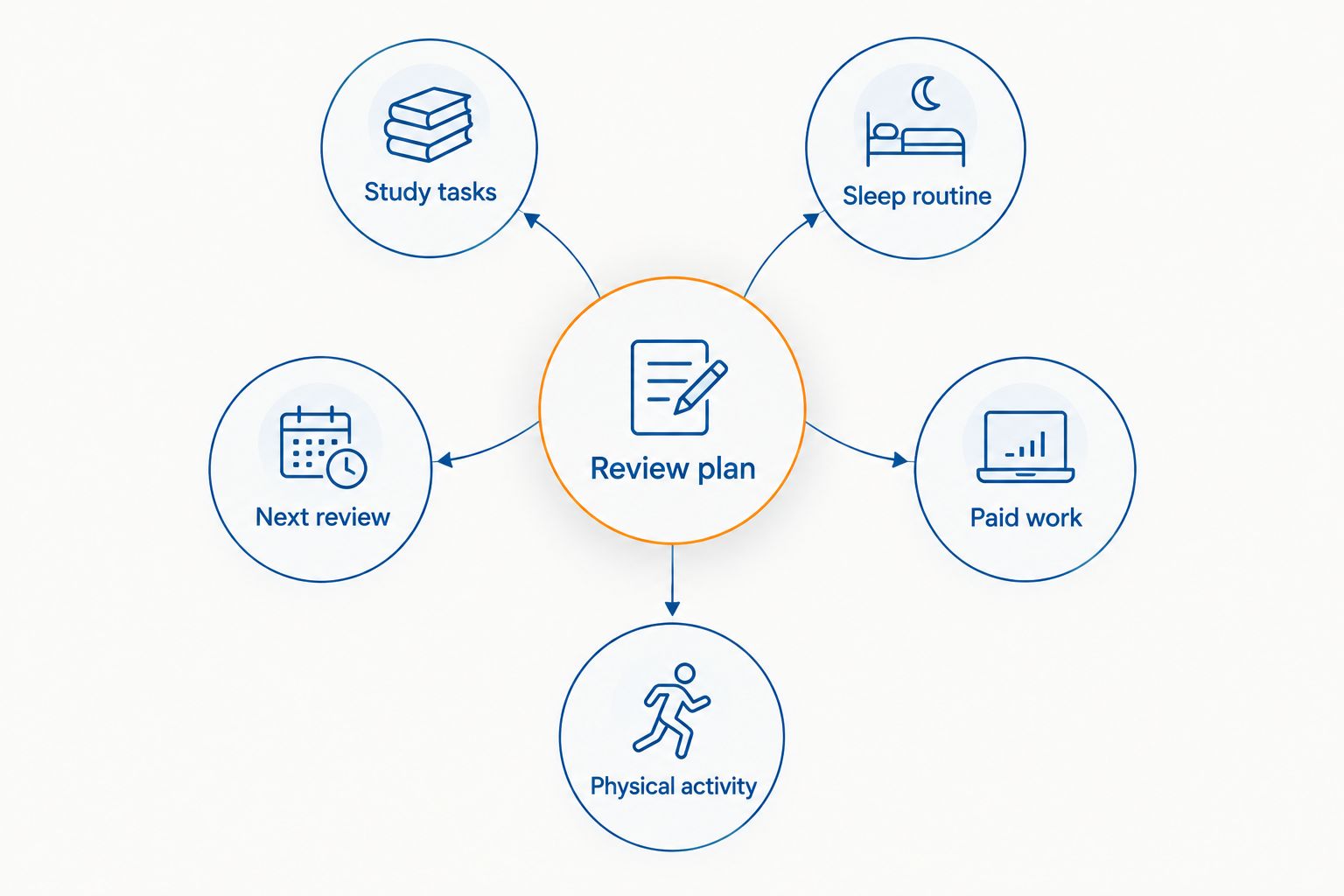
Bring this information to whichever qualified health professional you consult. Keep a copy for yourself so that you can ask consistent questions if another assessment or referral becomes appropriate.
- Define the concern being assessed and the reason for proposed care.
- Ask when the plan will be reviewed.
- Agree on which everyday tasks will be discussed at review.
- Clarify what would prompt a change, pause or referral.
- Keep decisions separate from pressure to commit to ongoing attendance.
Compare assessment and support options
There is no single care option that suits every university student. Choose according to the question you need answered, the nature of your concern and the assessment provided—not an expectation that one profession manages everything.
The following 2026 comparison describes roles and limitations. It does not rank clinical outcomes or assume that these services are available through your university.
| Option | Appropriate when | What it offers | Key limitation |
|---|---|---|---|
| Self-directed setup review | You want to examine your study environment | A practical check of desk access, equipment and daily routines | Cannot diagnose symptoms or establish whether care is needed |
| GP assessment | You need medical assessment of a new, unexplained or broader health concern | Medical evaluation and referral decisions | Another professional may be needed for a particular rehabilitation question |
| Physiotherapy assessment | You want to discuss movement, function or rehabilitation | Assessment and discussion of activity-based care where appropriate | Suitability and the plan depend on individual assessment |
| Chiropractic assessment at MyChiro | You are considering chiropractic care in Bondi Junction | Discussion of musculoskeletal concerns and proposed care following assessment | Adjustments are not automatically appropriate; medical referral may be needed |
| University accessibility service | You need to discuss study access or adjustments | Information about institutional processes and support | Does not replace clinical assessment or determine a diagnosis |
You can use more than one pathway when the roles are distinct. Tell each practitioner about relevant assessments and advice so that decisions do not rely on an incomplete account.
Common mistakes university students make
Assuming student status creates a need for adjustments
A laptop-heavy course does not establish a diagnosis or a need for regular chiropractic attendance. Seek an assessment for a specific concern when appropriate, rather than treating appointments as a required study habit.
Buying equipment before identifying the practical problem
An expensive chair cannot answer why a symptom occurs. First identify what is difficult about the existing setup, trial available changes and seek assessment when the concern requires it.
Leaving out placement work and casual shifts
A discussion focused only on lectures misses activities outside the classroom. Explain your actual week, including clinical placements, hospitality shifts, sport and commuting, without assuming any one activity is responsible.
Using symptom searches as a diagnosis
A search result about nerve pressure, posture or a disc condition does not establish what is happening in your case. Describe your experience to a qualified professional instead of asking for a procedure based on a label found online.
Committing without understanding the review plan
Ask why further visits are proposed and what will be reconsidered. Do not confuse a predetermined appointment schedule with an individual explanation of need, alternatives and review criteria.
FAQ
Do university students need chiropractic care?
University attendance alone does not establish a need for chiropractic care. An individual concern can be discussed with a qualified health professional, who can assess whether chiropractic care or another pathway is appropriate.
Can chiropractic care improve my concentration during exams?
This guide does not support chiropractic care as a way to improve concentration or exam performance. Discuss persistent concentration difficulties with an appropriate health professional rather than assuming they require adjustments.
Should I see a GP or a chiropractor for back pain?
A GP is an appropriate starting point for a new, unexplained or broader medical concern. Chiropractic assessment may be appropriate in some circumstances, but urgent symptoms require medical assessment rather than a routine chiropractic visit.
Do I have to agree to an adjustment at my first appointment?
You can decline a proposed adjustment or ask for more information before consenting. Ask about the reason for the procedure, relevant risks, uncertainties and alternatives.
Will a laptop stand stop neck or back pain?
A laptop stand does not guarantee that neck or back pain will stop. It changes the screen position, so consider keyboard access and discuss persistent or recurring symptoms with a qualified health professional.
How much movement should a university student aim for?
Australian Government guidance for adults aged 18–64 years recommends 150–300 minutes of moderate activity per week, or 75–150 minutes of vigorous activity, or an equivalent combination. It also recommends muscle-strengthening activity on 2 days per week; these are general-health guidelines, not an individual rehabilitation prescription.
What should I ask before continuing chiropractic care?
Ask why further care is proposed, when it will be reviewed and what would prompt a change or referral. You should understand the proposed plan and alternatives before deciding whether to continue.
Where is MyChiro located?
MyChiro is a chiropractic clinic and wellness centre in Bondi Junction, Sydney. Whether its chiropractic services are appropriate for a student depends on individual assessment.
One last thing
Bring your timetable, not just a description of your desk. A practical recommendation for 2026 is to explain what an ordinary week requires before discussing a care plan. Your lectures, commute, paid work and recreation provide context that a photograph of your posture cannot supply.
This guide is general education, not an individual assessment or a recommendation to receive adjustments. The movement guidance above comes from the Australian Government’s adult physical activity recommendations; the urgent-assessment examples reflect Healthdirect’s back-pain guidance.
Related guides
- Prepare for your first chiropractor appointment
- Qualifications to check when choosing a Sydney chiropractor
- Carrying a laptop bag: practical considerations