


Chiropractic care may be worth considering in 2026 when an individual assessment supports it, you understand the proposed care and alternatives, and there is an agreed way to review progress. The commitment includes your time, travel and any recommended follow-up—not just the initial appointment. Do not commit to ongoing care without understanding why it is proposed and when it will be reassessed.
- Is chiropractic care worth it in 2026? Assess suitability, informed consent, alternatives and review arrangements before deciding.
- Mychiro is a chiropractic clinic in Bondi Junction; its location alone does not establish whether care suits you.
- Ask what a proposed adjustment involves, what risks apply and what alternatives you have.
- Agree on a meaningful daily-life goal and a review point before committing to further care.
Is chiropractic care worth it in 2026?
There is no universal yes-or-no answer. Your decision should depend on the reason for seeking care, the explanation following assessment, your preferences and the proposed commitment—not a promise attached to chiropractic care as a whole.
Mychiro provides chiropractic care and spinal adjustments in Bondi Junction, Sydney. Mychiro is a local chiropractic care option, not a substitute for deciding whether a proposed service is appropriate for you.
Use this sequence before deciding:
- Clarify your goal. Describe what you want to understand or do differently in everyday life.
- Discuss suitability. Ask what the assessment suggests, what remains uncertain and whether another health professional should be involved.
- Understand consent. Request an explanation of the proposed procedure, its risks, alternatives and the option not to proceed.
- Agree on review. Ask when the plan will be reconsidered and what information will guide that decision.
- Reconsider the plan. Discuss whether to continue, change direction, seek another opinion or stop.
These are decision-making steps, not a recommended appointment schedule. You do not need to decide on an extended course of care before understanding the initial assessment.
Why this matters
A worthwhile healthcare decision is not simply a decision to book. It is an informed choice about whether a particular service fits your circumstances, including the uncertainty and practical commitment involved.
The Australian Commission on Safety and Quality in Health Care describes shared decision-making as a process in which patients and clinicians consider options together. Apply that principle to your 2026 decision: ask for the reasoning, express your preferences and make room for questions before consenting.
A clear explanation should also separate a proposed approach from a promised outcome. An assessment can inform a recommendation; it does not justify a guarantee about how you will respond.
What should you compare before choosing care?
Compare the purpose of each consultation rather than assuming a professional title determines the right pathway. The table below describes questions to explore, not rankings or promises about clinical outcomes.
| Option | When to consider discussing it | Potential practical advantage | Limitation or question to resolve |
|---|---|---|---|
| Chiropractic consultation | You want an assessment and discussion of proposed chiropractic care | An opportunity to ask about adjustments and whether they are appropriate | Attendance does not establish suitability for an adjustment; ask about risks and alternatives |
| GP consultation | You are unsure what is causing symptoms or whether medical assessment is needed | An opportunity to discuss broader medical concerns and referral needs | Further assessment or another professional's input may still be required |
| Physiotherapy consultation | You want to discuss movement, exercise and rehabilitation options | An opportunity to explore an individual movement-related plan | Ask what the proposed plan involves and how it will be reviewed |
| Another opinion | The explanation is unclear or you remain uncomfortable with the recommendation | Another opportunity to examine the reasoning and available options | It involves additional time and does not guarantee agreement between clinicians |
These options are not necessarily mutually exclusive. If more than one professional is involved, ask who is coordinating the plan and how recommendations will be communicated.
Choose the next consultation for the question you need answered, not because one profession is advertised as universally preferable. Avoid treating a comparison table as an individual clinical recommendation.
Why the value of chiropractic care varies
The same proposed service can represent a different commitment for different people. Consider these factors before deciding:
- Your reason for seeking care. A question about an everyday musculoskeletal concern requires a different discussion from unexplained or changing symptoms.
- The assessment findings. Ask how the recommendation follows from your history and examination, including what is still uncertain.
- Your preferences. Tell the clinician if you do not want a particular technique or would prefer to discuss alternatives.
- The practical commitment. Include travel, time away from work, caring responsibilities and any proposed follow-up in your decision.
- The review arrangements. A plan is easier to evaluate when you understand what will trigger reassessment, a change or referral.
- Coordination with other care. Explain what other professionals have recommended so that conflicting or duplicated advice can be discussed.
A plan that is convenient is not automatically clinically appropriate. Equally, an explanation that sounds plausible still needs to address your questions about evidence, uncertainty and consent.
What should you ask before an adjustment?
Start with a plain-language description of the proposed procedure. Ask which area would be involved, what the clinician intends to do and why that approach is being proposed for you.
For background terminology, the guide to what to expect from spinal manipulation provides a starting point for questions. General reading does not replace an individual explanation or consent discussion.
Ask the clinician:
- What assessment findings support this recommendation?
- What evidence applies to the proposed care for my circumstances?
- What uncertainties and risks should I understand?
- What other approaches can we discuss?
- What happens if I decline this procedure?
- What symptoms or concerns should prompt medical advice afterwards?
Healthdirect Australia's information on chiropractic care discusses risks associated with spinal manipulation. Request a discussion relevant to the particular procedure and your health history rather than accepting a blanket assurance about chiropractic care.
Consent is a choice, not a commitment to accept every proposed technique. You can ask for more information, decline a procedure or withdraw consent. A discussion should leave you understanding the choice rather than feeling hurried into it.
How can you make progress reviewable?
Before starting a proposed plan, choose something meaningful to discuss at review. Avoid relying only on whether an appointment felt pleasant or whether a technical explanation sounded convincing.
Use this simple record:
- Write 1 goal. Choose an everyday activity you want to discuss, such as getting through your commute or completing a household task.
- Note 2 activities. Record what currently happens during those activities, including any limits or adjustments you make.
- Record symptoms consistently. If useful, use a 0–10 symptom scale alongside a description of daily function; a score alone is not a diagnosis.
- Agree on review. Ask when the record will be discussed and what would justify continuing or changing the plan.
- Record other changes. Mention changes in activity, work, sleep, medication or other care rather than attributing every change to one appointment.
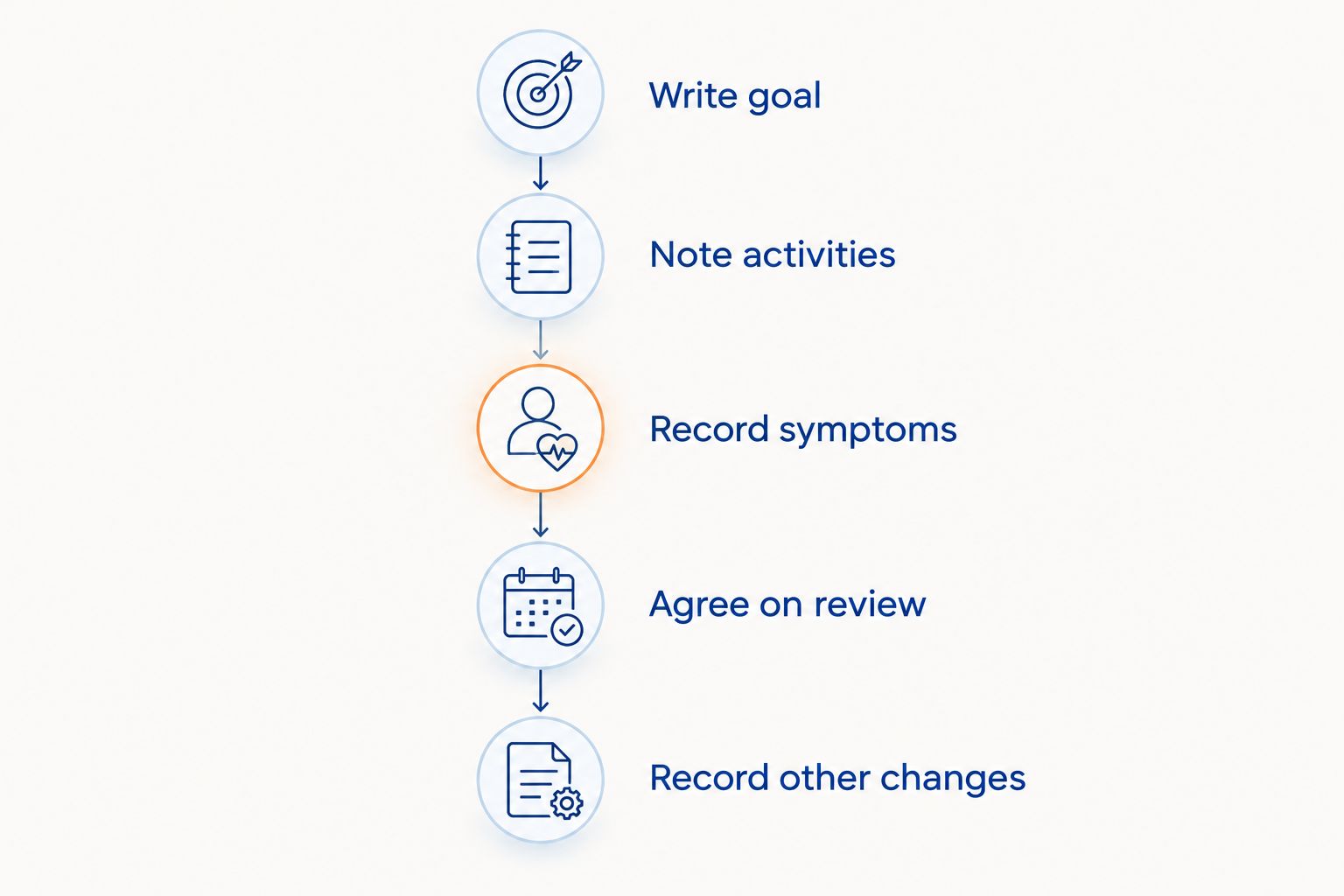
Your notes support a conversation; they do not prove what caused a change. Ask the clinician how your account fits with reassessment findings and whether the original recommendation still makes sense.
For a 2026 care decision, an agreed review point is more useful than an open-ended assumption that appointments should continue. Do not mistake the number of visits completed for evidence that a plan remains appropriate.
Should you agree to ongoing appointments straight away?
Ask for the clinical reasoning before agreeing to ongoing appointments. A recommendation should explain why follow-up is proposed, what it involves and when the need for further care will be reconsidered.
Request a written summary if that helps you think. You should be able to distinguish the assessment findings, the proposed next step and any longer-term suggestion without having to remember everything said during a consultation.
Questions worth taking home include:
- Is this a recommendation for my current concern or a general suggestion?
- What information supports the proposed frequency?
- What would lead us to reduce, change or stop appointments?
- What are the implications of waiting while I consider my options?
Do not accept a guarantee about future symptoms as a substitute for an explanation. You can seek another opinion if you remain unsure about the reasoning or commitment.
Is chiropractic care worth it if you are not improving?
If you are not noticing meaningful change, ask for reassessment rather than automatically repeating the same plan. Describe what has stayed the same, what has changed and whether the original goal still reflects what matters to you.
Reassessment should be a discussion about the next decision, not a promise that additional appointments will necessarily produce a particular outcome. Ask whether another approach or referral should be considered.
Do you need medical assessment before considering chiropractic care?
Medical assessment takes priority when symptoms suggest an urgent or broader medical concern. Do not use an online article to decide that unexplained, severe or changing symptoms are suitable for an adjustment.
Healthdirect Australia's back pain information identifies warning signs requiring urgent attention, including new bladder or bowel problems, numbness around the groin and significant leg weakness. Seek urgent medical assessment for these symptoms; call 000 in an emergency.
Recent significant trauma, fever with back pain, or symptoms accompanied by unexplained weight loss also warrant medical advice. These examples are not a complete screening checklist, and their absence does not establish that chiropractic care is appropriate.
What should a local clinic tell you before you decide?
Mychiro's stated services include chiropractic care and spinal adjustments. That factual description tells you what the clinic offers, but it does not establish a likely outcome for your symptoms.
When discussing chiropractic care with Mychiro, ask the same questions you would ask any provider: what is proposed, why it is proposed, what alternatives exist and how the decision will be reviewed. Your preferences and consent belong in that conversation.
For anyone comparing local options in 2026, location is a practical factor—not a clinical endorsement. Review qualifications, the explanation offered and whether your questions receive clear answers before deciding.
FAQ
Is chiropractic care worth it in 2026?
Chiropractic care may be worth considering following an individual assessment and an informed discussion of the proposed care, risks, alternatives and review arrangements. No general answer establishes whether it is appropriate for you.
Do I have to agree to an adjustment at my first appointment?
You do not have to agree to an adjustment. Ask for an explanation, take time to consider it and decline or withdraw consent if you do not wish to proceed.
Should I choose a chiropractor or a physiotherapist?
Choose according to the assessment and advice you need, not a blanket ranking of professions. Ask each clinician to explain the proposed approach, its limits and whether another professional should be involved.
How many chiropractic appointments should I have?
There is no appointment number that this article can recommend for you. Ask for an individual explanation of any proposed schedule and an agreed point for reassessment.
What if I do not notice any improvement?
Ask for reassessment if you do not notice meaningful change. Discuss your original goal, any new symptoms and whether the plan should change or another opinion is appropriate.
Can I see a GP while considering chiropractic care?
You can discuss your concerns and proposed chiropractic care with your GP. Tell each clinician about other care and recommendations so coordination can be considered.
What should I check before booking with Mychiro?
Check whether the consultation offered addresses the questions you want answered and ask what the assessment involves. Mychiro is a chiropractic clinic in Bondi Junction; individual suitability still requires assessment.
One last thing
Before you agree to care, write down this question: What would make us change the plan? Ask it alongside questions about the proposed approach, not only after you become uncertain.
A useful answer should explain the review process without promising a particular outcome. Your decision in 2026 is not a permanent vote for or against chiropractic care—it is consent to a particular next step that you understand.
Related guides
- What qualifications should a Sydney chiropractor have?
- How to prepare for your first chiropractor appointment
- How to choose the right chiropractor for your condition