


Instead of repeatedly asking HR whether chiropractic appointments qualify, confirm your workplace chiropractic program’s rules in writing, check the clinic’s requirements, and keep the approval with your claim documents. This guide explains that administrative process for Australian employees in 2026; employer funding and clinical suitability are separate decisions.
- A workplace chiropractic program requires written eligibility checks; an employer wellness benefit is not automatic approval.
- Mychiro provides chiropractic care in Bondi Junction; confirm any workplace funding arrangement before making an appointment.
- Keep employer reimbursement, private health extras and workers compensation paperwork separate.
- Funding approval does not establish whether chiropractic care is appropriate for you.
Why this matters
A workplace health benefit is useful only when you understand what it includes. A general reference to wellness, allied health or employee assistance does not establish that chiropractic appointments qualify under your employer’s policy.
Confirm the funding pathway before committing to an appointment under that benefit. Ask who approves it, which services qualify, whether approval must come first and what evidence you must submit afterwards.
Mychiro is a chiropractic clinic and wellness centre in Bondi Junction, Sydney. Its location and services do not establish participation in your employer’s program, so check that arrangement directly with both parties.
Use your employer’s current 2026 policy rather than a colleague’s previous claim as your reference. Your employment category, proposed appointment and provider still need to meet the applicable requirements.
Before you start
- Gather access and documents: Have your employee benefits policy, HR or benefits administrator’s contact details, and access to any required submission system. If another organisation administers the benefit, ask who makes eligibility decisions.
- Check the clinic separately: Have the proposed clinic’s details ready, and ask what appointment and receipt information it can provide. Do not assume the clinic can invoice your employer or process an unfamiliar benefit.
- Resolve the approval gotcha: Ask whether written approval is required before attendance. An appointment confirmation is not an employer funding authorisation, and a general wellness allowance is not confirmation that chiropractic care qualifies.
Create 1 private folder for the policy, correspondence, approvals and receipts. Keep clinical information out of shared workplace folders unless an authorised process specifically requires it and you understand the disclosure.
Eligibility confirmation
Identify your funding pathway
- Locate the current employee benefits policy or ask HR for the document governing your proposed appointment. Check its effective date and whether it applies to your employment arrangement.
- Ask whether chiropractic care is expressly included. If the policy uses a broader category, request a written answer about chiropractic rather than interpreting that category yourself.
- Identify the administrator responsible for approval. That might be an internal benefits contact or an external administrator; use the contact your employer nominates.
- Ask whether the proposal belongs under an employee wellness benefit or a separate process. If you are reporting a workplace injury, ask about the injury-reporting pathway rather than treating a wellness allowance as a substitute.
Expected result: You know which process applies and who can give an authoritative answer about eligibility.
The following table compares administrative pathways, not clinical recommendations. Its “suited to” column identifies the paperwork situation each pathway addresses; it does not establish entitlement.
| Pathway | Suited to | Administrative advantage if confirmed | Limitation to check |
|---|---|---|---|
| Employer reimbursement | Employees whose policy includes the proposed appointment | A defined route for submitting supporting documents | Whether prior approval and particular receipt details are required |
| Employer-arranged direct billing | Employees with an expressly authorised billing arrangement | The clinic and administrator can agree on invoice handling | Whether the clinic accepts the arrangement and the authorisation covers the appointment |
| Private health extras | Members checking their own chiropractic benefits | Eligibility questions can go directly to the health fund | Policy conditions and interaction with any employer reimbursement |
| Workers compensation | Employees seeking information about a reported work-related injury | A separate claim and approval process can be identified | Applicable scheme requirements, claim status and any required authorisation |
Do not select a pathway just because its paperwork looks simpler. Ask the relevant administrator which process applies to your circumstances.
Obtain written approval
- Send a focused enquiry identifying the service category, proposed clinic and whether you have already attended. Avoid including a detailed medical history in an initial HR enquiry.
- Request confirmation of eligible services, provider requirements, approval conditions and submission deadlines. Ask whether the initial assessment and any later appointments require separate decisions.
- Clarify what happens if the appointment date, provider or proposed service changes. Ask whether an amended authorisation is needed before proceeding.
- Save the written answer with the policy version used. Record any unresolved question rather than treating silence as approval.
Expected result: Your written approval identifies what is authorised, under which conditions and for which appointment or period.
For a 2026 application, request the policy and approval conditions that apply to the proposed attendance date. If an email conflicts with the policy document, ask the administrator to resolve the discrepancy in writing.
A useful enquiry covers 3 date fields: the proposed appointment date, the authorisation expiry date if applicable, and the submission deadline. These are checklist fields to request, not standard deadlines shared by all programs.
Clinic and appointment arrangements
Confirm provider acceptance
- Tell the clinic that you are checking an employer benefit before making an appointment under that arrangement. Explain whether you expect reimbursement or have written direct-billing authorisation.
- Ask whether the clinic can meet the administrator’s documentation requirements. Describe the required information rather than assuming a standard receipt will contain it.
- Check any provider-identification requirements with the administrator and clinic. Where registration is relevant, verify the practitioner’s current registration through the Australian Health Practitioner Regulation Agency’s public register.
- Ask what happens administratively if the employer declines payment or requests more information. Resolve responsibility for the account before relying on direct billing.
Expected result: The clinic and administrator agree on the intended administrative arrangement, or you know what remains unresolved.
Mychiro provides chiropractic care in Bondi Junction for local patients considering an assessment. Contact the clinic to ask whether your particular workplace arrangement can be accommodated; this guide does not establish employer partnerships or billing agreements.
Keep 2 written confirmations together: the administrator’s eligibility decision and the clinic’s response about the proposed arrangement. They answer different questions, and neither replaces the other.
Prepare for the assessment
- Keep the funding discussion separate from the clinical discussion. Explain your concerns and relevant health history to the practitioner rather than assuming employer approval establishes clinical suitability.
- Ask what the proposed assessment involves. Discuss any questions about consent, potential risks, alternatives and whether another health professional’s assessment is appropriate.
- Explain relevant work tasks without presenting an unconfirmed workplace cause as an established diagnosis. Describe what you do and what you have noticed.
- Ask before authorising reports or information sharing. Clarify what would be sent, to whom, for what purpose and through which channel.
Expected result: You understand the proposed assessment and the information-sharing arrangements before deciding whether to proceed.
Chiropractic care may be appropriate following assessment. An employer benefit is not a reason to request adjustments, imaging, a predetermined appointment schedule or any other service that has not been individually discussed.
Claim documentation
Submit and track your claim
- Check the receipt or invoice against the administrator’s actual requirements. Resolve missing or incorrect details with the clinic before submitting it.
- Use the submission method named in your policy or approval. Portal labels vary, so follow your employer’s instructions rather than looking for a universal chiropractic claim button.
- Attach only the documents requested through the authorised process. Ask for clarification before uploading consultation notes or other sensitive health information.
- Save the submission acknowledgement or reference, if provided. Record the submission date and check the administrator’s stated follow-up process.
- If the decision differs from your approval, request the reason in writing. Keep that response with the original authorisation and supporting documents.
Expected result: You have a traceable submission and know whether it is accepted, awaiting information or declined.
For your 2026 records, keep the approval, attendance documentation and decision together. Check your employer’s retention instructions rather than choosing a document-retention period from an unrelated benefits guide.
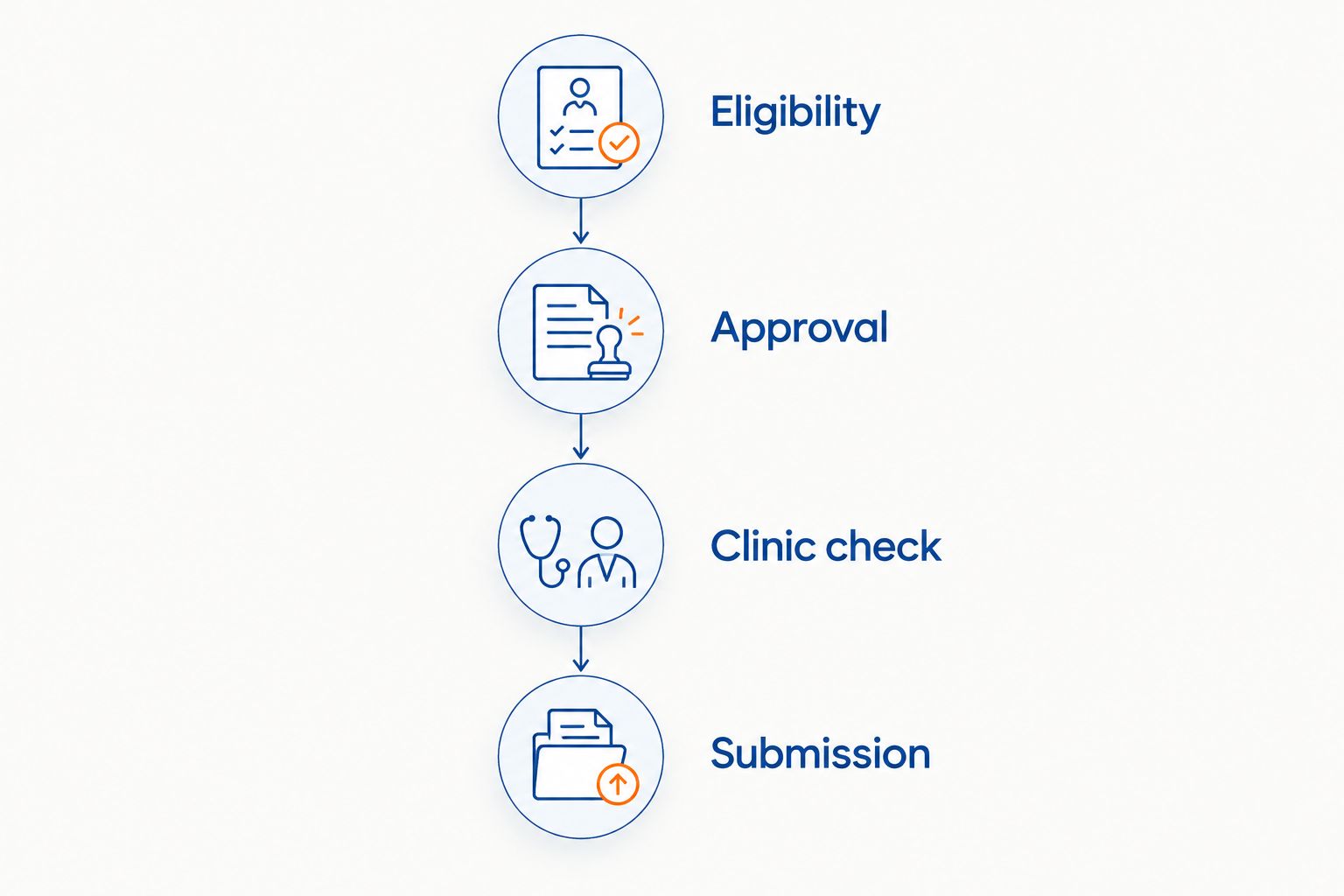
The administrative sequence is Eligibility, Approval, Clinic check, Submission. Complete each stage before assuming the next is settled; a submitted claim is not the same as an accepted claim.
When your employer arranges direct billing
Direct billing is an adjacent workflow, not a default feature of a workplace chiropractic program. Use it only when the employer or administrator and the clinic have expressly agreed to the arrangement.
- Obtain the administrator’s written authorisation and nominated billing contact.
- Ask the clinic whether it accepts that specific arrangement before attendance.
- Confirm which appointment or service the authorisation covers and whether further approval is required for later attendance.
- Clarify what administrative information the invoice must include. Keep requests for clinical reports separate from routine invoice handling.
- Ask how you will be notified if the invoice is disputed or the authorisation changes.
Expected result: You understand who receives the invoice, what authorisation supports it and what remains your responsibility.
The advantage of an agreed direct-billing arrangement is a clear invoice route. The limitation is that it depends on both parties accepting the same terms; an employer’s approval alone does not establish the clinic’s acceptance.
If direct billing is unavailable, return to the administrator for instructions. Do not assume you can attend first and convert the arrangement to reimbursement afterwards.
Troubleshooting
The policy says wellness but does not mention chiropractic
Ask the administrator to confirm the service category in writing. Do not interpret a broad category as approval, even if a colleague previously received reimbursement.
If the answer remains unclear, request the applicable policy clause and the name of the person authorised to decide. Keep the question administrative rather than sending unnecessary health details.
The clinic cannot use the employer’s billing process
Ask whether the employer permits another documented process, such as employee reimbursement. Confirm that process before attendance rather than asking the clinic to assume an unapproved billing arrangement.
Mychiro’s ability to accommodate a particular employer process must be checked directly. A local clinic listing does not confirm participation.
Your submission is declined after approval
Compare the decision with the written authorisation. Check the appointment date, provider details, service description and any conditions the administrator specified.
Request the precise reason and the correction or review process. Do not alter a receipt yourself or ask a clinic to describe a different service to fit the policy.
HR requests consultation notes
Ask what information is required, why it is required and who will receive it. Discuss the request with the clinic before authorising disclosure, including whether a narrower document would meet the stated administrative purpose.
Use the authorised channel. Avoid placing health records in a general team inbox or shared workplace chat.
You are unsure whether to use an injury claim
Ask your employer’s injury-management contact about the applicable reporting and claim process. Do not assume a wellness benefit determines whether an injury is work-related or whether another scheme applies.
Clinical assessment and administrative approval are separate. Seek appropriate medical assessment when needed rather than waiting for a benefits decision.
Customize your workflow
Keep the same administrative checklist if your employer changes providers, your employment arrangement changes or the benefit is renewed. Reconfirm the terms instead of reusing an old authorisation automatically.
For a 2026 renewal, check the policy version, relevant dates and any updated provider or documentation requirements. Keep the earlier approval as a record, not as evidence of continuing eligibility.
If you decide to arrange an assessment, use the first chiropractor appointment preparation guide to organise questions for the consultation. Bring the benefits paperwork separately so administrative approval does not become a substitute for discussing your individual circumstances.
FAQ
How do I access a workplace chiropractic program in Australia?
Ask your employer or benefits administrator whether chiropractic care is included, obtain any required written approval and confirm the arrangement with the clinic. Follow the specified documentation and submission process rather than assuming attendance will qualify.
Does my employer have to include chiropractic care in its wellness program?
Do not assume chiropractic care is included in an employer wellness program. Ask for the applicable policy and a written eligibility decision for your proposed appointment.
Can I use Mychiro through my workplace health benefit?
Ask your benefits administrator and Mychiro to confirm your specific arrangement. This guide does not establish that the clinic participates in any employer program or accepts direct billing.
Do I need a GP referral for an employer-funded chiropractic appointment?
Ask the administrator whether your particular benefit requires a referral or other documentation. Funding requirements and decisions about appropriate clinical assessment are separate questions.
Can I combine employer reimbursement with private health extras?
Ask both the employer administrator and your health fund before submitting related claims. Explain any payment or reimbursement already received and request instructions for the same appointment.
Is a workplace chiropractic program the same as workers compensation?
Do not treat a workplace wellness benefit as interchangeable with workers compensation. Ask the relevant administrator which process applies, particularly when you are reporting a work-related injury.
Does funding approval mean I need chiropractic adjustments?
No. Funding approval is an administrative decision, not a clinical assessment or a recommendation for adjustments. Chiropractic care may be appropriate following assessment, and you can discuss alternatives with a qualified health professional.
One last thing
An authorised benefit is permission to use a funding process, not an instruction to use healthcare. Confirm the paperwork if you are considering an appointment, then make your healthcare decision separately following an individual discussion with an appropriate practitioner.
Related guides
- Workers compensation approval for chiropractic care
- Using private health fund extras for chiropractic care
- Qualifications to check when choosing a Sydney chiropractor