


Instead of collecting quotes for an NDIS chiropractor, check the funding rules first: chiropractic services are listed as supports the NDIS does not fund. You cannot add chiropractic care simply by linking it to a plan goal; use the workflow below to separate disability-support planning from healthcare arrangements.
- An NDIS chiropractor search does not establish funding eligibility: chiropractic services are excluded from NDIS supports.
- Self-management and plan management do not make an excluded chiropractic service claimable.
- Mychiro provides chiropractic care in Bondi Junction; NDIS funding eligibility is a separate question.
- Ask the NDIA about eligible disability supports, and discuss healthcare needs separately with an appropriate health professional.
Why this matters
An available therapy budget is not permission to purchase every service described as therapy. The National Disability Insurance Scheme funds eligible disability supports, rather than every healthcare service a participant chooses to access.
The National Disability Insurance Agency’s published Supports that are not NDIS supports list includes chiropractic services. That exclusion is the starting point for this 2026 guide, not whether a practitioner accepts invoices or whether you have money remaining in your plan.
Mychiro is a chiropractic clinic for people seeking chiropractic care in Bondi Junction, not evidence of NDIS funding eligibility. You can read about Mychiro separately from deciding how an appointment would be funded.
This guide covers administrative questions, not whether chiropractic care is appropriate for you. A qualified health professional can discuss that question following assessment. Funding approval and clinical suitability are separate decisions.
Before you start
- Gather your current plan and relevant correspondence. Include the plan dates, the management arrangement for the relevant budget, and any written NDIA decisions about the support you are considering.
- Identify who can answer each question. The NDIA can clarify support rules and plan decisions. A plan manager can explain invoice administration. A healthcare professional can discuss your healthcare needs.
- Recognise the funding gotcha. A flexible budget, a provider’s invoice or a plan manager’s willingness to process paperwork does not turn chiropractic care into an eligible NDIS support.
Use one checklist for your 2026 funding enquiry so information does not become scattered across messages. Keep the original wording of decisions, rather than relying on someone’s summary of what the plan supposedly allows.
Do not book an appointment on the assumption that a later invoice will establish eligibility. First identify the service accurately and establish which funding arrangement, if any, applies.
Service identification
Establish what you are actually requesting
- Name the service accurately. If the proposed appointment is a chiropractic consultation or adjustment, describe it that way. Do not start with a broad label such as therapy and leave the actual service unspecified.
- Separate healthcare needs from participation goals. Record the everyday activity you want support with, but do not assume that a goal makes every associated healthcare service fundable.
- Read the exclusion list. Consult the NDIA’s Supports that are not NDIS supports guidance and locate chiropractic services. Use the current published version when checking your 2026 arrangements.
- Record the funding boundary. Note that chiropractic services are excluded, then identify any separate question about eligible disability supports that you still need answered.
Expected result: you have an accurate description of the proposed appointment and understand why it cannot simply be charged to an NDIS therapy budget.
A practitioner might provide more than one type of service. Eligibility still depends on the actual support being delivered and the applicable rules, not only the practitioner’s profession or business name. Do not assume that another service is eligible without checking it separately.
An invoice should describe what occurred. Changing a chiropractic appointment’s label to capacity building, functional support or another funding term does not change the underlying service.
Keep the enquiry focused
Use two separate questions when contacting the people involved:
- What eligible disability supports address the participation need described in my plan?
- What non-NDIS arrangements should I check if I choose to seek chiropractic care?
These questions avoid asking a plan manager to solve a clinical problem or asking a clinic to determine your NDIS entitlement. They also keep the support you need at the centre of the discussion, rather than making one service the assumed answer.
Funding-route check
Distinguish payment administration from eligibility
- Identify your management arrangement. Check whether the relevant funding is self-managed, plan-managed or NDIA-managed. Different parts of a plan can have different arrangements.
- Check the support before checking the invoice. Establish whether the actual service is an NDIS support before discussing payment processing.
- Ask for the basis of any conflicting advice. If someone says chiropractic care can be claimed, ask which current NDIA rule they are relying on and whether they are describing the same service.
- Retain the response. Keep written advice with your plan records, especially when it differs from the published exclusion list.
Expected result: you understand who administers the relevant budget without mistaking their administrative role for permission to fund chiropractic care.
The following comparison concerns NDIS payment administration. None of these arrangements removes the chiropractic exclusion.
| Management arrangement | Relevant to | Administrative feature | Funding limitation |
|---|---|---|---|
| Self-managed | Participants administering their own relevant funding | You manage payment and claim records | You must still follow NDIS support rules |
| Plan-managed | Participants using a plan manager for relevant funding | The plan manager administers provider payments | Invoice processing does not make an excluded support eligible |
| NDIA-managed | Participants whose relevant funding is managed by the NDIA | The NDIA administers payments under its requirements | Provider registration does not override support exclusions |
Self-management gives you responsibility for administration; it does not convert NDIS funding into unrestricted healthcare spending. Plan management changes who handles payment paperwork, not the nature of the service.
Likewise, Ahpra registration and NDIS provider registration answer different questions. Professional registration is not a statement that every appointment with that practitioner can be funded through a participant’s plan.
Enquiry records
Prepare a useful conversation with the NDIA
- Describe the participation need. Explain the activity you need assistance with and the support already recorded in your plan. Keep the description factual.
- State the service under discussion. Explain that you were considering chiropractic care and have identified it on the excluded-support list.
- Ask about eligible supports instead. Request clarification about disability supports relevant to your circumstances, without asking someone to relabel chiropractic care.
- Clarify the next administrative step. If your disability-support needs have changed, ask whether a plan variation, reassessment or another process is relevant.
- Save the outcome. Record who responded, the date and the explanation. Keep any formal decision separately from informal advice.
Expected result: your enquiry identifies an eligible-support question or an appropriate next administrative step, rather than an unsupported request to add chiropractic care.
For your 2026 enquiry, keep three records together: your current plan, the service description and the written response. This is a suggested filing method, not an NDIA document requirement.
A provider letter can describe a proposed service, but it cannot remove an exclusion. A participation goal also does not establish that the NDIS is the responsible funding system for a particular healthcare appointment.
The workflow is straightforward: identify the service, check its eligibility, clarify any remaining support question and retain the answer. Payment paperwork comes after those checks, not before them.
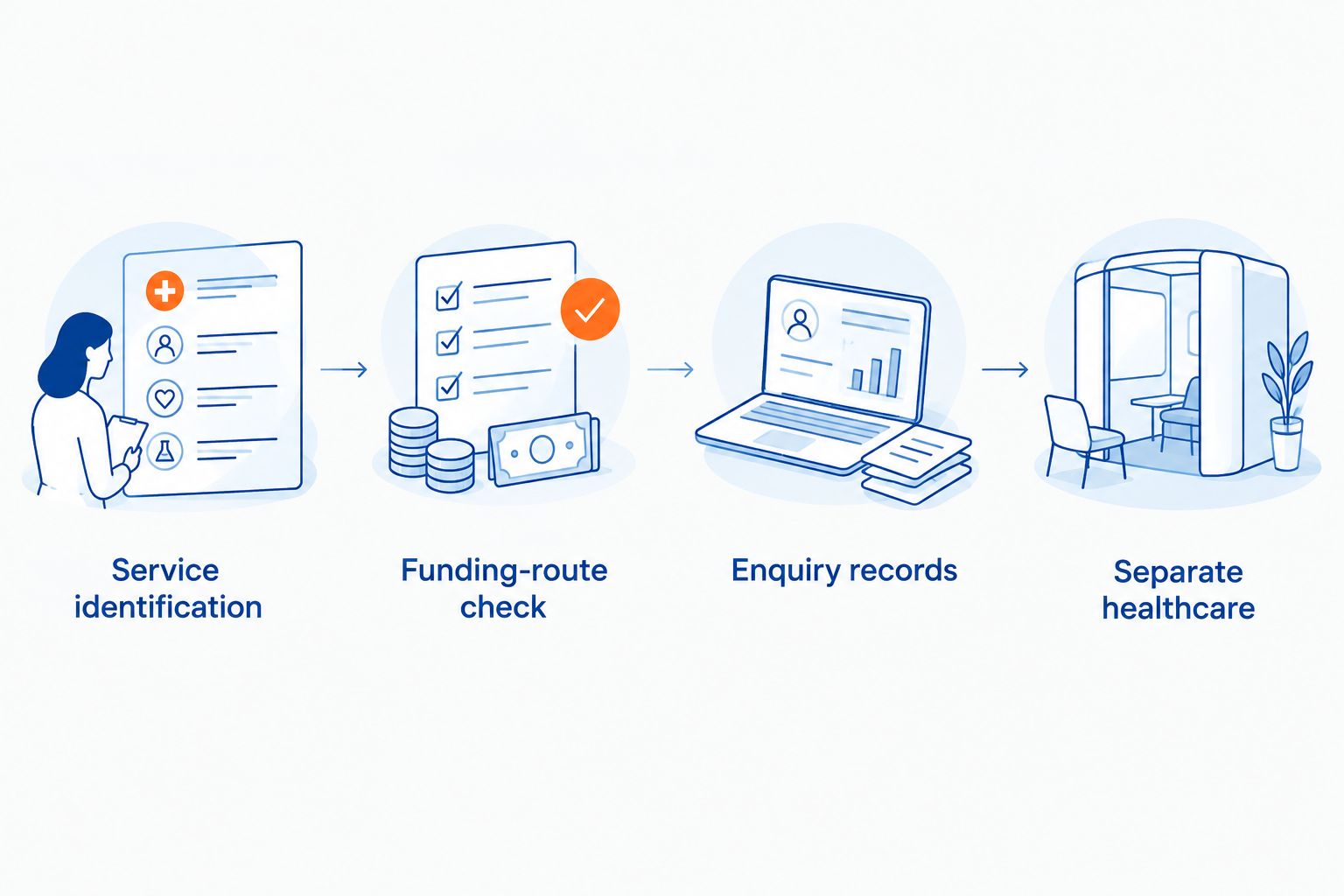
Separate healthcare
Consider arrangements outside your NDIS plan
If you choose to explore chiropractic care, discuss clinical suitability with an appropriate health professional and check payment arrangements separately. Mychiro provides chiropractic care; this article does not establish its NDIS registration, billing arrangements or participation in other funding schemes.
Ask the clinic what service is proposed and what information you need before deciding whether to proceed. Ask any other relevant funder about its own eligibility conditions. Do not infer those conditions from an NDIS plan.
| Route to check | Relevant to | What the enquiry establishes | Limitation |
|---|---|---|---|
| Private healthcare arrangements | People considering care outside NDIS funding | The clinic’s arrangements for the proposed appointment | No NDIS reimbursement follows from choosing private care |
| Medicare arrangements | People asking their GP about applicable referral pathways | Whether current Medicare requirements apply to their circumstances | Eligibility is conditional, not automatic for NDIS participants |
| Private health extras | People with a policy that includes relevant benefits | The insurer’s policy conditions for chiropractic services | Cover depends on the individual policy and its rules |
These are separate enquiries, not recommendations to obtain additional appointments. A GP can discuss healthcare needs and whether any Medicare referral pathway is relevant. An insurer can explain your existing policy.
Do not claim the same service twice or describe private healthcare as an NDIS-funded support. Keep records clear about the actual service and the funding arrangement used.
When your NDIS plan changes
A new plan or a changed budget is a reason to repeat the eligibility check, not assume chiropractic care has become included. The same applies when your funding management arrangement changes.
- Compare the new plan with the previous one and identify what actually changed.
- Check the current NDIS support rules for the actual service you intend to purchase.
- Ask the NDIA to clarify any wording you do not understand, particularly where it appears inconsistent with an exclusion.
- Keep the new response with the new plan and use the correct dates in subsequent correspondence.
Expected result: your records reflect the current plan without carrying forward an unsupported assumption from an earlier conversation.
If you already have an invoice you intended to claim, pause before submitting it. Describe the service honestly and seek clarification about the correct handling of the expense. If a claim has already been submitted, ask the NDIA or your plan manager how to address it rather than altering the service description.
Do not assume a previous payment proves future eligibility. The fact that an administrative transaction occurred does not establish that it met the support rules.
Troubleshooting
Your plan has an unused therapy budget
Unused funding does not override the chiropractic exclusion. Ask about eligible supports connected to your disability-support needs. Do not spend the remaining budget merely because the plan period is ending.
A clinic says it accepts NDIS participants
Accepting participants is not the same as establishing eligibility for a particular service. Ask what the clinic means, which service it proposes and which funding rule it relies on. Mychiro’s location and chiropractic services do not establish NDIS claim eligibility.
A plan manager says the invoice can be processed
Ask whether the advice concerns administrative processing or substantive eligibility. Give the plan manager the accurate service description and identify the NDIA exclusion. Resolve the discrepancy before relying on the proposed payment arrangement.
A support letter links appointments to your goals
A connection to your goals is not enough to override an excluded-support category. Ask the person preparing the letter to distinguish healthcare recommendations from requests for eligible disability supports. Keep both descriptions accurate.
A decision or explanation is unclear
Request the written decision and its reasons. Ask the NDIA about the review process that applies to that specific decision, including any stated deadline. A review process is not a promise that chiropractic care will become fundable.
Customise your workflow
Make a short funding record that you can reuse for future support enquiries. Include the actual service, the relevant rule, the person answering the question and the written outcome. Update it whenever the service or plan changes.
If your main question is about healthcare rather than disability-support funding, start a separate conversation with an appropriate health professional. This prevents a funding discussion from substituting for assessment, informed consent or discussion of alternatives.
For a 2026 plan meeting, describe what you need assistance to do rather than presenting chiropractic appointments as the predetermined solution. Ask which eligible supports address that need and what evidence is required for the specific request.
Keep eligibility, clinical suitability and payment administration as separate checks. Passing one does not establish the others, and none should be assumed from a provider’s invoice.
FAQ
Can I add an NDIS chiropractor to my plan?
Chiropractic services are listed as supports the NDIS does not fund. Linking appointments to a plan goal or having an available therapy budget does not remove that exclusion.
Can I pay for chiropractic care if I self-manage my NDIS plan?
Self-management does not make chiropractic services eligible for NDIS funding. You remain responsible for using plan funds according to the applicable NDIS support rules.
Can my plan manager approve a chiropractic invoice?
A plan manager cannot make an excluded chiropractic service eligible simply by processing its invoice. Ask for clarification if payment advice conflicts with the NDIA’s published support rules.
Does a GP referral make chiropractic care eligible for NDIS funding?
A GP referral does not remove the NDIS exclusion for chiropractic services. Medicare referral arrangements, where applicable, are a separate funding question with their own requirements.
What if my chiropractor writes a letter about my NDIS goals?
A provider letter does not override an excluded-support category. It should accurately describe the proposed service, while any request for eligible disability supports must be considered under the applicable rules.
Does Mychiro provide NDIS-funded appointments?
This guide does not establish Mychiro’s NDIS registration or billing arrangements. Mychiro provides chiropractic care in Bondi Junction, and chiropractic services are excluded from NDIS supports.
Who should I contact if my disability-support needs have changed?
Contact the NDIA or your usual NDIS contact to discuss the appropriate process. Describe the changed participation need and ask about eligible supports rather than assuming chiropractic care can be added.
One last thing
The useful starting question is not whether a clinic can issue an NDIS-style invoice. It is whether the actual service is an eligible NDIS support.
Write that service description before contacting anyone about payment. Clear wording helps keep healthcare choices, disability supports and financial records separate.
Related guides
- Preparing for your first chiropractor appointment
- Qualifications to check when choosing a Sydney chiropractor
- Understanding GP referrals and Medicare arrangements
- Checking private health extras for chiropractic care