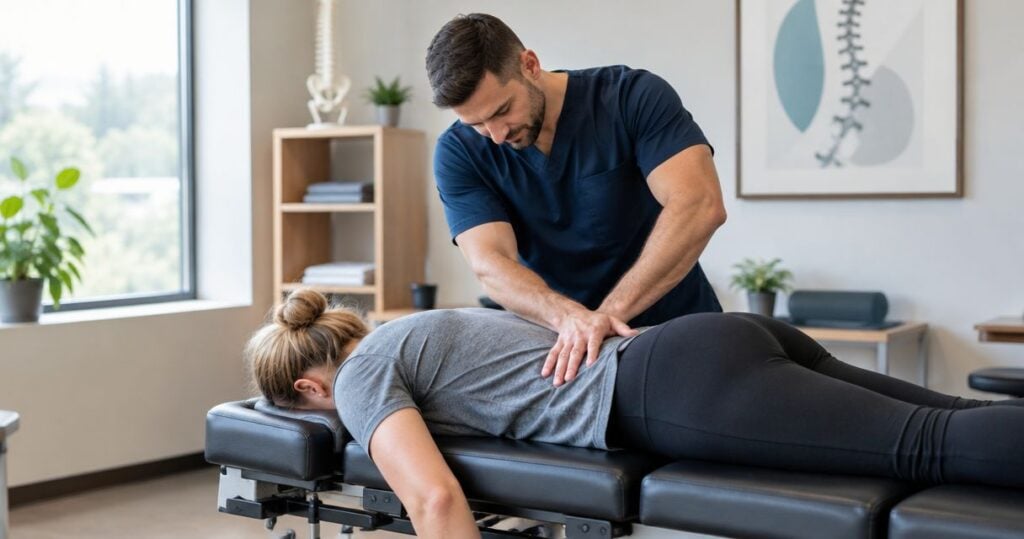
A chiropractor can assess back pain that feels like a pulled muscle, but whether chiropractic care is appropriate depends on the findings; an adjustment is not automatically indicated. A suspected muscle strain does not establish the cause of your pain, and symptoms that suggest something more serious need medical assessment rather than a routine chiropractic appointment.
- Can a chiropractor help with a pulled back muscle? Assessment comes before deciding whether chiropractic care is appropriate.
- MyChiro is a chiropractic clinic in Bondi Junction; suitability for care depends on an individual assessment.
- A painful movement alone cannot confirm a back muscle strain or establish that an adjustment is needed.
- New bladder problems, saddle numbness or progressive leg weakness need urgent medical assessment.
Can a chiropractor help with a pulled back muscle?
A chiropractor can assess a suspected back strain; that does not mean spinal manipulation is necessary or appropriate. The useful question is what an examination suggests, what options fit your circumstances, and whether you need another health professional.
An assessment generally involves these steps:
- Discuss the symptoms. Explain when the pain started, what you were doing, where it hurts and whether it travels elsewhere.
- Check relevant history. Mention previous episodes, health conditions, medicines, recent illness and any injury.
- Examine relevant movement and function. The clinician selects examination procedures according to your symptoms and history.
- Consider referral. Findings that suggest a cause outside the clinician’s scope need an appropriate medical pathway.
- Discuss the next step. This includes the option of advice without a hands-on procedure, alternatives and reasons to seek reassessment.
For an overview of the clinic’s offering, see MyChiro’s chiropractic services. A service description is not a recommendation for your particular episode of back pain.
Why this matters
Calling back pain a pulled muscle is understandable, particularly after lifting, gardening or an unfamiliar workout. It remains a description of what you suspect, not a confirmed diagnosis.
The Australian Commission on Safety and Quality in Health Care’s Low Back Pain Clinical Care Standard, published in 2022, addresses assessment, serious-pathology screening, activity advice and review for people with low back pain. Its scope is broader than a confirmed muscle injury, so it should not be presented as proof that chiropractic adjustments repair a strained muscle.
For a care decision in 2026, keep that distinction clear: guidance about low back pain does not establish an outcome for a particular procedure or person.
What should you do before deciding on an appointment?
Start with the symptoms, not the provider. The following comparison explains different assessment pathways; it does not diagnose your pain.
| Pathway | When to consider it | What it contributes | Important limitation |
|---|---|---|---|
| Emergency medical assessment | Back pain with new bladder or bowel dysfunction, saddle numbness or rapidly worsening leg weakness | Assessment of potentially serious causes | A routine chiropractic appointment is not a substitute |
| GP assessment | Uncertain symptoms, relevant medical conditions, fever, significant injury or concerns about medicines | Medical assessment and referral decisions | An examination is still needed to establish the next step |
| Physiotherapy assessment | Questions about movement, function and returning to activity | Assessment and discussion of activity-based management | An exercise plan must suit the findings, not just the label of strain |
| Chiropractic assessment | Considering chiropractic care for a musculoskeletal concern without urgent warning symptoms | Assessment and discussion of whether care or referral is appropriate | Assessment does not establish that an adjustment is needed |
Seek urgent medical assessment for new bladder or bowel problems, numbness around the genitals or anus, or progressive leg weakness with back pain. Do not wait for a routine appointment to discuss those symptoms. In an emergency in Australia, call 000.
Back pain after a significant fall, collision or other substantial injury also needs medical assessment. Fever, feeling systemically unwell, a history of cancer or unexplained weight loss are reasons to tell a medical practitioner promptly; they are not signs to interpret using an online checklist alone.
What should you tell the clinician?
A useful history is specific without trying to prove that a muscle is injured. Describe what happened and what has changed since then.
- Onset: Was there a particular movement, or did the pain develop gradually?
- Location: Is it local to the back, or does it extend into the buttock or leg?
- Function: What has changed about walking, dressing, sitting, sleeping or working?
- Other symptoms: Mention numbness, weakness, fever and bladder or bowel changes.
- Health history: Include previous spinal surgery, osteoporosis, cancer and current medicines.
- Your priorities: Explain the daily task you want to discuss, rather than requesting a particular technique immediately.
Bring relevant reports if you already have them. Do not arrange imaging simply to prepare for an appointment unless a qualified clinician has recommended it for a clinical reason.
This preparation helps keep a 2026 consultation focused on your circumstances. It also gives you a practical basis for asking why a particular next step has been proposed.
What can an assessment establish about a pulled muscle?
A clinician considers your history and examination together. Pain after lifting, tenderness or discomfort with movement does not, by itself, identify a particular injured tissue.
Ask how certain the working diagnosis is. A clear explanation should distinguish what the clinician has found from what remains uncertain, and explain whether that uncertainty changes the plan.
Does every suspected strain need a scan?
No. The Australian low back pain standard advises against routine imaging when there is no clinical reason to suspect a serious cause; imaging decisions depend on assessment.
A scan is not a prerequisite for every chiropractic consultation. Equally, an online article cannot decide that imaging is unnecessary for you, especially when your history or symptoms raise concerns.
Does a tight or tender area mean the spine needs adjusting?
No. Tightness or tenderness does not establish that spinal manipulation is indicated, and it does not prove that a joint is the source of your pain.
Ask what the proposed procedure is intended to address. The explanation should include its limitations and alternatives, rather than relying on a general claim about alignment or nerve pressure.
What should happen before any hands-on procedure?
You should understand the proposed procedure before deciding whether to consent. An appointment is an opportunity to discuss options, not an obligation to receive an adjustment.
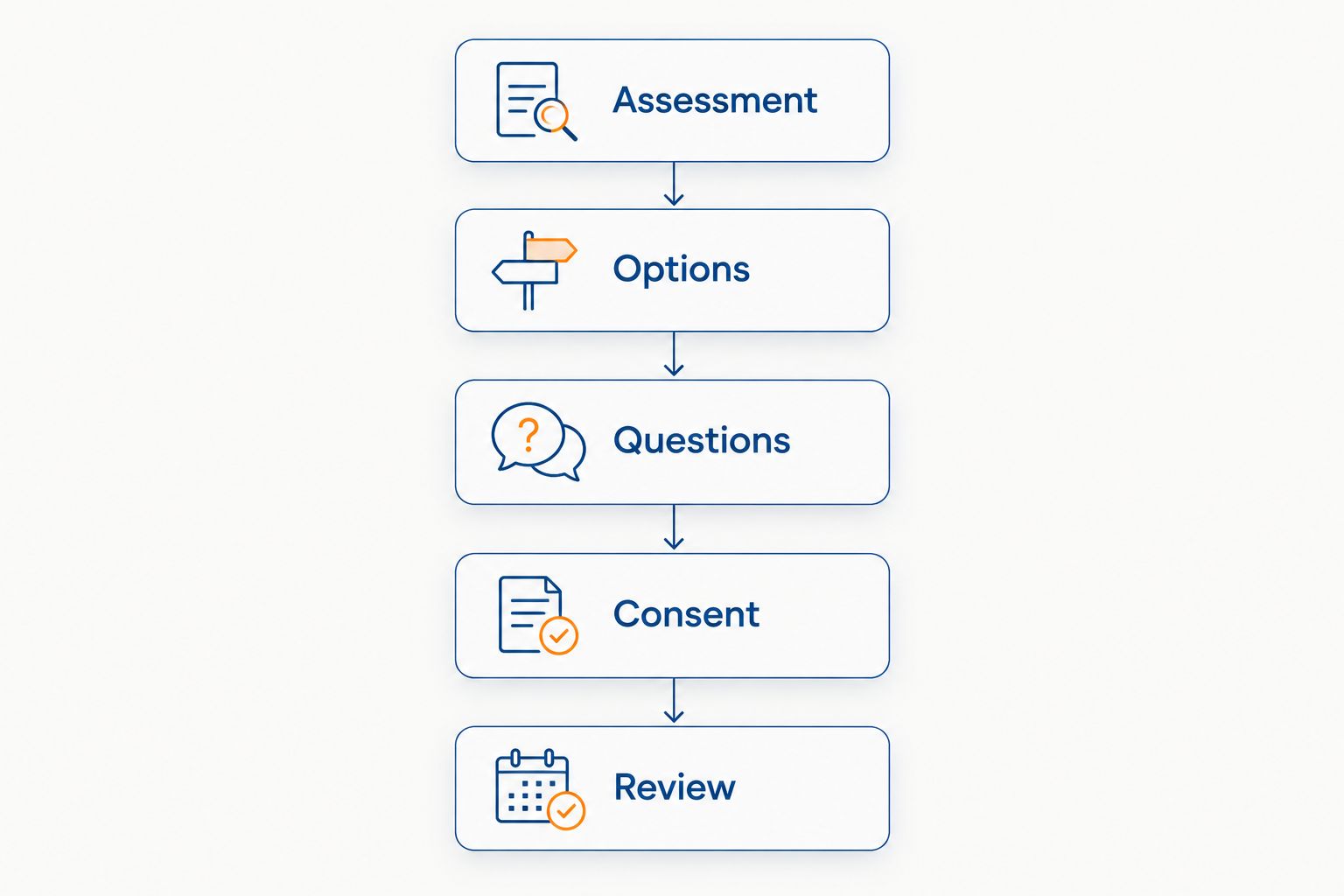
Use this sequence to structure the conversation:
- Assessment: What does the history and examination suggest?
- Options: What are the reasonable next steps, including no hands-on procedure?
- Questions: What are the potential benefits, risks, limitations and alternatives?
- Consent: Do you understand the proposal and want to proceed?
- Review: What would prompt reassessment, a changed plan or referral?
Consent is specific to the proposed care. You can ask for more explanation, decline a procedure or change your mind.
Ask what reassessment will involve rather than accepting an open-ended schedule. A plan discussed in 2026 should still explain the reason for each proposed appointment and what would change that recommendation.
Why the appropriate next step varies
The phrase pulled back muscle leaves several important questions unanswered. These factors affect what needs to be discussed or assessed:
- How the symptoms began. A gradual ache and pain after substantial trauma require different assessment considerations.
- Associated symptoms. Leg weakness, altered sensation or bladder changes change the referral discussion.
- Your medical history. Previous surgery, osteoporosis and other health conditions matter when considering procedures.
- The examination findings. A technique should not be selected solely because a symptom sounds familiar.
- Your daily demands. Returning to desk work and returning to heavy lifting involve different practical questions.
- Your preferences. You can discuss an approach that does not include spinal manipulation.
These factors do not predict a particular recovery time. They explain why a generic recommendation cannot replace an individual assessment.
What can you discuss about everyday activity?
For uncomplicated low back pain, the Australian clinical care standard supports advice about remaining active rather than prolonged bed rest. That is general guidance, not an instruction to push through every symptom or resume heavy lifting immediately.
Ask which activities are reasonable for your current presentation and how to modify tasks that aggravate symptoms. A discussion can cover walking, work duties, sleep disruption and the demands of caring for others.
Avoid turning general advice into a rigid exercise prescription. Repetitions, resistance and progression need context, especially when the cause of your symptoms has not been assessed.
Choose a functional question you can describe clearly: “How should I approach putting on my shoes?” is more useful than asking which adjustment is strongest. It connects the discussion to a task that matters to you without assuming a procedure is required.
How many chiropractic appointments would I need?
There is no fixed appointment count that follows from the words pulled back muscle. The findings, the proposed approach, your preferences and the need for reassessment should inform that discussion.
Ask why follow-up is recommended and what would justify continuing, changing or stopping the plan. A predetermined course is not evidence that each appointment is necessary.
Should I see a GP before a chiropractor?
Medical assessment takes priority when warning symptoms, significant injury or broader health concerns are present. If you are uncertain about the cause of the pain or whether a musculoskeletal appointment is appropriate, a GP can assess that uncertainty.
For non-urgent symptoms, the decision should reflect your circumstances and the clinician’s scope. It is not a competition between professions.
What if the symptoms change after an appointment?
New symptoms need fresh consideration; they should not automatically be attributed to an expected response. Tell the clinician what changed, when it started and how it affects your function.
New bladder or bowel dysfunction, saddle numbness or progressive leg weakness requires urgent medical assessment, including after an appointment. Do not assume worsening symptoms mean a procedure is working.
FAQ
Can a chiropractor help with a pulled back muscle?
A chiropractor can assess a suspected back strain and discuss whether chiropractic care or referral may be appropriate. That does not establish that an adjustment is needed or that it will repair an injured muscle.
Should I get my back adjusted immediately after pulling a muscle?
An immediate adjustment is not automatically indicated after suspected muscle strain. Assessment, discussion of alternatives and informed consent should come before any procedure.
How do I know whether I have pulled a back muscle?
Symptoms alone cannot reliably confirm a back muscle strain. A qualified health professional can consider your history and examination and explain the working diagnosis and any uncertainty.
When does back pain need urgent medical assessment?
Back pain with new bladder or bowel problems, saddle numbness or progressive leg weakness needs urgent medical assessment. In an emergency in Australia, call 000 rather than waiting for a routine chiropractic appointment.
Do I need an X-ray before seeing a chiropractor?
An X-ray is not automatically required before a chiropractic assessment. Imaging should have a clinical reason, based on your history and examination rather than a routine requirement for everyone.
Can I ask for an appointment without an adjustment?
Yes, you can discuss your concerns and decline an adjustment. Ask about assessment findings, alternatives, potential risks and whether another health professional is appropriate.
How long will a pulled back muscle take to recover?
A recovery deadline cannot be established from the description pulled back muscle alone. Discuss your symptoms, functional limitations and review plan with a qualified health professional rather than relying on a guaranteed timeline.
One last thing
The most useful outcome of an initial conversation is not necessarily a procedure. It can be a clearer explanation of what needs assessment, what remains uncertain and when to seek medical help.
MyChiro provides chiropractic care in Bondi Junction. If you are considering chiropractic care in 2026, ask about suitability before choosing a technique; an assessment does not commit you to an adjustment or an ongoing appointment schedule.
Related guides
- How to prepare for your first chiropractor appointment
- What to expect from spinal manipulation
- How chiropractors coordinate with GPs on imaging referrals