


Instead of carrying an unexplained chiropractor x-ray referral between appointments, ask your chiropractor and GP to share a clinical summary, clarify the imaging question and nominate who will review the result. This 2026 guide explains that handover in Australia without assuming you need a scan or that every request attracts a Medicare benefit.
- A chiropractor x-ray referral needs a clinical reason, an appropriate request and a clear results-review plan.
- Mychiro provides chiropractic care in Bondi Junction; imaging decisions require individual assessment.
- GP coordination and Medicare eligibility are separate questions: confirm both before arranging imaging.
- Share existing radiology reports before considering another scan, and identify who will explain the findings.
Why this matters
An imaging request, a GP referral and a radiology report are different documents. Confusing them can leave you repeating your history, arranging the wrong appointment or assuming another practitioner has received your results.
Mychiro is a chiropractic clinic for local patients seeking chiropractic care in Bondi Junction, Sydney. You can read about the clinic at Mychiro, but this guide does not describe a confirmed clinic-specific imaging protocol.
The useful question is not simply whether a chiropractor can request an x-ray. It is whether imaging is appropriate for your circumstances, whether the request meets the imaging provider's requirements, and who takes responsibility for the next decision.
For low back pain specifically, the Australian Commission on Safety and Quality in Health Care's Low Back Pain Clinical Care Standard addresses selective imaging and assessment for serious pathology. It does not support treating an x-ray as a routine requirement for every presentation.
Before you start
- Gather your records: bring existing imaging reports, information about where the images are held, your medication list and a brief symptom history. An old report and access to the actual images are separate things.
- Identify the practitioners: have your GP's and chiropractor's current contact details. Ask how relevant information can be shared, and discuss your consent and any limits on that sharing.
- Check the administrative gotcha: an imaging provider accepting a request does not establish Medicare eligibility. Before arranging imaging, ask the provider to check the requested examination, requester type and applicable requirements.
You do not need to choose a scan yourself before the discussion. Nor should you arrange another appointment solely to obtain a signature when the clinical reason has not been explained.
This workflow concerns routine coordination. If symptoms suggest an urgent medical problem, seek medical assessment rather than waiting for a routine referral exchange.
Clinical question and existing records
Start with the reason for the proposed investigation. The following are patient-facing checklist labels, not buttons or fields in a particular clinic's software.
- Record the timeline. Write down when the concern started, what has changed and which activities are affected. Keep the summary to 1 page so both practitioners can find the main points.
- List previous imaging. Include the body region, examination type, date and imaging provider where known. Tell the practitioner if the previous examination concerned the same issue or a different one.
- Clarify the question. Ask what the proposed x-ray is intended to investigate and how the answer would influence the next decision. A clinician should explain the reasoning in language you understand.
- Discuss alternatives. Ask whether assessment, review of existing records, observation or another investigation is more appropriate. These are clinical decisions, not a menu of scans to order yourself.
Expected result: you can explain the purpose of the proposed imaging, and both practitioners have enough background to assess the request rather than starting from a blank page.
Do not interpret a recommendation for imaging as confirmation of a diagnosis. Equally, a decision not to image is not a statement that your symptoms are unimportant. Ask what the assessment and follow-up plan involves either way.
For your 2026 handover, record the date of the discussion. A request based on an earlier presentation needs to be considered alongside any subsequent changes, rather than carried forward automatically.
GP handover and consent
A GP handover is useful when medical assessment, broader investigation or clarification of an imaging pathway is needed. The GP makes an independent clinical decision; the appointment is not simply an administrative step to reproduce another practitioner's request.
- Request a clinical summary. Ask your chiropractor to include the presenting concern, relevant history, examination findings, existing investigations and the specific question for the GP. The practitioner should distinguish observed findings from a provisional interpretation.
- Confirm consent. Discuss what information will be sent, to whom and by which channel. Tell the clinic if there is information you want to discuss privately with the GP first.
- Check delivery. Confirm the receiving practice's details and ask whether the summary has been sent. If you receive a copy, keep it with your records rather than assuming it replaces practitioner-to-practitioner communication.
- Discuss the decision. At the GP appointment, ask whether imaging is indicated and whether the proposed examination answers the clinical question. The GP can agree, recommend another pathway or explain why imaging is not currently appropriate.
Expected result: the GP has a specific question to assess, and you know the agreed next step. That step can be further assessment rather than imaging.
Keep a GP referral for chiropractic care separate from a request for diagnostic imaging. They have different purposes and eligibility requirements. The guide to GP referrals and Medicare-subsidised chiropractic care covers that adjacent administrative topic; it does not establish eligibility for an x-ray.
Imaging request and provider checks
Before you arrange the examination, confirm that the imaging provider can process the actual document you have. Avoid relying on a general statement that the centre accepts chiropractic requests.
- Check identity details. Check 2 identifiers—your full name and date of birth—against the request. Ask the issuing practitioner to correct discrepancies rather than altering clinical information yourself.
- Confirm the examination. Ask the provider to check the requested body region, examination and requester details. If something is unclear, the provider should seek clarification from the requesting practitioner.
- Check eligibility requirements. Ask whether the particular examination and requester category meet the applicable Medicare requirements. In 2026, use the current MBS Online item information rather than an old article or a rule remembered from another scan.
- Confirm result recipients. Ask which practitioner will receive the report and whether the other practitioner can receive a copy with appropriate consent. A copied recipient is not automatically responsible for reviewing the result.
- Disclose relevant information. Tell the imaging provider if you are pregnant or think you might be, and follow its screening instructions. Do not withhold that information because you assume it will prevent an examination.
Expected result: the provider has a usable request, the administrative requirements have been checked, and the report destination is clear.
Services Australia's diagnostic imaging guidance and MBS Online address referral and benefit requirements. Those requirements are separate from the clinical decision about whether you need imaging. Avoid assuming that an x-ray, CT and MRI follow identical rules.
Results review and responsibility
Having the examination is not the end of the workflow. Agree on how the result will reach you and which practitioner will explain its significance in the context of your assessment.
- Name the reviewer. Ask who is responsible for checking the report and communicating the next step. Record the practitioner's name, not just the practice name.
- Agree on contact. Ask how you will be contacted and what to do if you have not heard by the timeframe the practice gives you. Do not assume silence means the report is normal.
- Arrange relevant sharing. Where appropriate and with your consent, ask for the report to be shared with the other practitioner. Check whether access to the images is also needed.
- Ask about the decision. Bring 3 questions: what does the report mean in context, does it change the plan, and who coordinates any further assessment?
Expected result: you understand the agreed next step and know whom to contact with questions. A report in a patient portal does not replace that discussion.
An imaging finding alone does not establish that chiropractic adjustments are appropriate. Assessment, your preferences and relevant risks remain part of the discussion. Do not use an image or a report label as a self-directed reason to seek a particular intervention.
When imaging already exists or symptoms change
You can use the same coordination process without starting with a new request. This variant is particularly useful when another practitioner or hospital has already arranged imaging.
| Pathway | Appropriate context | Practical advantage | Limitation |
|---|---|---|---|
| Share existing imaging | A practitioner needs relevant previous records | Gives the reviewer information already obtained | Records may not answer the current question |
| Seek GP assessment first | The clinical question or medical pathway needs clarification | Allows an independent assessment before selecting an investigation | An appointment does not guarantee an imaging request |
| Proceed with an assessed imaging request | A clinician has identified an indication and the provider has checked the request | Connects the examination to a defined question | Request acceptance does not settle eligibility or follow-up responsibility |
If imaging already exists: identify the provider, ask how the report and images can be accessed, and let the assessing practitioner decide whether they are relevant. Do not arrange a repeat solely because a different practice has become involved.
If symptoms change: contact the responsible clinician and describe the change. Do not assume an existing request remains the appropriate next step.
For a 2026 record update, include what changed and when. This gives the practitioner information to reassess the plan without implying that a new scan is automatically required.
Troubleshooting
The imaging provider cannot process the request
Ask exactly what is missing or which requirement is not met. Send that information to the requesting practitioner, who can clarify or revise the document where appropriate. Do not ask a GP to reproduce the request without assessing its purpose.
The GP and chiropractor recommend different pathways
Ask each practitioner to explain the clinical question and reasoning. With your consent, request direct communication about the disagreement. Different recommendations do not mean you should obtain both investigations or proceed before the uncertainty is addressed.
The report reached only one practitioner
Contact the imaging provider or receiving practice to confirm where it was sent. Ask about sharing a copy with the other practitioner, then identify who will explain it. Do not assume shared access means shared responsibility.
Nobody has explained the result
Contact the nominated reviewing practice and ask for the agreed review arrangement. A portal notification is a delivery mechanism, not an interpretation. Keep the report available, but avoid deciding your own care pathway from isolated terminology.
You develop concerning symptoms while waiting
Do not wait for routine paperwork if you develop new bladder or bowel control problems, numbness around the saddle area, or new or worsening limb weakness. Seek urgent medical assessment. Healthdirect's back-pain guidance discusses warning symptoms; call 000 for a medical emergency.
Customize your workflow
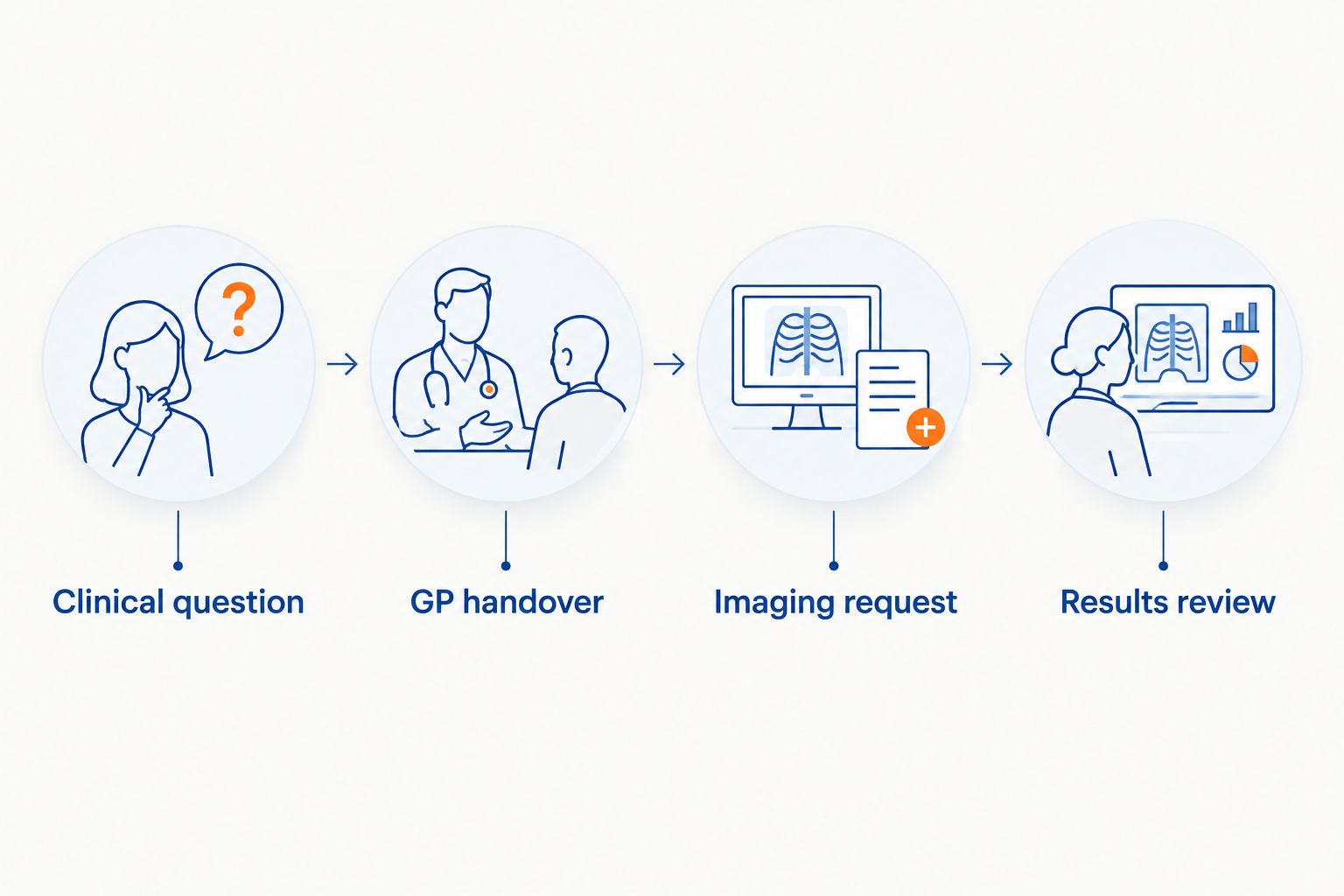
Create a simple record with four headings: Clinical question, GP handover, Imaging request and Results review. Under each, record the date, responsible practitioner and next action. This is a coordination aid, not a substitute for clinical records.
If several practitioners are involved, ask who coordinates the overall plan. Share information relevant to the current question rather than sending unrelated documents indiscriminately, and discuss any concerns about privacy before transmission.
For conversations about Mychiro chiropractic care, bring the same questions about assessment, consent and communication. Do not assume the clinic provides a particular imaging arrangement unless the clinic confirms it directly.
Useful Australian references for this 2026 guide are the Australian Commission's Low Back Pain Clinical Care Standard for low-back-pain assessment and imaging, Services Australia and MBS Online for diagnostic imaging administration, and Healthdirect for patient-facing warning-sign information. Each addresses a different part of the workflow.
FAQ
Can a chiropractor give me an x-ray referral in Australia?
Chiropractors can request certain x-ray examinations in Australia, but the appropriate examination and applicable requirements need checking. Ask the imaging provider to verify your specific request rather than assuming all imaging follows the same rules.
Do I always need a GP referral after a chiropractor requests imaging?
A GP appointment is not an automatic extra step for every chiropractic imaging request. GP assessment may be appropriate when medical review, further investigation or clarification of the request is needed.
Does Medicare cover a chiropractor x-ray referral?
Medicare eligibility depends on the particular examination and applicable MBS requirements, including the requester category. Ask the imaging provider to check the actual request against current requirements before arranging the examination.
Do I need an x-ray before chiropractic adjustments?
An x-ray is not a routine requirement for every person considering chiropractic care. Discuss whether imaging is clinically indicated and how its findings would affect the assessment or proposed plan.
Can my chiropractor and GP receive the same radiology report?
Relevant reports can be shared through appropriate arrangements and with your consent. Confirm the recipients and separately identify which practitioner is responsible for reviewing the result with you.
What should I bring to my GP when discussing an imaging request?
Bring the request, the chiropractor’s clinical summary, relevant previous reports and your medication list. Include a brief timeline of symptoms and any changes since the request was written.
Can I use an old x-ray instead of having another one?
An assessing practitioner needs to decide whether previous imaging answers the current clinical question. Share the existing report and image-access details before assuming another examination is needed.
One last thing
A copied report recipient is not the same as a nominated results reviewer. Before leaving the discussion, ask who will explain the report and what you should do if that contact does not occur. That small administrative distinction keeps the final step visible.
Related guides
- Prepare for your first chiropractor appointment
- Qualifications to check when choosing a Sydney chiropractor
- Discussing back pain with a chiropractor or medical doctor