


Choosing a chiropractor vs physiotherapist for back pain requires an assessment of your symptoms, goals and the proposed care—not a blanket preference for either profession. This 2026 comparison explains the overlap, the limits of profession-based claims and the questions to ask before agreeing to a plan.
- Chiropractor vs physiotherapist for back pain: compare assessment, exercise, manual therapy and review plans—not professional titles alone.
- Mychiro provides chiropractic care in Bondi Junction; suitability for an individual requires assessment.
- Guidelines address care approaches and patient needs, rather than declaring one profession universally preferable.
- New bladder changes, saddle numbness or progressive leg weakness require urgent medical assessment.
Chiropractor vs physiotherapist for back pain: how do you choose?
Compare the proposed care, its rationale and its review criteria—not just the practitioner's title. Chiropractic and physiotherapy are distinct regulated professions in Australia, but the care offered by individual practitioners can overlap. Neither title tells you exactly what an appointment will involve.
The comparison below describes general professional practice, not a promise about any particular clinic. For local context, Mychiro's chiropractic services include chiropractic care and spinal adjustments.
| Question | Chiropractor | Physiotherapist |
|---|---|---|
| General focus | Assessment and management of musculoskeletal concerns, with spinal adjustments among possible approaches | Assessment of movement and physical function, with exercise and rehabilitation among possible approaches |
| Hands-on care | Adjustments, mobilisation or other manual approaches may be discussed | Mobilisation or other manual approaches may be discussed |
| Exercise and education | Ask whether these are included and how they are tailored | Ask how exercise and education are tailored and progressed |
| Potential practical advantage | An option when you want to discuss chiropractic approaches following assessment | An option when you want to discuss movement rehabilitation following assessment |
| Important limitation | An adjustment-focused plan does not automatically address every relevant need | An exercise prescription is not automatically appropriate without individual assessment |
| What to verify | Registration, explanation, consent, alternatives and reassessment | Registration, explanation, consent, alternatives and reassessment |
Why this matters
Back pain can affect work, sleep, exercise and confidence in movement. Choosing solely by professional title leaves out the details that determine whether the proposed plan fits your circumstances.
A useful consultation should leave you understanding what has been assessed, what remains uncertain and what happens next. You should also understand when medical assessment or another professional's input is appropriate.
For your 2026 decision, separate three questions: what might explain your symptoms, what options are reasonable to discuss, and how the plan will be reviewed. A technique name answers none of these by itself.
What does the evidence actually compare?
Research can compare particular interventions, packages of care or groups of practitioners. Those are different questions. Evidence about spinal manipulation, for example, is not automatically evidence that every chiropractic service is appropriate for every person with back pain.
The same distinction applies to exercise. A study of a structured exercise programme does not establish that any generic exercise sheet will suit your situation.
Several authoritative guidance documents provide context for this 2026 comparison:
- World Health Organization: guideline for non-surgical management of chronic primary low back pain in adults. Its scope includes person-centred assessment and a range of non-surgical care approaches in primary and community settings.
- Australian Commission on Safety and Quality in Health Care: Low Back Pain Clinical Care Standard. Its scope includes assessment, information, appropriate investigations, management and review.
- NICE: Low back pain and sciatica in over 16s: assessment and management. Its recommendations place manual therapy within a package that includes exercise, rather than presenting it as a stand-alone answer.
These documents have different populations and purposes. None should be reduced to a claim that one professional title guarantees a particular outcome.
Ask which recommendation applies to your presentation and why. A guideline reference is meaningful only when the practitioner explains its relevance and its limits.
Why the type and duration of back pain matter
Guidance for chronic primary low back pain is not interchangeable with guidance for a new injury or a suspected serious cause. The WHO guideline's chronic scope concerns pain lasting more than 3 months; that duration alone does not establish a diagnosis.
Tell the practitioner when symptoms started, whether they have changed and whether you have previously been assessed. Do not assume an explanation from a previous episode necessarily applies to a new one.
What should a chiropractic consultation clarify?
A chiropractic consultation should clarify your concern, relevant history and whether a chiropractic approach may be appropriate following assessment. If an adjustment is proposed, ask what it involves, why it is being considered and what alternatives exist.
You can discuss chiropractic care without committing to spinal manipulation. Consent applies to the proposed procedure, not merely to attendance at the clinic.
Questions to ask include:
- What findings inform your working explanation?
- What uncertainties remain after the assessment?
- Why are you proposing this particular approach?
- What are its material risks and alternatives?
- What would lead you to change the plan or refer me elsewhere?
The practical limitation is that an adjustment is a procedure, not a complete explanation of your back pain. Ask how any proposed hands-on care relates to your activities, self-management and review plan.
Mychiro is a Bondi Junction chiropractic clinic for people seeking a discussion about chiropractic care. Whether its services are appropriate for your back pain depends on an individual assessment.
What should a physiotherapy consultation clarify?
A physiotherapy consultation should clarify the physical activities you are having difficulty with and the assessment findings relevant to them. Exercise, education or hands-on approaches can be discussed according to the presentation and the practitioner's scope.
If exercises are proposed, ask for more than their names. You need to understand the starting level, how to perform them and what response should prompt you to stop or seek advice.
Useful questions include:
- How does this exercise relate to my stated goal?
- What should I do if symptoms change during or after it?
- How will you decide whether to progress or modify it?
- What can I do independently between appointments?
- Would another professional's assessment change the plan?
The practical limitation is that a programme must fit your abilities, circumstances and assessment findings. A detailed exercise list alone does not demonstrate that those requirements have been addressed.
Why the recommended approach varies
An individual plan should reflect more than where you point to the pain. These are relevant discussion points—not a checklist you can use to diagnose yourself.
- Symptom pattern: Describe onset, location, changes and any symptoms beyond the back.
- Medical history: Mention relevant diagnoses, previous surgery, medicines and earlier investigations.
- Functional goals: Explain which everyday activities you want to discuss, rather than requesting a technique alone.
- Preferences and consent: Tell the practitioner which approaches you want explained and which you do not want.
- Practical circumstances: Discuss work demands, access needs and your ability to follow a proposed home programme.
- Response to the plan: Agree how changes, lack of progress or new symptoms will affect reassessment and referral.
You do not need to arrive with a preferred diagnosis. A clear account of your experience is more useful than trying to fit your symptoms to a label found online.
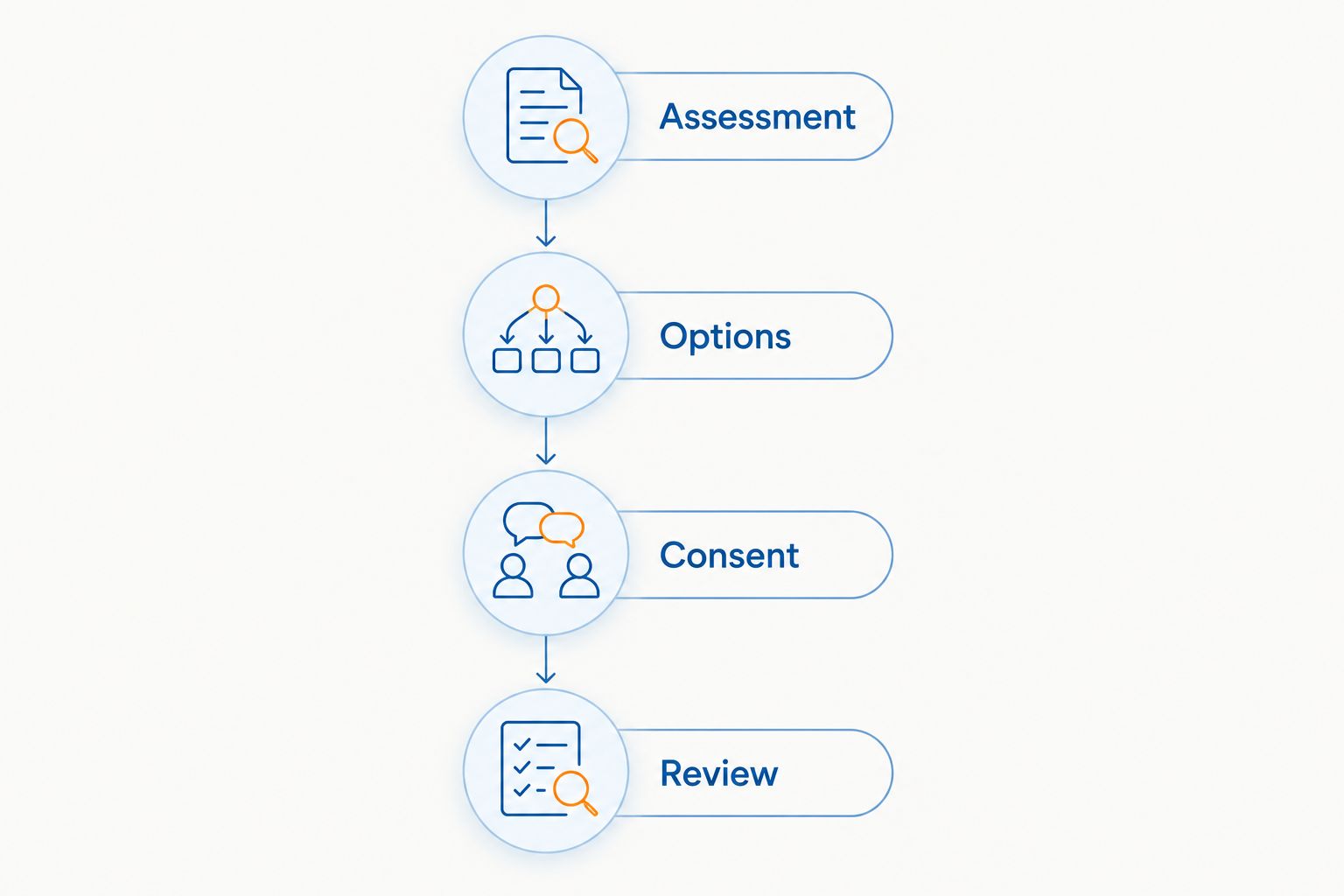
How should you compare two proposed care plans?
Use the same questions for both professions. In 2026, a persuasive explanation still needs to distinguish an assessment finding from a prediction about your individual outcome.
- Assessment: Ask what was considered and whether anything requires medical investigation or referral.
- Options: Ask about the proposed approach, reasonable alternatives and the option of declining a procedure.
- Consent: Discuss material risks and uncertainties before proceeding, not after a technique begins.
- Review: Agree what will be monitored and what would trigger a change in direction.
Keep the answers in your own words. If you cannot explain the proposed plan afterwards, ask for clarification before deciding.
A review plan should connect to something you care about, such as walking to the shops or completing a work task. Ask how that activity will be discussed alongside symptoms, rather than treating attendance itself as evidence of progress.
A pain score from 0 to 10 points is one possible discussion tool, not a diagnosis. If a practitioner uses it, ask how they will interpret it alongside function and your own priorities.
Can you see a chiropractor and physiotherapist together?
Seeing both is not automatically necessary. Before adding another practitioner, ask what distinct question or unmet need the additional consultation would address.
The decision about when to see a physiotherapist should account for symptoms and assessment needs, rather than relying on a fixed waiting period after an injury. Significant trauma or concerning changes require medical assessment, not a routine comparison between allied health appointments.
If you do consult both professions, ask who will coordinate the plan. With your consent, relevant information can be shared so that recommendations are understood rather than duplicated or contradicted.
Clarify the purpose of each appointment, which home instructions take priority and how disagreements will be resolved. More appointments are not, by themselves, evidence of more appropriate care.
The same principle applies at Mychiro: a chiropractic appointment does not establish that you also need physiotherapy, and a physiotherapy appointment does not establish that you need an adjustment.
Do you need an X-ray before choosing either profession?
Routine imaging is not a prerequisite for every episode of back pain. The Australian Low Back Pain Clinical Care Standard recommends reserving imaging for circumstances where assessment identifies a relevant indication.
Ask what clinical question an investigation would answer and whether its result would change management. A scan is not a substitute for explaining symptoms, history and examination findings.
Neither a professional title nor an imaging offer should decide your choice on its own. If imaging or further medical investigation is proposed, ask about its purpose and the next step after the result.
When should you seek medical help instead?
Some presentations need medical assessment rather than a routine chiropractic or physiotherapy booking. This section is general referral guidance, not a way to rule out serious illness at home.
Seek urgent medical assessment for new difficulty passing urine, loss of bladder or bowel control, numbness around the saddle area, or progressive leg weakness. In Australia, call 000 for an emergency.
Back pain following significant trauma, or occurring with fever or a significant change in general health, also warrants prompt medical advice. Tell the clinician about a history of cancer or other relevant medical conditions.
Do not wait for a manual therapy appointment to investigate concerning changes. If you are unsure about urgency, contact an appropriate medical service for advice.
FAQ
Should I choose a chiropractor or physiotherapist for back pain?
Choose after comparing the assessment, proposed care, consent discussion and review plan. Neither professional title alone establishes which approach is appropriate for your symptoms.
Do physiotherapists and chiropractors use the same techniques?
Some approaches overlap, including exercise, education and certain manual techniques. Ask the individual practitioner what they propose rather than assuming their care from their title.
Can I decline a chiropractic adjustment?
Yes, you can decline a proposed adjustment. Ask about alternatives and what declining means for the proposed plan before giving consent.
Does back pain always need an X-ray?
No, back pain does not always require an X-ray. The Australian Low Back Pain Clinical Care Standard recommends imaging when assessment identifies a relevant indication.
Is seeing both professions necessary?
Seeing both professions is not automatically necessary. Ask what distinct need each consultation addresses and how recommendations will be coordinated.
How many appointments will I need?
An appointment count cannot be determined from the professional title alone. Ask for an individual rationale, an agreed review point and criteria for changing or stopping the plan.
What back pain symptoms need urgent medical assessment?
New bladder or bowel changes, saddle numbness or progressive leg weakness require urgent medical assessment. Call 000 in Australia for an emergency.
One last thing
You can agree to an assessment without agreeing to every proposed procedure. Ask for the explanation, discuss uncertainties and make each decision with an understanding of the alternatives.
For your 2026 comparison, take one written activity goal and one question about reassessment to either practitioner. Those details make the discussion more specific than asking which profession is universally preferable.
Related guides
- How to prepare for your first chiropractor appointment
- What qualifications should a Sydney chiropractor have?
- How to combine chiropractic care with physiotherapy in one plan