


Instead of carrying separate instructions between appointments, organise chiropractor and physiotherapist combined care around a shared summary, agreed responsibilities and a review point. MyChiro provides chiropractic care in Bondi Junction; this guide explains how to discuss coordination with your practitioners without assuming you need both services.
- Chiropractor and physiotherapist combined care needs assessment, consent and clear responsibilities—not an automatic schedule of appointments.
- MyChiro provides chiropractic care for local patients in Bondi Junction.
- Keep one current care summary and ask practitioners to reconcile conflicting exercise or activity instructions.
- Adding physiotherapy or chiropractic adjustments does not establish that combined care is appropriate for you.
Why this matters
Two appointment calendars do not make one care plan. If practitioners receive different information, you can end up relaying advice yourself, following overlapping instructions or being unsure whom to contact when something changes.
The purpose of coordination is to make decisions and responsibilities clear, not to increase the number of services you receive. Whether chiropractic care, physiotherapy, both or another pathway is appropriate requires individual assessment.
For a plan started in 2026, record the current date and identify which instructions remain active. An old exercise sheet should not silently become part of a new plan simply because it is still in your bag.
This is an organisational guide, not a recommendation for adjustments, an exercise prescription or a diagnosis. Discuss clinical decisions with the qualified health professionals responsible for your care.
Before you start
- Confirm the purpose of each assessment. Ask what question each practitioner will assess and whether another service is needed. Do not assume two professions mean two necessary courses of care.
- Gather relevant information. Prepare your current instructions, medication list, relevant reports you already have, practitioner contact details and the activities you want to discuss. Do not arrange new imaging simply to complete this checklist.
- Check consent and communication arrangements. Separate clinics do not necessarily share records. Ask how information can be exchanged, who will receive it and what consent each clinic requires before relying on a handover.
The non-obvious obstacle is record access. Naming your physiotherapist at a chiropractic appointment does not mean the chiropractor has received the physiotherapist's findings, or vice versa.
If MyChiro is part of your care, ask about its actual communication process rather than assuming it offers an integrated physiotherapy service. The clinic's stated service is chiropractic care and spinal adjustments.
Your shared care summary
Use a paper document or a document you control. The bold labels below are suggested template headings, not buttons or fields in a clinic's software.
Information collection
- Create a Current summary with your name, preparation date and the names of the practitioners involved. Start with a 1-page summary; keep longer reports separate.
- Add Your priorities. Describe an everyday activity you want assessed, such as sitting at work, walking or carrying shopping. Record what you currently notice without assigning yourself a diagnosis.
- Add Current instructions. Copy the instructions you have actually received, including exercise details and any activity restrictions. Mark anything you do not understand as a question rather than filling in the gap yourself.
- Add Relevant information. List existing reports and other care you receive. Ask practitioners which documents they need; the summary should not become an unfiltered archive.
Expected result: You have a dated overview that distinguishes your observations from practitioner advice.
Keep the language neutral. A description such as difficulty completing a usual activity gives the practitioner something to assess; it does not require you to decide whether the cause is posture, a joint, a muscle or nerve pressure.
For your 2026 summary, include a version date whenever you change the document. This makes it easier to identify whether someone is reading current instructions or an earlier copy.
Consent and handover
- Ask each clinic how it accepts information from another practitioner. Confirm the intended recipient rather than sending health information to an unverified address.
- Discuss Sharing permission. Ask what information will be shared, for what purpose and whether you can limit the scope. Follow each clinic's consent process.
- Identify Handover responsibility. Agree whether a practitioner will send a summary directly or whether you will provide a copy. Do not assume the transfer has happened.
- Confirm Receipt. At the next discussion, ask whether the receiving practitioner has reviewed the relevant information and whether anything needs clarification.
Expected result: You know what information is being exchanged, who is responsible for sending it and whether it has arrived.
A shared summary is not unrestricted access to your entire health history. Ask about secure transfer and storage, especially if you use personal email or a shared household device.
Keep 2 practitioner contact entries if two clinicians are involved. This is a document-organising suggestion, not a recommendation to arrange two appointments. Include your GP's details when the GP is involved in the plan.
Responsibilities and instructions
- Ask each practitioner to explain Purpose and scope: what they are assessing, what they propose and where their role ends. Ask about alternatives, risks and the option of not proceeding with a proposed intervention.
- Agree on Plan ownership. Identify who will maintain the current summary and who will clarify exercise or activity instructions. Administrative coordination does not replace either practitioner's clinical responsibility.
- Create One active list of agreed home instructions. Ask the practitioners to identify duplication or disagreement before combining programmes yourself.
- Record Contact guidance. Ask whom to contact about questions, changes or unexpected responses, and what requires medical assessment instead of waiting for a routine appointment.
Expected result: Each active instruction has a named source, a purpose and a route for clarification.
Do not assign roles solely by profession. A physiotherapist's involvement does not automatically mean that all exercise decisions belong to that practitioner, and a chiropractor's involvement does not make adjustments a required part of the plan.
Ask for a specific reason for each proposed service. A combined plan should explain why both practitioners are involved rather than simply listing what each clinic offers.
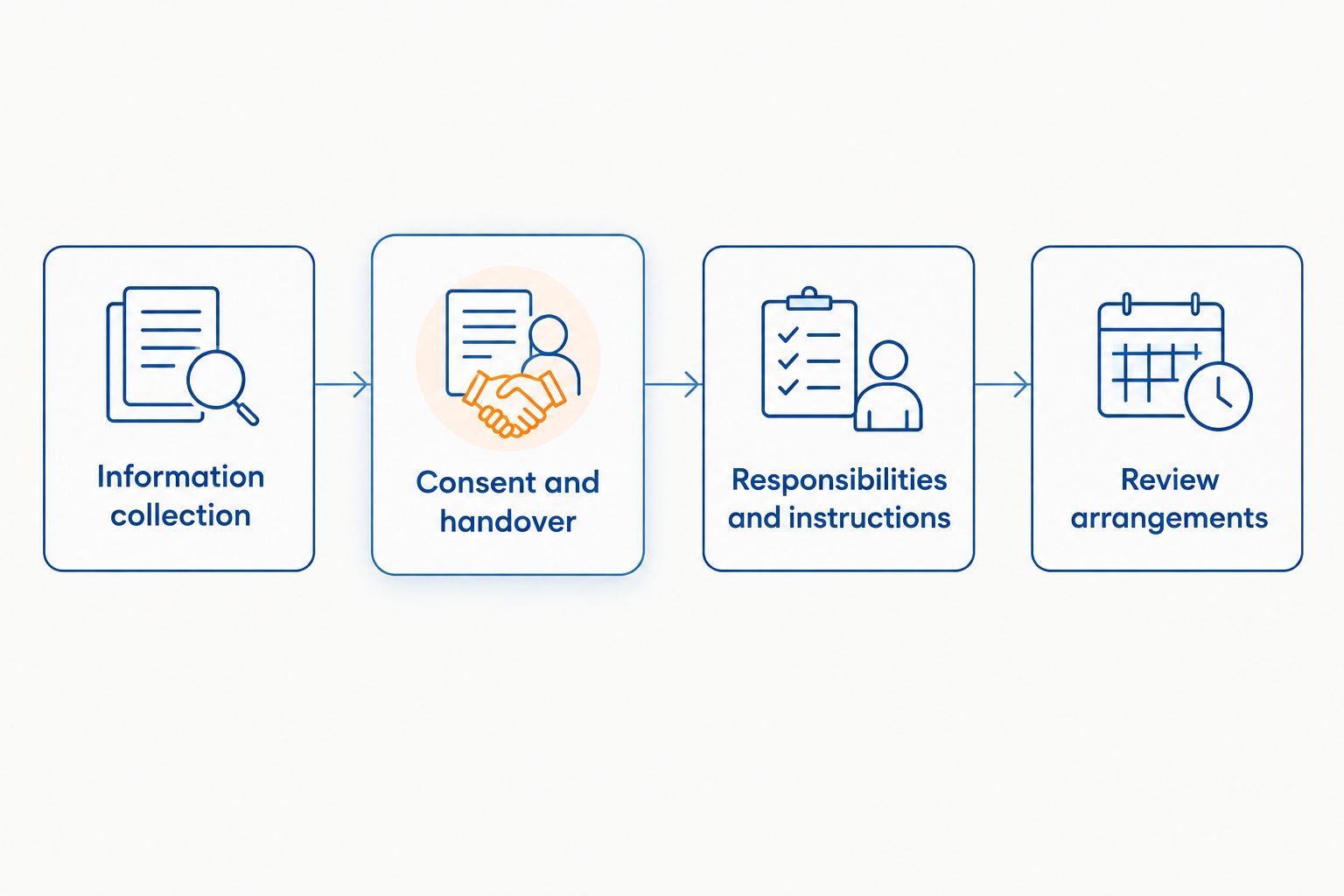
Review arrangements
- Record Review arrangements with the responsible practitioner. Ask when the plan will be reconsidered and what information will inform that discussion. Do not substitute a generic appointment schedule for individual advice.
- Choose Review observations together. These can include your experience of a relevant activity, your ability to follow the instructions and questions about the plan.
- Use 3 headings in your update: What changed, What you followed and Questions to discuss. Record observations rather than deciding which intervention caused them.
- Ask about Continue, change or stop. Clarify what would justify continuing a service, changing the approach, ending that part of care or seeking another assessment.
Expected result: Your plan has a defined decision point rather than an open-ended assumption that both services continue.
For a 2026 review note, include the date and identify which practitioner supplied any revised instructions. Retain earlier copies separately so they cannot be mistaken for the active version.
An appointment count is not a clinical outcome. Ask whether the original reason for involving both practitioners still applies, particularly when your circumstances or priorities change.
Which coordination arrangement fits your situation?
The arrangements below are ways to organise communication, not rankings of clinical care. Discuss the appropriate pathway after assessment.
| Arrangement | Suited to | Practical advantage | Limitation |
|---|---|---|---|
| One practitioner, with referral if needed | People whose assessed needs do not require concurrent services | Fewer handovers and one set of current instructions | Another assessment might become necessary |
| Concurrent chiropractic and physiotherapy involvement | People for whom practitioners identify distinct reasons for both services | Each practitioner can contribute within an agreed role | Requires communication and checks for overlapping advice |
| Sequential involvement | People whose assessment supports a change in practitioner involvement over time | Responsibilities can be clearer at each stage | The next practitioner still needs an accurate handover |
Choose the arrangement for a documented reason, not because combined care sounds more thorough. No row establishes that one pathway produces a better clinical result.
Concurrent involvement also means coordinating calendars, records and questions. Sequential involvement avoids some simultaneous instructions, but it should not become an automatic series of services without reassessment.
Update the plan whenever instructions change
A second useful workflow is an instruction-change handover. Use it when a practitioner revises your programme, another health professional becomes involved or your usual activities change.
- Record the change. Note the date, the practitioner and the exact revised instruction. Ask whether it replaces an earlier instruction or adds to it.
- Identify affected advice. Ask whether the change alters anything another practitioner has recommended. Do not assume instructions remain compatible.
- Share with permission. Use the agreed communication route and confirm who needs the update.
- Replace the active copy. Mark the old instruction as superseded. Keep the current list separate from historical notes.
Expected result: Everyone who needs the update can distinguish the current plan from previous advice.
For example, if a practitioner changes an exercise instruction, do not automatically keep the old version alongside it. Ask what remains active and whether the other practitioner needs to review the change.
This workflow applies to a 2026 plan whether you use paper or a digital document. The essential feature is a clear record of which advice is current, not a particular app.
Troubleshooting
The practitioners give different instructions
Describe the conflict precisely and ask the practitioners to clarify it directly, with your permission. Do not average different instructions or choose the more demanding version yourself.
Ask which instruction to follow while the disagreement is being clarified. Record the answer and the practitioner who supplied it.
You have overlapping home programmes
Bring both lists to the practitioner responsible for reviewing home instructions. Ask which exercises remain active and whether any are duplicated or intended for different purposes.
A longer list is not evidence of a more suitable plan. Explain what you can realistically follow so the instructions can be discussed in that context.
The handover has not arrived
Check the recipient, the consent requirements and who was meant to send it. Ask whether you can provide a copy through the clinic's accepted channel.
Tell the practitioner when information is incomplete. Do not present your recollection of another assessment as a verified report.
You cannot tell whether the plan still needs both services
Return to the documented purpose of each practitioner's involvement. Ask what supports continuation and what would trigger a change or discharge from that part of care.
If the reasoning remains unclear, discuss another assessment or opinion. You do not need to keep adding appointments to resolve an administrative gap.
New or concerning symptoms occur
Do not use the shared document as a triage tool. Seek urgent medical assessment for new bladder or bowel dysfunction, numbness around the groin or rapidly progressing weakness; call 000 for a medical emergency.
Healthdirect Australia provides public guidance on back-pain warning signs and emergency care. Discuss other new or worsening symptoms with an appropriate health professional rather than waiting for the planned review.
Customise your workflow
Build the summary around your actual day. Work demands, exercise preferences, sleep, other health care and practical barriers are subjects to discuss—not reasons to prescribe yourself extra services.
If you use a digital document, review sharing permissions and remove access that is no longer needed. If you use paper, bring the current copy and keep older instructions in a separate folder.
MyChiro's guide to chiropractic care for physiotherapists is a related discussion to read alongside questions about practitioner roles. It does not replace an individual assessment or establish that the clinic provides physiotherapy.
Before adding another appointment, ask whether information sharing alone would address the coordination problem. A missing handover and a clinical need for another service are different issues.
FAQ
Can I see a chiropractor and physiotherapist at the same time?
Concurrent involvement can be discussed after individual assessment; it is not automatically necessary. Ask each practitioner why both services are proposed and how they will coordinate instructions.
Does combined care work better than seeing one practitioner?
This guide does not establish that combined care produces better clinical outcomes. The appropriate pathway depends on your assessment, preferences and the evidence relevant to any proposed intervention.
Should I book both appointments on the same day?
There is no universal same-day schedule for chiropractic and physiotherapy appointments. Ask the practitioners whether timing matters for the specific assessments or interventions being considered.
Who should manage my home exercise instructions?
Ask the practitioners to agree who will coordinate the active exercise list. Both should clarify how their advice fits together rather than leaving you to merge separate programmes.
Do I need a GP involved in the plan?
Discuss GP involvement when medical assessment, referral requirements or broader health concerns are relevant. Urgent or concerning symptoms require medical assessment rather than routine coordination between appointments.
Can MyChiro share information with my physiotherapist?
Ask MyChiro about its consent requirements and accepted communication process. Do not assume records are shared automatically or that the clinic provides an integrated physiotherapy service.
What should I bring when discussing combined care?
Bring your current instructions, relevant existing reports, medication list and practitioner contact details. Include your questions and the everyday activities you want assessed, without arranging new tests solely for the discussion.
When should a combined plan be reviewed?
Agree on a review point with the responsible practitioners following assessment. Revisit the plan when instructions change, concerns arise or the reason for involving both services needs reconsideration.
One last thing
A coordinated plan can include stopping a service. Ask each practitioner what would indicate that their involvement is no longer needed, and record that alongside the reasons for continuing.
The most useful shared document is not the longest one. It is the current one that tells you what applies, who supplied it and whom to ask before making changes.
Related guides
- How to prepare for your first chiropractor appointment
- What to expect from spinal manipulation
- What qualifications should a Sydney chiropractor have?