After a car accident, you may have questions about your symptoms and who pays for treatment. In NSW, CTP funding for chiropractic appointments depends on the circumstances of your claim, the proposed service and the insurer’s requirements. Check whether approval is needed before relying on insurer payment. This guide explains the main steps; a claim number alone does not confirm approval for chiropractic care.
- Does CTP cover chiropractic care? NSW funding depends on your claim, the proposed services and applicable approval requirements.
- Ask your insurer what authorisation is required before arranging appointments you expect it to fund.
- MyChiro is a chiropractic clinic in Bondi Junction; confirm CTP administration arrangements directly with the clinic.
- Keep medical assessment separate from insurance approval: neither replaces the other.
Does a CTP claim mean treatment is approved?
CTP claim acceptance and approval for a particular service are separate questions. Compulsory third party insurance concerns injuries arising from motor vehicle accidents; it is not the same as insurance for damage to your car.
This guide concerns NSW claims. Other states and territories have different schemes, so a Sydney clinic location does not establish which rules apply to your accident.
MyChiro provides chiropractic care in Bondi Junction. That service description does not establish whether the clinic accepts your claim, meets your insurer's provider requirements or invoices the insurer directly.
Following a crash, seek appropriate medical assessment before considering chiropractic care. Do not delay urgent medical attention while waiting for insurance paperwork; call 000 in an emergency. This article explains administration, not whether chiropractic care is appropriate for an accident-related injury.
What to check before booking care
- Gather your claim materials: accident date and location, vehicle details, police event number if available, insurer correspondence and relevant medical documentation. Keep copies rather than relying on a telephone conversation.
- Identify the responsible scheme and insurer: ask the insurer or the NSW State Insurance Regulatory Authority, known as SIRA, if you are unsure where to lodge. Have your claim number ready if one has already been issued.
- Check the approval boundary: ask whether an initial assessment, subsequent appointments and any additional services require separate authorisation. A referral, claim number or clinic booking does not by itself confirm insurer payment.
For NSW statutory benefits claims, SIRA's motor accident guidance sets a general lodgement period of 3 months after the accident. Lodging within 28 days matters for receiving weekly income payments from the day after the accident. Exceptions and individual circumstances require advice from the insurer or SIRA; do not assume a late claim is automatically excluded.
For a current claim, confirm the applicable deadlines directly rather than relying on an older checklist. Your accident date and claim circumstances matter.
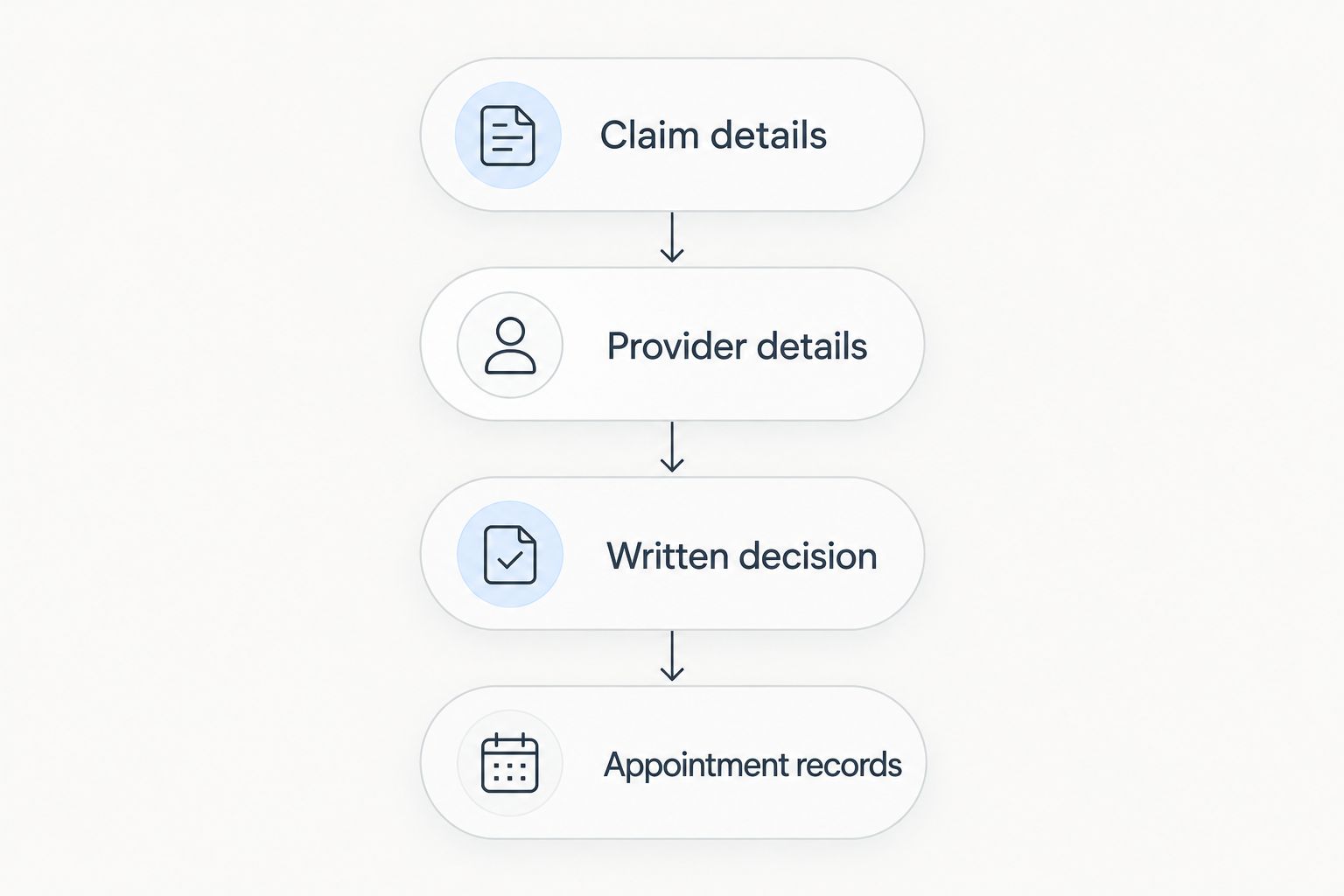
Claim details and insurer instructions
The first configuration unit is your claim record: establish who makes the funding decision and how that person wants documents submitted. There is no single insurer portal with identical buttons or fields, so use your insurer's actual instructions rather than looking for a universal chiropractic approval screen.
- Confirm the scheme. Give the insurer the accident location and date. Ask whether your request belongs under NSW CTP and which insurer should receive it.
- Lodge or identify the claim. Follow the insurer's instructions for the application and supporting medical documentation. If a claim already exists, check that your contact details and claim number are correct.
- Request a contact point. Record the claims contact's name, email address or approved submission channel. Ask how to identify correspondence so it reaches your file.
- Ask about the current decision status. Distinguish an application received, a claim accepted and a proposed service authorised. Record exactly what has been decided.
- Request the requirements in writing. Ask which documents, provider details and clinical information are needed for consideration of chiropractic services.
Expected result: you know which insurer is responsible, how to submit documents and whether a funding request can proceed. If those answers remain unclear, resolve them before assuming an appointment will be covered.
Keep one claim record
Create a folder such as CTP claim 2026 and store the application, attachments, decisions and correspondence together. Use a short correspondence log with the date, sender, subject and next action.
After a telephone call, email a factual summary and ask the recipient to correct any misunderstanding. Your summary is a record of the discussion, not a substitute for an approval decision.
Provider details and funding request
Before booking with a provider, confirm what details the insurer requires. Accepting private health insurance does not mean a clinic automatically accepts CTP claims.
- Confirm provider participation. Ask whether the clinic accepts enquiries relating to your CTP insurer and whether the proposed chiropractor meets the insurer's applicable requirements.
- Clarify the first appointment. Ask the insurer whether an initial assessment requires prior approval or falls within an applicable exception. Request the answer in writing.
- Identify who submits the request. Establish whether the clinician sends the clinical request, you submit documents, or both parties have separate tasks.
- Use the required documentation. Ask whether the insurer requires an Allied Health Treatment Request (AHTR), another form or additional information. Let the treating professional complete clinical sections.
- Check administrative accuracy. Confirm your name, claim number, accident date and proposed provider details match the claim record. Do not alter a clinician's findings to fit an application.
Expected result: the insurer receives an identifiable request with the supporting information it has asked for. Submission means the request is awaiting consideration; it does not establish approval.
If you are considering MyChiro chiropractic care, confirm these arrangements directly with the clinic. No clinic's general service information replaces a claim-specific funding decision.
A practical request template
Use the following as an email structure, replacing the instructions with your actual details:
- Subject: include your claim number and identify the proposed chiropractic service request.
- Claim details: give your full name and accident date.
- Provider details: identify the proposed chiropractor and clinic.
- Approval question: ask whether prior authorisation is required and what documentation is outstanding.
- Payment question: ask whether an approved service would be paid directly to the provider or reimbursed to you.
- Written response: request confirmation of the decision and its scope.
Do not include unnecessary medical information in a general enquiry. Ask for the insurer's appropriate channel before sending sensitive documents.
Written decision and payment arrangements
Read the approval itself, not just the email subject line. A message acknowledging receipt or requesting more information is not the same as a decision authorising the proposed services.
- Locate the decision. Find the written response relating to the particular request and provider.
- Read its scope. Check which services, appointment limits, dates and conditions are specified. Ask about anything unclear before relying on it.
- Match the provider. Confirm that the decision applies to the chiropractor or clinic you intend to attend. Ask whether a provider change requires a new request.
- Confirm payment handling. Establish who submits invoices and whether you are expected to pay anything yourself. Do not assume direct billing.
- Share the relevant decision. Give the clinic the approval and claim details through its agreed channel, and retain your own copy.
Expected result: you and the clinic understand what the insurer has authorised and how invoicing will work. A clinical recommendation and a funding decision remain separate documents with separate purposes.
Direct billing versus reimbursement
Neither arrangement establishes eligibility. Use the table to identify the paperwork responsibilities, then confirm the actual arrangement with the insurer and provider.
| Payment arrangement | Administrative fit | Advantage | Limitation |
|---|---|---|---|
| Direct billing | Where the insurer and provider confirm that the provider submits invoices | The provider handles the agreed invoice submission | It does not remove approval conditions or confirm every service is covered |
| Reimbursement | Where the insurer instructs you to submit paid invoices | You retain the payment record and submission trail | Paying an invoice does not establish entitlement to reimbursement |
Do not submit the same expense through multiple funding channels without disclosing the situation and checking the applicable rules. Keep the original invoice and any payment record.
Appointment records and review points
The final unit keeps the actual appointments aligned with the written decision. It also gives you a clear point to stop and ask questions when the proposed plan changes.
- Record attendance. Keep appointment dates and copies of invoices or receipts. Check that the provider and service descriptions are accurate.
- Track the approval boundary. Compare appointments with any authorised limits or dates. Ask who monitors the remaining authorisation.
- Record changes. Tell the relevant health professional about changes in your health, and tell the insurer about administrative changes affecting the request.
- Check the next review. Ask when updated information is needed and who will submit it. Do not treat an initial approval as open-ended authorisation.
Expected result: your records show what was authorised, what occurred and what needs a fresh decision. Keep these records throughout the claim rather than reconstructing them after an invoice is questioned.
When the proposed plan or provider changes
A second workflow applies when you already have approval but the proposed services change. Existing approval is not evidence that a different request has also been authorised.
Ask the treating professional to explain the proposed change and whether it is clinically appropriate following assessment. Separately, ask the insurer what updated documentation is required for a funding decision.
Use this sequence:
- Identify what changes: the provider, proposed services, frequency or period covered.
- Ask whether the existing authorisation includes that change.
- Submit the updated request through the insurer's required channel where necessary.
- Obtain the written decision and check its scope before assuming funding continues.
Do not arrange extra appointments simply because an approval has unused capacity. Clinical need should be discussed with the relevant health professional, independently of the administrative allowance.
If funding or billing becomes confusing
You have a claim number but no service approval
Ask the insurer whether the proposed service needs authorisation and whether a request has been received. Keep the acknowledgement separate from any decision. A claim number identifies the file; it does not describe the services funded.
The insurer says information is missing
Request a specific list of outstanding documents and identify who must supply each item. Clinical information belongs with the relevant clinician; identity or claim-reference corrections can usually be addressed administratively. Confirm receipt after submission.
The clinic and insurer give different billing instructions
Ask both parties to reconcile the instructions before you rely on insurer payment. Check the provider named in the approval, the invoice recipient and the claim reference. Do not assume the clinic can invoice directly because another provider did.
A funding request is declined
Ask for the written reasons and the available review process, including the applicable deadline. NSW CTP disputes have different pathways depending on the decision; SIRA can provide scheme information, and independent legal advice can address your circumstances. A new booking does not resolve a funding dispute.
You already paid for an appointment
Keep the invoice, receipt and any earlier correspondence. Ask the insurer whether reimbursement can be considered and what evidence it needs. Do not assume that a later approval applies retrospectively to an earlier service.
If your claim or circumstances change
Assign each next action to a person: you, the clinician or the insurer. A useful claim log includes the document requested, responsible person, submission date and response received; avoid storing clinical details in a shared calendar.
For MyChiro enquiries, use the contact page to ask about current claim administration arrangements. Ask about provider participation and paperwork before assuming the clinic can accept insurer-funded appointments.
If an appointment is clinically appropriate following assessment, the guide to preparing for your first chiropractor appointment covers general preparation. Bring relevant medical information and the funding decision, while recognising that an assessment does not commit you to adjustments or ongoing care.
FAQ
Does CTP cover chiropractic care after a car accident?
Chiropractic services can be considered under NSW CTP, but funding is not automatic. Ask your insurer about claim eligibility, provider requirements and authorisation for the specific proposed services.
Do I need a GP referral for CTP-funded chiropractic care?
Ask your insurer which medical documents and referrals it requires for your claim. Being able to book privately without a referral does not establish eligibility for insurer funding; seek appropriate medical assessment after a crash.
Can I book before the insurer approves the request?
A booking does not establish insurer payment. Ask whether prior approval is required or an exception applies, and obtain written clarification before relying on funding; do not delay urgent medical care for an insurance decision.
How long do I have to lodge a NSW CTP claim in 2026?
SIRA’s general NSW statutory benefits claim lodgement period is 3 months after the accident. Lodging within 28 days matters for weekly income payments from the day after the accident; confirm the rules and any exceptions with the insurer or SIRA.
Can I choose my own chiropractor for a CTP claim?
Confirm your proposed chiropractor with the insurer before assuming the service will be funded. Provider requirements, clinic participation and the scope of approval need to be checked separately.
Will the insurer pay the chiropractor directly?
Direct payment depends on the arrangements confirmed by your insurer and provider. Ask who submits invoices and whether reimbursement applies instead; neither arrangement removes the need to check authorisation.
What should I do if the insurer refuses the request?
Request written reasons and information about the applicable review process and deadline. Contact SIRA for NSW scheme information or obtain independent advice about your circumstances.
Keep insurer decisions with your records
Keep the clinical plan and the insurer's decision side by side. One describes proposed care; the other describes the funding decision. If they differ, ask questions rather than assuming either document substitutes for the other.
Keep the insurer’s written decisions and attachments with your claim records. At MyChiro Bondi Junction, new patients can book a free initial consultation for assessment and advice. Same-day treatment, if clinically appropriate and chosen, is $125 with no obligation. CTP funding, clinic participation and insurer approvals must be confirmed separately.
Related guides
- What qualifications should a Sydney chiropractor have?
- How chiropractors coordinate with GPs on imaging referrals