


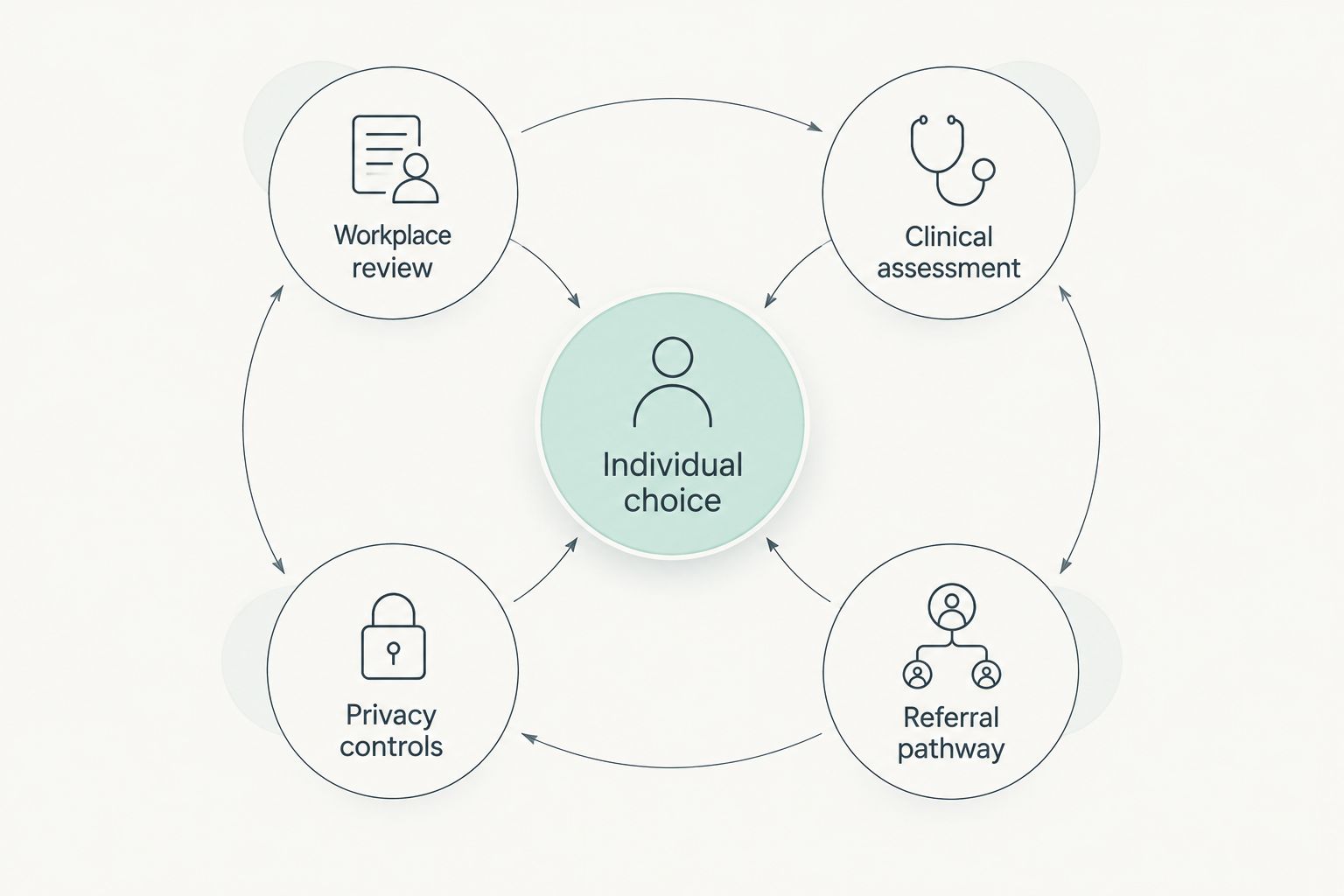
Workplace chiropractic care is an optional individual healthcare pathway within an employer’s wellness programme, with the aim of supporting access to assessment rather than promising business or clinical outcomes. If you are considering a corporate wellness chiropractor in 2026, separate individual care from workplace risk management, staff privacy and employment decisions.
- A corporate wellness chiropractor should be an optional healthcare choice, not a compulsory staff benefit.
- MyChiro provides chiropractic care in Bondi Junction; confirm any proposed workplace arrangements directly.
- Workplace wellness needs task reviews, employee consultation and privacy controls alongside any individual healthcare access.
- Choose providers by registration, consent processes and assessment arrangements, not promised productivity gains.
MyChiro is a chiropractic clinic and wellness centre in Bondi Junction, Sydney. Its stated services include chiropractic care and spinal adjustments; ask directly about any proposed employer arrangement rather than assuming corporate packages, workplace visits or reporting services are offered.
Why chiropractic care matters for workplace wellness
For employers, the relevant question is where optional chiropractic care belongs within a wider workplace wellness programme. An appointment benefit does not replace reviewing the work itself. Keep workload, equipment, task design and access to appropriate healthcare on separate, connected tracks.
Your employees also need different things from the programme. A remote worker needs a way to raise concerns about their home setup, while a warehouse worker needs a process for reporting task-related difficulties. Neither situation establishes a need for chiropractic adjustments.
For your 2026 planning, distinguish three responsibilities: the employer manages workplace arrangements, the clinician makes individual clinical decisions, and the employee decides whether to participate. Do not make a manager the gatekeeper for confidential health discussions.
This guide focuses on programme design and provider questions. It does not establish that chiropractic care is appropriate for a particular employee or that it will change absence, productivity or healthcare spending.
How to assess a corporate wellness chiropractor
Map work demands before choosing a provider
Start with your existing consultation process. Ask employees which tasks, equipment or scheduling arrangements they want reviewed, without asking them to disclose diagnoses in a team meeting.
Use a short written form or a suggested 15-minute staff discussion to identify practical issues. That duration is a planning choice, not a health recommendation. Include remote staff, different shifts and employees who are not interested in a healthcare benefit.
Your 2026 brief should describe work rather than label bodies. Write that staff share desks or move equipment between rooms; do not infer spinal damage, nerve pressure or a need for adjustments from those observations.
- Record tasks, locations and equipment involved.
- Ask how employees currently raise work-related concerns.
- Separate equipment requests from confidential health questions.
- Include workers outside standard office hours.
- Assign an owner to each workplace issue raised.
Make workplace changes a separate workstream
Review what your organisation can change directly before purchasing a clinical benefit. Existing equipment instructions, internal safety procedures and employee consultation provide a starting point; seek a competent workplace adviser where the task requires one.
For example, you can check whether shared equipment is adjustable and whether employees know how to request assistance. These are administrative checks, not proof that a particular setup causes or resolves symptoms.
Avoid issuing a universal posture prescription or requiring everyone to use the same accessory. A desk review, a clinical assessment and a purchasing decision answer different questions. Document each separately so that an appointment does not close an unresolved workplace report.
- Check whether existing equipment adjustments are understood.
- Review how shared workstations are handed over.
- Provide a clear route for requesting equipment assistance.
- Review task variation and break arrangements with staff.
- Keep unresolved workplace concerns on the action register.
Check provider scope and individual consent
Use the Ahpra public register to check a proposed chiropractor’s current registration. Ask the provider to explain the assessment process, consent arrangements, alternatives, referral approach and how employees can raise concerns.
MyChiro is a local chiropractic care option for individuals seeking a clinic in Bondi Junction. That identifies its service and location, not suitability for every employee. You can contact MyChiro to clarify whether an arrangement you are considering is offered.
A clinic may provide an individual clinical pathway, but it does not take over the employer’s workplace responsibilities. Keep any commercial proposal separate from recommendations made after an employee’s assessment.
- Confirm the practitioner’s identity and current registration.
- Request a plain-language description of the proposed service.
- Ask how options, risks and consent are discussed.
- Clarify when another health professional would be involved.
- Confirm that an employee can decline any proposed procedure.
Protect employee choice and health information
Draft the privacy arrangements before collecting enrolments. Start with a simple information map: what the employer receives, what the clinic holds and what any administrator processes.
For a 2026 programme, keep participation optional and separate from performance discussions. Do not ask managers to collect symptom histories or circulate appointment lists. Explain what administrative information is genuinely needed and obtain appropriate privacy advice before implementing the process.
An employer-funded benefit does not remove the need for individual consent. If a work-capacity question arises, use an appropriate formal process rather than asking a treating practitioner for informal clinical updates.
- State that participation and clinical decisions are voluntary.
- Keep clinical records outside ordinary HR programme files.
- Identify who can access administrative information.
- Explain what happens if someone withdraws.
- Avoid team-level reporting that identifies individual participants.
Build assessment and referral into the pathway
Write a clear boundary between general education and personal healthcare. A group presentation can explain how to seek assistance; it should not diagnose attendees or prescribe a shared course of adjustments.
Ask the provider how individual assessment determines whether any proposed care may be appropriate. Employees should be able to discuss alternatives, ask questions and choose another practitioner without having to justify that choice to their manager.
Keep urgent healthcare outside the wellness booking pathway. Healthdirect Australia advises calling 000 for a medical emergency. A workplace benefit must not delay emergency assistance or medical assessment while an employee waits for a preferred provider.
- Separate group education from individual clinical assessment.
- Avoid automatic procedures after workplace screening activities.
- Ask how referral decisions are communicated to the employee.
- Explain where employees should seek urgent assistance.
- Keep emergency procedures visible independently of the programme.
Define a limited pilot and review process
Start with a written proposal rather than an open-ended commitment. As an administrative example, use a 4-week planning period to confirm responsibilities, communications and privacy arrangements before offering access. This is not a recommended clinical schedule.
Set a separate 30-day programme review after launch. Ask whether employees understood the choices, could access the information and knew how to raise concerns. Do not use attendance as evidence of clinical benefit.
For your 2026 reporting, separate implementation measures from health outcomes. A completed enquiry, a resolved equipment request and a clinical change are different measures; reporting them together obscures what the programme actually delivered.
- Name the programme owner and escalation contact.
- Specify the pilot’s administrative start and review dates.
- Record whether information reached different shifts and locations.
- Review access barriers without collecting unnecessary clinical details.
- Decide what would justify changing or ending the arrangement.
Write communications around questions, not promises
Draft the employee announcement yourself before commissioning promotional material. Explain what is offered, who delivers it, how to ask questions and what remains an individual decision.
An employee searching for relieving neck-related tension headaches is seeking condition-specific information, not consenting to a workplace appointment or establishing that chiropractic care is appropriate. Keep that distinction when selecting educational material: a search phrase is not a diagnosis or an evidence basis for an employer’s claim.
Do not promise fewer sick days, improved performance or a particular symptom outcome. Avoid promotional testimonials and employee success stories about clinical results. Describe the access arrangement factually and leave personal clinical recommendations to the assessing health professional.
- Describe the service without promising a clinical result.
- State that assessment does not commit anyone to procedures.
- Keep managers out of individual healthcare recommendations.
- Provide a private route for administrative questions.
- Have clinical claims independently checked before public use.
Compare workplace wellness options by purpose
Choose the option that matches the question you need answered. An equipment review and an individual healthcare consultation are not interchangeable, and no single option covers every responsibility.
The table distinguishes intended roles rather than ranking clinical outcomes. Confirm the actual provider’s scope before making arrangements.
| Option | Appropriate for | Practical advantage | Key limitation |
|---|---|---|---|
| Internal workplace review | Recording tasks, equipment concerns and staff requests | Starts with existing consultation processes | Does not provide an individual clinical assessment |
| Workplace ergonomics adviser | Reviewing the relationship between tasks, equipment and work arrangements | Focuses on the work environment | Does not replace personal healthcare |
| Individual chiropractic consultation | Employees choosing to discuss chiropractic care after assessment | Provides a separate clinical discussion | Does not establish a need for adjustments or replace workplace controls |
| GP consultation | Employees seeking medical assessment or advice about healthcare pathways | Provides a medical point of contact | Does not replace the employer’s task and equipment review |
| Physiotherapy consultation | Employees seeking an individual physiotherapy assessment | Provides another healthcare pathway | Suitability and recommendations remain individual |
Ask providers to explain their role without presenting another profession as inferior. Employees need a genuine choice, including the choice not to use an employer-associated provider.
Common mistakes employers make
Turning a voluntary benefit into an expectation
A calendar invitation from a senior manager can look compulsory even when the accompanying text says otherwise. Keep healthcare invitations separate from required training and avoid asking employees to explain non-participation. Give supervisors a clear instruction not to recommend appointments during performance conversations.
Buying appointments instead of addressing work concerns
If employees report equipment or task problems, keep those reports open until the organisation has addressed them through its workplace process. Offering access to a clinician is not evidence that the reported work issue has been investigated. Assign responsibility for both streams rather than allowing each party to assume the other is handling it.
Treating screening as proof that everyone needs care
Do not turn a posture photograph, questionnaire or brief workplace observation into a predetermined appointment schedule. Ask what the activity can establish, what its limitations are and how individual consent works. Participation in an educational event should not enrol an employee in ongoing clinical care.
Reporting participation as a health result
An appointment count tells you that appointments occurred. It does not demonstrate that chiropractic care changed symptoms, absence or productivity. In a 2026 management report, label administrative measures accurately and avoid drawing clinical conclusions from programme uptake or positive comments about convenience.
FAQ
What is a corporate wellness chiropractor?
A corporate wellness chiropractor is a chiropractor considered within an employer’s workplace wellness arrangements. The term alone does not establish a particular service package, workplace attendance arrangement or clinical suitability for staff.
Should every employee have a chiropractic assessment?
A workplace wellness programme should not presume that every employee needs a chiropractic assessment. Participation should remain voluntary, and any personal healthcare decision belongs with the employee and an appropriately qualified health professional.
Does MyChiro offer corporate wellness packages?
Confirm any proposed corporate arrangement directly with MyChiro. The clinic’s stated services include chiropractic care and spinal adjustments in Bondi Junction; this guide does not establish that workplace packages or onsite services are offered.
Can an employer see employees’ chiropractic records?
Do not design a wellness benefit around employer access to employees’ clinical records. Establish appropriate consent, privacy and administrative arrangements before collecting information, and obtain advice for the specific programme.
Does an ergonomic review replace a clinical appointment?
An ergonomic review and a clinical appointment serve different purposes. Review workplace tasks and equipment through the workplace process, while employees seek individual healthcare advice according to their circumstances.
How often should staff attend a chiropractor?
An employer should not set a standard chiropractic attendance schedule for staff. Any proposed care should follow individual assessment, discussion of options and consent, rather than a programme attendance target.
Can a workplace programme promise fewer sick days?
This guide provides no basis for promising fewer sick days from chiropractic care. Report administrative measures separately and do not present participation figures as evidence of a clinical or business outcome.
One last thing
Keep the workplace action register open even when an employee chooses healthcare. That single administrative rule prevents a referral or appointment from being mistaken for a completed workplace response.
Before approving your 2026 programme, ask who owns each equipment request, how employees retain clinical choice and what information the employer actually needs. If those answers are unclear, resolve the programme design before inviting participation. A clearly bounded benefit is easier to explain than an ambitious promise you cannot substantiate.
Related guides
- Accessing chiropractic care through a workplace health programme
- Preparing for your first chiropractor appointment
- What qualifications should a Sydney chiropractor have?