
Long shifts at the cutting bench can be difficult when your back, shoulders, wrists or hands are sore. If discomfort is affecting how you work, begin with what hurts, when you notice it and which tasks are difficult. A chiropractor can assess relevant musculoskeletal symptoms and discuss suitable options, while workplace safety concerns are addressed separately.
- Sore shoulders, wrists or back during shifts? Describe your symptoms and the tasks that are becoming difficult.
- At MyChiro in Bondi Junction, you can discuss muscle and joint discomfort and appropriate care options.
- Describe cutting, lifting and cleaning tasks separately when discussing workplace demands.
- Workplace changes and clinical care address different questions; neither automatically replaces the other.
Back, shoulder and hand discomfort during butcher shifts
Standing at a cutting bench, moving cartons and cleaning equipment can feel very different when you have back, shoulder or hand pain. Describe when symptoms appear and which movements are uncomfortable. An individual assessment helps explore possible causes rather than assuming that your trade explains the pain.
Your work discussion should include the layout, equipment and pace of the shift. Safe Work Australia’s Hazardous manual tasks model code identifies factors including repetitive movement, sustained or awkward posture, and force when assessing workplace risks. This is workplace guidance, not evidence that chiropractic care changes those risks.
Start with the work tasks you find most difficult. The guide to ergonomic setups for shift workers provides related reading, but any proposed change must also meet your workplace’s hygiene, equipment and safety requirements.
Clinical care does not replace an employer’s responsibility to assess hazardous manual tasks. Keep those conversations connected, but distinct.
How to approach care and workplace demands
1. Map your actual tasks before choosing care
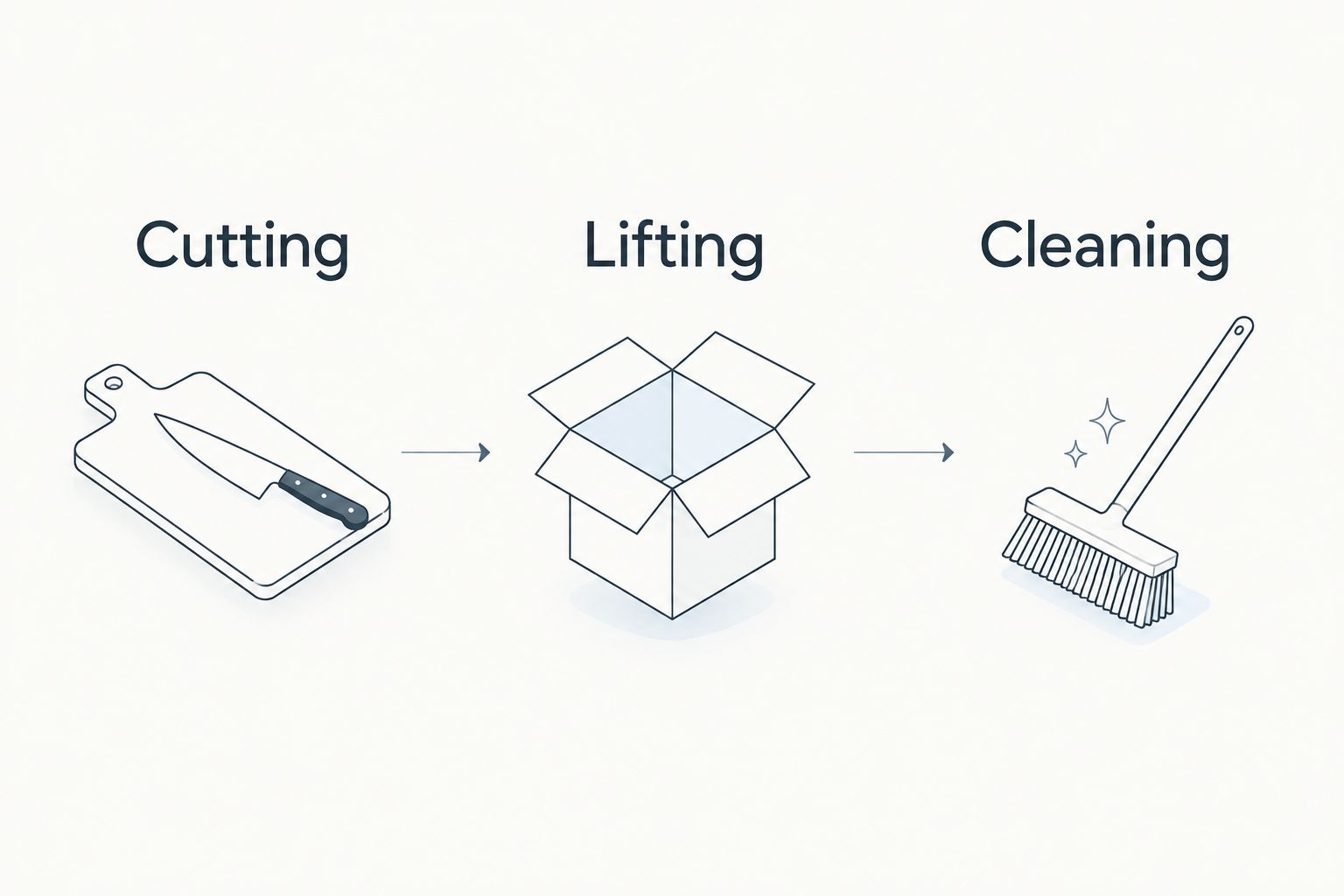
Begin with a simple paper record rather than buying equipment or booking a course of appointments. List 3 tasks: cutting, lifting and cleaning. Add what you were doing when a concern arose, what changed during the shift, and whether the same issue occurs away from work.
The record is a conversation aid, not a way to diagnose yourself. A concern during cutting does not establish that the knife, bench or spine caused it. Record observations without assigning a cause.
Include quieter preparation periods as well as busy service periods in your notes. This can help explain patterns without assuming the busiest task caused your symptoms.
- Cutting: note the bench, product position, tool and reach involved.
- Lifting: describe the load, starting position, destination and available assistance.
- Cleaning: record low surfaces, extended reaches and equipment restrictions.
- Note whether a task changed before the concern began.
- Separate what you observed from what you think caused it.
2. Review the work setup with your supervisor
Use your task record to start a workplace discussion. Ask whether frequently handled items can be repositioned, whether handling aids are available, and who can assess a task that is difficult to change. Do not improvise alterations around blades, machinery or food-contact surfaces.
Safe Work Australia’s manual-task guidance prioritises identifying and controlling hazards. It does not reduce the discussion to a single lifting technique or posture instruction. Your review should consider the work system, not just how you stand.
A change that suits one cutting station is not automatically suitable elsewhere. Check the proposed arrangement against the equipment instructions and workplace procedures before using it.
- Ask who is responsible for reviewing manual-task hazards.
- Discuss the position of regularly used tools and materials.
- Check existing procedures for awkward or bulky loads.
- Raise damaged flooring, obstructed routes or unsuitable equipment.
- Agree who will follow up on proposed changes.
3. Choose an assessment rather than a promised outcome
Write your questions down before contacting a clinic. Ask what an initial consultation involves, who will assess you, and how the practitioner decides whether chiropractic care is appropriate. A job-specific marketing phrase is not evidence of a relevant qualification or a particular result.
Mychiro provides chiropractic care and spinal adjustments in Bondi Junction. Mychiro is a local option for adults considering chiropractic care, not a substitute for workplace hazard assessment. Whether an adjustment may be appropriate requires an individual assessment and discussion.
At an appointment, ask what the assessment suggests and which options are available. You can discuss relevant risks, alternatives or referral before choosing whether to proceed.
- Check the practitioner’s registration through the Ahpra public register.
- Describe your work tasks rather than requesting a technique by name.
- Ask what the assessment can and cannot establish.
- Request an explanation of proposed care, alternatives and material risks.
- Ask when another health professional’s assessment would be appropriate.
4. Bring a concise work and health summary
Prepare a 1-page summary for your consultation. Include your main concern, when it began, relevant health information and the tasks you want to discuss. This keeps the conversation focused without requiring you to reconstruct a complicated shift from memory.
Tell the practitioner about medicines, previous procedures and other care you are receiving. Do not leave out information because it seems unrelated to your back or neck; let the practitioner decide what is relevant to the assessment.
Bring a description of your current duties rather than an old job description. Include temporary changes such as covering another station or undertaking different deliveries, without assuming those changes explain your symptoms.
- Bring your task record and current medication list.
- Describe the concern in your own words.
- Note any previous assessments and relevant reports you already have.
- Identify duties you are struggling to complete.
- State what you want explained before making a care decision.
5. Agree on practical goals and a review point
Before accepting a plan, ask how the practitioner will review it. You need an explanation of the proposed approach, what will be reassessed, and what would prompt a change or referral. A fixed schedule based only on being a butcher does not answer those questions.
Choose work-related discussion points rather than a promised recovery date. For example, you might want to discuss tolerance of a particular task or confidence about following agreed duties. These are topics for assessment and review, not predicted outcomes.
Keep 2 questions on your review sheet: “What has changed?” and “What should happen next?” You can use the same questions with your GP or other involved health professionals.
- Agree which concerns will be reviewed.
- Ask why each proposed appointment is being recommended.
- Record advice about work duties accurately.
- Ask what to do if symptoms change between appointments.
- Discuss whether further assessment or another approach is needed.
6. Keep workplace reporting separate from appointment decisions
If you think work contributed to an injury or concern, follow your workplace reporting process. Seeking healthcare and reporting a workplace issue are different actions. One should not be treated as proof that the other has been completed.
For NSW workers, SIRA provides information about workers compensation processes, nominated treating doctors and return-to-work arrangements. Check the requirements relevant to your circumstances rather than assuming a clinic visit establishes a claim or authorises particular duties.
Keep dates, task descriptions and relevant correspondence organised. Avoid changing duties solely on the basis of a general online article; discuss restrictions and suitable duties through the relevant clinical and workplace channels.
- Ask your employer how to report a work-related concern.
- Keep copies of relevant forms and correspondence.
- Confirm who is coordinating any agreed work changes.
- Ask about approval requirements before claim-funded care.
- Check that everyone is working from the current duties plan.
Compare the available pathways
These options address different needs. The table is a decision aid, not a ranking of clinical outcomes, and more than one pathway can be relevant.
| Option | Suited to | Practical advantage | Key limitation |
|---|---|---|---|
| Workplace task review | Questions about cutting stations, handling and work organisation | Examines the task where it happens | Does not provide a medical diagnosis |
| GP consultation | Uncertain symptoms, broader health concerns or medical assessment | Provides a medical assessment pathway | Does not replace an on-site task review |
| Chiropractic consultation | Adults considering assessment and discussion of chiropractic care | Provides a setting to discuss whether chiropractic care is appropriate | Adjustments are not appropriate for every presentation; risks and alternatives require discussion |
| Physiotherapy consultation | People considering assessment of movement and rehabilitation needs | Provides another musculoskeletal assessment pathway | The profession’s name alone does not determine an individual plan or outcome |
Mychiro offers the chiropractic pathway described above. No option in the table should be selected on a promise that it will resolve a work-related concern.
Choose according to the question you need answered, not a claim that one profession suits every butcher.
Common mistakes butchers make when considering care
Treating the job title as a diagnosis
“Butcher’s back” is not enough information to select care. Explain the location and nature of your concern, its timing, and the tasks involved. Avoid assuming that standing, lifting or posture establishes the cause.
Changing the bench without checking the whole station
Raising a work surface changes more than its height. Check reach, equipment positioning, hygiene requirements and access with the person responsible for the station. Do not introduce an improvised platform or mat without workplace approval.
Expecting appointments to replace task changes
A clinic consultation does not alter a storage layout, delivery process or production schedule. Raise workplace concerns through the workplace process even if you also seek healthcare. Equally, a task review does not replace assessment of an unexplained health concern.
Accepting an open-ended schedule without review questions
Ask why care is proposed and how it will be reviewed. You do not need to agree to an indefinite schedule simply because your work is physically demanding. Request a clear explanation before deciding.
When medical assessment takes priority
Do not use a routine chiropractic appointment as the default response to every symptom. Healthdirect Australia’s back-pain guidance identifies warning signs that require urgent assessment, including new bladder or bowel control changes and numbness around the groin or saddle area.
Seek urgent medical assessment for those symptoms, new or progressive weakness, or pain following significant trauma. Call 000 for a medical emergency. This guidance is not a diagnosis, and the absence of these signs does not establish that chiropractic care is appropriate.
If you are unsure where to seek help, contact a medical service for triage rather than choosing a manual technique online.
FAQ
Do I need a chiropractor because I work as a butcher?
Being a butcher does not automatically mean you need chiropractic care. Your symptoms, health history, examination and preferences should inform a discussion about appropriate next steps.
What should I ask a chiropractor for butchers?
Ask how the practitioner will assess your concern and decide whether chiropractic care is appropriate. Describe cutting, handling and cleaning separately, and request an explanation of alternatives, material risks and review arrangements.
Will chiropractic adjustments resolve pain from my shifts?
You should not assume that adjustments will resolve pain associated with your shifts. Suitability requires individual assessment, and workplace demands need their own review.
Should I see my GP or a chiropractor first?
Choose medical assessment when symptoms are unexplained, involve broader health concerns or include warning signs. A routine chiropractic consultation is not a substitute for urgent medical assessment.
How many appointments will I need?
Your occupation alone cannot determine an appointment schedule. Ask for the reason for any proposed care, the planned review point and what would prompt a change or referral.
Can I keep working while I arrange an assessment?
An online guide cannot determine whether your current duties are appropriate. Discuss your symptoms and tasks with a qualified health professional and follow your workplace reporting and duties processes.
Does Mychiro provide chiropractic care in Bondi Junction?
Mychiro is a chiropractic clinic and wellness centre in Bondi Junction, Sydney, offering chiropractic care and spinal adjustments. Whether a particular service may be appropriate requires individual assessment and discussion.
One last thing
Bring a description of the task, not just the name of the trade. “I work as a butcher” gives less useful detail than explaining where the product sits, how you move it and which part of the task concerns you.
For your next workplace or healthcare discussion, bring the same practical task summary to both. That creates a shared starting point without assuming a diagnosis, prescribing care or promising an outcome.
Related guides
- Qualifications to check when choosing a Sydney chiropractor
- Preparing for your first chiropractor appointment
- Questions about chiropractic appointment frequency