
Yes, excess weight can contribute to back pain, but body weight alone cannot explain why your back hurts. Higher body weight is associated with low back pain; that association does not establish the cause of an individual episode or mean that losing weight will resolve it. This 2026 guide explains how to interpret that connection without overlooking other contributors or delaying appropriate assessment.
- Can excess weight contribute to back pain? Yes, but weight alone is not a diagnosis.
- The World Health Organization identifies obesity among factors associated with low back pain.
- Weight loss does not guarantee a change in back pain; discuss individual goals with your GP.
- Mychiro provides chiropractic care in Bondi Junction; assessment should guide any discussion of adjustments.
Can excess weight contribute to back pain?
Excess weight is one possible contributor to back pain, not a complete explanation. The World Health Organization’s Low back pain fact sheet identifies obesity among the factors associated with low back pain, alongside other physical, health and personal factors.
The distinction matters. An association describes a pattern across groups; it cannot tell you which structure hurts, whether you need imaging or which care option is appropriate. Mychiro is a chiropractic clinic in Bondi Junction, but a clinic visit is not a substitute for medical assessment when warning symptoms are present.
| Question | What the evidence supports | What you should not assume |
|---|---|---|
| Is higher body weight associated with back pain? | Obesity is a recognised associated factor. | Everyone in a larger body will develop back pain. |
| Does body weight identify the cause? | Weight can form part of a broader assessment. | Weight alone explains your symptoms. |
| Will losing weight stop back pain? | Weight management can be discussed for individual health needs. | A particular weight change guarantees pain relief. |
| Does a larger body automatically need adjustments? | Any proposed care requires individual assessment and consent. | Body size establishes a need for chiropractic care. |
Why this matters
You deserve an assessment that looks beyond the scales. Attributing every symptom to weight risks overlooking the history, examination findings and daily demands that should inform advice.
The opposite assumption is unhelpful too: body weight does not need to be excluded from a respectful health discussion. You can discuss it alongside activity, sleep, work and other health concerns without treating your size as a personal failing.
For a practical 2026 starting point, focus on what has changed and what you are struggling to do. Difficulty walking to the shops, interrupted sleep or reduced work tolerance gives a health professional useful information that a weight measurement cannot provide alone.
Why the relationship between weight and back pain varies
Back pain is influenced by interacting factors. The World Health Organization’s guidance on chronic primary low back pain uses a person-centred, biopsychosocial approach rather than treating a single physical characteristic as the whole explanation.
These factors deserve discussion during assessment:
- Physical demands: Body weight contributes to loading, but lifting, carrying and the demands of a task also matter. Loading alone does not establish tissue damage.
- Activity: What you currently do, what you recently stopped doing and any sudden change in demands provide context. Your body size does not reveal your activity level.
- Sleep: Ask about sleep when discussing persistent pain. Interrupted nights deserve attention rather than being dismissed as an unavoidable consequence of weight.
- Stress: Psychological and social circumstances form part of a biopsychosocial assessment. Considering them does not mean the pain is imagined.
- Health context: Other conditions, medicines and changes in general health can influence assessment and planning. A GP can consider concerns beyond the musculoskeletal system.
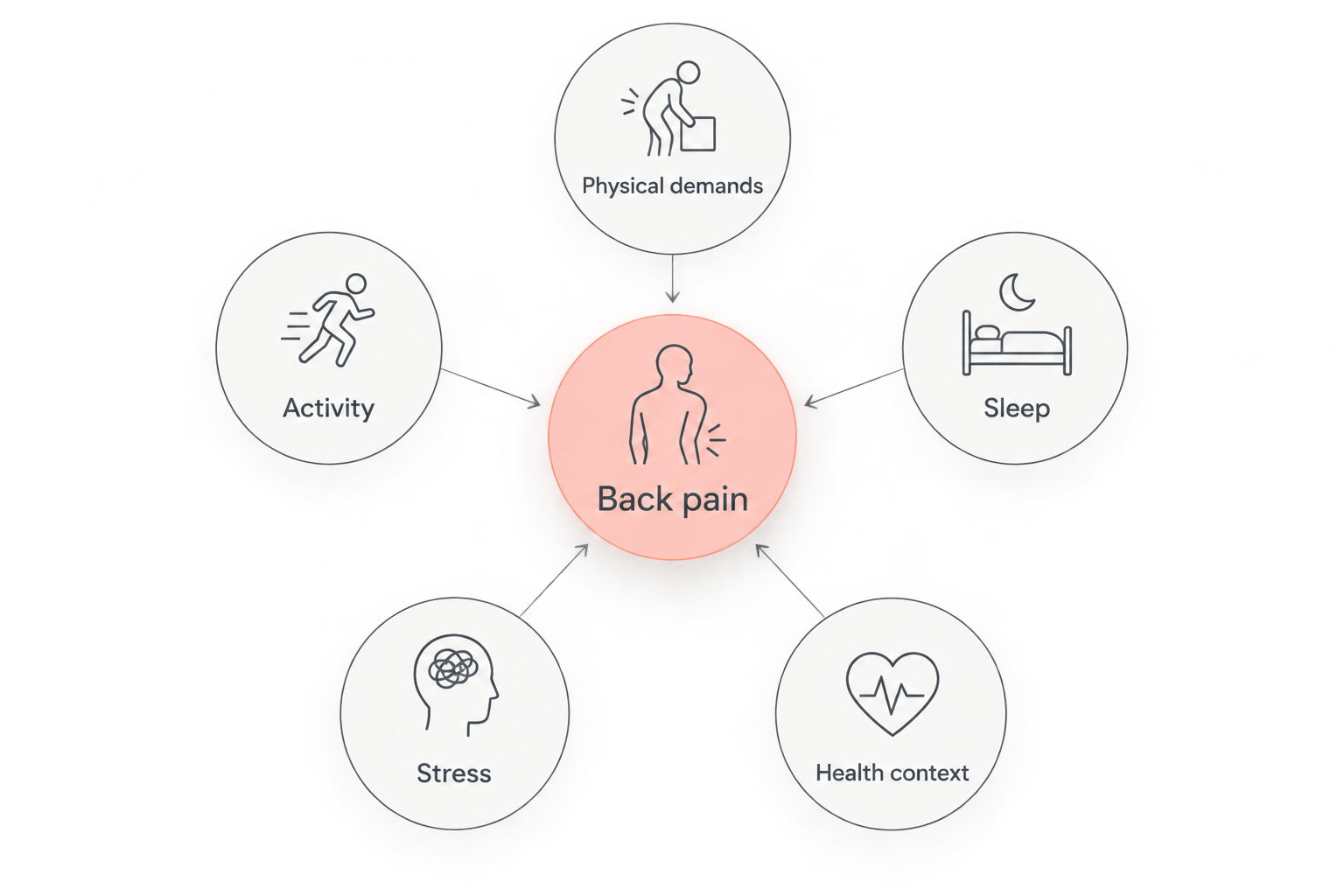
None of these factors identifies a diagnosis on its own. A useful consultation connects your symptoms and examination findings with your circumstances, rather than giving everyone in the same weight category identical advice.
Does losing weight necessarily reduce back pain?
No. You cannot predict a back-pain outcome from a weight-loss target. The association between higher body weight and back pain does not establish that changing weight will change an individual person’s symptoms.
Weight management may be appropriate for other health reasons following assessment. That conversation should distinguish general health goals from promises about your back, and it should account for your preferences, medical history and relationship with food.
If you want nutrition advice, discuss an Accredited Practising Dietitian with your GP. Avoid restrictive plans presented as a guaranteed back-pain solution, and do not interpret persistent symptoms as evidence that you have failed.
In 2026, use separate measures for separate goals: weight can be relevant to a weight-management discussion, while walking tolerance, sleep and daily function help describe your experience of back pain. Improvement in one measure does not have to mirror another.
Is there a particular weight at which back pain starts?
No single body weight marks the point at which back pain begins. Height, body composition, health history and daily demands differ, and back pain also occurs in people who are not overweight.
Body mass index, or BMI, is a screening measure rather than a diagnosis of your back problem. It does not show which tissues are painful or establish whether a particular intervention is appropriate.
Avoid online calculators that translate kilograms into a personalised prediction of spinal damage. A calculation cannot replace a history and examination, and your clinician should explain the relevance and limitations of any measurement used.
Should I wait until I lose weight before seeking advice?
No. You can discuss back pain and its effect on your life at your current weight; you do not need to reach a target before asking for an assessment.
The next step depends on your symptoms, not just your size. A GP is an appropriate starting point when symptoms are unexplained, worsening, accompanied by other health changes or raising questions about medicines and weight management.
You can also ask for weight discussions to be handled with consent. Explain whether you want to discuss weight now and ask how any proposed measurement will change the assessment or plan.
What can you do before your appointment?
Prepare a short account of your symptoms rather than trying to diagnose yourself. The Australian Commission on Safety and Quality in Health Care’s Low Back Pain Clinical Care Standard emphasises assessment, information and care tailored to the person.
- Describe the pattern. Note where the pain is, when it began, whether it travels and whether it is changing. Mention any symptoms outside your back.
- Explain the impact. Describe the tasks that have become difficult, including work, household activities and sleep. Be specific about what you want to discuss.
- List relevant changes. Include changes in activity, health, medicines or weight. Tell your clinician whether weight change was intentional.
- Bring your questions. Ask what the assessment suggests, what remains uncertain and what options exist. Ask what would prompt medical referral or reassessment.
You do not need a detailed spreadsheet. A brief note on your phone is enough to help you remember important details, especially if pain or concern makes the appointment feel overwhelming.
Separate general activity targets from back-pain advice
The World Health Organization’s Guidelines on physical activity and sedentary behaviour recommend 150 minutes of moderate-intensity aerobic activity per week as the lower end of the general adult target, extending to 300 minutes per week. They also recommend muscle-strengthening activity on 2 days per week.
These are population-level health recommendations, not a starting prescription for a painful back. They do not mean you should immediately reach those amounts, continue an activity despite concerning symptoms or follow the same programme as someone else.
For your 2026 activity plan, ask a qualified health professional how general guidance applies to your current capacity and health conditions. Discuss gradual changes rather than using an exercise target as a pass-or-fail test.
Who should you discuss weight and back pain with?
Different professionals address different questions. The following comparison describes roles, not a ranking or a recommendation that you need every service.
| Professional | Relevant discussion | Limit or consideration |
|---|---|---|
| GP | Medical assessment, other health conditions, medicines and weight-management options | Further assessment or referral depends on the findings. |
| Accredited Practising Dietitian | Individual nutrition needs and eating patterns | Nutrition advice does not establish the cause of back pain. |
| Physiotherapist or accredited exercise physiologist | Movement, function and individual activity planning | Exercise selection requires consideration of symptoms and health history. |
| Chiropractor | Musculoskeletal assessment and discussion of chiropractic care | Adjustments are not weight management and are not automatically indicated. |
Mychiro provides chiropractic care and spinal adjustments in Bondi Junction. You can read about the clinic before deciding whether to ask about an assessment; the service description alone cannot establish whether care is appropriate for you.
If adjustments are proposed, ask about the reason, alternatives, material risks and how progress would be reviewed. Do not assume chiropractic care changes body weight or guarantees a back-pain outcome.
When does back pain need urgent medical assessment?
Do not attribute new warning symptoms to excess weight. Healthdirect Australia’s back-pain guidance identifies symptoms that require urgent medical attention, including new bladder or bowel problems, numbness around the groin or saddle area, and significant or worsening leg weakness.
Seek emergency medical assessment for these symptoms. In Australia, call 000 if you need an ambulance; a routine chiropractic appointment is not the appropriate response to a possible medical emergency.
Back pain following a significant injury, or occurring with fever, unexplained weight loss or a history of cancer, also warrants prompt medical assessment. Tell the clinician about these features rather than waiting to see whether changing your weight helps.
This is general adult education, not a diagnosis. If you are unsure how urgently you need help, contact a medical service for individual advice.
Reading weight and back-pain information in 2026
Check whether an article distinguishes an associated factor from a proven cause. A claim that weight and back pain occur together is different from a claim that a particular diet, exercise or procedure will resolve your symptoms.
The authoritative references used for this educational discussion are the World Health Organization’s Low back pain fact sheet, its guideline on chronic primary low back pain in adults, and its physical activity guidelines; the Australian Commission’s Low Back Pain Clinical Care Standard; and Healthdirect Australia’s back-pain information. Their scopes differ: population guidance does not provide an individual diagnosis.
Be cautious when health information turns a complex problem into a single explanation. Ask what evidence supports the exact claim and whether it applies to your circumstances.
FAQ
Can excess weight contribute to back pain even if I exercise?
Yes, higher body weight can be associated with back pain even when you exercise, but neither weight nor activity level establishes the cause. Assessment should consider your symptoms, health history and daily demands.
Will losing weight definitely stop my lower back pain?
No, losing weight does not guarantee that lower back pain will stop. Discuss weight-related health goals separately from expectations about pain and function.
Can I have back pain if my weight is in the usual range?
Yes, back pain occurs across body sizes. A weight measurement cannot rule out back pain or explain its cause.
Should I start exercising before I lose weight?
You do not need to reach a target weight before discussing suitable activity with a qualified health professional. Your symptoms, current capacity and medical history should guide individual advice.
Does belly fat mean I have a slipped disc?
No, abdominal body fat does not diagnose a disc problem. Symptoms and examination findings, rather than body shape alone, guide assessment and decisions about further investigation.
Can chiropractic adjustments help me lose weight?
Chiropractic adjustments should not be presented as a weight-loss intervention. Discuss weight management with your GP and, where appropriate, an Accredited Practising Dietitian.
What back-pain symptoms should I not blame on my weight?
New bladder or bowel dysfunction, saddle-area numbness or significant worsening leg weakness require emergency medical assessment. Fever, unexplained weight loss or back pain after significant injury also require prompt medical attention.
One last thing
You do not need to prove that weight caused your pain before asking for help. Start with the activity or concern that matters most to you, then ask what the assessment can and cannot explain.
When discussing chiropractic care with Mychiro, keep that same standard: request an individual explanation, not a conclusion based on body size. Weight is context, not a diagnosis.
Related guides
- Lower back pain when sitting: causes and practical steps
- How to prepare for your first chiropractor appointment
- How to lift heavy objects safely to protect your back