


Lower back pain often improves over a few weeks, but some episodes last longer or return after settling. That general pattern is not a personal recovery deadline: worsening symptoms, new neurological changes or difficulty managing daily activities need assessment rather than a longer wait.
- How long does lower back pain usually last? Often a few weeks, but individual recovery varies.
- Duration labels describe time, not the cause of lower back pain or a guaranteed recovery date.
- New bladder changes, saddle numbness or progressive leg weakness require urgent medical assessment.
- Mychiro is a chiropractic clinic in Bondi Junction; chiropractic care requires individual assessment, not a promised recovery schedule.
How long does lower back pain usually last?
Uncomplicated lower back pain commonly improves over the first few weeks. Improvement does not always mean every symptom disappears at once: you might walk more comfortably before sitting through a workday becomes manageable.
Use the direction of change, not a calendar deadline, to judge progress. Seek assessment earlier if pain is severe, worsening or limiting ordinary activities. The guide to when back pain needs a chiropractor or a doctor provides related reading, but urgent symptoms need medical care rather than an online comparison.
The following duration categories are commonly used in clinical guidance, including the Australian Commission on Safety and Quality in Health Care’s Low Back Pain Clinical Care Standard. This 2026 guide uses them as descriptions, not predictions.
| Duration category | Common timeframe | What it tells you | What it cannot tell you |
|---|---|---|---|
| Acute lower back pain | Less than 6 weeks | Symptoms are relatively recent | The exact cause or recovery date |
| Subacute lower back pain | 6–12 weeks | Symptoms have continued beyond the initial period | Whether a particular procedure is needed |
| Persistent lower back pain | More than 12 weeks | Symptoms warrant a longer-term management discussion | That pain is permanent or necessarily indicates ongoing damage |
Definitions differ slightly between guidelines. None of these categories replaces your history, examination or assessment of changes in symptoms.
Why this matters
A recovery estimate helps you plan work and everyday activities, but it becomes unhelpful when you treat it as a promise. Being outside a typical timeframe does not establish a diagnosis, and being inside it does not rule out a problem that needs attention.
For decisions in 2026, separate three questions: how long symptoms have lasted, whether function is improving, and whether warning signs are present. Those questions are more useful than comparing your recovery with someone else’s.
A timeframe describes a group; an assessment addresses your situation. You do not need to wait for a duration category to change before asking for help.
Acute lower back pain: less than 6 weeks
Lower back pain lasting less than 6 weeks is commonly described as acute. The label refers to duration, not necessarily severity: recent pain can still make getting dressed, sleeping or working difficult.
Australian clinical guidance supports staying active within your capabilities rather than prolonged bed rest for uncomplicated lower back pain. That does not mean pushing through severe symptoms or immediately returning to heavy lifting.
Consider which ordinary activities remain manageable. Short periods of comfortable movement, changes of position and temporary adjustments to demanding tasks can be discussed with a health professional.
An early assessment may be appropriate if you cannot manage daily activities, are unsure about your symptoms or have relevant medical history. The acute category is not an instruction to wait 6 weeks.
Subacute lower back pain: 6–12 weeks
Lower back pain lasting 6–12 weeks is commonly described as subacute. At this stage, an assessment should consider progress, current limitations and whether the original management plan needs changing.
Prepare specific examples rather than reporting only that your back still hurts. Explain whether walking, sitting, sleeping or returning to work has become easier, stayed the same or become harder.
A review can include physical, psychological and social factors. This biopsychosocial approach recognises that pain and disability involve more than a single structure; it does not mean symptoms are imagined.
Ask what the working diagnosis is, what remains uncertain and what would justify further investigation or referral. Continuing the same approach without reviewing progress is not a substitute for reassessment.
Persistent lower back pain: more than 12 weeks
Lower back pain lasting more than 12 weeks is commonly described as persistent or chronic. This describes how long pain has continued; it does not mean improvement is impossible.
The World Health Organization’s guideline on chronic primary low back pain supports person-centred assessment and a coordinated approach. Its scope is adults with chronic primary low back pain, not every possible cause of back pain.
A management discussion may cover activity, exercise, education, sleep, work demands and psychological support where relevant. The appropriate combination depends on assessment, preferences and other health conditions.
Persistent pain needs an individual plan, not an open-ended promise of appointments. Agree on practical goals and a review point, including what happens if function does not improve or symptoms change.
Why lower back pain duration varies
Two people with pain in the same area do not necessarily have the same condition or recovery pattern. Clinical guidance considers several contributors rather than assigning a fixed healing time from symptom location alone.
- The underlying problem. Nonspecific lower back pain, nerve-related symptoms and pain associated with another medical condition require different assessment decisions.
- Previous episodes and current function. Your history and ability to manage ordinary tasks help a clinician understand the present episode.
- Physical demands. Lifting, prolonged positions and limited opportunities to modify work can affect how you manage symptoms.
- Sleep and general health. These belong in an assessment, particularly when symptoms persist or other health concerns are present.
- Stress, concerns and support. Worry about movement, workplace pressures and practical support can influence the experience of pain and disability.
These factors are not a checklist for predicting your recovery date. They identify areas to discuss and possible barriers to address.
Avoid reducing the explanation to a single posture, a weak core or a spine being out of place. An explanation should fit the clinical findings and leave room for uncertainty.
How should I monitor progress while my back hurts?
Track what you can do as well as how you feel. A brief record can make a consultation more useful without turning every movement into a test.
For your 2026 symptom record, use the same simple headings each time:
- Symptom changes. Note whether symptoms are improving, unchanged or worsening, and whether their location has changed.
- Daily function. Record an ordinary activity that matters to you, such as dressing, walking or preparing a meal.
- Activity response. Describe what happens during an activity and afterwards, without repeatedly provoking pain to check it.
- Review questions. Write down uncertainties about work, movement, medication or the next assessment.
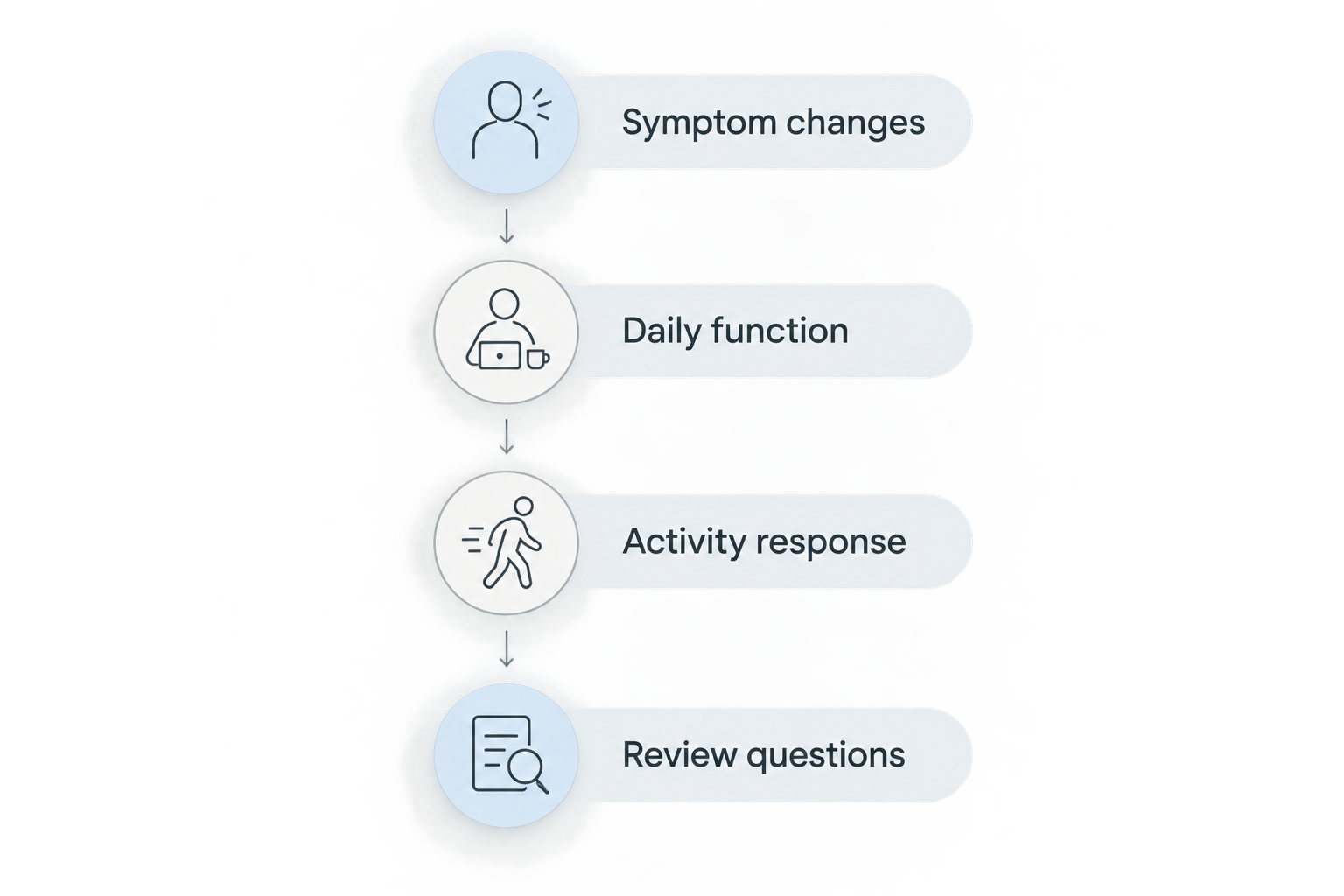
Take the record to your appointment. A clinician can interpret it alongside an examination; a diary alone cannot identify the cause of pain.
A difficult day does not establish that your condition has deteriorated. However, a sustained worsening pattern or new symptoms deserves reassessment rather than being dismissed as a normal fluctuation.
When should I seek medical assessment instead of waiting?
Seek emergency medical assessment for new bladder or bowel dysfunction, numbness around the genitals or anus, or severe or progressive leg weakness. These symptoms can indicate serious nerve involvement and should not wait for a routine chiropractic appointment.
Seek prompt medical advice for back pain associated with fever or feeling markedly unwell, significant trauma, unexplained weight loss or a history of cancer. Tell the clinician about osteoporosis, immune suppression and relevant medicines because these can affect assessment decisions.
A warning sign does not establish a diagnosis. It changes the need for clinical assessment, and several symptoms may need to be considered together.
Do not use the 6-week or 12-week categories to decide that medical assessment can wait. New symptoms matter more than the age of the episode.
Should I rest until my lower back pain disappears?
Less than 6 weeks of pain does not automatically require complete rest. For uncomplicated lower back pain, the Australian clinical care standard and NICE guidance support continuing normal activities as capabilities allow, rather than prolonged bed rest.
You can discuss temporary changes to demanding tasks with a qualified health professional. This is different from forcing painful stretches, repeatedly testing a difficult lift or assuming every uncomfortable movement is harmful.
If activity produces new weakness, altered sensation or other concerning changes, seek assessment. Advice about ordinary movement does not override warning signs.
Do I need a scan if pain lasts longer than expected?
More than 12 weeks of pain does not automatically mean you need an X-ray or MRI. The Australian clinical care standard and NICE guidance advise against routine imaging for nonspecific lower back pain when there is no clinical indication.
Imaging decisions depend on findings and whether the result is likely to change management. Suspected serious pathology requires a different pathway from uncomplicated lower back pain.
Ask what question a proposed scan would answer. Duration is part of the assessment, but it is not the only reason to investigate.
Where does chiropractic care fit?
Mychiro provides chiropractic care and spinal adjustments in Bondi Junction, Sydney. Whether chiropractic care may be appropriate for your lower back symptoms depends on assessment; the clinic’s service description does not establish a likely outcome or recovery time.
Before agreeing to an intervention, discuss its purpose, alternatives, risks and review criteria. You can also ask when GP assessment or another referral would be appropriate.
No appointment count can be calculated from pain duration alone. A plan should explain how progress will be assessed and what changes if the agreed goals are not being met.
FAQ
How long does lower back pain usually last?
Lower back pain often improves over a few weeks, but individual episodes vary and some persist or recur. Worsening symptoms, substantial limitations or warning signs need assessment rather than waiting for a typical recovery date.
Is lower back pain still acute after a month?
Lower back pain lasting less than 6 weeks is commonly classified as acute. The category describes duration and does not determine the cause, severity or need for assessment.
Does back pain lasting more than 12 weeks mean permanent damage?
More than 12 weeks of back pain does not, by itself, establish permanent damage. Persistent pain warrants an individual assessment and a discussion of function, contributing factors and management options.
Should I stay in bed until my lower back feels normal?
Prolonged bed rest is generally not recommended for uncomplicated lower back pain. Discuss manageable activity and temporary task adjustments with a qualified health professional, particularly if you are struggling with daily activities.
When does lower back pain need emergency assessment?
New bladder or bowel dysfunction, numbness around the genitals or anus, or severe or progressive leg weakness require emergency medical assessment. Do not wait for a routine appointment or a recovery timeframe to pass.
Can Mychiro tell me exactly how many appointments I need?
A reliable appointment count cannot be determined from pain duration alone. Any proposed chiropractic care should follow assessment and include discussion of alternatives, risks, goals and review criteria.
One last thing
Before your next consultation, choose a meaningful everyday activity to discuss—not just a pain score. Being able to describe what has changed gives your health professional a clearer account of your progress.
For this 2026 guide, the source framework is the Australian Commission’s Low Back Pain Clinical Care Standard, NICE’s Low back pain and sciatica in over 16s guideline, and WHO’s guideline on chronic primary low back pain in adults. Their guidance informs general education; none provides a personal recovery deadline.
Related guides
- Lower back pain when sitting: causes and practical steps
- Mychiro guide to preparing for your first chiropractor appointment
- How chiropractors coordinate with GPs on imaging referrals