


Your first chiropractic appointment in Sydney should start with a discussion of your concerns, relevant health history and goals, followed by an explanation of any proposed assessment. An adjustment is not an automatic requirement: ask about the reasons, risks, alternatives and consent before deciding whether to proceed. This guide explains what to prepare, what to ask and what you should understand before leaving.
- For the search ‘good chiropractor sydney first-time patients’, prioritise registration, clear explanations and informed consent.
- Mychiro is a Bondi Junction chiropractic clinic serving local people considering chiropractic care.
- Ask what an assessment involves before agreeing to an examination or adjustment.
- Request the reasons for any imaging, proposed appointments or referral before making a decision.
What should first-time chiropractic patients in Sydney expect?
Think of your first visit as a decision-making appointment, not a commitment to ongoing care. The sequence should leave you understanding what is being proposed and why.
- Explain your concerns. Describe what prompted the appointment, your relevant health history and what you want to discuss.
- Discuss the assessment. Ask what the chiropractor proposes to examine and how that information will inform the next decision.
- Consider the options. Request an explanation of the findings, uncertainties, proposed care, alternatives and relevant risks.
- Decide what happens next. You can agree, ask further questions, decline a procedure or take time to consider the information.
For a separate preparation checklist, read how to prepare for your first chiropractor appointment. Confirm the clinic’s actual appointment process before attending; this article does not describe a guaranteed sequence at every practice.
Why this matters
Choosing a clinic and consenting to a procedure are separate decisions. Booking an appointment does not replace a discussion about whether a particular examination or adjustment is appropriate for you.
If you are comparing Sydney clinics in 2026, concentrate on information you can verify rather than promises about results. Registration, understandable explanations and room to ask questions give you concrete criteria for that comparison.
Leave the first consultation understanding the next decision, not just the next appointment date. You do not need to master chiropractic terminology to ask for that clarity.
Before booking: check the practitioner and appointment details
Check the individual chiropractor’s current registration on the Ahpra public register. Search for the practitioner by name rather than relying only on a clinic’s advertising or a title used in a directory.
For your 2026 shortlist, make these 3 checks:
- Practitioner identity: Who will conduct the consultation, and what is their registered profession?
- Appointment scope: Does the booking cover discussion and assessment, and when would any proposed procedure be explained?
- Practical arrangements: What paperwork, accessibility arrangements or clothing requirements should you know about?
A clinic’s location helps you judge whether attending is practical. It does not establish whether a particular procedure is appropriate for your circumstances.
Mychiro provides chiropractic care and spinal adjustments in Bondi Junction, Sydney. That factual description identifies the service and location; individual suitability still requires assessment and discussion.
What should you bring to your first appointment?
Prepare a short account of your concern in your own words. Describe when you first noticed it, how it affects everyday activities and what you have already discussed with other health professionals.
Bring these 5 items where relevant:
- Your medication list: Include prescribed medicines, non-prescription medicines and supplements.
- Relevant correspondence: Bring existing referral letters or reports connected with the concern you want assessed.
- Existing imaging reports: Ask the clinic whether any reports you already hold would be relevant.
- Your questions: Write down anything you want explained before an examination or procedure.
- Administrative details: Ask which identification, payment or health-fund information the clinic needs.
You do not need to arrive with your own diagnosis. Describing your experience is more useful than trying to fit it into a technical label.
Tell the practitioner about relevant medical conditions, previous surgery and current care from other clinicians. Do not stop prescribed medication or alter another clinician’s advice in preparation for an appointment without discussing it with the relevant health professional.
During the consultation: explain what matters to you
Start with the activity or concern that brought you in. For example, you might want to discuss discomfort while sitting or uncertainty about a movement; these are reasons for a conversation, not proof that an adjustment is needed.
Tell the chiropractor what you are comfortable discussing and what concerns you about the appointment. If you do not want a particular procedure, say so before the examination begins.
Useful questions include:
- What information do you need before suggesting the next step?
- What would this examination tell you?
- What remains uncertain after today’s assessment?
- Would input from my GP or another health professional be appropriate?
A practical goal helps structure the conversation, but it is not a promised outcome. Ask how any proposed plan would be reviewed rather than accepting a prediction about exactly how you will respond.
Before an adjustment: understand the proposal
An adjustment is a procedure you can discuss, not a compulsory part of attending. Ask the chiropractor to describe the proposed technique, the body area involved and why it is being considered in your circumstances.
The explanation should cover the expected benefits, relevant risks, alternatives and the option of not proceeding. Ask for language you understand, particularly if terms such as manipulation, mobilisation or decompression are used.
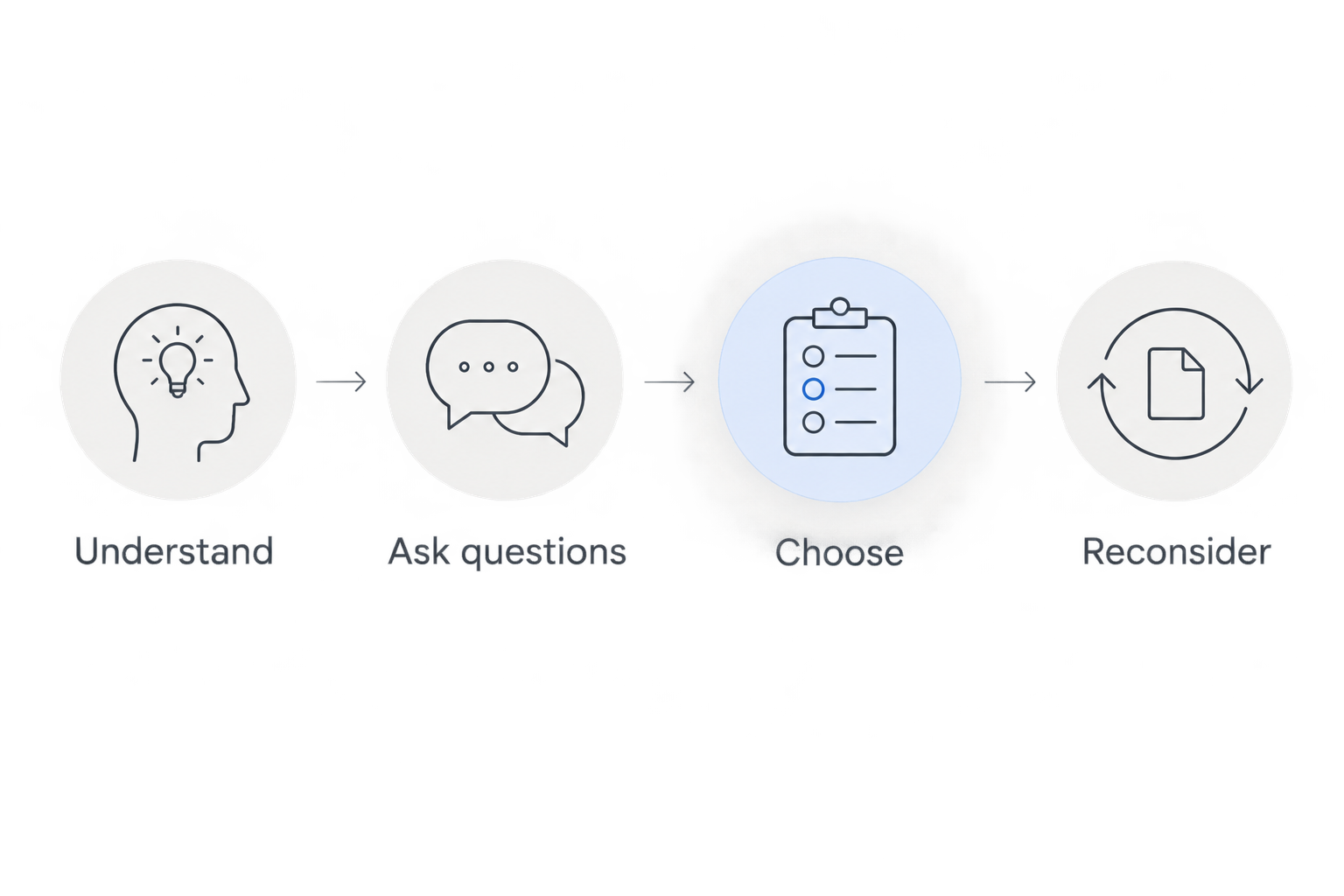
Use this sequence before making your decision:
- Understand: Ask what is proposed and why.
- Ask questions: Clarify risks, uncertainties and alternatives.
- Choose: Agree, decline or request more time.
- Reconsider: Speak up if your decision changes.
You can ask the practitioner to stop an examination or procedure. Tell them immediately if you are uncomfortable, do not understand what is happening or no longer wish to continue.
A signed form is not a substitute for your questions being answered. If you need an interpreter, support person or another communication arrangement, discuss that with the clinic before attending.
What decisions might follow the assessment?
The next step depends on the assessment and your preferences. Do not assume that every first appointment must end with an adjustment, imaging request or series of bookings.
| Possible next step | When to discuss it | Practical advantage | Limitation or question |
|---|---|---|---|
| Further discussion before deciding | You want more explanation or time | Keeps the decision open | Ask what remains unresolved |
| A proposed chiropractic procedure | The practitioner explains why it may be appropriate | Gives you a specific proposal to consider | Ask about evidence, risks and alternatives |
| Input from another health professional | Another assessment or opinion is proposed | Brings the relevant clinician into the decision | Clarify who will arrange communication |
| A review appointment | There is a stated reason to reassess | Creates a defined opportunity to review the plan | Ask what would change the recommendation |
These are discussion pathways, not recommendations for every patient. Request the reasoning that applies to you rather than choosing a pathway from a general article.
Why first appointments vary
There is no reason to expect identical consultations across all Sydney clinics in 2026. Your history, the question being assessed and your decisions affect what needs discussion.
These factors can shape the appointment:
- The concern you bring: Different questions require different explanations and assessment choices.
- Your existing records: Relevant reports can inform what needs clarification.
- Your current healthcare: Other clinicians’ involvement needs to be considered.
- Your consent and preferences: You can request explanations, decline procedures or take time.
- Communication and access needs: Tell the clinic about arrangements you require before attending.
Ask the clinic how long to allow for your booking rather than relying on a general estimate. Appointment length alone does not tell you whether the assessment or explanation meets your needs.
Do first-time patients need X-rays or decompression?
Do not assume you need either because it appears in a service list. Ask for an individual explanation of any proposed investigation or procedure before agreeing to it.
For imaging, ask what clinical question the practitioner wants answered and how the result would affect the next decision. Explain what imaging you have already had, and ask whether coordination with your GP is appropriate.
For procedures, understanding what spinal decompression involves is separate from establishing whether it is appropriate for you. A general description cannot determine suitability, and an article aimed at office workers does not replace an individual assessment.
Ask the practitioner to distinguish the name of a service from the reason for proposing it. If the explanation remains unclear, request more information before deciding; you do not need to agree simply because equipment is available.
How should you discuss an ongoing care plan?
Ask what each proposed appointment is intended to assess or address. A plan should give you enough information to understand why another visit is being suggested and when the recommendation will be reconsidered.
Before accepting a plan in 2026, ask:
- What is the purpose of the next appointment?
- What would you review at that visit?
- What would lead you to change or stop the plan?
- What alternatives should I consider?
- When would another health professional’s input be appropriate?
Request the financial and administrative terms separately from the clinical explanation. Ask about cancellation conditions, payment arrangements and anything you would be agreeing to before signing paperwork.
Do not interpret a proposed number of visits as a guaranteed result. Ask for a review process, not a promise about recovery. You can take written information away and consider your decision.
What should you know before leaving?
Use the end of the consultation to check your understanding. Explain the proposed next step back in your own words and ask the practitioner to clarify anything you have misunderstood.
Before leaving, make sure you know:
- What was assessed and what remains uncertain.
- Whether any procedure was performed and what it involved.
- What individual instructions, if any, you have been given.
- Who to contact with questions about the consultation.
- Whether a review or referral was proposed, and why.
If a procedure is proposed, ask beforehand what responses or symptoms require follow-up and where to seek help. For a medical emergency in Australia, call 000 rather than waiting for a chiropractic appointment.
For practical appointment questions, you can contact Mychiro. Confirm the arrangements you need without assuming that booking commits you to a procedure or ongoing plan.
FAQ
How do I choose a chiropractor in Sydney for my first visit?
Check the individual practitioner’s current Ahpra registration and ask how assessment, consent and proposed care are explained. Location and appointment arrangements also matter, but neither establishes whether a procedure is appropriate for you.
Will I have an adjustment at my first chiropractic appointment?
An adjustment is not an automatic requirement of a first appointment. Any proposed procedure needs an explanation and your consent; you can ask questions or decline.
What should I wear to a chiropractic consultation?
Ask the clinic what clothing is suitable for the proposed assessment. Also discuss privacy, changing arrangements and any access or communication needs before attending.
Should I bring previous scans or medical reports?
Ask whether existing scans, reports or referral letters are relevant to your appointment. Bring your medication list and explain any current care from other health professionals.
Can I say no to a neck adjustment?
Yes, you can decline a neck adjustment or any other proposed procedure. Ask what alternatives can be discussed and tell the practitioner if your consent changes.
How many chiropractic appointments will I need?
There is no appointment count that this general guide can prescribe for you. Ask why each visit is proposed, what will be reviewed and what would change the plan.
What if I want to speak to my GP before deciding?
You can speak to your GP before deciding about a proposed procedure or plan. Ask for a written explanation of the proposal and discuss whether communication between practitioners would be appropriate.
One last thing
For your first appointment in 2026, write down one closing question: What decision do I need to make today, and what can I take time to consider? It separates information gathering from consent and gives you a clear way to finish the conversation.
You can attend an assessment, ask questions and leave without agreeing to an ongoing plan. Understanding the proposal is a valid purpose for the visit.
Related guides
- What qualifications should a Sydney chiropractor have?
- What to expect from spinal manipulation
- How often should you see a chiropractor?