

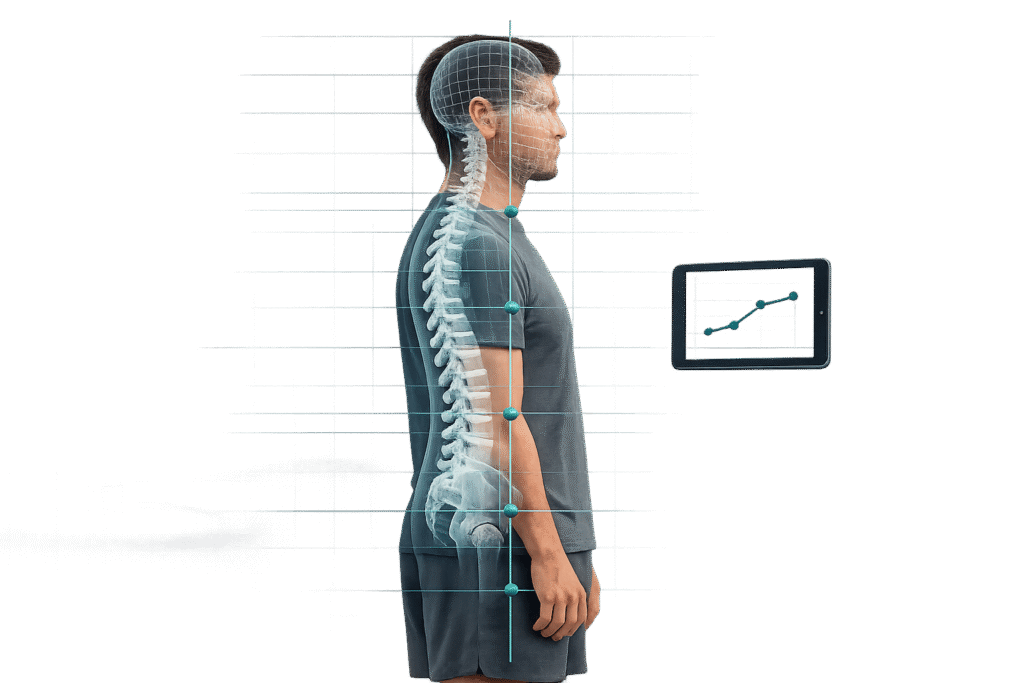
Digital posture assessments give chiropractors precise data on body alignment using tools like 3D scanners, posture analysis software, and digital X-rays. These methods replace manual techniques with accurate, measurable results, helping chiropractors identify alignment issues, plan treatments, and track progress over time. Key benefits include quick assessments, radiation-free monitoring, and patient-friendly visual reports. By integrating these tools with clinical expertise, chiropractors can offer tailored care to address posture-related discomfort and improve spinal health.
Physiolistic 3D Posture analysis 2023
sbb-itb-585d67d
What Are Digital Posture Assessments?
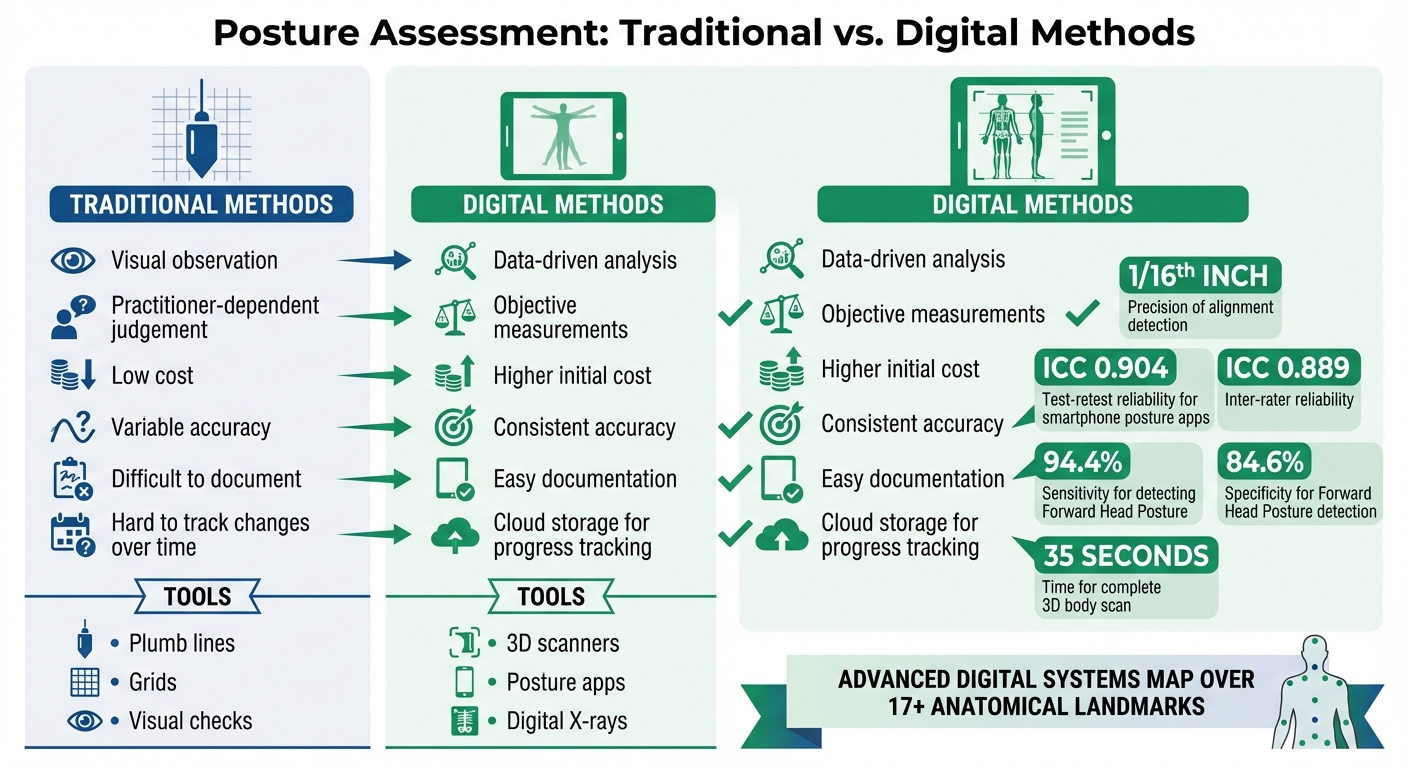
Traditional vs Digital Posture Assessment Methods Comparison
Digital posture assessments use cutting-edge imaging technology and software to analyse body alignment with precision. Instead of relying on just visual observation, these tools pinpoint anatomical landmarks like the tragus of the ear, the C7 vertebra, and the acromion (shoulder point). By calculating angles, displacements, and symmetry relative to a centre of gravity or a Vertical Access Line (VAL), they provide objective, measurable data.
The process typically involves capturing images or 3D scans from the front, back, and sides. Advanced systems can map over 17 anatomical landmarks, delivering detailed metrics such as Forward Head Posture (FHP) or the Craniovertebral Angle (CVA). Some systems even incorporate artificial intelligence and computer vision technologies, like PoseNet, to automatically identify these points – eliminating the need for physical markers. This approach offers a level of precision and consistency that traditional methods often lack.
Traditional vs Digital Posture Assessments
Traditional posture assessments depend on tools like plumb lines, grids, or simple visual checks to estimate alignment. While these methods are low-cost and easy to use, they come with limitations. They rely heavily on the practitioner’s judgement, which can vary, making it harder to document findings accurately or track changes over time.
Digital assessments, on the other hand, are data-driven and highly consistent. For example, a meta-analysis of smartphone posture apps showed impressive reliability, with an Intraclass Correlation Coefficient (ICC) of 0.904 for test–retest reliability and 0.889 for inter-rater reliability when measuring craniovertebral angles. Similarly, the PostureScreen Mobile app demonstrated 94.4% sensitivity and 84.6% specificity for identifying Forward Head Posture. Many digital systems also store data in the cloud, allowing practitioners to compare multiple assessments over time and identify trends. This level of precision and reliability makes digital methods a game-changer for posture evaluations.
Main Benefits of Digital Assessments
One of the standout benefits of digital posture assessments is their accuracy. These tools can detect subtle misalignments and muscle compensation patterns that might go unnoticed with traditional methods. For instance, modern 3D body scanners can complete a full assessment in just 35 seconds, providing instant results. This detailed data helps chiropractors develop personalised treatment plans and monitor progress effectively.
Another major advantage is how these tools engage patients. Digital systems generate visual reports and 3D avatars that simplify complex biomechanical data. Instead of imagining what a postural issue looks like, patients can see clear, colour-coded visuals or 3D models highlighting areas of stress. This makes it easier for them to understand their condition and stay motivated during treatment.
"It gives us a black and white starting point so we can repeat the test to measure progress and also learn what is working for the person, and what techniques we need to change." – Dr. Scott Gardner, Chiropractor, Gardner Family Chiropractic
Digital Tools Chiropractors Use for Posture Assessment
Chiropractors today rely on advanced digital tools to assess and monitor posture, enhancing their ability to provide tailored care. These tools generally fall into three categories: posture analysis software, 3D body scanners, and digital X-ray analysis systems. Each plays a specific role in creating a detailed understanding of spinal health and alignment.
Posture Analysis Software
PostureScreen Mobile is a popular choice in Australian chiropractic clinics. Using a tablet or smartphone, this software captures multi-angle images of a patient’s posture. It then overlays a Vertical Access Line (VAL), representing the body’s centre of gravity, to identify any deviations.
One standout feature is its Trend Analysis, which allows chiropractors to compare results over time. This helps track improvements or determine if adjustments to treatment plans are needed. The app is portable, cost-effective, and generates digital reports that make it easy to monitor progress.
"PostureScreen is like looking at your posture (or your kids) with ‘fresh eyes’. You begin to see what a Chiropractor sees when we perform orthopaedic assessments." – The Spinal Centre
This software serves as a starting point for more in-depth evaluations provided by other technologies.
3D Body Scanners and Imaging Systems
Tools like Fit3D offer a 360° digital scan of the body in just 35 seconds, creating a detailed avatar that highlights anatomical landmarks. By automating measurements, these scanners eliminate the inconsistencies that can occur with manual methods. They’re sensitive enough to detect alignment shifts as small as 1/16th of an inch, offering a level of precision that traditional methods often miss.
Many of these scanners also come with integrated balance scales, which measure weight distribution across four points. This data helps chiropractors identify how uneven loading may contribute to chronic pain or postural compensations. The automated nature of these systems saves time and ensures results can be easily shared with patients or other healthcare professionals.
"The biggest thing we hear from our Chiropractic clients that choose Fit3D is that they like the assessments are automated so they can ‘save time.’" – Fit3D
While 3D scanners focus on external alignment, digital X-rays delve deeper into the skeletal structure.
X-Ray Analysis for Spinal Alignment
When it comes to evaluating internal skeletal health, tools like PostureRay provide unparalleled accuracy. These systems use computer vision modules to digitise anatomical landmarks on X-rays, enabling chiropractors to measure spinal displacements and subluxations with precision. The software also generates "lines of mensuration", which can highlight issues that might be missed with manual analysis.
Although X-rays involve radiation exposure and require specialised equipment, they remain critical for diagnosing structural problems that external imaging can’t detect. PostureRay has undergone extensive clinical testing, making it a trusted option for detailed spinal evaluations.
"PostureRay® bridges the critical gap between traditional manual methods and modern digital radiography." – PostureCo
It’s worth noting that while these AI-assisted tools can expedite the process, chiropractors must manually verify all digitised markers to ensure accuracy. Technology aids the process, but professional judgement is irreplaceable.
How Chiropractors Use Digital Posture Assessments
The Assessment Process
Digital posture assessments are a quick and precise way for chiropractors to evaluate a patient’s alignment. During the process, the patient stands in a neutral position while tools like an iPad app, digital camera, or 3D body scanner capture front and side views in just 35 seconds. The software then analyses key anatomical landmarks, comparing them to the Vertical Access Line (VAL) – a representation of the body’s centre of gravity. This analysis highlights deviations and generates a detailed visual report showing issues like head carriage, shoulder alignment, pelvic tilt, and spinal curvature. These insights can uncover hidden factors contributing to pain or movement challenges.
"Posture can be considered the window to the spine, specific abnormal posture displacements are associated with specific spinal positions." – Wellspring Chiropractic
This initial data becomes the foundation for designing a treatment plan tailored to the patient’s unique alignment issues.
Developing Personalised Treatment Plans
The digital assessment data helps chiropractors pinpoint specific displacements, such as forward head posture or pelvic rotation. This allows them to recommend targeted corrective exercises and, when necessary, use surface EMG scans to analyse muscle activity compensating for these misalignments.
What makes this process particularly effective is the visual report. It simplifies complex biomechanical information, making it easier for patients to understand how their posture relates to their symptoms. When patients see the connection clearly, they’re often more motivated to stick to their prescribed exercise routines.
With a personalised plan in place, chiropractors can use ongoing digital assessments to evaluate how these interventions improve posture over time.
Monitoring Progress Over Time
Regular follow-up scans, often conducted every three months, provide side-by-side comparisons of current posture against the initial baseline. These comparisons help chiropractors refine treatment plans using objective data. Some clinics even incorporate wearable sensors to monitor daily habits, such as slouching, offering additional insights into how everyday activities might affect progress. This combination of regular monitoring and real-time feedback ensures that treatment remains effective and responsive to the patient’s needs.
The Future of Digital Tools in Chiropractic Care
Digital advancements are reshaping how chiropractors assess posture and monitor long-term health, offering new ways to integrate technology into patient care.
Artificial intelligence (AI) is stepping into the spotlight with posture analysis, helping practitioners identify potential issues earlier. AI-powered tools, like those using PoseNet, can pinpoint anatomical reference points without requiring physical markers on the patient’s body. These systems also analyse movement patterns and lifestyle factors, alerting chiropractors to risks before they escalate. This shift moves care from being reactive to preventive, with real-time imaging innovations paving the way for even more advanced monitoring.
Wearable technology is also making strides in delivering actionable insights. Take the Upright GO 2, for example. In August 2025, data from 57,000 users showed a 54% reduction in back pain after using the device, which vibrates to correct slouching. Looking ahead, wearables could sync with clinical software, enabling chiropractors to monitor patients between appointments. This real-time data could help fine-tune treatment plans based on how patients respond in their daily routines. Some devices are even incorporating gamification features like goals and badges to keep patients engaged and accountable.
Scanning technology is becoming increasingly precise. The INSiGHT neuroTECH suite introduced the neuroCORE in 2025, a surface EMG device that maps muscle tension and fatigue in real-time. Meanwhile, Australian clinics are adopting VALD Systems, which use force plates and 3D motion capture sensors for detailed movement analysis. These tools offer highly accurate measurements, even for subtle alignment changes. However, there are challenges – such as the cost and space required for this high-end equipment – that practitioners must navigate.
Despite these innovations, technology works best when paired with clinical expertise. As Dr. David Fletcher, CEO of CLA Inc., explains:
"Posture isn’t just about aesthetics – it’s a key indicator of nervous system health."
The balance lies in using technology to enhance, not replace, the therapeutic relationship. Combining digital precision with hands-on care can lead to better outcomes.
Future systems may take things even further by integrating spinal health data with metrics like sleep quality, heart rate variability, and stress levels. This broader view reinforces the role of digital tools in offering a comprehensive understanding of musculoskeletal health, helping chiropractors connect posture to lifestyle influences over time.
Conclusion
Digital posture assessments are transforming chiropractic care by moving from subjective guesses to precise, measurable analysis. Tools like 3D scanners, surface EMG, and smartphone photogrammetry provide accurate data to detect subtle misalignments and muscle compensation patterns that might otherwise go unnoticed.
These technologies also play a key role in patient education. Detailed visual reports make complex data easy to understand, helping patients see the "why" behind their treatment plans. This visual feedback can motivate patients to stick to prescribed exercises and adjustments. In fact, research pooling data from 29 studies with 1,910 participants found that smartphone posture apps deliver highly reliable results, with an Intraclass Correlation Coefficient (ICC) of 0.904[1].
Regular scans offer a clear picture of progress over time, allowing chiropractors to fine-tune treatment plans based on how the body responds. With full-body scans taking just 35 seconds, routine monitoring becomes practical, helping to catch postural issues before they develop into long-term problems, ultimately supporting better spinal health.
However, while these digital tools provide objective insights, they must be combined with clinical expertise. A chiropractor’s ability to interpret the data within the context of a patient’s symptoms, lifestyle, and goals remains essential. This blend of digital precision and professional judgement enables more focused, evidence-based approaches to posture management. Together, these advancements are paving the way for personalised, effective chiropractic care.
This information is general and not a substitute for professional medical advice. Chiropractic care focuses on musculoskeletal health, and results vary between individuals. Always consult a qualified healthcare professional before making decisions about your health.
FAQs
Do I need an X-ray for a digital posture assessment?
Digital posture assessments typically don’t involve X-rays. Instead, they rely on tools like photos, specialised software, or 3D scanners to visually analyse posture and detect misalignments. That said, if there’s a history of traumatic injury or concerns about potential underlying conditions, X-rays or digital radiology might be suggested to capture detailed internal images for a more thorough examination.
How accurate are posture apps and 3D scans?
Posture apps and 3D scans can be handy for assessing posture, but their accuracy isn’t always consistent. Smartphone photogrammetry and AI-based systems can provide useful insights, yet they typically fall short compared to professional-grade tools. Clinical methods like digital body scans or surface EMG scans are often considered more reliable for detailed posture evaluations.
How often should I repeat a posture scan?
The frequency of posture scans can vary based on your lifestyle, age, and any existing health conditions. For those who spend long hours at a desk or have posture-related concerns, scheduling a scan once a year is usually a good way to track and manage any changes or potential problems.