

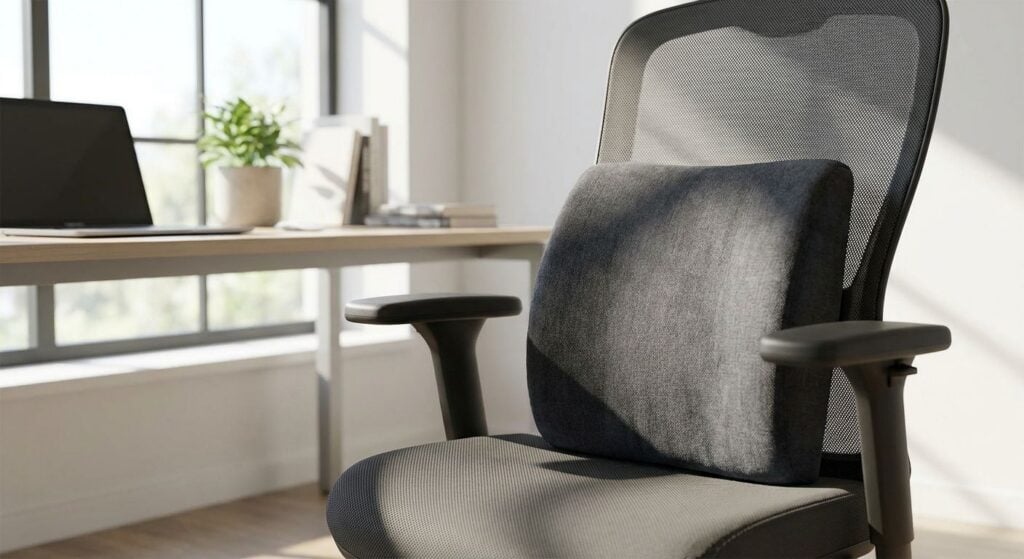
Office chairs rarely match your spine, and a $2,000 ergonomic chair can still leave a gap at your lower back. This guide ranks the main types of lumbar support cushions for office chairs in 2026, so you can pick one that actually matches your chair and your seated hours.
- Memory foam contour cushions remain the most versatile pick for standard office chairs in 2026 — Buy.
- Inflatable lumbar cushions suit hybrid workers who move between desks or offices — Consider.
- Firm foam rolls work best for narrow-backed task chairs but feel too rigid for mesh chairs — Hold.
- Best lumbar support cushion choice depends on chair depth, strap adjustability and how many hours you sit daily.
Why this matters
Most office chairs are built to a generic frame, not your spine's natural curve. Sitting for long stretches without support at the lower back is a common complaint among people who work at a desk, and it comes up often in conversations with a chiropractor at clinics like MyChiro in Bondi Junction.
A lumbar cushion doesn't replace a proper posture assessment, but it can make a seated workday more comfortable when it's matched to your chair depth and sitting habits. Shift workers and desk-bound staff who log long, irregular hours — covered in more detail in this piece on shift workers with back pain — are exactly the audience this cushion category is built for.
How this list is ranked
Each cushion type below is assessed on four practical criteria: how well it holds its shape across a workday, whether it adjusts to different chair depths, how portable it is between desks, and how it performs in Sydney's humid summer months. None of these cushions are assessed for clinical outcomes — this is a product comparison, not a treatment recommendation, and persistent back or neck discomfort is worth raising with a health professional rather than solving with a cushion alone.
The ranking draws on standard ergonomic guidance around seated posture and typical office chair dimensions, cross-referenced against material and design categories widely sold in Australia in 2026.
The ranked list
1. Memory foam contour cushion — the all-rounder
Memory foam cushions hold a curved shape roughly 4 to 6 centimetres deep at the lumbar point, matching the natural inward curve of most adult chairs. They compress under body heat and slowly spring back, which is why they're the most common style sold for office use in 2026.
They suit anyone in a fixed desk chair for 6 to 8 hours a day and strap onto most standard office chair backs. The trade-off is heat retention — foam can feel warm in un-air-conditioned rooms during a Sydney summer. Verdict: Buy for a standard mesh or fabric office chair used daily.
2. Adjustable mesh lumbar support with strap — the hybrid-desk pick
Mesh lumbar supports use a breathable fabric stretched over a semi-rigid frame, with straps that typically adjust to fit chair backs between roughly 35 and 55 centimetres wide. The mesh surface stays cooler than solid foam across a full workday.
This style works well for hot-desking staff who move between different chairs during the week, since the strap system transfers easily. It's a weaker match for chairs with unusually shallow or deep backrests. Verdict: Buy for shared offices or hybrid work setups.
3. Inflatable lumbar cushion — the pack-and-go option
Inflatable cushions use a small hand pump or valve to adjust firmness on the spot, and they fold flat to a fraction of their inflated size for a laptop bag or drawer. Firmness is fully adjustable, which suits people who share a chair with colleagues or travel between office locations.
The downside is durability — valve seals are the most common failure point, and firmness needs regular top-ups through the week. Verdict: Consider if portability matters more than long-term durability.
4. Orthopedic wedge cushion — the seat-first pick
Wedge cushions sit on the chair seat rather than the backrest, tilting the pelvis slightly forward to encourage an upright seated position. They're usually 6 to 8 centimetres thick at the rear edge, tapering toward the front.
This style pairs well with a separate backrest cushion but doesn't address lower-back contact on its own — it changes seat angle, not lumbar contact. People managing broader spinal concerns, including those researching degenerative disc changes, often ask whether a wedge alone is enough; on its own, it's a partial fix at best. Verdict: Consider as an add-on, not a standalone lumbar solution.
5. Gel-infused hybrid cushion — the warm-climate pick
Gel-infused cushions layer a thin gel pad over foam to draw heat away from the body, which matters through Sydney's warmer months when standard foam can feel stifling by mid-afternoon. The gel layer adds weight — these cushions typically run heavier than plain foam equivalents.
They suit anyone in a non-air-conditioned home office or a chair near a window. The extra weight makes them a poor fit for people who move cushions between desks daily. Verdict: Buy for a fixed home-office chair in a warm room.
6. Firm foam roll (cylindrical) — the minimalist's pick
A firm foam roll, sometimes called a McKenzie-style roll, is a simple cylinder placed at the small of the back. It's the cheapest and most compact option on this list, with no straps, valves or gel layers to fail.
It works on narrow task chairs where a full contour cushion won't fit but feels too rigid and too localised for wider mesh office chairs used all day. Verdict: Hold unless your chair is genuinely too narrow for a full cushion.
What to avoid
- Ultra-thin decorative cushions sold as "back pillows" with no structured foam core — they compress flat within weeks and stop providing any real contact at the lumbar curve.
- One-size, non-adjustable straps on shared or multi-chair offices — if the strap doesn't loosen past roughly 45cm, it won't fit a wider executive chair.
- Cushions bought without checking your chair's backrest depth first — a 6cm-deep cushion on a chair with only 8cm of backrest clearance will push you forward off the seat, undoing any benefit.
Not sure a cushion is enough?
Discuss ongoing back or posture concerns with a Bondi Junction chiropractor.
Comparison table
| Cushion type | Material | Adjustability | Portability | Best for | Verdict |
|---|---|---|---|---|---|
| Memory foam contour | Viscoelastic foam | Strap-fit, fixed shape | Low | Daily fixed-desk use | Buy |
| Mesh with strap | Breathable mesh + frame | High, strap-adjustable | Medium | Hot-desking, hybrid work | Buy |
| Inflatable | PVC/TPU bladder | Manual firmness control | High | Travel, shared chairs | Consider |
| Orthopedic wedge | Dense foam wedge | Fixed angle | Medium | Pairing with a backrest cushion | Consider |
| Gel-infused hybrid | Foam + gel layer | Strap-fit, fixed shape | Low | Warm rooms, home offices | Buy |
| Firm foam roll | Solid foam cylinder | None | High | Narrow task chairs | Hold |
Where to buy
- Measure your chair's backrest depth before ordering — most listings state cushion thickness, so match it against the gap behind your lower back rather than guessing.
- Check the return window on any cushion under $60 — cheaper foam cores vary widely in density, and a cushion that feels firm in a showroom can soften within a month of daily use.
- Prioritise a washable or wipeable cover if the cushion will sit in a shared office chair used by more than one person across the week.
Seniors managing ongoing joint stiffness sometimes need a firmer, more supportive cushion profile than younger desk workers — that's covered in more depth in this guide on joint stiffness in older adults.
FAQ
What is the best lumbar support cushion for office chairs in 2026?
There isn’t one single best option — memory foam contour cushions suit most standard fixed-desk chairs, while mesh strap cushions suit hot-desking setups better. The right choice depends on your chair’s backrest depth and how many hours you sit daily.
Do lumbar cushions help with back pain?
A lumbar cushion may support a more upright seated posture across a workday, but it isn’t a substitute for a proper assessment. Ongoing or worsening back pain is worth discussing with a chiropractor or other qualified health professional.
Is memory foam or inflatable lumbar support better?
Memory foam holds a consistent shape and suits a fixed desk chair used daily, while inflatable cushions pack flat and suit people who move between chairs or travel. Neither is universally better — it comes down to how often you relocate the cushion.
How thick should a lumbar cushion be?
Most lumbar cushions sold in 2026 sit between 4 and 6 centimetres deep at the thickest point. A cushion much thicker than your chair’s backrest clearance can push you forward off the seat.
Can a lumbar cushion replace chiropractic care?
No. A lumbar cushion is a seating aid, not a form of clinical care, and it doesn’t address the underlying cause of ongoing discomfort. Persistent symptoms are best raised with a chiropractor for a proper assessment.
How do I fit a lumbar cushion to a mesh office chair?
Check the strap length against your chair’s backrest width, which typically runs between 35 and 55 centimetres on standard office chairs. A mesh cushion with an adjustable strap fits a wider range of mesh chair frames than a fixed-shape foam cushion.
Do gel cushions work better in warm climates?
Gel-infused cushions draw heat away from the body better than plain foam, which matters in a non-air-conditioned room during Sydney’s warmer months. The trade-off is added weight compared to standard foam cushions.
How long does a lumbar cushion last?
Foam cores in cheaper cushions can soften within a month of daily use, while denser foam and mesh-frame designs typically hold their shape for longer. Checking the return window before buying protects against early softening.
One last thing
A cushion changes contact, not habits — ergonomic guidance consistently points to short movement breaks through the day as the other half of the equation, alongside whatever cushion sits behind you. Standing up for even a few minutes every hour resets the load on your spine in a way no cushion, however well-matched to your chair, can do alone.
Related guides