

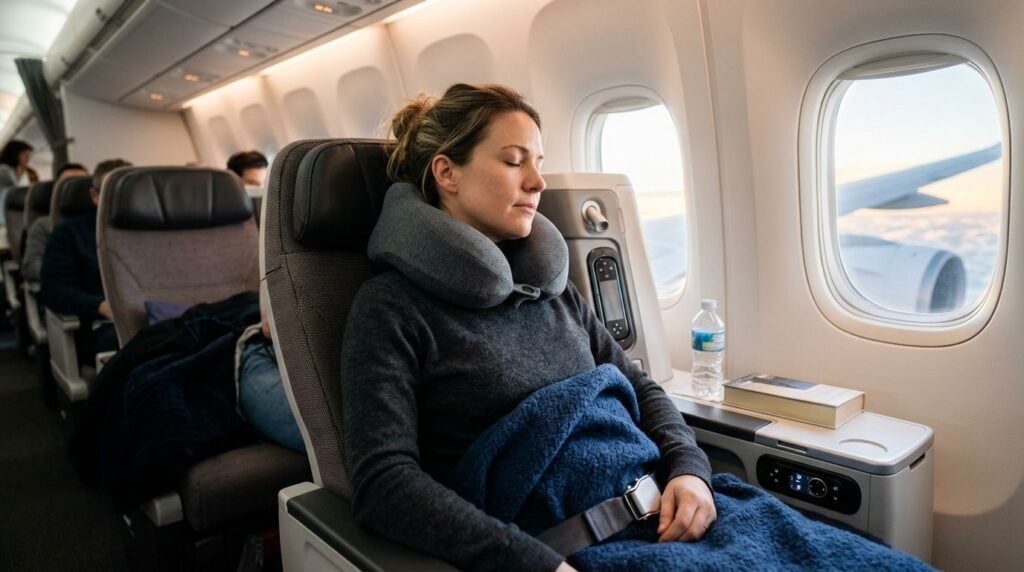
Twelve hours in economy with your head lolling every time you doze off is a fast way to turn a long-haul flight into three days of a stiff neck. The right travel pillow keeps your head roughly level with your spine instead of dropping forward or sideways, and the shape that works for you depends on your seat, your sleep position and whether you already carry some neck stiffness.
- The best neck pillow for flights overall in 2026 is a contoured memory foam U-shaped pillow for upright dozing.
- Inflatable wrap-style pillows win on packing space for carry-on-only trips.
- Chin-strap J-shaped pillows suit flyers whose head drops forward or who breathe through the mouth when asleep.
- Wearable hood-style pillows give window-seat flyers lateral support the standard U-shape can’t.
- Adjustable-firmness inflatable pillows suit travellers already managing neck stiffness before boarding.
Why this matters
A neck pillow isn't a medical device and it won't correct an existing spinal issue on its own, but the shape you choose changes how much your neck muscles work to hold your head up during a flight. Most long-haul discomfort comes from hours of unsupported forward or sideways head tilt, not from the flight itself.
MyChiro sees this pattern often in patients who fly for work, including the routine covered in chiropractic care for flight attendants and frequent flyers — repeated exposure to the same poor head position, flight after flight, adds up. If you already deal with neck pain when you sleep on your side at home, the same alignment principles from the guide to pillows for side sleepers with neck pain carry over to a plane seat.
This guide ranks the five main travel pillow shapes against criteria a chiropractor would actually look at: whether the shape keeps the ear roughly over the shoulder, how much it restricts natural movement, and whether it suits someone who already has some neck sensitivity.
What makes the best neck pillow for flights
- Neutral head position — supports the skull without pushing the chin forward or the head sideways
- Portability — packs down small enough for a carry-on without eating your luggage allowance
- Adjustability — firmness or fit can be tuned rather than one-size-fits-all
- Breathability — material doesn't trap heat against the neck over a 10+ hour sector
- Seat compatibility — works whether you're in an aisle, middle or window seat
- Suitability for sensitive necks — doesn't force a position that aggravates existing stiffness
Best neck pillows for flights at a glance
| Pillow type | Best for | Standout feature | Key limitation |
|---|---|---|---|
| Memory foam U-shaped pillow | Long-haul comfort overall | Holds shape all flight | Bulkier to pack |
| Inflatable wrap-style pillow | Minimal packing space | Deflates flat for carry-on | Firmness can feel uneven |
| Chin-strap J-shaped pillow | Preventing head-drop | Stops chin sagging forward | Strap feels restrictive to some |
| Wearable hood-style pillow | Window-seat sleepers | Anchors to headrest for lateral support | Needs a firm headrest to work |
| Adjustable-firmness inflatable pillow | Existing neck stiffness | Firmness tunes by inflation | Needs manual adjustment mid-flight |
1. Memory foam U-shaped pillow: best neck pillow for flights overall
The classic U-shape wraps around the back and sides of the neck, and memory foam versions hold that shape for the full flight instead of collapsing after an hour. It's the shape most commonly recommended for anyone sitting upright for long stretches, because it supports the head from both sides at once rather than just one.
Memory foam U-shaped pillow pros:
- Keeps the head roughly centred whether you tilt slightly left or right
- Retains loft for the whole flight, unlike foam-bead alternatives that flatten
- Doubles as neck support for car trips or long train rides
Memory foam U-shaped pillow cons:
- Takes up more carry-on space than inflatable options
- Can trap heat against the neck on warmer cabin settings
- Less useful if you sleep leaning fully into the window
Best for: flyers who sit mostly upright and want consistent support without adjusting anything mid-flight. Verdict: Buy.
2. Inflatable wrap-style pillow: best for minimal packing space
This style deflates to roughly the size of a small pouch, which matters if you're travelling carry-on only or stacking multiple flights in one trip. It wraps the neck similarly to a foam U-pillow but relies on air pressure rather than foam density for support.
Inflatable wrap-style pillow pros:
- Packs flat when not in use, ideal for backpackers and frequent short-haul hops
- Lightweight compared with foam alternatives
- Works well layered under a hood or scarf for extra warmth
Inflatable wrap-style pillow cons:
- Firmness can feel uneven if not inflated correctly
- Valve failure over repeated trips is a known weak point for this style
- Less cushioning than foam if you lean hard against it
Best for: travellers who need a pillow that disappears into a day bag between flights, including anyone also managing heavy luggage on long trips. Verdict: Buy.
3. Chin-strap J-shaped pillow: best for preventing head-drop
The J-shape supports one side of the neck and includes a strap or extension that catches the chin, stopping it from dropping forward when you fall asleep with your mouth open. It suits people whose main problem isn't sideways lolling but a forward head-drop that wakes them up mid-nap.
Chin-strap J-shaped pillow pros:
- Directly addresses forward chin-drop, which the standard U-shape doesn't fully solve
- Frees up the opposite shoulder since support is one-sided
- Compact compared with full U-shaped foam versions
Chin-strap J-shaped pillow cons:
- Strap can feel restrictive around the jaw for some flyers
- Offers less support if you tend to lean fully sideways
Best for: anyone who wakes mid-flight because their head has dropped forward rather than sideways. Verdict: Buy.
4. Wearable hood-style pillow: best for window-seat sleepers
This design attaches to the headrest wings and suspends part of the pillow so the head has something to lean into laterally, which standard U-shapes don't provide as well against a window. It's built specifically around the seated recline angle rather than a generic wrap shape.
Wearable hood-style pillow pros:
- Gives real lateral support for flyers who lean into the window
- Reduces the sideways head-bob that a standalone U-pillow can't stop
- Some versions include a hood that blocks light for daytime sectors
Wearable hood-style pillow cons:
- Bulkier to pack than inflatable or standard foam options
- Needs a firm, adjustable headrest to anchor properly, which isn't every aircraft seat
- Awkward fit in aisle or middle seats
Best for: flyers who always book the window and sleep leaning into it. Verdict: Buy.
5. Adjustable-firmness inflatable pillow: best for existing neck stiffness
This version lets you tune firmness by how much air you add, and some models include a secondary lumbar attachment. For anyone already managing tightness through the neck and upper back, being able to soften or firm up support mid-flight is more useful than a fixed foam shape.
Adjustable-firmness inflatable pillow pros:
- Firmness is tunable rather than fixed, useful if stiffness changes hour to hour
- Doubles as lumbar support for the return leg of the flight
- Packs flatter than foam when deflated
Adjustable-firmness inflatable pillow cons:
- Requires manual adjustment rather than working straight out of the bag
- Valve mechanisms can wear out over repeated long-haul use
Best for: travellers who already notice neck or upper-back stiffness before they even board. If that stiffness is persistent rather than travel-related, it's worth discussing with a chiropractor before your next long-haul sector rather than relying on a pillow alone. Verdict: Buy, with a check-in on persistent stiffness.
“If a travel pillow keeps your ear roughly over your shoulder while you doze, it’s doing its job; if your chin ends up on your chest, the shape isn’t right for how you sleep.”
How we ranked these travel pillows
Each shape was assessed against the same six criteria set out earlier: neutral head position, portability, adjustability, breathability, seat compatibility, and suitability for someone with existing neck sensitivity. No single shape wins on every criterion, which is why the ranking splits by use case rather than naming one universal winner.
Which neck pillow should you choose in 2026?
For most flyers booking a long-haul economy seat in 2026, the memory foam U-shaped pillow remains the default pick because it supports the head from both sides without needing adjustment. Pack light and you're carry-on only, the inflatable wrap-style pillow is the better trade-off. If you already carry neck stiffness onto the plane, prioritise a shape that's adjustable over one that just looks supportive in a product photo, and treat persistent stiffness after multiple flights as a signal to get it assessed rather than something to sleep through.
Neck stiffness after flying?
Discuss ongoing neck or shoulder tightness with the team at MyChiro in Bondi Junction.
FAQ
What’s the best neck pillow for flights in 2026?
For most long-haul flyers in 2026, a contoured memory foam U-shaped pillow gives the most consistent support because it holds its shape for the whole sector. Travellers packing carry-on only often prefer an inflatable wrap-style version instead.
Are inflatable travel pillows as supportive as memory foam ones?
Inflatable pillows can match memory foam for head position if inflated correctly, but the firmness feels less even across the whole neck. They win on packability, which matters more on multi-flight itineraries.
Can a neck pillow help prevent neck pain after a long flight?
A pillow that keeps your head aligned over your shoulders reduces the muscle strain of hours spent unsupported, which can lessen post-flight stiffness. If neck pain persists well after landing, it’s worth discussing with a chiropractor or GP rather than relying on a pillow alone.
How should a travel neck pillow fit?
It should keep your ear roughly level with your shoulder rather than letting your chin drop to your chest or your head fall sideways. If you wake up with your neck bent sharply in one direction, the shape or firmness isn’t right for how you sleep.
Is it better to use a firmer or softer neck pillow if I already have neck stiffness?
An adjustable-firmness inflatable pillow lets you tune support rather than committing to one fixed density, which suits people managing existing stiffness. Persistent stiffness that shows up on every flight is worth having assessed rather than managed with a pillow alone.
What’s the difference between a J-shaped and U-shaped travel pillow?
A J-shaped pillow supports one side of the neck and typically includes a chin strap to stop the head dropping forward. A U-shaped pillow supports both sides evenly, which suits flyers who tilt left or right rather than forward.
Do wearable hood-style neck pillows work in every seat?
They work best in window seats where they can anchor to the headrest wing for lateral support. Aisle and middle seats don’t give the same anchor point, so a standard U-shaped or inflatable pillow usually performs better there.
How long can I safely use a travel neck pillow on one flight?
There’s no fixed limit, but shifting position every few hours reduces the chance of waking up stiff regardless of pillow shape. If you land with neck pain that doesn’t ease within a day or two, that’s worth mentioning to a health professional rather than repeating the same pillow setup on the next trip.
One last thing
The biggest variable most flyers ignore isn't the pillow shape, it's seat recline angle: a pillow inflated too firm still pushes your chin forward if your seat is fully upright, no matter how good the shape is on paper. Recline first, then fit the pillow to the angle you're actually sitting at.
Related guides


