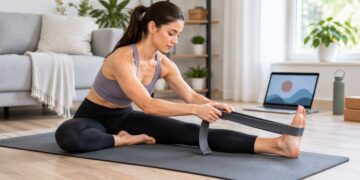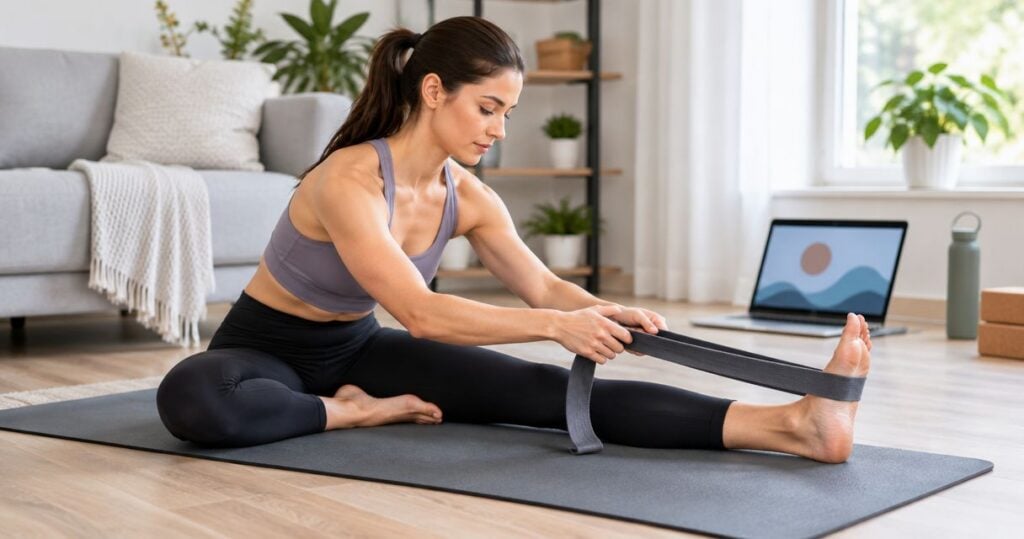
For a straightforward hamstring-stretching setup, consider a non-elastic strap with sewn hand loops; choose a buckle strap if you want adjustable loop size, or a plain woven strap if you prefer no fittings. This 2026 guide compares equipment designs and handling—not clinical outcomes or promises about back flexibility.
- Multi-loop stretching straps suit users who prefer separate handholds rather than a buckle.
- Buckle straps offer adjustable loops but require you to check the fastening before use.
- Plain woven straps have no fittings, but you must maintain your grip.
- Mychiro distinguishes stretching equipment choices from individual advice about symptoms or exercise suitability.
Why this matters
A stretching strap gives you something to hold when reaching your foot is awkward. Its construction matters: fixed handholds, adjustable fastenings and elastic resistance are different features, not interchangeable descriptions.
Choose the design for its handling, not a promise to relieve pain or change your spine. A strap's appearance does not establish whether a particular exercise is appropriate for you. Mychiro is a chiropractic clinic and wellness centre in Bondi Junction; equipment selection is separate from an individual clinical assessment.
This guide compares strap types rather than named products. It does not rank manufacturers, report product testing or recommend a stretching programme for an injury.
What makes a stretching strap practical?
Use these criteria when comparing stretching straps in 2026. Look for descriptions and photographs that show how the equipment works, rather than relying on a product title.
- Handhold design: Decide whether you want sewn loops, a continuous length of fabric or a buckle-adjusted loop.
- Material behaviour: Check whether the strap is non-elastic webbing or an elastic exercise band. These behave differently under tension.
- Usable reach: Check the stated length and where the handholds sit. Overall length alone does not describe where you can grip.
- Fastening instructions: If the design has a buckle, the manufacturer should explain how to thread and release it.
- Condition and care: Look for inspection, cleaning and storage instructions. Stitching and fittings need attention as well as the fabric.
No single design answers every preference. Someone who dislikes threading buckles has a different equipment requirement from someone who wants a continuously adjustable loop.
Stretching strap types at a glance
The order below starts with fixed handholds, then adjustable loops, then simpler equipment. It is a handling comparison—not a ranking of health benefits.
| Strap type | Suited to | Standout design feature | Key limitation |
|---|---|---|---|
| Non-elastic multi-loop strap | Users wanting separate handholds | Sewn loops along the strap | Handhold positions are fixed |
| Non-elastic buckle strap | Users wanting an adjustable loop | Buckle changes loop size | Requires correct threading |
| Plain woven strap | Users preferring no fittings | Continuous gripping surface | No dedicated handholds |
| Elastic exercise band | Users whose exercise instructions specify resistance | Material stretches under tension | Not equivalent to a non-elastic strap |
Before ordering, identify the construction in the actual listing. Words such as yoga, mobility and stretching describe intended uses; they do not tell you whether the material stretches or how a fastening works.
1. Non-elastic multi-loop strap: for separate handholds
A non-elastic multi-loop strap has sewn openings along its length. You select a handhold rather than wrapping loose fabric around your hands or threading a buckle.
The defining feature is the sequence of fixed loops. Different products have different spacing, so inspect the layout rather than assuming every multi-loop strap offers the same reach.
Multi-loop strap advantages:
- Separate openings identify available hand positions.
- No buckle needs threading when you change handholds.
- The non-elastic construction distinguishes it from a resistance band.
Multi-loop strap limitations:
- You cannot reposition a sewn loop between its fixed locations.
- Loop size and spacing are product-specific.
- Each stitched connection needs inspection for damage.
Suited to: Users who prefer selecting an existing handhold over adjusting a fastening.
For your 2026 equipment shortlist, check photographs of the entire strap, including its ends. Close-up fabric images alone do not show whether the loop arrangement matches your intended setup.
Verdict: Consider a multi-loop strap when fixed handholds are your main requirement.
2. Non-elastic buckle strap: for adjustable loop size
A buckle strap uses a fitting to form and adjust a loop. The fastening mechanism varies, so follow the instructions supplied with the particular design.
Unlike a sewn-loop strap, the buckle determines the loop size. That distinction matters if you prefer adjusting fabric through a fitting rather than choosing among separate openings.
Buckle strap advantages:
- The fastening allows adjustment of loop size.
- A continuous strap provides fabric beyond the buckle.
- You can choose a design around your preferred fastening style.
Buckle strap limitations:
- You must understand the threading method.
- The buckle adds a component to inspect.
- A fastening does not replace attention to your grip and position.
Suited to: Users who want an adjustable loop and are comfortable checking the fastening.
Read the manufacturer's instructions before relying on a product photograph. A listing that shows a buckle without explaining its use leaves an important handling question unanswered.
Verdict: Consider a buckle strap if adjustable loop size matters more than having fixed handholds.
3. Plain woven strap: for a fitting-free design
A plain woven strap is a continuous length of non-elastic fabric without sewn hand loops or a buckle. You hold the fabric itself.
Its simplicity is also its trade-off: there is no dedicated opening to select and no fitting to maintain a loop. Check that the manufacturer identifies the item as exercise equipment and provides instructions for its intended use.
Plain woven strap advantages:
- No buckle requires threading.
- No fixed loop spacing dictates hand placement.
- The continuous construction is straightforward to inspect.
Plain woven strap limitations:
- You need to maintain your hold on the fabric.
- There are no dedicated handholds.
- Fabric feel and grip cannot be established from colour or appearance alone.
Suited to: Users who deliberately prefer holding continuous webbing rather than using loops or hardware.
Do not assume an ordinary belt, luggage strap or household cord is equivalent. Their intended purposes and fastening arrangements differ from exercise equipment.
Verdict: Consider a plain woven strap only if its lack of handholds matches your preference.
4. Elastic exercise band: for resistance-based instructions
An elastic exercise band lengthens under tension. That makes it a different equipment category from a non-elastic stretching strap, even when a listing uses similar exercise terminology.
Choose equipment that matches the instructions you are following. If an exercise specifies non-elastic support, an elastic band changes the setup rather than simply substituting another handle.
Elastic exercise band advantages:
- Its defining feature is elastic resistance.
- It suits instructions that specifically call for a resistance band.
- Its material behaviour clearly differs from woven webbing when accurately described.
Elastic exercise band limitations:
- Its length changes as tension changes.
- Resistance descriptions need to be interpreted using the manufacturer's information.
- It is not a like-for-like replacement for a non-elastic strap.
Suited to: Users following an exercise plan that explicitly specifies elastic resistance.
An elastic band is included here to clarify the distinction, not to recommend adding resistance to a hamstring stretch. More tension is not a purchasing goal in itself.
Verdict: Skip an elastic band when the instructions call for a non-elastic stretching strap.
How the comparison is organised
This 2026 comparison prioritises handhold design, adjustability, material behaviour and inspection requirements. Multi-loop straps appear first because they provide distinct handholds without a buckle; buckle straps follow for readers who prefer adjustable loops.
Plain woven straps offer fewer fittings but no dedicated handholds. Elastic bands appear separately because their changing length makes them a different equipment choice. None of these design observations establishes a clinical advantage or an expected flexibility result.
Check the listing before choosing
Start with Construction, then Handholds, then Instructions, then Condition. This sequence keeps your attention on what the equipment is and how the manufacturer intends it to be used.
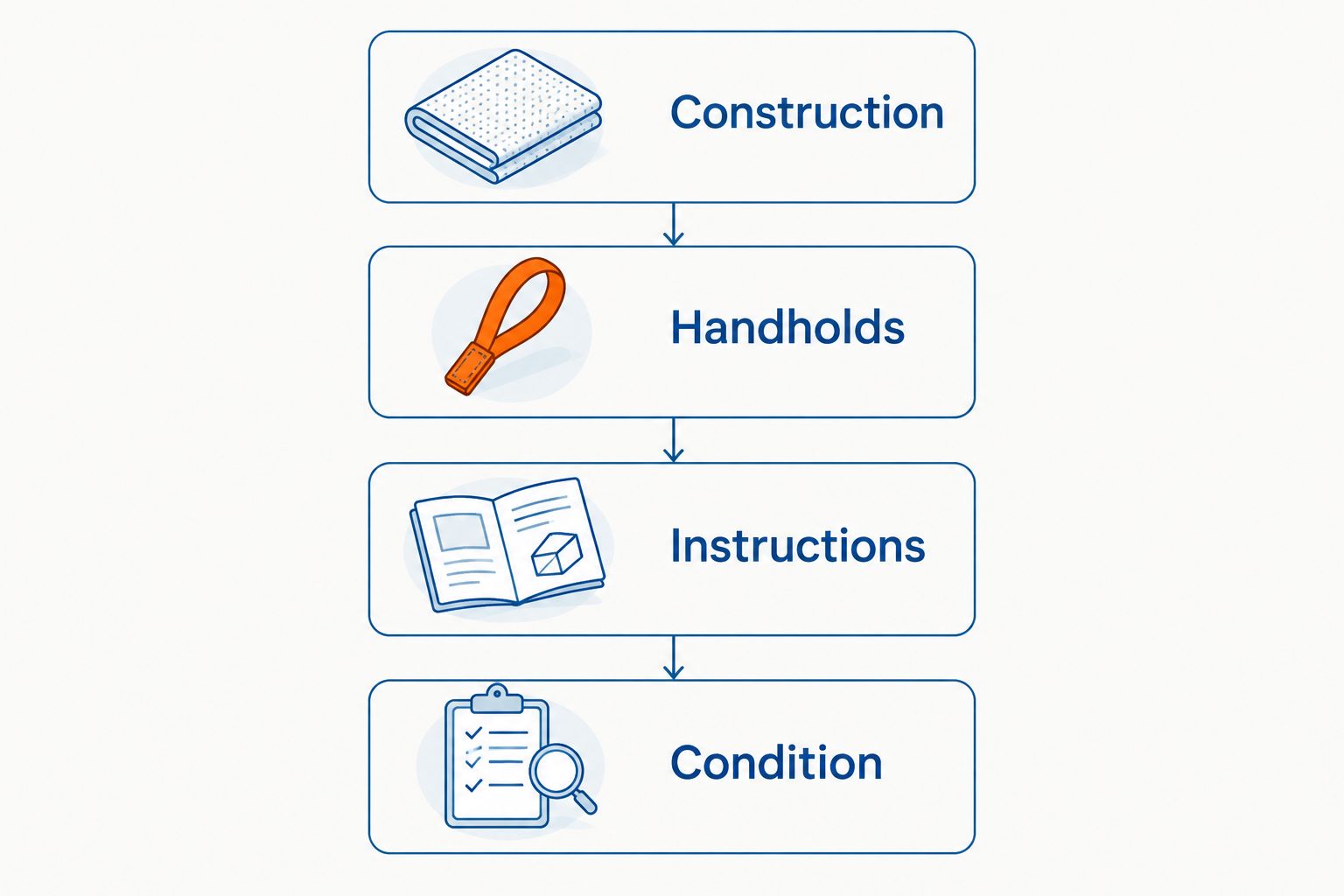
A useful listing should let you answer practical questions without interpreting promotional language. Check the following before adding a strap to your equipment:
- Is the material explicitly described as elastic or non-elastic?
- Does the photograph show the complete handhold arrangement?
- Are the dimensions stated, rather than inferred from a model's pose?
- Are fastening and care instructions available?
- Does the manufacturer explain when damaged equipment should be withdrawn from use?
Avoid treating medical-sounding product names as evidence. Terms such as rehabilitation or spinal support do not establish that a strap is appropriate for your circumstances.
Separate flexibility shopping from an injury decision
A shopping comparison cannot determine why the back of your thigh feels uncomfortable. If you have symptoms, ask a qualified health professional whether stretching is appropriate before choosing equipment around a self-diagnosis.
The decision about running with a mild hamstring strain is separate from selecting a strap: a product's loops, buckle or fabric cannot establish whether running or stretching is appropriate after an injury. Equipment advice should not become permission to exercise through symptoms.
For your 2026 shortlist, separate two questions: which design do you prefer handling, and is the intended exercise appropriate for you? Only the first question can be answered by comparing product construction.
Mychiro's stretching strap guide concerns equipment features, not a recommendation for chiropractic care or an individual exercise prescription. New, persistent or worsening symptoms warrant discussion with a qualified health professional rather than progressively stronger pulling.
Prepare questions, not a stretching target
If a health professional has suggested using a strap, ask for instructions that identify the equipment and the exercise. A product demonstration is not the same as advice tailored to your circumstances.
Useful questions include:
- Should the equipment be elastic or non-elastic?
- Where should I hold it, and how should the fastening sit?
- What position should I use?
- What should prompt me to stop and ask for advice?
- How should I change or review the exercise instructions?
Do not copy a demonstration's leg height as your target. Likewise, do not choose a longer strap simply because a photograph shows a more dramatic position.
If you are discussing equipment at Mychiro, bring the manufacturer's description or instructions. That identifies the construction more clearly than saying you own a yoga strap or stretching band.
Which stretching strap should you choose?
Start by comparing non-elastic multi-loop straps if you want separate handholds. Choose a buckle design instead when adjustable loop size is your priority, or plain webbing when you intentionally prefer no fittings.
Keep elastic bands on a different shortlist unless your exercise instructions specify resistance. The decision is about matching equipment to instructions—not choosing the strongest material or the deepest-looking stretch.
In 2026, the practical purchase question remains simple: can you identify the material, understand the handholds and follow the manufacturer's instructions? If a listing leaves those points unclear, leave that item off your shortlist.
FAQ
Which stretching strap design should I compare for hamstrings?
Compare non-elastic multi-loop straps if you want separate handholds. A buckle strap offers adjustable loop size instead; the appropriate exercise still depends on your circumstances.
Is a yoga strap the same as a stretching strap?
The names do not establish the construction. Check whether the item has a buckle, sewn loops or elastic material, and read its intended-use instructions.
Should I choose an elastic or non-elastic strap?
Choose the material specified in the exercise instructions you are following. An elastic band changes length under tension and is not equivalent to non-elastic webbing.
What length stretching strap do I need?
Choose using the manufacturer’s dimensions and the reach required by your intended setup. Check handhold placement as well as overall length; there is no universal length specified in this guide.
Can a stretching strap tell me whether my hamstrings are causing back pain?
No. A strap is equipment, not a diagnostic test. Discuss symptoms with a qualified health professional rather than using your response to a stretch to identify their cause.
Should I use a strap after a hamstring injury?
Seek individual advice about exercise suitability after an injury. This equipment comparison does not establish whether stretching is appropriate or when to resume it.
What should I inspect on a stretching strap?
Inspect the fabric, stitching and any fastening according to the manufacturer’s instructions. Do not use damaged equipment, and ask the supplier if its condition or intended use is unclear.
One last thing
A photograph can hide the most important difference between two straps: whether the material stretches. Read the construction description before counting loops or comparing accessories.
Keep the instructions with your equipment, too. Knowing how a buckle threads or how a strap should be inspected is more useful than remembering the promotional name on its packaging.
Related guides
- Hamstring stretching and lower back pain
- Resistance bands for at-home exercises
- Preparing for your first chiropractor appointment