


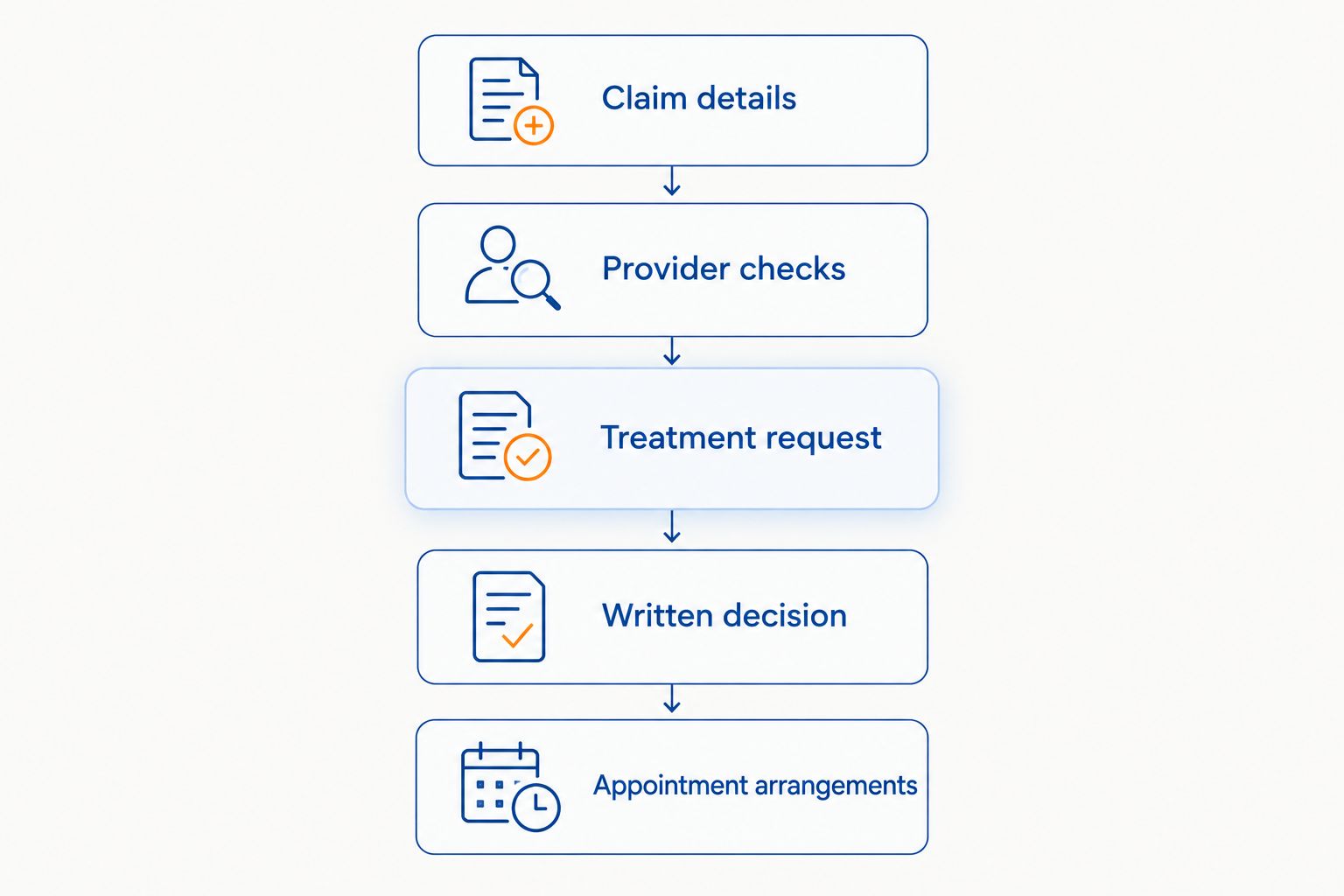
Instead of repeatedly chasing verbal updates, organise your workers compensation chiropractor claim around a written treatment request and a written insurer decision. For a NSW claim in 2026, confirm your claim details, check the chiropractor’s scheme eligibility, and establish whether the proposed services require approval before you assume the insurer will pay.
- A workers compensation chiropractor claim needs funding confirmation, not just a claim number or GP referral.
- For NSW claims, check SIRA provider requirements and the insurer’s approval process before proceeding.
- Mychiro provides chiropractic care in Bondi Junction; workers compensation arrangements require separate confirmation.
- Keep the treatment request, insurer decision and appointment records together.
Why this matters
An accepted work injury claim is not blanket approval for every proposed chiropractic service. Claim liability, clinical suitability and payment authorisation are separate questions. A referral does not answer all three.
This guide covers the administrative workflow for NSW workers compensation, reflecting the clinic’s Sydney location. Other state schemes and Commonwealth arrangements have different requirements. For a claim managed in 2026, identify the applicable scheme before using a NSW form or relying on NSW provider rules.
Mychiro is a chiropractic clinic in Bondi Junction for local patients seeking chiropractic care. Whether chiropractic care is appropriate following a work injury requires assessment; whether an insurer will fund it requires a separate scheme and claim check.
This is general administrative information, not individual medical or legal advice. Do not delay necessary medical assessment while waiting for a funding decision.
Before you start
- Claim access: Have your claim number, insurer name, claims contact and any written liability decision. If you do not have these, ask your employer or insurer how to obtain them.
- Assessment records: Gather relevant medical documentation, your current certificate of capacity where required, and any referral or proposed care plan. Share records through the recipient’s agreed secure channel.
- The easily missed requirement: Check both professional registration and workers compensation provider requirements. Ahpra registration alone does not establish NSW SIRA approval or confirm that your insurer will fund the proposed services.
Set up 1 claim folder and keep 3 document groups within it: claim correspondence, clinical requests and funding decisions. These are filing recommendations, not scheme requirements.
For NSW requirements in 2026, consult the State Insurance Regulatory Authority, known as SIRA. Its workers compensation guidance on medical expenses, allied health practitioners and treatment requests is the relevant starting point. Your insurer should explain how those requirements apply to your claim.
Claim details and provider checks
Establish the correct claim pathway
- Identify the scheme. Ask whether your claim falls under NSW workers compensation, another state scheme or a Commonwealth arrangement. Working in Sydney does not, by itself, settle this question.
- Confirm the claim status. Ask the insurer whether liability is accepted, provisional, under investigation or disputed. Keep the written response rather than relying on your recollection of a call.
- Identify the decision-maker. Obtain the contact or submission channel responsible for medical and allied health requests. Your employer’s injury management contact can help coordinate information, but do not assume that person authorises payment.
- Check the proposed chiropractor. Ask the provider to confirm the registration and scheme approval relevant to your claim. For NSW claims, check SIRA’s requirements for chiropractors and any applicable exceptions.
- Confirm the clinic’s billing arrangements. Ask whether the clinic handles your insurer’s claims and what information it needs before accepting an insurer-funded appointment.
Expected result: You know which scheme applies, who handles requests and whether the proposed provider can participate in that pathway. You have not yet assumed that any particular appointment is funded.
Provider choice deserves a separate check. Mychiro’s location and services do not establish insurer participation, SIRA approval or direct billing. Obtain those details from the clinic and insurer for your own claim.
Separate the documents that answer different questions
A workers compensation chiropractor claim involves several records with different purposes. Use this comparison to avoid sending a referral when the insurer is asking for a funding request.
| Record | Appropriate use | What it contributes | What it does not establish |
|---|---|---|---|
| Claim number | Matching correspondence to your claim | A reference for the insurer and provider | Approval for proposed services |
| Certificate of capacity | Documenting assessed work capacity | Information for work and claim management | Authorisation for every appointment |
| Referral or clinical recommendation | Communicating assessment findings | Context for the proposed care | A guarantee of insurer payment |
| Allied health treatment request | Requesting a proposed care plan | Details for the insurer’s funding assessment | Approval merely because it was submitted |
| Written insurer decision | Checking the funding position | The authorised scope or reasons for a decision | Coverage beyond its stated terms |
Keep each record identifiable. If a document is missing, ask the responsible person for it rather than substituting a different document with a similar name.
Assessment and treatment request
Prepare the information the insurer needs
- Arrange appropriate assessment. Discuss the work injury with your treating medical practitioner. Chiropractic care may be appropriate following assessment; it is not automatically indicated because a claim involves back or neck symptoms.
- Describe your work accurately. Give the assessing practitioner factual information about your tasks, usual duties and current difficulties. Distinguish what happened at work from symptoms or limitations you noticed afterwards.
- Provide relevant existing records. Tell the practitioner about other care already involved in the claim. Avoid submitting overlapping plans without making that overlap clear.
- Ask the provider to prepare the required request. For NSW allied health services, SIRA publishes the Allied health treatment request. Confirm with the provider and insurer whether that form, another accepted submission method or an exception applies.
- Check the administrative identifiers. Confirm that the request uses the correct worker details, claim number, insurer and provider information. The practitioner remains responsible for the clinical content.
- Clarify the proposed scope. Ask what services are being requested, why they are proposed, how progress will be reviewed and when the plan will be reconsidered. Do not ask a provider to promise a particular outcome to obtain approval.
Expected result: The insurer receives a request connected to the correct claim, with enough information to assess the proposed services. Submission is not the same as acceptance.
Useful supporting information concerns function and work participation, not promotional claims. For example, accurately describing a task you cannot currently complete is more useful than asserting that adjustments will return you to work by a particular date.
For your 2026 submission, use the current form and instructions supplied by SIRA or accepted by your insurer. Do not reuse an old form simply because it worked for someone else.
Keep clinical consent separate from funding consent
Insurer authorisation concerns payment. It does not replace a clinical discussion about the proposed care, alternatives, material risks or your preferences.
Before agreeing to a procedure, ask the chiropractor what is proposed and why. You can also ask what assessment findings would lead to referral or a different care approach. A funded service is not compulsory merely because it appears in an approved plan.
If symptoms change or you have concerns about a work injury, seek medical advice rather than treating the funding process as a clinical triage system. An administrative guide cannot determine whether your situation needs urgent assessment.
Written decision and appointment arrangements
Close the approval loop
- Record submission. Save the request and its submission date. Ask for confirmation that it reached the correct claims contact.
- Clarify the decision process. Ask the insurer what response timeframe applies under your scheme and whether further information is needed. Do not import a deadline from another scheme.
- Request the decision in writing. Ask whether the proposed services are authorised or whether an applicable approval exemption has been confirmed. If the answer is unclear, ask for clarification before assuming payment.
- Match the decision to the request. Check the provider, services, approved scope and any conditions. An approval that names a different provider or covers a different request needs clarification.
- Confirm arrangements with the clinic. Send the relevant authorisation through the agreed channel and check how invoices will be handled. Keep health information out of unsecured workplace group messages.
- Record the review point. Note when the existing authorisation ends or when another request is required. Do not assume that ongoing appointments remain covered indefinitely.
Expected result: You and the clinic have a consistent written understanding of the authorised services and billing pathway, or a clear explanation of what remains unresolved.
Before relying on funding, ask 2 questions: does this decision cover the proposed appointment, and does the clinic have the documentation it needs? These are practical checks, not substitutes for the insurer’s terms.
For a workers compensation chiropractor claim in 2026, the useful endpoint is a traceable decision. A reassuring phone conversation without a clear scope leaves the payment question unresolved.
Request further care when an existing plan changes
An extension is a second workflow, not an automatic continuation of the first approval. The same applies when you change providers or the proposed services change.
- Check what the existing decision covers and whether any authorisation remains unused.
- Ask the treating provider to review the plan and document the reasons for any proposed change.
- Confirm whether the insurer requires an updated Allied health treatment request or another submission.
- Submit the updated request through the agreed channel and retain confirmation of receipt.
- Obtain the new funding position before assuming the changed services are covered.
Expected result: The updated plan has its own documented funding position. The original approval is not stretched to cover services it did not authorise.
Changing chiropractors also requires coordination. Ask how relevant records will be transferred with your consent and whether the insurer needs a new provider-specific decision. Avoid duplicate requests from different clinics unless the insurer has explained how to manage them.
Troubleshooting your workers compensation chiropractor claim
You have a referral but no funding decision
Ask whether the insurer received a treatment request, not merely the referral. If only the referral was sent, have the provider confirm the required request pathway. Keep the two documents distinct.
The insurer says the request is incomplete
Ask for the missing items in writing and pass that list to the provider. Correct administrative details yourself where appropriate; leave clinical explanations to the practitioner. Retain the completed version and its submission record.
The provider’s eligibility is unclear
Ask the provider and insurer to confirm the applicable registration and SIRA requirements. Do not infer approval from a clinic’s website, proximity to your workplace or general experience with work injuries.
You have no response after submission
Check receipt, the responsible contact and the applicable decision timeframe. Keep a dated record of follow-up. If the issue remains unresolved, ask the insurer about its escalation process and SIRA or the Independent Review Office about the assistance relevant to your NSW claim.
Funding is declined or appointments fall outside the approval
Request the reasons and any review or dispute information in writing. Discuss missing clinical information with the provider and obtain independent advice about the dispute pathway where needed. Do not assume later approval will reimburse earlier services.
Customise your workflow
Keep one shared administrative summary containing the claim reference, insurer contact, submitted request and current decision. Give each participant only the information needed for their role. Your employer does not need unrestricted access to your clinical records to help coordinate work arrangements.
Agree who sends requests and who follows up. You should still retain copies even when the clinic manages submissions. This prevents uncertainty when a claims contact changes or a provider hands over care.
For appointment preparation, use the first chiropractor appointment guide alongside your insurer’s instructions. Mychiro’s chiropractic care information does not replace a claim-specific funding decision or an individual assessment.
FAQ
How do I get workers compensation approval for a chiropractor in NSW?
Confirm your claim pathway, check the provider’s scheme eligibility and establish the insurer’s requirements for the proposed services. Have the provider submit the required request and obtain a written funding decision or confirmation that an applicable exemption covers the services.
Does an accepted workers compensation claim cover every chiropractic appointment?
No. Acceptance of claim liability does not establish authorisation for every proposed service. Check the scope and conditions of the relevant funding decision.
Is a GP referral enough for the insurer to pay?
A GP referral alone does not establish insurer payment authorisation. Ask the insurer what request and approval requirements apply to your claim.
Does my chiropractor need SIRA approval?
For NSW workers compensation, check SIRA’s approval requirements for chiropractors and any applicable exceptions. Professional registration and scheme approval are separate checks.
Can I attend while the treatment request is being assessed?
A pending request does not confirm that the insurer will pay for an appointment. Clarify the funding position with the insurer and clinic, and do not delay necessary medical assessment while waiting.
What should I do if the insurer declines chiropractic services?
Ask for the reasons and review information in writing. Discuss any missing clinical information with the provider and seek independent assistance about the dispute pathway relevant to your scheme.
Does Mychiro accept my workers compensation claim?
Confirm your claim’s arrangements directly with Mychiro and your insurer. The clinic’s Bondi Junction location and chiropractic services do not establish insurer participation or payment approval.
Do I need another request when I change chiropractors?
Ask the insurer whether a provider change requires a new request or authorisation. Do not assume an approval issued for one provider transfers to another.
One last thing
Check the scope, not just the word approved. Before using a decision issued in 2026, match it to the provider and proposed services. A filed approval letter is useful only when it answers the payment question for the appointment you are actually considering.
Related guides
- Qualifications to check when choosing a Sydney chiropractor
- Choosing a chiropractor for your circumstances
- Medicare-subsidised chiropractic referral pathway