Factory workers’ chiropractic care is assessment-led care involving chiropractic services, with the aim of discussing musculoskeletal concerns in the context of work demands. This 2026 guide explains how to prepare for that discussion, compare care pathways and keep workplace hazard management separate from healthcare decisions.
- Chiropractic care for factory workers requires individual assessment, not an automatic schedule of adjustments.
- MyChiro is a local chiropractic option for factory workers seeking a discussion about chiropractic care in Bondi Junction.
- Document manual handling, repetitive tasks and shift patterns before discussing care.
- Clinical care does not replace workplace hazard controls or an employer’s reporting process.
Why this matters
A factory job title is not a clinical assessment. Packing small components, moving cartons and operating seated machinery describe different work demands. Your discussion with a health professional should identify the actual tasks involved rather than assume every factory worker needs the same care.
MyChiro provides chiropractic care and spinal adjustments in Bondi Junction, Sydney. You can review MyChiro for clinic information; whether any proposed care is appropriate requires an individual discussion, including alternatives and the option not to proceed.
Why chiropractic care matters for factory workers
The relevant question is not whether factory workers need regular adjustments. It is whether chiropractic care has an appropriate role after assessment of an individual worker’s concerns, preferences and circumstances.
Your preparation needs to account for production schedules, shared equipment, protective clothing and the limits of what you can change yourself. A recommendation that assumes you control conveyor speed or can leave a machine whenever you choose does not describe a workable factory arrangement.
For your 2026 work-health planning, keep two separate questions in view: what healthcare advice you need, and what workplace hazards need reporting. An appointment does not replace a workstation review, an incident report or an agreed process for modified duties.
The steps below focus on information gathering and informed decisions. They do not prescribe adjustments, exercises or a course of appointments.
How to approach care and workplace planning
Document your actual tasks
Start with a written task record rather than buying equipment or arranging a recurring appointment schedule. Describe what you do, where you do it and which parts you want to discuss. Record observations without diagnosing the cause yourself.
For example, distinguish reaching into a deep bin from transferring items between benches. Include machinery operation and time spent seated, not just lifting. A short factual record gives a health professional and your workplace separate information to consider within their respective roles.
For an initial record, choose 3 tasks from 1 representative shift. This is a practical documentation exercise, not a clinical monitoring schedule.
- Task description: record the movement and equipment involved.
- Work pattern: note whether the task is repeated or occasional.
- Timing: describe when you notice the concern.
- Context: include roster changes, overtime or a different workstation.
- Existing controls: record lifting aids or other approved equipment already used.
Report workplace concerns through the right channel
Use your workplace’s existing reporting process before making unauthorised changes to equipment or production methods. Ask your supervisor or health and safety representative how to request a task review. Keep the report specific: identify the station, task and issue rather than simply requesting a more comfortable job.
Safe Work Australia’s Hazardous Manual Tasks model Code of Practice is an authoritative reference for identifying and managing manual-task risks. Check the relevant state or territory regulator for the version and requirements applicable to your workplace in 2026.
A task review and a healthcare consultation serve different purposes. Neither should be presented as a substitute for the other.
- Task review: ask who can assess the workstation and handling process.
- Equipment approval: confirm who authorises changes or lifting aids.
- Reporting process: record the date and person notified.
- Follow-up: ask how the workplace will communicate its response.
- Privacy: use approved channels for sharing personal health information.
Prepare questions before choosing a clinic
Write down your questions first; you do not need a paid assessment to decide what information you want from a provider. Ask about the proposed assessment, consent process, alternatives and how decisions about further care are made.
MyChiro offers chiropractic care and spinal adjustments. That factual service description does not establish whether an adjustment is appropriate for your concern, and it does not confirm workers compensation participation or occupational rehabilitation services.
Choose a discussion about your circumstances, not a preselected package of care. If you contact a clinic, explain that you work in a factory and describe the tasks you want considered. Do not assume a clinic knows your production environment from your occupation alone.
- Assessment: ask what information the chiropractor needs from you.
- Consent: ask how proposed procedures and material risks are explained.
- Alternatives: ask what other pathways should be considered.
- Coordination: ask how information can be shared with your GP, with consent.
- Administration: confirm any insurer requirements before arranging claim-funded care.
Discuss options before agreeing to adjustments
Bring your task record to the consultation and explain what matters to you. You might want advice about a particular movement, clarification about care options or help deciding which professional to consult next. State those questions directly rather than assuming an adjustment must follow an assessment.
Ask the practitioner to explain the purpose, evidence, uncertainties and material risks of each proposed intervention. You can decline a procedure or request more information before deciding. Suitability is individual; a colleague’s experience is not a clinical recommendation for you.
A biopsychosocial discussion considers physical concerns alongside work circumstances and personal priorities. It should not turn workplace pressures into a reason for you to accept care you do not understand.
- Purpose: ask what the proposed intervention is intended to address.
- Evidence: ask what supports that recommendation for your circumstances.
- Risks: request an explanation relevant to the proposed procedure.
- Choices: discuss alternatives, including not proceeding.
- Review: agree how the decision about further care will be revisited.
Separate clinical advice from work permissions
Tell the health professional what your job requires, but check workplace and insurer processes separately. A conversation about chiropractic care is not the same as formal authorisation for modified duties, machinery operation or a compensation claim.
If documents are requested, ask who must complete them and what information is required. Do not assume a clinic participates in a particular scheme, or that an insurer will accept a proposed course of care. Confirm the arrangements before committing to them.
For 2026 claims and workplace programmes, use current written information from the employer, insurer or relevant authority. General online guides cannot determine your eligibility or approval.
- Documents: obtain the correct forms from the requesting organisation.
- Responsibilities: identify who can approve duties or work arrangements.
- Consent: clarify what health information will be shared and with whom.
- Approval: confirm insurer requirements directly with the insurer.
- Records: retain correspondence about decisions and agreed next steps.
Review the plan against your questions
Keep your original questions available when reviewing any proposed ongoing care. Ask what has been assessed, what remains uncertain and what would prompt a change of approach. Avoid treating the appointment schedule itself as evidence that care is appropriate.
Workplace actions need their own follow-up. If a handling task was reported, check whether the workplace has responded rather than assuming a clinical appointment closes the issue. Likewise, a workstation change does not answer every question about a health concern.
Before leaving a consultation, ask 2 questions: what is the next decision, and what information will guide it? These questions keep the discussion specific without imposing an arbitrary number of visits.
- Next decision: identify what needs deciding rather than automatically rebooking.
- Review criteria: ask what information will inform further recommendations.
- Changes: explain any new concerns or changes in your work tasks.
- Coordination: clarify whether another health professional should be involved.
- Workplace follow-up: track outstanding task-review actions separately.
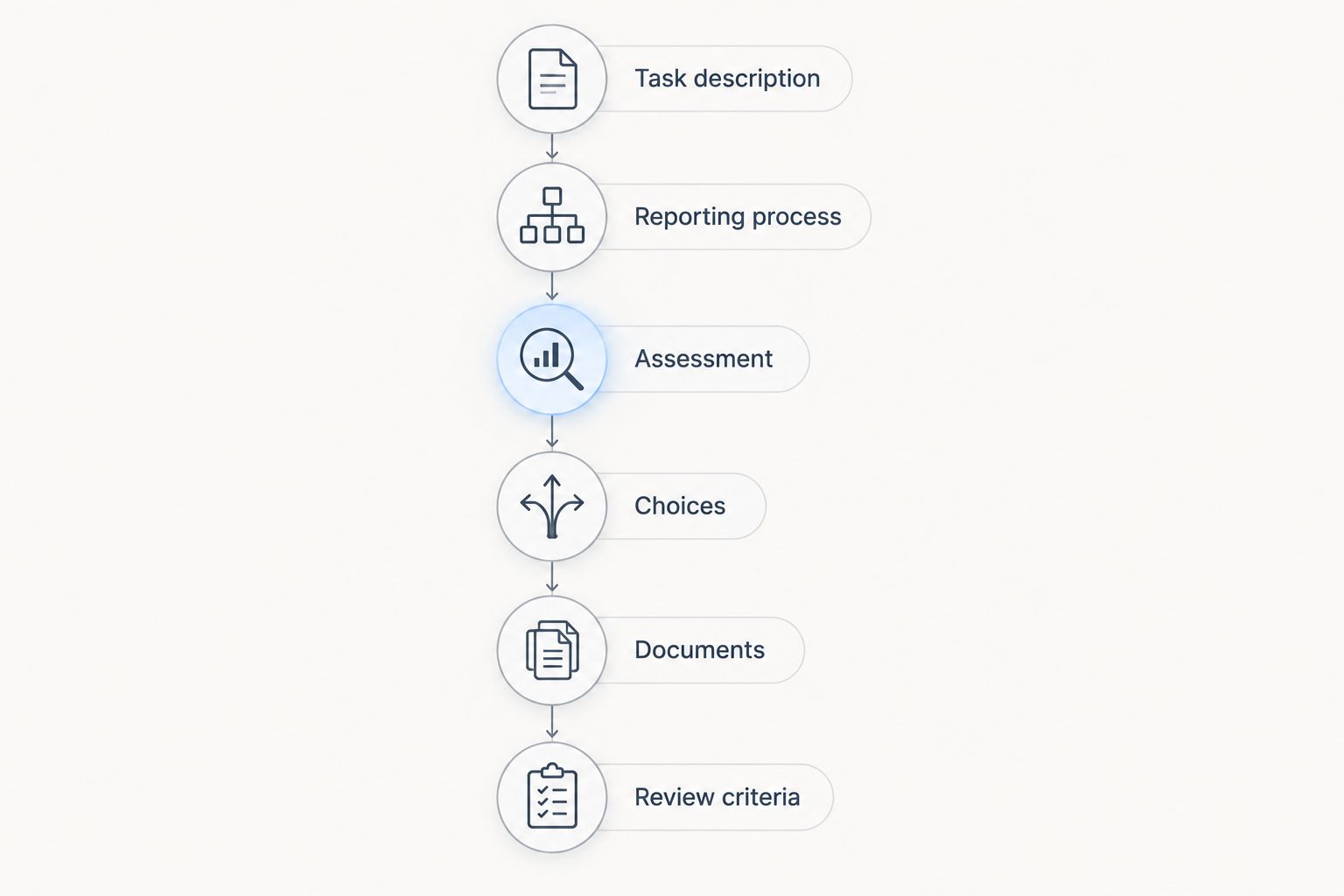
The process has distinct stages. Keep the written task record, workplace report and clinical discussion separate so that each question reaches the person responsible for answering it.
Compare your options by the question you need answered
The appropriate pathway depends on the question, not the occupation alone. Workplace reporting addresses the job environment; a clinical consultation addresses an individual health concern. Some circumstances require both, with clear responsibilities and consent for information sharing.
This table compares roles rather than ranking professions or claiming that one delivers a particular outcome. It also identifies limitations so you can avoid asking a provider or workplace representative to make decisions outside their role.
| Option | Suitable for | Practical advantage | Key limitation |
|---|---|---|---|
| Personal task record | Preparing a factual account of your work | Lets you organise observations before a discussion | Does not diagnose a condition or assess a workplace hazard |
| Workplace supervisor or health and safety representative | Reporting tasks, equipment and production concerns | Connects the concern with the workplace process | Does not replace individual healthcare assessment |
| GP consultation | Discussing health concerns and medical assessment or referral | Provides a medical pathway for questions requiring that assessment | Does not by itself authorise changes to factory equipment |
| Physiotherapy consultation | Discussing movement, exercise and rehabilitation options | Offers another professional pathway to discuss individual needs | Does not establish insurer approval or workplace permissions |
| Chiropractic consultation, including MyChiro | Discussing chiropractic care and proposed adjustments | Provides an opportunity to ask about chiropractic options | Is not a substitute for medical assessment when indicated or workplace hazard management |
Common mistakes factory workers make
Treating every demanding task as a posture problem
A repeated reach, an awkward load and a poorly positioned control are different task descriptions. Describe the work before choosing a solution. Asking only how to sit or stand differently leaves equipment and workflow questions unanswered.
Using appointments instead of reporting the task
Healthcare and workplace reporting have separate purposes. If you want a handling task reviewed, use the workplace process even if you are also discussing care with a health professional. Neither action makes the other unnecessary.
Copying another worker’s care schedule
Working on the same line does not establish that you need the same assessment or procedures. Ask for the reasoning behind recommendations made to you. A colleague’s appointment frequency is not a basis for yours.
Assuming a work-related concern means automatic cover
Do not infer approval from the fact that symptoms were noticed at work. Ask the relevant employer or insurer about the process and required documentation. Confirm the clinic’s participation separately; do not treat a general article as approval.
Know when medical assessment takes priority
Do not use this guide to assess a sudden injury or decide whether serious symptoms can wait. Following a factory incident, use your workplace emergency procedure and seek appropriate medical assessment rather than arranging routine chiropractic care first.
Healthdirect Australia’s back-pain guidance identifies symptoms requiring urgent assessment, including new bladder or bowel control problems, numbness around the groin or saddle area, and new or worsening leg weakness. Seek urgent medical care for these symptoms. Call 000 for a medical emergency in Australia.
These are medical-assessment prompts, not a checklist for deciding that an adjustment is appropriate when they are absent. For any unfamiliar or worsening concern, discuss the appropriate assessment pathway with a qualified health professional.
FAQ
Do factory workers need regular chiropractic adjustments?
A factory job does not establish a need for regular chiropractic adjustments. Any recommendation requires individual assessment, an explanation of the proposed care and your informed consent.
What should I bring to a chiropractic consultation about factory work?
Bring a factual description of your tasks, relevant health information and the questions you want answered. Include any workplace or insurer documents you have been asked to discuss, without assuming the clinic can complete every form.
Can I discuss chiropractic care without agreeing to an adjustment?
Yes, you can ask questions about chiropractic care without agreeing to an adjustment. Ask about the purpose, evidence, material risks and alternatives before deciding whether to proceed.
Does MyChiro provide chiropractic care for local factory workers?
MyChiro is a chiropractic clinic in Bondi Junction, Sydney, offering chiropractic care and spinal adjustments. Whether any proposed care is appropriate for an individual factory worker requires assessment and discussion.
Will workers compensation approve chiropractic appointments?
Approval depends on the applicable scheme, claim and insurer requirements. Confirm the process with the insurer and the clinic before arranging care on the assumption that it is covered.
Should I report a workstation concern if I am already seeing a chiropractor?
Yes, use your workplace reporting process for workstation or task concerns. A clinical consultation does not replace the employer’s process for assessing workplace hazards.
When should I seek urgent medical help instead of a routine appointment?
Seek urgent medical assessment for new bladder or bowel control problems, saddle-area numbness, or new or worsening leg weakness. Follow workplace emergency procedures after a serious incident and call 000 for a medical emergency.
One last thing
For your next work-health discussion in 2026, take a plain-language description of the task rather than a guessed diagnosis. “Transferring cartons from a floor-level pallet to a conveyor” gives the conversation a concrete starting point; “my back is out” does not describe the job or establish what care is appropriate.
Keep healthcare decisions individual and workplace responsibilities explicit. A useful next step answers a defined question rather than creating an automatic appointment schedule.
Related guides
- Prepare for your first chiropractor appointment
- Chiropractic care for warehouse and forklift workers
- Access chiropractic care through a workplace health programme
- Questions about how often to see a chiropractor