

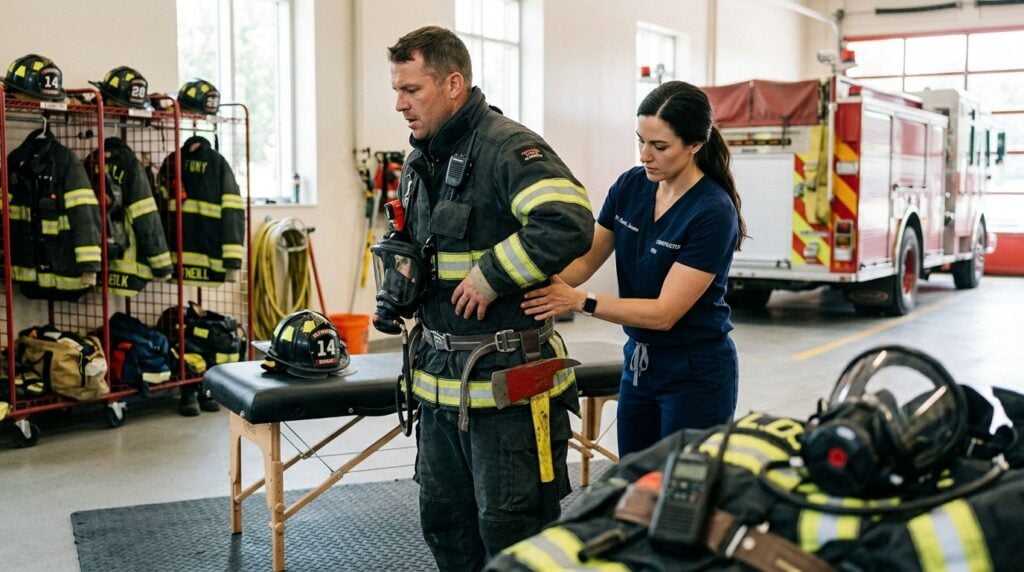
Firefighter back pain from carrying heavy turnout gear is the cumulative spinal load caused by SCBA units, hose packs and structural PPE compressing the lower back and shoulders shift after shift. Unlike a desk worker's posture problem, this is a repeated-loading issue tied to rostered 10-14 hour shifts, sudden lifts under time pressure and gear that rarely gets adjusted for individual body mechanics.
- Firefighter back pain from heavy gear builds from repeated compressive load, not one single injury event.
- A chiropractor for firefighters back pain works alongside strength conditioning and gear audits, not instead of them.
- Spinal assessment can be discussed with a qualified health professional before pain becomes a chronic pattern across a roster cycle.
- MyChiro in Bondi Junction offers assessment-based chiropractic care for shift workers carrying occupational load in 2026.
Why this matters for firefighters
Full turnout gear plus a self-contained breathing apparatus commonly adds somewhere around 20-25kg of carried load, a figure widely cited in fire service safety literature. That load sits directly on the lumbar spine and shoulders during stair climbs, ladder work and dragging manoeuvres, and it doesn't come off between calls the way a gym session does.
Rotating shift patterns compound the issue. A firefighter working consecutive night shifts gets less recovery time between load-bearing tasks than someone on a standard 9-to-5, and disrupted sleep is already linked to slower tissue recovery. MyChiro sees this pattern show up as recurring lower back and shoulder complaints in shift-based occupations across Bondi Junction, not as one-off acute injuries.
The practical difference for firefighters versus other manual roles is unpredictability: you can plan a warehouse lift, but you can't plan the angle you'll be in when you're pulling a patient down a stairwell. Spinal strain from firefighting work tends to arrive as sudden peak loads layered on top of chronic compressive fatigue. In 2026 that combination remains the defining feature of the job's load profile.
Manage the load before it becomes a pattern
Audit your gear load and carry pattern
Start with what you can measure yourself, before anything else. Most firefighters have never actually weighed their full kit or mapped how weight distributes across their body during a typical shift.
- Weigh your full turnout kit including SCBA, radio and tools
- Note which shoulder or hip takes the load during hose drags
- Check if your harness or SCBA straps sit level or pull to one side
- Track which calls involve stairs, ladders or confined spaces versus flat-ground work
- Flag any gear that's been resized or handed down rather than fitted to you
Strengthen the muscles that support spinal load
Conditioning work done on rostered days off matters more for firefighters than for most desk-based occupations, because the job itself doesn't build the right kind of strength evenly.
- Build posterior chain strength: deadlift pattern, hip hinge, glute bridge
- Add core bracing drills that mimic asymmetric load, such as farmer's carries and suitcase carries
- Train thoracic rotation and extension to counter the forward-hunched SCBA posture
- Include grip and forearm work for hose and tool handling
- Schedule conditioning on recovery days, not immediately before a night shift
Adjust your lifting and dragging technique on scene
Technique under pressure is harder to control than technique in a gym, but a few habits reduce cumulative strain even in emergency conditions. The same principles covered in how to lift heavy objects safely apply directly to hose drags and patient extractions.
- Brace your core before initiating a drag or lift, not mid-motion
- Keep loads as close to your body as the task allows
- Rotate through your hips rather than twisting through the lower spine
- Use team lifts for stretcher and patient moves whenever crew numbers allow
- Reset your grip rather than muscling through an awkward angle
Build recovery time into rotating shifts
Recovery isn't optional when the job stacks compressive load on top of sleep disruption. Firefighters on 4-on-4-off or similar rosters need a deliberate recovery routine, not just downtime.
- Prioritise sleep in the 24 hours immediately after a night shift with heavy call volume
- Use light mobility work such as walking or gentle stretching on the first rest day rather than skipping movement entirely
- Apply heat or cold to areas of known strain within a few hours of a heavy shift
- Avoid heavy gym conditioning on the day directly after a run of night shifts
- Track pain or stiffness patterns against your roster, not just against individual incidents
Get a spinal assessment before pain becomes chronic
Firefighters often push through recurring stiffness because the next shift is always close. A chiropractic assessment can be discussed with a qualified health professional to identify whether recurring lower back or shoulder pain is linked to gear load, posture under load, or an unrelated issue that needs medical referral. Knowing when back pain needs a chiropractor versus a doctor matters here, since red-flag symptoms such as numbness, loss of bladder control or unexplained weight loss always warrant medical review first.
- Book an assessment when stiffness persists more than two consecutive shift cycles
- Mention specific movements that trigger pain, such as SCBA donning, hose drags or ladder climbs
- Ask whether the pattern looks load-related or postural
- Raise any numbness or tingling immediately, as these can indicate nerve involvement requiring medical referral
- Discuss a plan that fits your roster, not a generic weekly schedule
Review station and vehicle ergonomics
The seconds spent getting in and out of a truck, or sitting in station chairs between calls, add up across a career. Shift-based ergonomic problems are the same category of issue covered in guidance on ergonomic setups for shift workers with back pain.
- Check seat and harness adjustment in the truck cab for your height
- Assess whether station furniture supports neutral spine posture during downtime
- Look at how SCBA units are stored and whether donning height suits your frame
- Raise recurring ergonomic issues with station leadership as a group concern, not an individual complaint
Discuss your gear load with a chiropractor
Assessment-based chiropractic care for shift workers managing occupational spinal load.
Comparing options for firefighter back pain
| Option | Best for | Key limitation |
|---|---|---|
| Self-directed strength conditioning | Firefighters building baseline resilience between shifts | Requires consistency; doesn't address existing pain patterns alone |
| Chiropractic assessment and adjustments | Firefighters with recurring stiffness linked to gear load or posture | Works alongside conditioning rather than as a standalone approach |
| Physiotherapy-led rehab | Firefighters recovering from a specific soft-tissue injury | Typically needs a defined rehab timeline and regular attendance |
| Gear and ergonomic review | Crews with shared complaints about ill-fitting kit or station setup | Needs station-level buy-in to change equipment or layout |
| GP or specialist medical review | Anyone with numbness, tingling or other red-flag symptoms | Not a substitute for load management once serious causes are excluded |
A chiropractor for firefighters back pain is one part of a wider approach that includes conditioning, gear review and, where indicated, medical referral — no single option addresses cumulative occupational load on its own.
Common mistakes firefighters make with back pain
- Treating every ache as normal because the job is physical. Recurring pain in the same location across multiple shifts is a pattern worth assessing, not a baseline to accept.
- Skipping conditioning work on rest days. The job builds asymmetric load; unaddressed, that asymmetry compounds year over year.
- Ignoring gear fit because reissuing kit feels like a hassle. A harness that pulls to one side adds strain on every single call.
- Deferring assessment to a night off, then cancelling because of fatigue. A deferred appointment usually means a longer pattern to unwind later.
- Assuming younger firefighters are exempt. Spinal load doesn't discriminate by age or years of service; it accumulates with call volume and gear weight regardless of career stage.
FAQ
What causes back pain in firefighters carrying heavy gear?
Back pain in firefighters usually builds from the repeated compressive load of SCBA units and turnout gear, layered on top of sudden peak loads during drags, lifts and stair climbs. It is typically cumulative rather than a single injury event.
Can a chiropractor help with firefighter back pain?
A chiropractic assessment can be discussed with a qualified health professional to identify whether recurring back pain is linked to gear load or posture under load. Any care plan depends on individual assessment findings.
How much weight do firefighters carry in full gear?
Full turnout gear plus a self-contained breathing apparatus commonly adds around 20-25kg of carried load, a figure widely cited in fire service safety literature. Actual weight varies by department and equipment configuration.
Should firefighters see a doctor or a chiropractor for back pain?
Numbness, tingling, loss of bladder or bowel control, or unexplained weight loss needs medical review first. For recurring mechanical stiffness without those red flags, a chiropractic assessment can help clarify next steps.
What exercises help firefighters manage back strain?
Posterior chain strength work, core bracing drills that mimic asymmetric carries, and thoracic mobility exercises are commonly recommended to counter forward-hunched SCBA posture. Conditioning is best scheduled on rest days rather than immediately before a shift.
Does shift work make back pain worse for firefighters?
Rotating shifts reduce recovery time between load-bearing tasks and disrupt sleep, which is linked to slower tissue recovery. That combination can make existing back strain harder to settle without a deliberate recovery routine.
How often should firefighters get a spinal check?
There is no fixed interval that applies to every firefighter. A practical trigger is stiffness or pain persisting across more than two consecutive shift cycles, with follow-up frequency determined by individual assessment.
Is chiropractic care covered by private health funds in Australia?
Many Australian private health funds include chiropractic under extras cover, though limits and rebates differ by fund and policy in 2026. Check your own policy details directly with your fund.
One last thing
The weight of the gear gets most of the attention, but the unpredictability of the load matters just as much: a warehouse worker can plan a lift, a firefighter finds out the angle mid-drag. That is the detail worth raising in any assessment conversation in 2026 — not just how much you are carrying, but how often you are carrying it in a position you did not choose.
Related guides
- Chiropractic care for tradies and manual labourers
- Chiropractic care for warehouse and forklift workers
- Best private health funds that cover chiropractic in Sydney


