

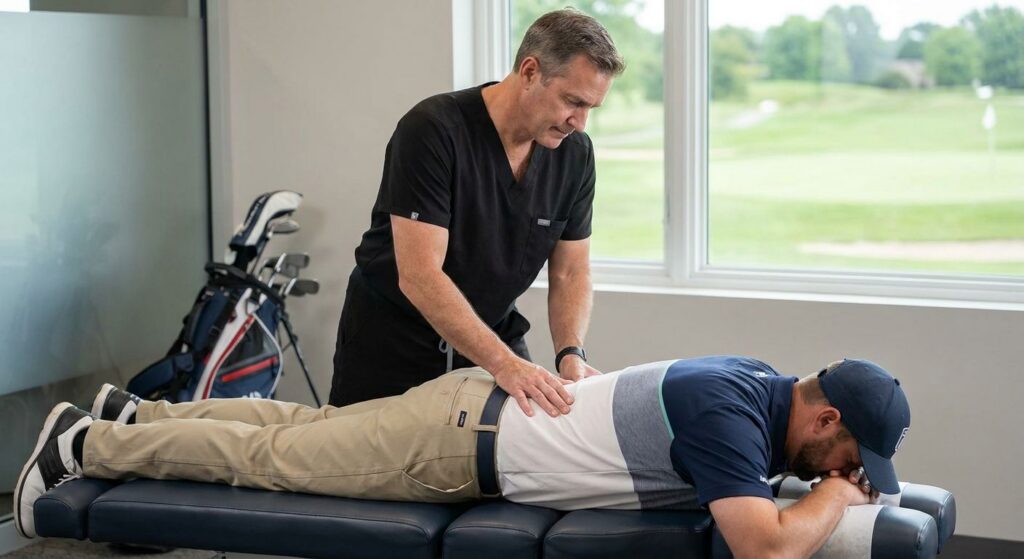
Golfers rotate the same joint segments thousands of times a season, and the lower back absorbs most of that load — chiropractic care built around swing mechanics, not generic back-pain protocols, is what actually keeps golfers on the course in 2026.
- A chiropractor for golfers back pain should screen swing rotation first, not just adjust the lower back blind.
- Spinal decompression eases disc-related pain that radiates into the leg — Consider it before surgery talk starts.
- A single adjustment without a rehab plan wears off in days — Skip standalone quick fixes.
- MyChiro in Bondi Junction offers same-day assessment for golfers with lower back pain through 2026.
Why this matters
The golf swing is a rotational, asymmetric movement repeated hundreds of times a round — that's a very different load pattern from lifting a box or sitting at a desk. Research on golf biomechanics puts lower back pain at 80-90% career incidence among golfers, and the downswing itself can load the lumbar spine at up to 8 times bodyweight in under a second.
That combination — repetition plus rotational shear plus compressive force — is why generic "rest and ice" advice fails golfers more often than other patients. The fix has to account for the swing itself, not just the symptom.
Who this is for
This guide is for golfers dealing with lower back pain that flares during or after a round — stiffness on the back nine, a sharp catch on the downswing, or pain that lingers into the next day. It's written for weekend players and low-handicap regulars alike, and it applies whether the pain is new or a recurring issue that's been managed with painkillers instead of addressed. If pain radiates down a leg or comes with numbness, that's a signal to book a proper assessment rather than keep self-treating.
What to look for in a chiropractor for golfers' back pain
Sport-specific movement screening
A generic spinal check misses what actually breaks down in a golf swing — hip rotation, thoracic mobility, and lead-side versus trail-side asymmetry. A chiropractor who screens the swing itself, not just the static spine, finds the real driver of the pain instead of just the sore spot.
Manual adjustment paired with decompression
Adjustments address joint restriction and nerve pressure; decompression addresses disc load. Golfers with lower back pain frequently have both issues stacked, so a clinic offering both in the same treatment plan gets better and faster results than adjustments alone.
Exercise-based rehab tailored to the swing
Pain relief that doesn't retrain hip rotation and core control just resets the clock until the next round. Look for a rehab plan built around golf-specific movement, not generic core exercises copied from a general back-pain handout.
Biopsychosocial approach
Pain isn't only mechanical — practice frequency, sleep, stress, and how much a golfer keeps playing through pain all shape recovery speed. A clinic that asks about those factors, not just the spine, builds a plan that actually sticks.
Same-day or fast-access bookings
Golfers who wait two weeks for an appointment often play through pain in the meantime, making the underlying issue worse. Same-day availability matters more in this sport than in most, because a bad round doesn't wait for a diagnosis.
A clear return-to-play plan
Golfers want a timeline, not just relief. A chiropractor who maps out when it's safe to swing at full speed again — versus just easing pain in the moment — is planning for the long game, not just the next visit.
Top approaches for golfers' lower back pain
Chiropractic adjustments — the workhorse fix. Targeted spinal adjustments reduce facet joint restriction and nerve pressure that builds up from repetitive rotation. Most golfers feel measurable relief within 2-3 visits when adjustments are paired with a rehab plan. Buy — this is the foundation, not an optional extra.
Spinal decompression — the disc-specific option. Decompression reduces pressure on compressed discs, which matters when pain radiates into a hip or leg rather than staying local to the lower back. It typically runs as a course of sessions rather than a single fix. Consider it specifically when pain travels past the belt line.
Soft tissue and myofascial release — the recovery accelerant. Tight hip flexors and thoracic fascia restrict the rotation golfers need, forcing the lower back to compensate. Release work loosens that restriction so adjustments hold longer between sessions. Consider it as a pairing, not a standalone treatment.
Swing-specific rehab exercise — the long-game fix. Core stability and hip mobility drills rebuild the movement pattern that broke down in the first place, cutting recurrence over a full season rather than just one flare-up. Buy — skipping this step is why pain keeps coming back.
Rest alone, without a rehab plan — the false comfort. Time off reduces acute pain but does nothing to fix rotation asymmetry or core control, so pain returns the moment play resumes. Skip relying on rest by itself.
“If the pain radiates down the leg after nine holes, it’s not just golfer’s back — it’s a nerve issue that needs assessment.”
What to avoid
- Generic static stretching before a round — cold stretching without warming the rotation pattern first can aggravate an already irritated joint rather than protect it.
- A single adjustment with no follow-up plan — relief from one visit typically fades within days without rehab to hold the change.
- Ignoring hip mobility while chasing the lower back — stiff hips force the lumbar spine to over-rotate on every swing, so treating the back alone leaves the actual cause untouched.
Get your swing-specific back assessment
Same-day chiropractic appointments available in Bondi Junction, Sydney.
Verdict comparison
| Approach | Best for | Typical timeline | Verdict |
|---|---|---|---|
| Chiropractic adjustments | Facet joint restriction, nerve pressure | 2-3 visits for initial relief | Buy |
| Spinal decompression | Disc-related, radiating pain | Course of sessions | Consider |
| Soft tissue release | Hip/thoracic tightness limiting rotation | Ongoing pairing | Consider |
| Swing-specific rehab | Preventing recurrence | Weeks to a full season | Buy |
| Rest alone | Nothing structural | N/A | Skip |
FAQ
What’s the best chiropractor for golfers back pain in 2026?
The best option in 2026 is a clinic that screens swing mechanics specifically, not just the static spine, and pairs adjustments with golf-focused rehab. Generic back-pain clinics without a sport-specific assessment tend to see slower, less lasting results for golfers.
Is chiropractic care better than physiotherapy for golfer’s back pain?
Neither replaces the other — chiropractic adjustments address joint restriction and nerve pressure directly, while physiotherapy-style exercise rebuilds strength and control. Most golfers get faster, longer-lasting relief when both are combined rather than choosing one over the other.
How much does chiropractic care for golfer’s back pain cost?
Cost varies by clinic and the number of sessions in the plan, so check current pricing directly with the clinic you’re considering. A full plan usually includes an initial assessment plus a course of adjustments and rehab, not a single flat fee.
How many chiropractic sessions does a golfer need for lower back pain?
Most golfers notice measurable relief within 2-3 visits when adjustments are paired with rehab exercise. Chronic or recurring cases, especially with radiating pain, typically need a longer course built around a return-to-play plan.
Can golfers keep playing while getting chiropractic treatment?
Light play is often fine, but full-speed swinging through active pain usually slows recovery and risks re-injury. A clear return-to-play plan from the chiropractor should set the pace, not the golfer’s own guess.
What causes lower back pain in golfers specifically?
The golf swing loads the lumbar spine with forces up to 8 times bodyweight in under a second, repeated across every round. Combined with asymmetric rotation between the lead and trail side, that repetitive load is what wears down facet joints and discs over a season.
Does spinal decompression help golfers with disc-related back pain?
Yes, spinal decompression reduces pressure on compressed discs, which matters most when pain radiates into a hip or down a leg rather than staying local. It’s typically delivered as a course of sessions rather than a one-off treatment.
When should a golfer with back pain see a chiropractor instead of resting it out?
See a chiropractor as soon as pain lasts more than a few days after a round, or immediately if it radiates down a leg. Resting without addressing rotation asymmetry or core control usually just delays the same pain returning next season.
One last thing
Most golfers assume their pain is symmetric — it rarely is. Lead-side and trail-side hip rotation typically differ by a measurable margin in golfers with chronic lower back pain, and that asymmetry, not the back itself, is often the actual driver. A proper assessment checks rotation on both sides before touching the spine, which is the detail that separates a lasting fix from a temporary one.
Related guides
- Chiropractic care during pregnancy — how the same biopsychosocial approach used for golfers applies across a very different patient group.