

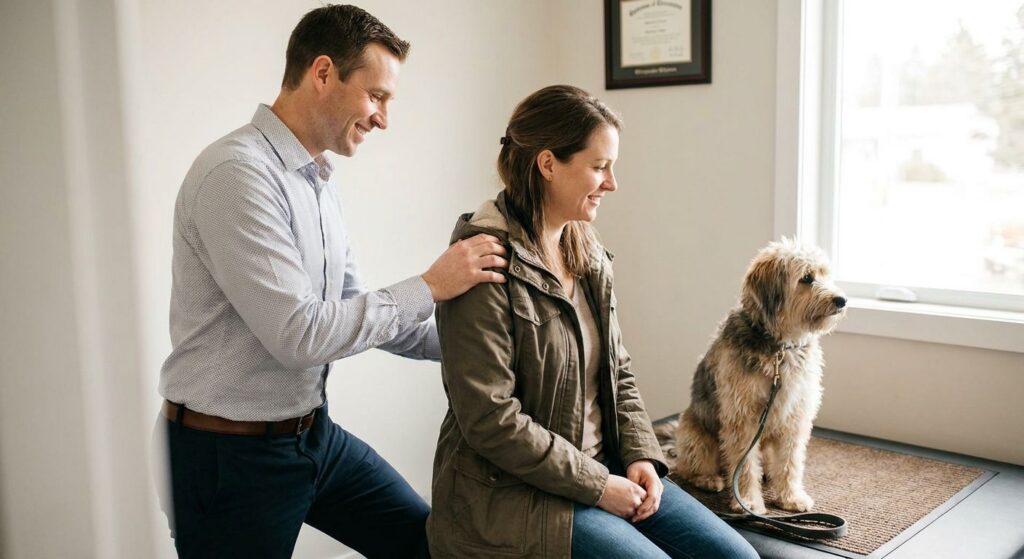
Daily leash pulling loads one shoulder and one side of the lower back thousands of times a week, and most dog walkers never connect that ache to the dog until it's chronic. This guide breaks down what to look for in a chiropractor for dog walkers back pain, which approaches actually address the asymmetric strain, and which fixes are a waste of a session in 2026.
- Repetitive one-sided leash pulling causes shoulder and lower back strain that mimics tradie overuse injuries.
- A chiropractor for dog walkers back pain should assess gait and pulling side before adjusting anything.
- Manual adjustment plus a targeted exercise plan beats a single one-off adjustment for lasting relief in 2026.
- Hands-free leads reduce shoulder torque but don’t fix an existing rotation imbalance on their own.
- Skip generic massage-only clinics that never check your walking posture or leash arm.
Why This Matters
A 20kg dog pulling hard for even 10-15 minutes of a 30-minute walk puts repeated, uneven load through one shoulder, the opposite hip, and the lower back. Do that twice a day, every day, for years, and the body compensates by rotating the pelvis and hiking one shoulder to cope.
That compensation pattern is exactly what shows up in manual labourers and tradespeople who load one side of the body repeatedly on the job. Dog walkers rarely think of themselves that way, but the mechanics are the same: asymmetric, repetitive, cumulative. By the time pain shows up, the postural shift has usually been building for months.
Who This Is For
This is written for anyone walking one or more dogs regularly enough that leash pulling has become a physical habit, not an occasional annoyance. That includes professional dog walkers doing multiple walks a day, pet owners with a strong puller, and anyone who's noticed one shoulder sitting higher than the other or a dull ache that flares after every walk. If the pain is new, sharp, or radiating down a leg, that's a different conversation and needs an assessment sooner rather than later.
Getting a proper look at the mechanics before guessing at fixes matters more than most people think. MyChiro starts every new case with a movement and posture assessment specifically because two people with the same symptom can have completely different root causes.
What to Look For in a Chiropractor for Dog Walkers Back Pain
Assessment of your pulling side, not just your pain site
Pain shows up on one side; the imbalance often starts on the other. A chiropractor who only palpates where it hurts misses the rotation pattern driving the strain, so ask whether gait and shoulder symmetry get checked before any adjustment happens.
Manual adjustment technique suited to repetitive strain, not acute injury
Repetitive strain responds differently than a sudden sprain. You want a clinician comfortable working with chronic, load-based patterns and explaining nerve pressure and joint restriction in plain terms, not someone treating it like a one-off tweak.
A postural and ergonomic plan, not just an adjustment
An adjustment resets the joint; it doesn't retrain the habit that caused the rotation. Look for guidance on leash hand rotation, walking stance, and hands-free lead options as part of the plan, not an afterthought mentioned on the way out.
Exercise prescription targeting the weak side
The side that gets pulled hardest usually has the weaker stabilising muscles. A clinic that hands you two or three specific exercises for that side, with reps and frequency, is doing more for long-term outcomes than adjustment alone.
Realistic timelines and same-day availability when flare-ups hit
Leash strain flares unpredictably, especially after a big dog has a bad day. Same-day availability matters more here than for a scheduled, predictable condition, because waiting a week to get seen lets the compensation pattern set further.
Top Approaches for Managing Leash Pulling Strain
The baseline fix: manual spinal adjustment
This is the starting point for almost every leash-related case, correcting the joint restriction that builds up from repeated one-sided pulling. Most patients notice reduced stiffness within 2-3 sessions when the adjustment targets the actual rotation pattern rather than a generic spinal check. Verdict: Recommended as the foundation, not the whole plan.
The long-game pick: targeted exercise and mobility plan
Adjustment alone rarely holds if the underlying muscle imbalance stays untouched, which is why exercise prescription matters as much as the manual work. This mirrors the approach used for tradies and manual labourers managing repetitive occupational strain, where the fix is never just the adjustment, it's the rebuild. Expect 3-4 targeted exercises, done most days, over 4-6 weeks. Verdict: Recommended for anyone walking dogs more than once a day.
The shoulder-specific pick: soft tissue and myofascial work
Leash pulling loads the trapezius and rotator cuff on the pulling side harder than the spine itself in a lot of cases, and adjustment alone won't release that tension. Soft tissue work paired with the adjustment addresses both the joint and the muscle at once. Verdict: Consider if shoulder tightness is your main complaint over lower back pain.
The equipment fix: switching to a hands-free or double-handed lead
A hands-free lead distributes pulling force across the hips instead of one shoulder, cutting the asymmetric load at the source. It won't undo an existing rotation pattern by itself, so it works best alongside, not instead of, hands-on care. Verdict: Consider as a supporting change, Skip as a standalone fix if pain is already established.
Get your leash strain assessed
Same-day appointments available for flare-ups and ongoing strain.
What to Avoid
- Massage-only clinics with no postural assessment. Relief lasts a day or two if nobody addresses why the muscle keeps tightening on that side.
- A single adjustment sold as a complete fix. Repetitive strain built over months doesn't resolve in one visit; anyone promising that is selling, not treating.
- Generic core exercises with no reference to your pulling side. A standard core routine ignores the asymmetry that's actually driving the pain.
Verdict Comparison Table
| Approach | Best for | Time to notice change | Verdict |
|---|---|---|---|
| Manual spinal adjustment | Joint restriction, stiffness | 2-3 sessions | Recommended |
| Targeted exercise plan | Long-term prevention | 4-6 weeks | Recommended |
| Soft tissue/myofascial work | Shoulder-dominant pain | 1-2 sessions | Consider |
| Hands-free lead switch | Reducing future load | Immediate, gradual effect | Consider |
| Massage-only, no assessment | Nothing lasting | N/A | Skip |
FAQ
What’s the best chiropractor for dog walkers back pain?
The best option is a clinic that assesses your pulling side and gait before adjusting anything, not one that treats every back pain case the same way. In 2026, that assessment-first approach is standard at most reputable clinics, including MyChiro in Bondi Junction.
Can leash pulling actually cause long-term back pain?
Yes, repeated one-sided pulling over months or years creates a postural rotation pattern similar to occupational repetitive strain injuries. The pain usually shows up gradually, not after one bad walk.
How many chiropractic sessions does leash pulling strain need?
Most people notice reduced stiffness within 2-3 sessions, with a full exercise-supported plan running 4-6 weeks. Severity and how often you walk dogs affect the timeline.
Is a hands-free lead better than a standard leash for back pain?
A hands-free lead distributes pulling force across the hips instead of one shoulder, which reduces future strain. It doesn’t correct an existing imbalance on its own, so pair it with hands-on treatment if pain is already present.
Should I stop walking dogs while getting treated?
Usually no, unless pain is sharp or radiating, in which case reducing walk length or frequency temporarily helps. Most treatment plans work around continued walking, adjusting technique rather than stopping activity.
Is chiropractic care better than physio for leash pulling strain?
Neither is universally better; chiropractic care focuses on joint restriction and nerve pressure, while physio leans more on rehabilitation exercise. Many clinics combine manual adjustment with exercise prescription to cover both.
How much does treatment for leash pulling strain cost?
Costs vary by clinic and how many sessions your case needs, so check current pricing directly with the clinic you’re considering. Ongoing exercise plans typically add minimal extra cost beyond the initial sessions.
Can two dogs pulling in different directions cause worse strain?
Yes, walking two dogs that pull in opposite directions creates rotational strain through the spine that’s harder for the body to compensate for than a single puller. This pattern often needs a more specific assessment of both shoulders and hips.
One Last Thing
The detail most dog walkers miss: switching which hand holds the leash halfway through the walk does more for prevention than almost any stretch, because it stops the rotation pattern from being one-directional every single day. It costs nothing and takes zero extra time, and clinics that mention it in 2026 are usually the ones actually looking at your walking mechanics, not just your sore spot.
Related Guides
- Chiropractic care for runners with knee and hip pain
- Chiropractic care for gym-goers and weightlifters
- Chiropractic care for golfers with lower back pain