


If you are considering a chiropractor for migraines, start with a medical assessment rather than assuming that your headaches originate in your neck. Chiropractic care should not replace a migraine diagnosis or medical management; a separate concern about neck movement or discomfort can be discussed with a qualified health professional following assessment.
- Considering a chiropractor for migraines? Seek medical assessment before attributing headaches to your neck.
- Mychiro provides chiropractic care in Bondi Junction; this does not establish suitability for migraine management.
- Neck discomfort alongside a headache does not establish that the neck caused it.
- Sudden severe headache or headache with new neurological symptoms requires urgent medical attention.
Why this matters
Searching for headache care in 2026 can bring together very different claims: migraine advice, posture tips, spinal adjustments and medication information. Those topics are not interchangeable. The useful starting point is identifying what needs medical assessment and what questions to ask before agreeing to any additional care.
Mychiro is a chiropractic clinic and wellness centre in Bondi Junction, Sydney. A clinic's service description is not evidence that an adjustment is appropriate for a particular headache. That decision requires an individual assessment, discussion of alternatives and an explanation of the proposed care's limitations.
A headache diagnosis should guide care—not the name of the service you found online. This guide explains that distinction, outlines information to take to your GP and sets out questions about consent without promising a clinical outcome.
Should you see a chiropractor for migraines and headaches?
Seek medical assessment for suspected migraine before considering chiropractic care for an accompanying neck complaint. A familiar headache pattern, a newly developed headache and an abrupt severe headache require different decisions. Do not use an online checklist to decide that an unfamiliar headache is simply muscular.
| Pathway | Appropriate discussion | What it does not establish |
|---|---|---|
| GP assessment | Headache history, examination, diagnosis, medication and referral questions | That every headache requires a scan or referral |
| Pharmacist discussion | Medicine instructions, interactions and frequency of use | A diagnosis for a new or changing headache |
| Chiropractic assessment | Whether a separate musculoskeletal concern warrants assessment and whether referral is needed | That neck findings explain migraine or justify adjustments |
| Emergency assessment | Sudden severe headache or headache with concerning accompanying symptoms | An appointment pathway to postpone while trying manual care |
These pathways have different purposes. A discussion about neck movement cannot substitute for reviewing a new headache, and a medicine review cannot answer every question about persistent neck discomfort. Tell each practitioner about the other care you receive so recommendations are not made in isolation.
When should you seek urgent medical attention?
Call 000 in Australia for a sudden, extremely severe headache, or a headache accompanied by new weakness, difficulty speaking, confusion, collapse or loss of vision. Do not drive yourself if you have symptoms that affect your ability to drive.
Seek urgent medical assessment for a headache accompanied by fever and a stiff neck, or a new severe headache after a head or neck injury. A new or substantially changed headache during pregnancy or after giving birth also requires prompt medical assessment rather than a chiropractic appointment.
These are examples, not a complete screening tool. If your symptoms are severe, unfamiliar or concerning, seek medical advice instead of waiting for a routine appointment.
Migraine and other headaches need different assessments
Migraine, tension-type headache and headache attributed to a neck disorder are distinct diagnostic categories. The International Headache Society's International Classification of Headache Disorders, known as ICHD-3, provides diagnostic criteria; it is not a self-diagnosis questionnaire.
Migraine: duration alone does not establish the diagnosis
For adults, ICHD-3 describes untreated or unsuccessfully treated migraine attacks as lasting 4–72 hours. That duration is only part of the criteria. Associated symptoms, the character of the pain and the history of attacks also matter.
Do not wait for a headache to reach a particular duration before seeking help if it has concerning features. Equally, a headache lasting within that window is not automatically migraine. Your clinician needs the wider history and an assessment.
Tension-type headache: the label is not a posture diagnosis
A feeling of tightness does not establish that posture or muscle tension caused your headache. Tension-type headache has its own diagnostic criteria, and everyday descriptions such as pressure, tightness or heaviness are not enough to distinguish it from other headaches.
Describe what you experience rather than choosing a cause in advance. Tell your GP whether ordinary activity changes the headache and whether you notice nausea, light sensitivity or sound sensitivity.
Headache attributed to a neck disorder: neck discomfort is not enough
ICHD-3 requires more than the presence of neck pain to classify a headache as cervicogenic, meaning attributed to a neck disorder. Coexisting symptoms do not, by themselves, demonstrate cause and effect.
A practitioner should explain the reasoning behind any proposed diagnosis. Ask what findings support it, what alternatives were considered and whether medical assessment is needed before any manual procedure.
Why headache assessment and care vary
There is no single appointment plan that follows from the search term chiropractor for migraines. Assessment depends on the history, the examination and the question being investigated—not a standard package of adjustments.
Factors to discuss include:
- Headache pattern: Explain when headaches began, how often they occur and whether the pattern has changed.
- Associated symptoms: Describe nausea, sensory changes, visual symptoms, dizziness or other symptoms without assuming their cause.
- Medicine use: Bring prescription medicines, non-prescription products and supplements, including how often you use them.
- Medical history: Mention relevant diagnoses, previous investigations, injuries and advice from other clinicians.
- Separate neck concerns: Explain neck discomfort or movement limitations without treating them as proof of the headache's origin.
- Your preferences: Discuss procedures you do not want, questions about risks and whether you would prefer further medical advice first.
An assessment should leave room for referral, no manual care or a different approach. It should not begin with an assumption that an adjustment is necessary.
What should you record before a headache appointment in 2026?
Bring a clear record rather than trying to remember every episode during the consultation. A diary gives your clinician information to interpret; it does not diagnose the headache or prove that a particular food, activity or posture caused it.
- Record symptoms. Note when the headache started, how long it lasted, where you felt it and any accompanying symptoms.
- List medicines. Include the product name, dose, time taken and frequency of use, following the instructions on your prescription or packaging.
- Describe impact. Record activities you stopped or changed, including work, study, sleep and usual daily tasks.
- Bring questions. Write down what is unfamiliar, what has changed and what you want clarified about diagnosis or next steps.
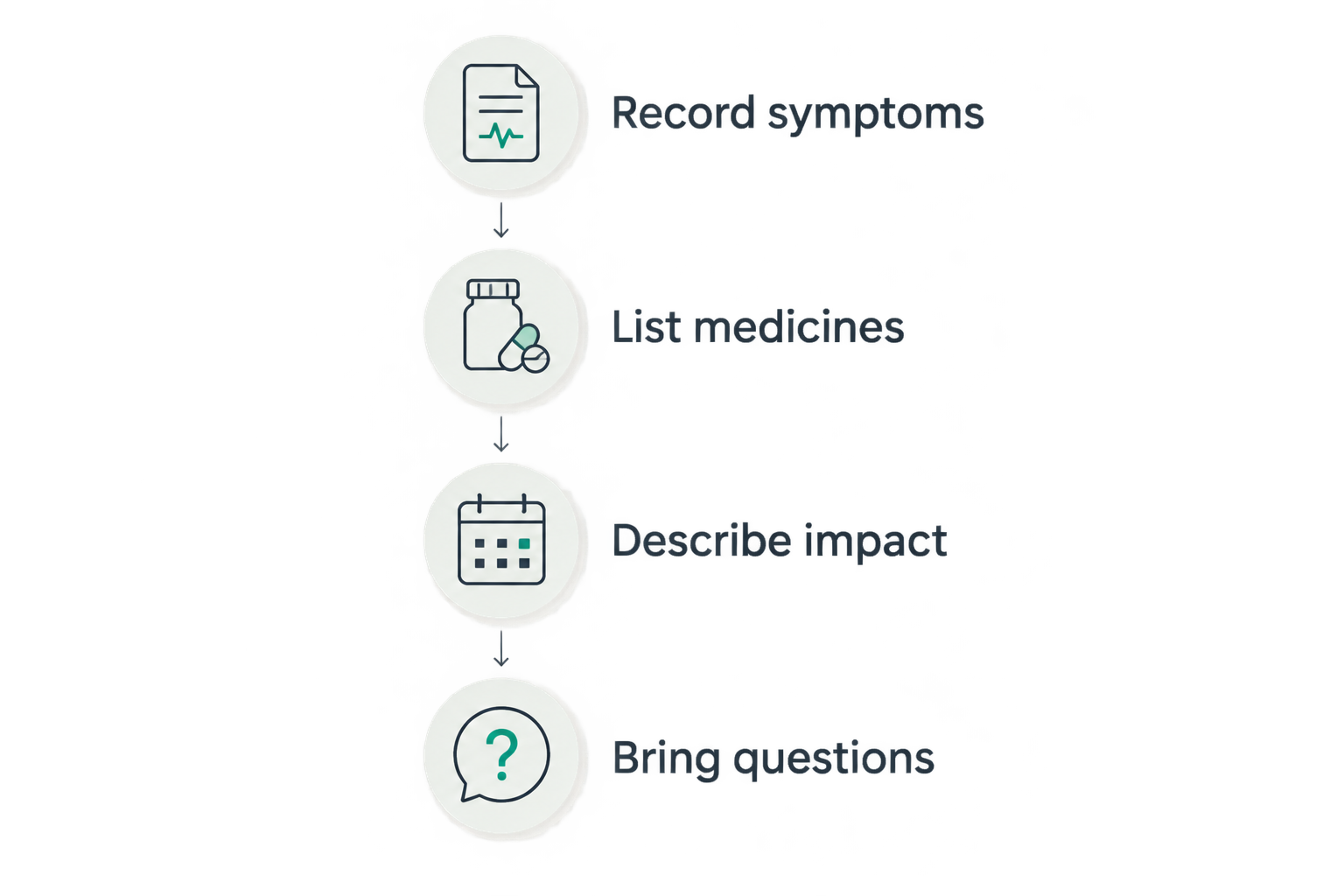
Keep the record manageable. A brief, consistent description is more useful than a complicated tracking system you abandon. Take existing medical letters or investigation reports if you have them, rather than assuming another practitioner already has access.
If symptoms change while you are keeping a diary, seek advice. Recording a headache is not a reason to postpone assessment.
What does informed consent involve in 2026?
Before agreeing to a chiropractic procedure, ask for an explanation of its purpose, proposed benefits, material risks, alternatives and the option of not proceeding. The discussion should relate to your circumstances rather than a general statement about chiropractic care.
Useful questions include:
- What concern are you proposing to assess or address?
- Are you discussing my headache, my neck discomfort or both?
- What evidence supports this particular recommendation?
- What are the uncertainties and material risks?
- What alternatives can I discuss, including no manual procedure?
- What would lead you to stop, reassess or refer me?
An adjustment is a manual procedure, not a prerequisite for asking questions. You can decline a proposed procedure, ask for more time or seek another opinion. Do not interpret a practitioner finding neck stiffness as an obligation to proceed with neck manipulation.
Mychiro provides chiropractic care and spinal adjustments. Whether any procedure is appropriate for you requires individual assessment; the clinic's services should not be interpreted as a promise of migraine improvement.
Can neck pain during a migraine mean the migraine starts in the neck?
Neck pain alongside a migraine does not establish that the migraine starts in the neck. Timing matters, but an association is not proof of a cause. Describe whether the neck discomfort appears before, during or after the headache and whether it also occurs independently.
Ask your clinician to distinguish an observation from a diagnosis. Statements about posture, spinal alignment or nerve pressure need a clear explanation and a claim-specific evidence basis; they should not replace medical assessment of headache symptoms.
How many chiropractic sessions would you need for migraines?
There is no session number that can be recommended from the search term alone. Do not assume that a predetermined course of adjustments is necessary for a headache diagnosis.
If separate musculoskeletal care is proposed, ask what it is intended to address, how it will be reviewed and when the plan would change. Ongoing appointments require an individual rationale, not an assumption that everyone needs continuing adjustments.
When should frequent headaches be reviewed by a GP?
Frequent, changing or disruptive headaches warrant a GP discussion. You do not need to reach a diagnostic threshold before asking for advice.
ICHD-3 includes 15 or more headache days per month for more than 3 months within its chronic migraine criteria, alongside additional requirements. This is a classification threshold—not a waiting period, a self-diagnosis or a reason to continue without review.
FAQ
Should I see a GP before a chiropractor for migraines?
Seek medical assessment for suspected migraine before assuming your headache originates in your neck. A GP can assess the headache history and discuss diagnosis, medicines and referral where appropriate.
Can a chiropractic adjustment be promised to stop migraines?
A chiropractic adjustment should not be presented as a promise to stop migraines. Any proposed procedure requires an individual explanation of its purpose, evidence, uncertainties, risks and alternatives.
How long does a migraine usually last in adults?
ICHD-3 describes untreated or unsuccessfully treated migraine attacks in adults as lasting 4–72 hours, alongside other diagnostic criteria. Duration alone does not establish migraine or rule out a cause requiring urgent assessment.
Does neck stiffness prove my headache comes from my spine?
Neck stiffness does not prove that your headache comes from your spine. A clinician needs to consider the headache history, examination and alternative explanations before attributing the headache to a neck disorder.
Should I stop my migraine medicine before a chiropractic appointment?
Do not stop or change prescribed migraine medicine without advice from your prescriber. Bring your medicine list and discuss questions about non-prescription products with a pharmacist or GP.
What headache symptoms mean I should call an ambulance?
Call 000 for a sudden extremely severe headache or a headache with new weakness, difficulty speaking, confusion, collapse or loss of vision. Do not delay emergency assessment to attend a chiropractic appointment.
Does Mychiro provide chiropractic care in Bondi Junction?
Mychiro is a chiropractic clinic and wellness centre in Bondi Junction, Sydney. That service description does not establish that chiropractic care is appropriate for an individual migraine or headache.
One last thing
For your next headache discussion in 2026, bring a question rather than a conclusion: What supports this diagnosis, and what would make us reconsider it? That question helps separate a plausible explanation from an assumption and gives you a clearer basis for deciding what to do next.
This is general adult health information, not an individual diagnosis or a recommendation for a procedure. Diagnostic descriptions refer to the International Headache Society's ICHD-3; emergency guidance is consistent with Australian public-health headache advice from Healthdirect Australia.
Related guides
- How to prepare for your first chiropractor appointment
- What qualifications should a Sydney chiropractor have?
- How to compare chiropractic clinics near you