
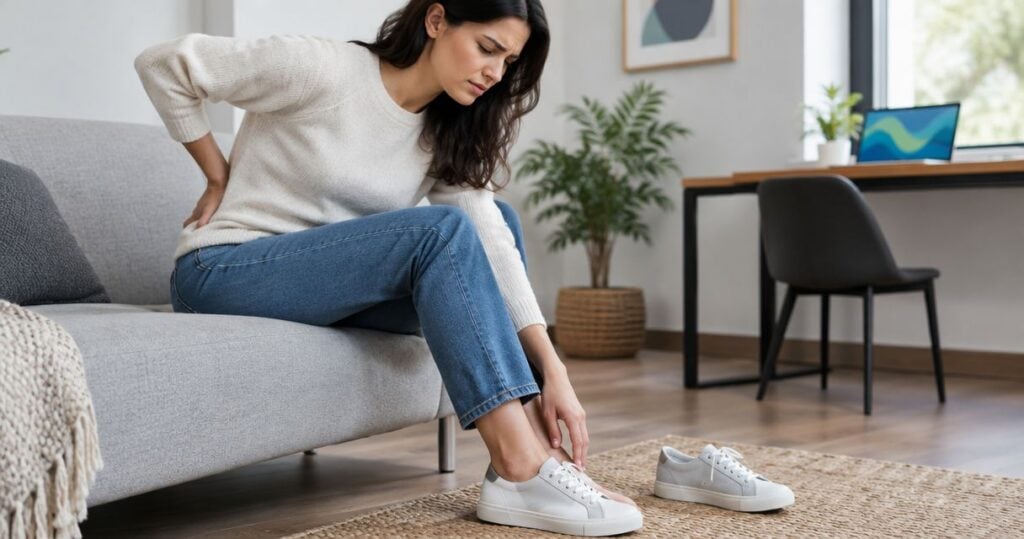
Poorly fitting or uncomfortable footwear may contribute to back discomfort, but back pain alone does not establish that your shoes caused it. A change in symptoms after changing shoes is a clue to discuss, not a diagnosis. This 2026 guide explains how to review footwear, recognise the limits of shoe-based advice and decide when to seek assessment.
- Can poor footwear cause back pain? It may contribute, but shoes alone do not establish the cause.
- Mychiro is a chiropractic clinic in Bondi Junction; footwear concerns can also be discussed with a podiatrist.
- Check fit, condition and activity demands before assuming you need different shoes or orthotics.
- Seek medical assessment for back pain accompanied by new weakness, bladder changes or other warning signs.
Can poor footwear cause back pain?
Footwear can affect how you stand and walk, but that does not prove a particular shoe causes lower back pain. Separate a plausible contributor from a confirmed cause. Your symptoms, activities and health history all belong in the assessment.
Mychiro provides chiropractic care in Bondi Junction. Footwear questions should form part of a broader discussion rather than an automatic reason for chiropractic adjustments.
| What you notice | What it tells you | What it does not establish |
|---|---|---|
| Discomfort starts while wearing a particular pair | The footwear and activity deserve review | That the shoes injured your back |
| Your feet hurt and you change your walking pattern | Foot symptoms need attention | That your spine is out of alignment |
| You feel more comfortable in another pair | That pair feels different during that activity | That it addresses the cause of back pain |
| Back pain continues across different shoes | Footwear is not the only issue to consider | A specific spinal diagnosis |
Why this matters
A simple explanation is appealing when your back hurts. It can also lead you towards unnecessary purchases or delay an assessment of persistent symptoms.
For footwear decisions in 2026, distinguish comfort claims from clinical claims. A shoe can fit comfortably without being a treatment for back pain, and a product labelled supportive does not establish that you need it.
NICE guideline NG59, covering low back pain and sciatica in people aged over 16, advises against offering foot orthotics or rocker-sole shoes to manage low back pain. That recommendation does not mean footwear comfort is irrelevant; it means footwear products should not be presented as an established answer to back pain.
What does poor footwear actually mean?
Poor footwear is not a diagnosis or a single shoe category. Start with something observable: a pinching toe box, a slipping heel, damaged fastening or a sole that no longer grips appropriately for your work.
Avoid judging a shoe solely by its appearance. A flat shoe is not automatically suitable for you, and a thick sole does not establish that a shoe offers the right fit.
Fit: check pressure and movement
Your toes should not feel compressed, and your foot should not slide around inside the shoe. Look for rubbing, pressure or a fastening that cannot hold your foot comfortably.
Try shoes with the socks and any prescribed inserts you normally wear. If an insert makes the shoe cramped, the combination needs review rather than an assumption that discomfort is part of getting used to it.
Condition: look beyond the shoe's age
Inspect the outsole, upper and fastening. Visible damage, loss of grip or a shoe that no longer holds your foot as intended are practical reasons to review its condition.
There is no universal replacement deadline that establishes when shoes start causing back pain. Likewise, uneven wear is not enough to diagnose a leg-length difference, foot disorder or spinal problem.
Purpose: match the shoe to the task
Walking, working in a commercial kitchen and attending an event involve different footwear requirements. Consider the surface, workplace rules and whether you need protective footwear.
Comfort remains relevant, but it does not replace required protection. If work shoes are uncomfortable, discuss approved alternatives with your employer rather than removing required safety features.
How do common footwear options compare?
No footwear category deserves a blanket recommendation for everyone with back pain. Use the comparison below to organise a fit check, not to select a treatment.
| Footwear option | Suitable context | Practical advantage | Limitation |
|---|---|---|---|
| Securely fastened walking shoes | Everyday walking when the fit suits you | Fastenings let you adjust the fit | Cushioning and shape vary; the category does not guarantee comfort |
| Flat casual shoes | Casual activities when they remain comfortable | Low-profile designs suit some preferences | A flat sole alone says little about fit or suitability |
| High heels | Occasional use according to preference and tolerance | Meet some dress requirements | Elevation changes foot position; discomfort deserves attention |
| Open-backed sandals or thongs | Casual settings where appropriate | Easy to put on and remove | Foot retention and workplace suitability vary |
| Protective work boots | Workplaces requiring protective footwear | Provide the protection specified for the task | Weight, shape and fit still need consideration |
Choose footwear for fit, function and the task—not a promise to correct your spine. Do not interpret this table as a ranking of shoes for back pain.
Why footwear-related discomfort varies
The same pair can feel different across activities. These factors help you describe the situation without assuming a diagnosis:
- Fit: Note whether the shoe pinches, slips or rubs, including when you wear your usual socks.
- Condition: Check damaged components, sole grip and whether fastenings still work.
- Activity: Record whether discomfort occurs during walking, standing, lifting or another task.
- Work environment: Include the surface, protective-footwear requirements and opportunities to change position.
- Recent changes: Mention a new job, different training routine, new shoes or a change in daily walking.
- Other symptoms: Describe foot pain, leg symptoms and back discomfort separately rather than combining them into one explanation.
These are discussion points, not a self-diagnosis checklist. A health professional can consider which details matter in your circumstances.
How can you check whether your shoes are involved?
Use a straightforward review rather than deliberately provoking pain. The aim is to describe a pattern clearly enough to support a clinical conversation.
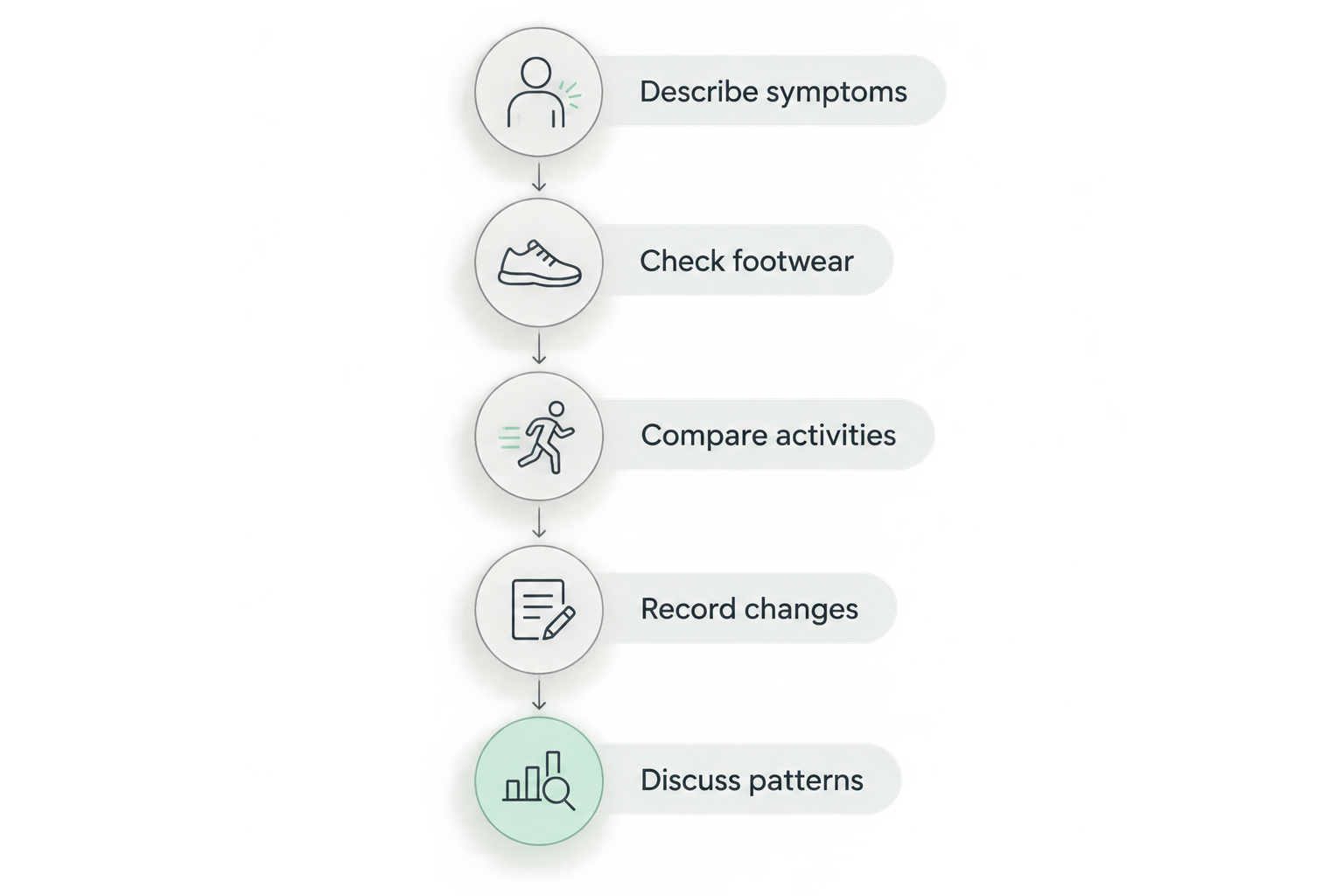
- Describe symptoms. Write down where you feel discomfort and what you were doing when it began. Distinguish pressure or rubbing in the foot from pain in the back.
- Check footwear. Inspect fit, fastening and visible damage. Include your usual work shoes rather than looking only at exercise shoes.
- Compare activities. Note whether different shoes were worn during genuinely comparable tasks. A quiet day at home is not equivalent to a demanding shift.
- Record changes. Include changes in workload, sleep, exercise and footwear. Do not attribute everything to whichever change is easiest to see.
- Discuss patterns. Bring your notes to a qualified health professional if symptoms persist, recur or limit usual activities.
A symptom record does not need to be elaborate. A brief description of the task, footwear and symptoms is more informative than a conclusion such as bad shoes caused my back pain.
Do not repeatedly wear an uncomfortable pair to prove a connection. Stop a comparison if symptoms increase, and seek advice rather than continuing a home experiment.
Do you need insoles or custom orthotics?
Back pain by itself does not establish a need for orthotics. For decisions made in 2026, keep a foot-specific prescription separate from a claim that an insert will address lower back pain.
NICE NG59 advises against offering foot orthotics for managing low back pain, with or without sciatica. If a clinician proposes an orthotic, ask what finding it addresses and what outcome will be reviewed.
Discussions of custom orthotics for collapsed arches concern a foot-specific question; they do not establish that a collapsed arch caused someone's back pain. A podiatrist can assess foot symptoms and explain whether an orthotic has a role for that individual.
Bring existing orthotics and the shoes you wear with them to an assessment. Mention pressure, rubbing or a change in comfort rather than assuming the device needs more time or that stronger support is necessarily preferable.
What should you do about shoes at work?
Start with the requirements of your role. Protective footwear, slip resistance and employer policies still apply when you are looking for a more comfortable option.
Ask whether approved alternatives are available in a different width, shape or fastening style. Keep the discussion specific: heel slipping, toe pressure and discomfort during a particular task are clearer than saying a shoe lacks support.
Also describe the work itself. Long periods in one position, carrying equipment and changes in workload belong in the conversation alongside footwear; a shoe purchase does not replace a workplace review.
For your 2026 work-footwear review, keep a written list of required features and fit concerns. This helps you compare compliant options without relying on labels that promise posture correction or back-pain relief.
When should back pain receive medical assessment?
Do not assume new or concerning symptoms come from footwear. Healthdirect Australia's back-pain guidance identifies symptoms that require urgent medical attention rather than a shoe change.
Seek urgent medical care for back pain with new difficulty controlling your bladder or bowel, numbness around the groin or saddle area, or new or worsening leg weakness. Call 000 if you need emergency assistance.
Arrange prompt medical assessment for back pain following a significant injury, or pain accompanied by fever, unexplained weight loss or feeling generally unwell. Tell the clinician about a history of cancer or other significant medical conditions.
For persistent or recurring pain without emergency features, a GP can assess symptoms and discuss appropriate next steps. Footwear observations can contribute to that discussion, but they should not delay it.
Where does chiropractic care fit?
Mychiro is a Bondi Junction chiropractic clinic and wellness centre. Chiropractic adjustments should not be presented as a way to correct damage supposedly caused by shoes without an appropriate assessment and a supported clinical explanation.
Whether chiropractic care may be appropriate following assessment can be discussed with a qualified health professional. Ask about the proposed approach, its risks and alternatives, and whether another professional should assess foot-specific concerns.
You are not committing to a course of care by asking questions. In 2026, the practical starting point remains an individual assessment—not a preset number of appointments linked to your footwear.
FAQ
Can poor footwear cause back pain even if my feet do not hurt?
Footwear may contribute to discomfort without obvious foot pain, but that pattern does not confirm the cause of back pain. Describe the footwear, activity and symptoms to a qualified health professional if the problem persists.
Are flat shoes always preferable when my back hurts?
Flat shoes are not automatically suitable for everyone with back pain. Consider fit, fastening, comfort and the requirements of the activity rather than sole height alone.
Will replacing worn shoes resolve my lower back pain?
Replacing worn shoes does not guarantee a change in lower back pain. Review damaged or poorly fitting footwear, but seek assessment for symptoms that persist, recur or affect daily activities.
Do I need custom orthotics because I have back pain?
Back pain alone does not establish a need for custom orthotics. NICE guideline NG59 advises against offering foot orthotics to manage low back pain, while foot-specific concerns can be assessed separately.
Should I bring my work shoes to an appointment?
Bringing your usual work shoes can help you explain fit concerns and the tasks associated with discomfort. Bring prescribed inserts too, and describe any workplace protection requirements.
Can Mychiro tell me whether my shoes caused my back pain?
Mychiro provides chiropractic care, but footwear history alone cannot establish the cause of back pain. Discuss your symptoms and whether medical or podiatry assessment is appropriate before assuming you need adjustments.
When should I seek urgent help rather than change shoes?
Seek urgent medical care for back pain with new bladder or bowel changes, saddle-area numbness or new or worsening leg weakness. Call 000 if you need emergency assistance.
One last thing
Bring the shoes, not just the theory. Your usual footwear, existing inserts and a description of the activity give a clinician something concrete to consider without assuming your shoes are responsible.
A comfortable pair is a reasonable footwear goal. It is not proof that the cause of back pain has been identified.
Related guides
- Preparing for your first chiropractor appointment
- Lower back pain when sitting: causes and practical steps
- Questions to ask when comparing chiropractic clinics